Notice to Steward and Assistants; Chief and All Cooks; Baker; Pastry Cook; Head Waiter; Dining Room Captains and Waiters
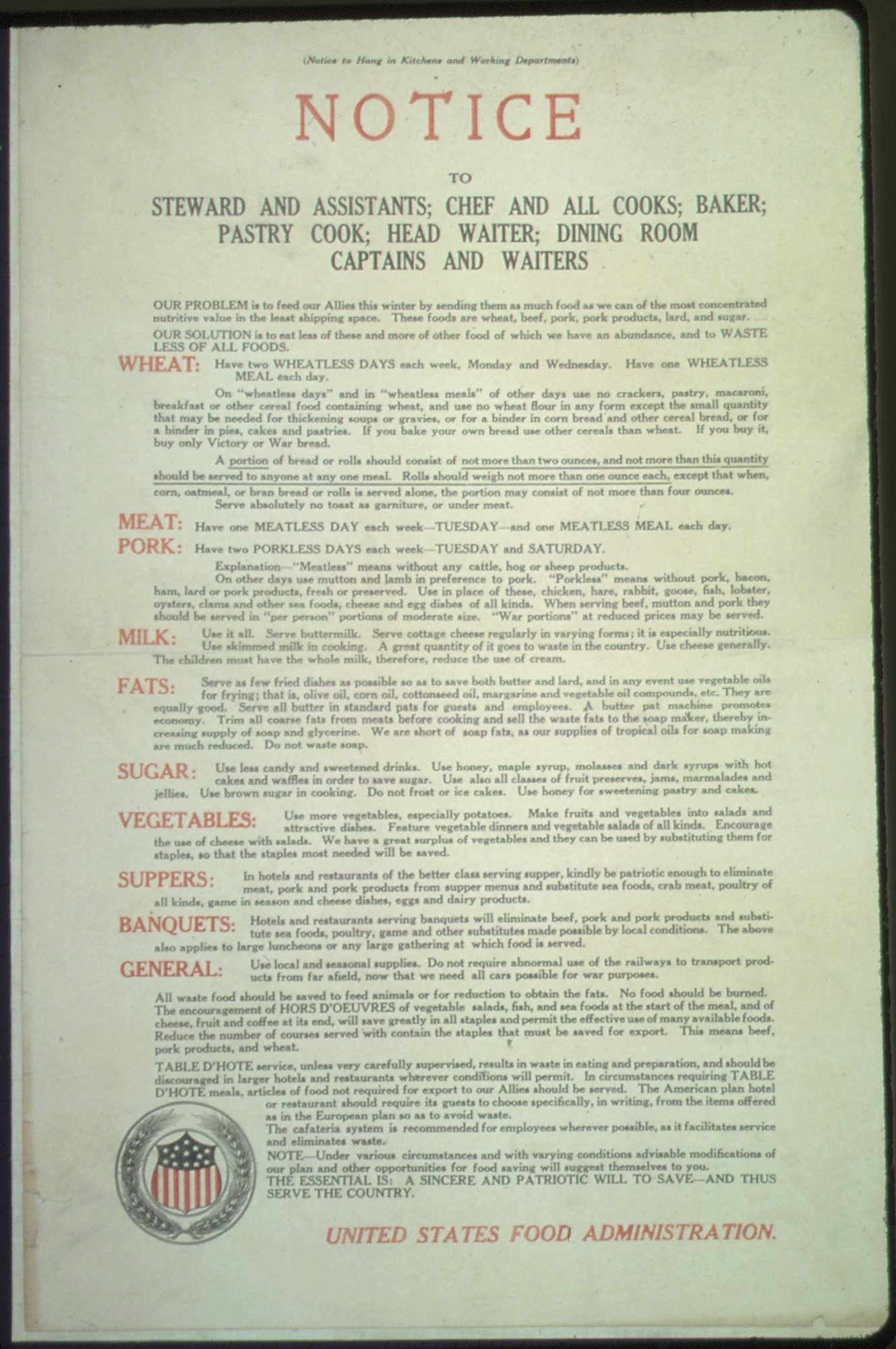
A text-only notice addressed to hotel and restaurant kitchen and dining staff sets out wheatless, meatless and porkless days and rules for milk, fats, sugar, vegetables, suppers and banquets, with a Food Administration seal at lower left. The appeal rests on a stated national food shortage for the Allies and on specific working instructions, closing with the line that a sincere and patriotic will to save will serve the country.
Propaganda techniques used in this poster
- Date
- 1917
- Period
- First World War
- Made by
- U.S. Food Administration
- Region
- North America
- Country
- United States
- Medium
- Poster
- Issuer type
- State
- Regime
- Wilson Administration
- Leader
- Woodrow Wilson
- Audience
- Domestic public
- Purpose
- Mobilize or secure compliance
- Themes
- Home front, Economy and finance
- Event
- World War I
- Regime
- Wilson administration
- Leader
- Woodrow Wilson
- Source
- Identified Openly sourced: the speaker is who they say they are
- Source
- U.S. National Archives (NARA), RG 4 (U.S. Food Administration), World War I Posters (NAID 512439), retrieved October 3, 2026
- Rights
- NARA Unrestricted; hosted by owner decision
U.S. Food Administration. National Archives and Records Administration, 4-P-88.
Text on the object
(Notice to Hang in Kitchens and Working Departments)

NOTICE

TO
STEWARD AND ASSISTANTS; CHEF AND ALL COOKS; BAKER;
PASTRY COOK; HEAD WAITER; DINING ROOM
CAPTAINS AND WAITERS

OUR PROBLEM is to feed our Allies this winter by sending them as much food as we can of the most concentrated nutritive value in the least shipping space. These foods are wheat, beef, pork, pork products, lard, and sugar.
OUR SOLUTION is to eat less of these and more of other food of which we have an abundance, and to WASTE LESS OF ALL FOODS.

WHEAT: Have two WHEATLESS DAYS each week, Monday and Wednesday. Have one WHEATLESS MEAL each day.
On "wheatless days" and in "wheatless meals" of other days use no crackers, pastry, macaroni, breakfast or other cereal food containing wheat, and use no wheat flour in any form except the small quantity that may be needed for thickening soups or gravies, or for a binder in corn bread and other cereal bread, or for a binder in pies, cakes and pastries. If you bake your own bread use other cereals than wheat. If you buy it, buy only Victory or War bread.
A portion of bread or rolls should consist of not more than two ounces, and not more than this quantity should be served to anyone at any one meal. Rolls should weigh not more than one ounce each, except that when, corn, oatmeal, or bran bread or rolls is served alone, the portion may consist of not more than four ounces.
Serve absolutely no toast as garniture, or under meat.

MEAT: Have one MEATLESS DAY each week—TUESDAY—and one MEATLESS MEAL each day.
PORK: Have two PORKLESS DAYS each week—TUESDAY and SATURDAY.
Explanation—"Meatless" means without any cattle, hog or sheep products.
On other days use mutton and lamb in preference to pork. "Porkless" means without pork, bacon, ham, lard or pork products, fresh or preserved. Use in place of these, chicken, hare, rabbit, goose, fish, lobster, oysters, clams and other sea foods, cheese and egg dishes of all kinds. When serving beef, mutton and pork they should be served in "per person" portions of moderate size. "War portions" at reduced prices may be served.

[… remaining text omitted: the MILK, FATS, SUGAR, VEGETABLES, SUPPERS and BANQUETS paragraphs]

GENERAL: Use local and seasonal supplies. Do not require abnormal use of the railways to transport products from far afield, now that we need all cars possible for war purposes.
All waste food should be saved to feed animals or for reduction to obtain the fats. No food should be burned.
The encouragement of HORS D'OEUVRES of vegetable salads, fish, and sea foods at the start of the meal, and of cheese, fruit and coffee at its end, will save greatly in all staples and permit the effective use of many available foods. Reduce the number of courses served with contain the staples that must be saved for export. This means beef, pork products, and wheat.
TABLE D'HOTE service, unless very carefully supervised, results in waste in eating and preparation, and should be discouraged in larger hotels and restaurants wherever conditions will permit. In circumstances requiring TABLE D'HOTE meals, articles of food not required for export to our Allies should be served. The American plan hotel or restaurant should require its guests to choose specifically, in writing, from the items offered as in the European plan so as to avoid waste.
The cafateria system is recommended for employees wherever possible, as it facilitates service and eliminates waste.
NOTE—Under various circumstances and with varying conditions advisable modifications of our plan and other opportunities for food saving will suggest themselves to you.
THE ESSENTIAL IS: A SINCERE AND PATRIOTIC WILL TO SAVE—AND THUS SERVE THE COUNTRY.

UNITED STATES FOOD ADMINISTRATION.
Transcribed from the 2000 px scan; the MILK, FATS, SUGAR, VEGETABLES, SUPPERS and BANQUETS paragraphs are omitted to stay within the 4000-character limit (they are legible on the image). Spellings are the sheet's own, including 'cafateria' and 'with contain'; small type is dense and a few letters may be misread.