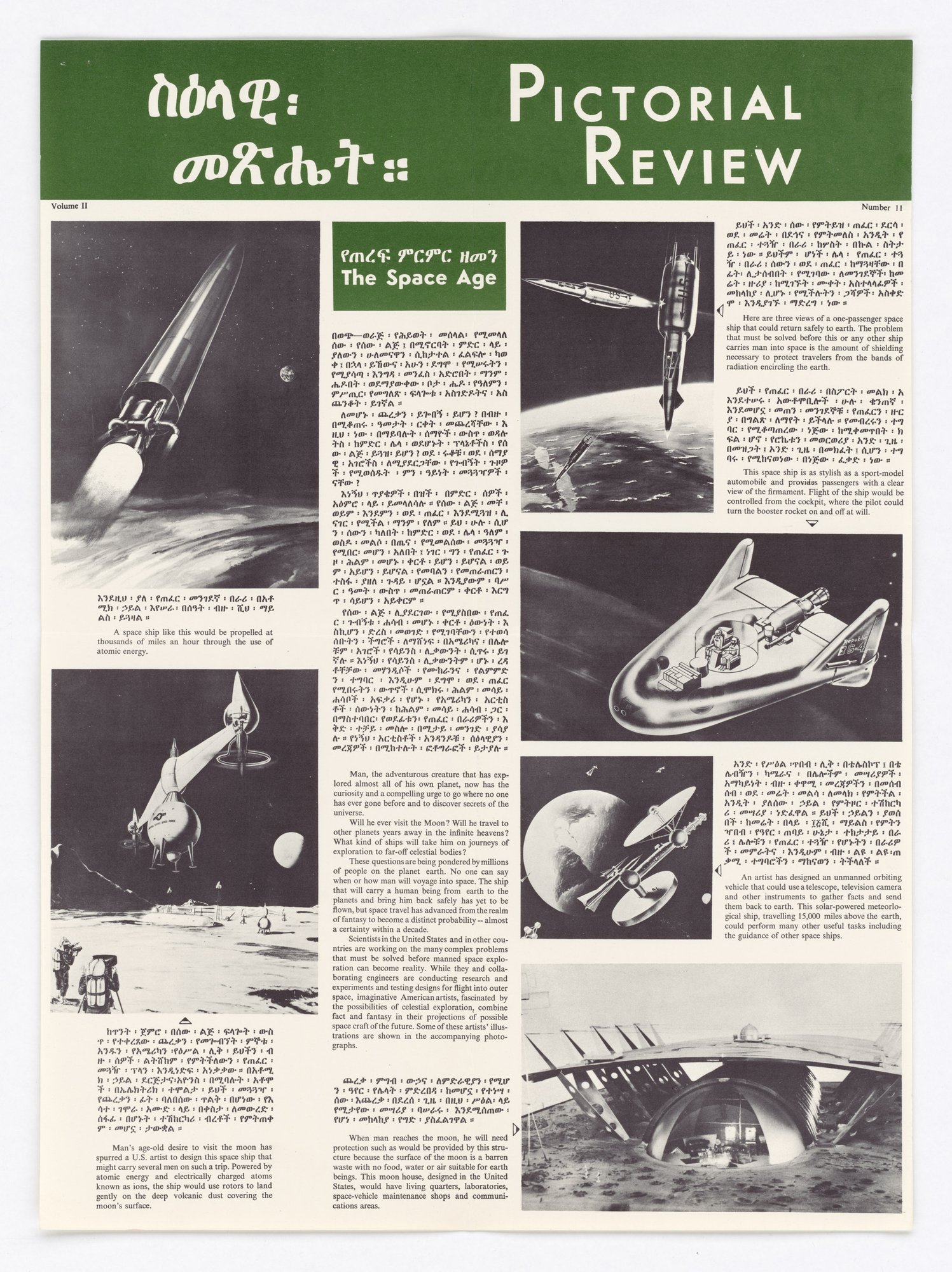
Pictorial Review poster, No. 11: The Space Age, future spacecraft (Amharic-English, Addis Ababa)
A third 'Space Age' sheet, this time of artists' illustrations: an atomic-powered ship, a one-passenger return craft, a Moon landing, an orbiting weather satellite and a Moon house. The text says space travel has moved 'from the realm of fantasy to a distinct probability' and that U.S. and other scientists are at work. The tell is glittering generalities: a hopeful future of exploration is shown through drawings, with no costs or military uses shown.
Propaganda techniques used in this poster
- Date
- July 28, 1959
- Period
- Cold War
- Made by
- U.S. Information Agency (predecessor: State Department International Information and Educational Exchange Program), Propaganda Posters Distributed in Asia, Latin America and the Middle East series
- Region
- North America
- Country
- United States
- Medium
- Poster
- Issuer type
- State
- Regime
- Eisenhower Administration
- Leader
- Dwight D. Eisenhower
- Audience
- Foreign public
- Purpose
- Persuade or win support
- Themes
- Science and technology, War and the military
- Event
- Cold War
- Source
- Unidentified Source blurred: contractors, cutouts, buried disclosure
- Source
- U.S. National Archives (NARA), RG 306, Propaganda Posters Distributed in Asia, Latin America and the Middle East, retrieved October 3, 2026
- Rights
- Public domain (U.S. government work; NARA RG 306)
U.S. Information Agency / Department of State, July 28, 1959. National Archives, Record Group 306 (NAID 6948760, 306-PPB-14o).
Text on the object
ስዕላዊ፡ መጽሔት። / PICTORIAL REVIEW
Volume II    Number 11

የጠረፍ ምርምር ዘመን
The Space Age

[Amharic text columns paralleling the English captions, not transcribed]

Man, the adventurous creature that has explored almost all of his own planet, now has the curiosity and a compelling urge to go where no one has ever gone before and to discover secrets of the universe.
Will he ever visit the Moon? Will he travel to other planets years away in the infinite heavens? What kind of ships will take him on journeys of exploration to far-off celestial bodies?
These questions are being pondered by millions of people on the planet earth. No one can say when or how man will voyage into space. The ship that will carry a human being from earth to the planets and bring him back safely has yet to be flown, but space travel has advanced from the realm of fantasy to become a distinct probability -- almost a certainty within a decade.
Scientists in the United States and in other countries are working on the many complex problems that must be solved before manned space exploration can become reality. While they and collaborating engineers are conducting research and experiments and testing designs for flight into outer space, imaginative American artists, fascinated by the possibilities of celestial exploration, combine fact and fantasy in their projections of possible space craft of the future. Some of these artists' illustrations are shown in the accompanying photographs.

A space ship like this would be propelled at thousands of miles an hour through the use of atomic energy.

Man's age-old desire to visit the moon has spurred a U.S. artist to design this space ship that might carry several men on such a trip. Powered by atomic energy and electrically charged atoms known as ions, the ship would use rotors to land gently on the deep volcanic dust covering the moon's surface.

Here are three views of a one-passenger space ship that could return safely to earth. The problem that must be solved before this or any other ship carries man into space is the amount of shielding necessary to protect travelers from the bands of radiation encircling the earth.

This space ship is as stylish as a sport-model automobile and provides passengers with a clear view of the firmament. Flight of the ship would be controlled from the cockpit, where the pilot could turn the booster rocket on and off at will.

An artist has designed an unmanned orbiting vehicle that could use a telescope, television camera and other instruments to gather facts and send them back to earth. This solar-powered meteorological ship, travelling 15,000 miles above the earth, could perform many other useful tasks including the guidance of other space ships.

When man reaches the moon, he will need protection such as would be provided by this structure because the surface of the moon is a barren waste with no food, water or air suitable for earth beings. This moon house, designed in the United States, would have living quarters, laboratories, space-vehicle maintenance shops and communications areas.
English portions are as printed. The Amharic masthead reads 'Pictorial Review'; the Amharic captions and columns parallel the English text and are not separately translated here.
English text transcribed in full; the Amharic (Ge'ez script) columns, which parallel the English captions, are not transcribed. No imprint or credit line is printed on the scan. The Amharic heading is given.