Pictorial Review poster, No. 10: Alaska and Hawaii, the 49-star flag (Amharic-English, Addis Ababa)
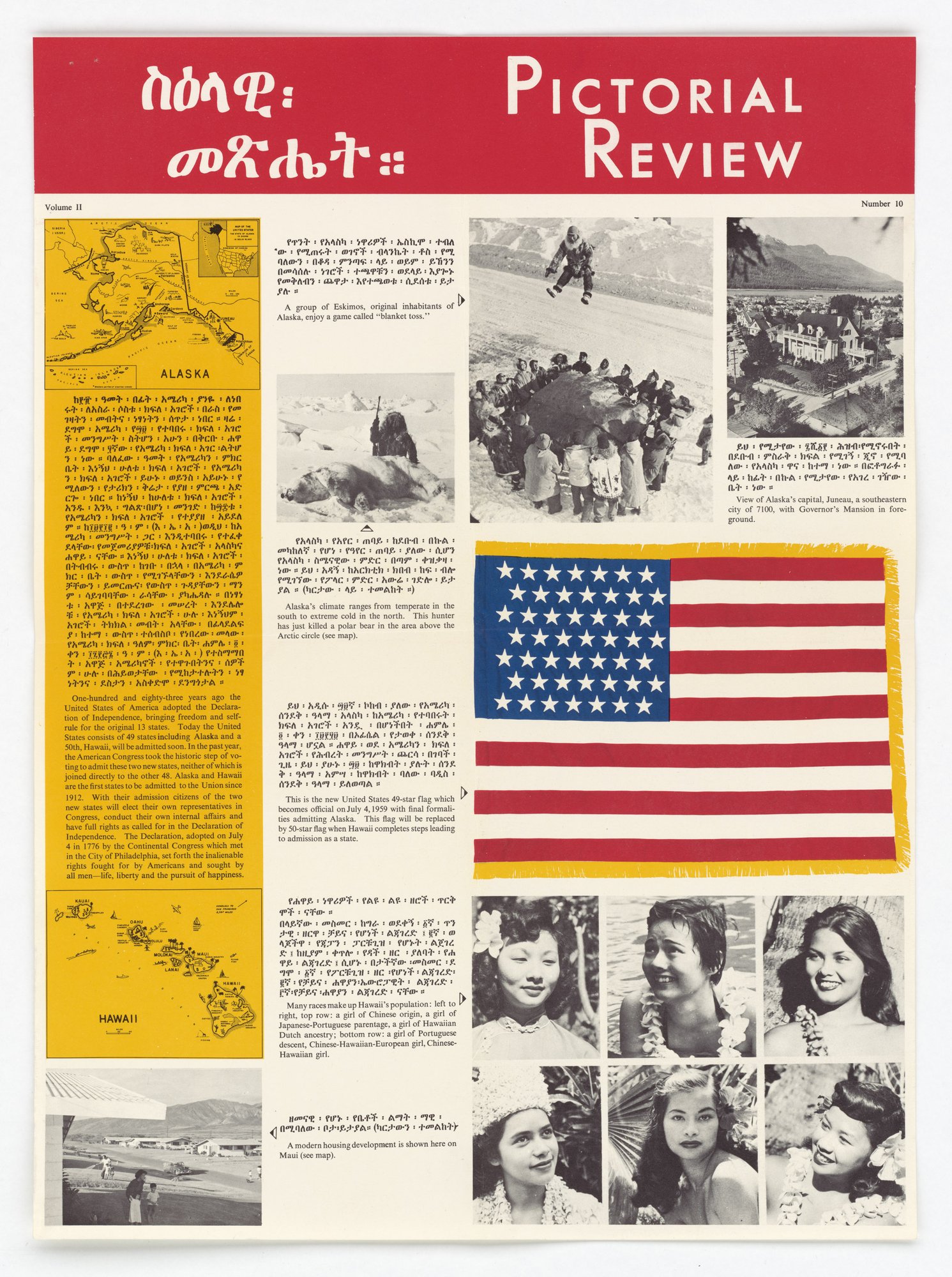
A photo sheet on U.S. statehood for Alaska and Hawaii, with maps, a 49-star flag, Alaskan and Hawaiian scenes and portraits of six Hawaiian girls labelled by ancestry. Text links the Declaration of Independence's 'life, liberty and the pursuit of happiness' to the new states. The tell is transfer and glittering generalities: the flag and founding words are attached to statehood, with Hawaii's mixed population offered as a showcase.
Propaganda techniques used in this poster
- Date
- July 7, 1959
- Period
- Cold War
- Made by
- U.S. Information Agency (predecessor: State Department International Information and Educational Exchange Program), Propaganda Posters Distributed in Asia, Latin America and the Middle East series
- Region
- North America
- Country
- United States
- Medium
- Poster
- Issuer type
- State
- Regime
- Eisenhower Administration
- Leader
- Dwight D. Eisenhower
- Audience
- Foreign public
- Purpose
- Persuade or win support
- Themes
- Elections and party politics, Race and ethnicity
- Event
- Cold War
- Source
- Unidentified Source blurred: contractors, cutouts, buried disclosure
- Source
- U.S. National Archives (NARA), RG 306, Propaganda Posters Distributed in Asia, Latin America and the Middle East, retrieved October 3, 2026
- Rights
- Public domain (U.S. government work; NARA RG 306)
U.S. Information Agency / Department of State, July 7, 1959. National Archives, Record Group 306 (NAID 6948759, 306-PPB-14n).
Text on the object
ስዕላዊ፡ መጽሔት። / PICTORIAL REVIEW
Volume II    Number 10

ALASKA
HAWAII

[Amharic text columns paralleling the English captions, not transcribed]

One-hundred and eighty-three years ago the United States of America adopted the Declaration of Independence, bringing freedom and self-rule for the original 13 states. Today the United States consists of 49 states including Alaska and a 50th, Hawaii, will be admitted soon. In the past year, the American Congress took the historic step of voting to admit these two new states, neither of which is joined directly to the other 48. Alaska and Hawaii are the first states to be admitted to the Union since 1912. With their admission citizens of the two new states will elect their own representatives in Congress, conduct their own internal affairs and have full rights as called for in the Declaration of Independence. The Declaration, adopted on July 4 in 1776 by the Continental Congress which met in the City of Philadelphia, set forth the inalienable rights fought for by Americans and sought by all men--life, liberty and the pursuit of happiness.

A group of Eskimos, original inhabitants of Alaska, enjoy a game called "blanket toss."

Alaska's climate ranges from temperate in the south to extreme cold in the north. This hunter has just killed a polar bear in the area above the Arctic circle (see map).

View of Alaska's capital, Juneau, a southeastern city of 7100, with Governor's Mansion in foreground.

This is the new United States 49-star flag which becomes official on July 4, 1959 with final formalities admitting Alaska. This flag will be replaced by 50-star flag when Hawaii completes steps leading to admission as a state.

Many races make up Hawaii's population: left to right, top row: a girl of Chinese origin, a girl of Japanese-Portuguese parentage, a girl of Hawaiian Dutch ancestry; bottom row: a girl of Portuguese descent, Chinese-Hawaiian-European girl, Chinese-Hawaiian girl.

A modern housing development is shown here on Maui (see map).
English portions are as printed. The Amharic masthead reads 'Pictorial Review'; the Amharic captions and columns parallel the English text and are not separately translated here.
English text transcribed in full; the Amharic (Ge'ez script) columns, which parallel the English captions, are not transcribed. No imprint or credit line is printed on the scan. Map labels 'ALASKA' and 'HAWAII' are given; place names inside the maps are not transcribed.