Produce - Store (Little Exhibits, Nutrition, Set Two, Sheet 2)
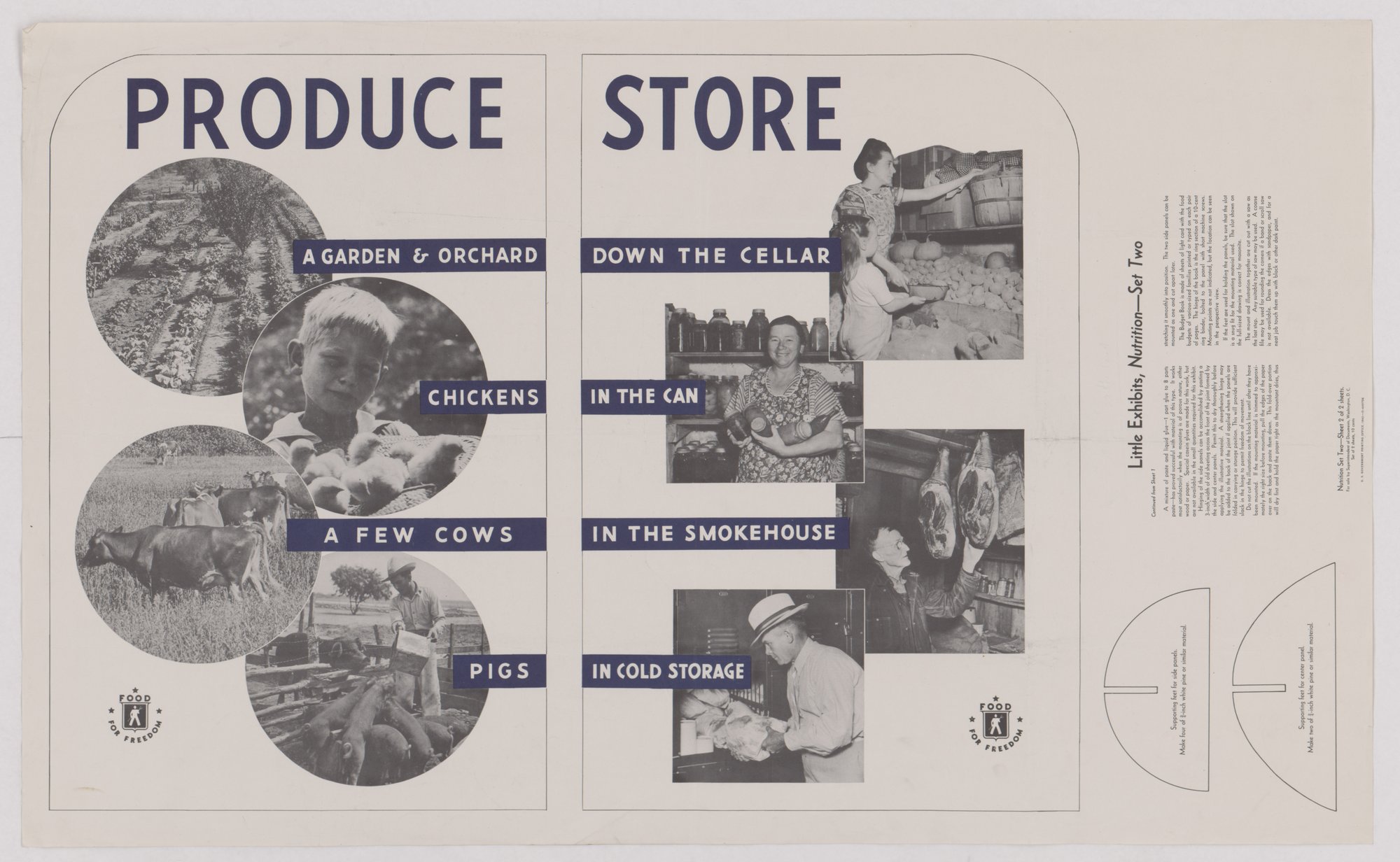
Black-and-white display sheet: round and rectangular photographs of a garden and orchard, chickens, cows, pigs, then a cellar, canned goods, a smokehouse and cold storage, under the headings 'Produce' and 'Store', with Food for Freedom emblems. The right margin holds assembly instructions for a cut-out table-top exhibit. Plain-folks imagery of ordinary farm families; the persuasion is mild.
Propaganda techniques used in this poster
- Date
- 1942
- Period
- Second World War
- Made by
- U.S. Department of Agriculture (Food for Freedom), for sale by Superintendent of Documents
- Region
- North America
- Country
- United States
- Medium
- Poster
- Issuer type
- State
- Regime
- Roosevelt Administration
- Leader
- Franklin D. Roosevelt
- Audience
- Domestic public
- Purpose
- Mobilize or secure compliance
- Themes
- Home front, Economy and finance, Health
- Event
- World War II
- Regime
- Roosevelt administration
- Leader
- Franklin D. Roosevelt
- Source
- Identified Openly sourced: the speaker is who they say they are
- Source
- U.S. National Archives and Records Administration, Record Group 44, World War II Posters, retrieved October 4, 2026
- Rights
- Public domain (U.S. government work)
U.S. Department of Agriculture. National Archives and Records Administration, RG 44, 44-PA-1581 (NAID 515246).
Text on the object
PRODUCE
A GARDEN & ORCHARD
CHICKENS
A FEW COWS
PIGS
[emblem:] FOOD FOR FREEDOM
STORE
DOWN THE CELLAR
IN THE CAN
IN THE SMOKEHOUSE
IN COLD STORAGE
[emblem:] FOOD FOR FREEDOM

Little Exhibits, Nutrition--Set Two
Continued from Sheet 1

A mixture of paste and liquid glue--1 part glue to 8 parts paste--has proved successful with material of this type. It works most satisfactorily when the mounting is of porous nature, either wood or paper. Special casein glues are made for this work, but are not available in the small quantities required for this exhibit.
Hinging of the side panels can be accomplished by pasting a 3-inch width of old sheeting across the front of the joint formed by the side and center panels. Permit this to dry thoroughly before applying the illustrative material. A strengthening hinge may be added to the back of the joint if applied when the panels are folded in carrying or storage position. This will provide sufficient slack in the hinge to permit freedom of movement.
Do not cut the illustrations on the black line until after they have been mounted. If the mounting material is trimmed to approximately the right size before mounting, pull the edges of the paper over on the back and paste them down. This fold-over portion will dry first and hold the paper tight as the mountant dries, thus stretching it smoothly into position. The two side panels can be mounted as one and cut apart later.
The Budget Book is made of sheets of light card with the food budgets of various-sized families printed or typed on each pair of pages. The hinge of the book is the ring section of a 10-cent ring binder, bolted to the panel with short machine screws. Mounting points are not indicated, but the location can be seen in the perspective view.
If the feet are used for holding the panels, be sure that the slot is a snug fit for the mounting material used. The slot shown on the full-sized drawing is correct for masonite.
The mount and illustration together are cut out with a saw as the last step. Any suitable type of saw may be used. A coarse file may be used for rounding the corners if a band or scroll saw is not available. Dress the edges with sandpaper, and for a neat job touch them up with black or other dark paint.

Supporting feet for side panels.
Make four of 3/4-inch white pine or similar material.
Supporting feet for center panel.
Make two of 3/4-inch white pine or similar material.

Nutrition Set Two--Sheet 2 of 2 sheets.
For sale by Superintendent of Documents, Washington, D. C.
Set of 2 sheets, 10 cents.
[imprint:] U. S. GOVERNMENT PRINTING OFFICE : 1942--O-449756