Radio instruction course, chart no. 3: fundamentals of the vacuum tube
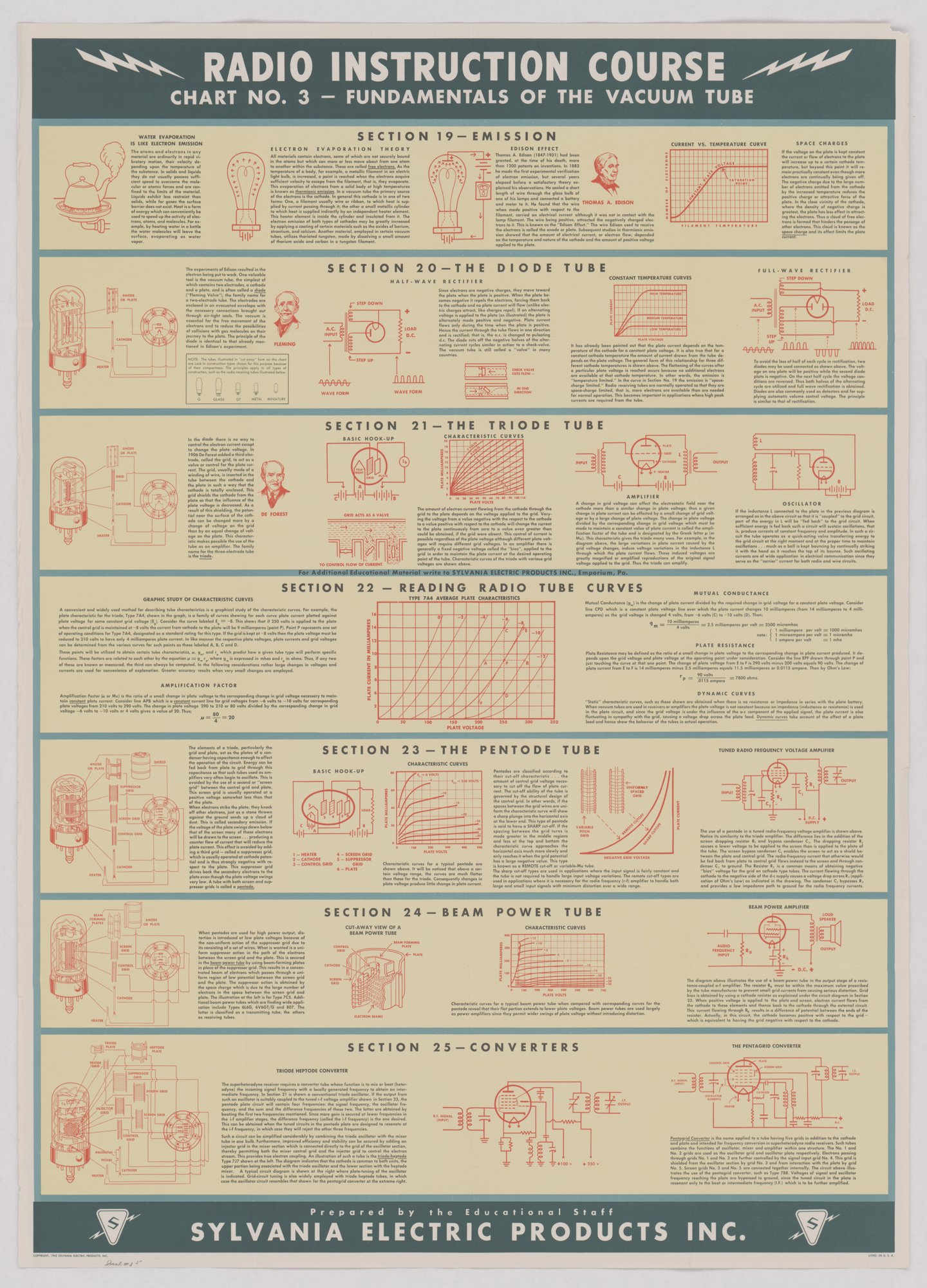
A dense instructional chart in seven bands, Sections 19 to 25, covering electron emission and the diode, triode, pentode, beam power and converter tubes, with circuit diagrams, curves and portraits of Edison, Fleming and De Forest. The technique is faint here: the sponsor's name rides on a technical training aid, a mild transfer.
Propaganda techniques used in this poster
- Date
- 1943
- Period
- Second World War
- Made by
- Sylvania Electric Products Inc., Educational Staff
- Region
- North America
- Country
- United States
- Medium
- Poster
- Issuer type
- Corporation
- Regime
- Roosevelt Administration
- Leader
- Franklin D. Roosevelt
- Audience
- Domestic public
- Purpose
- Warn or inform
- Themes
- Science and technology, War and the military
- Event
- World War II
- Regime
- Roosevelt administration
- Leader
- Franklin D. Roosevelt
- Source
- Identified Openly sourced: the speaker is who they say they are
- Source
- U.S. National Archives and Records Administration, Record Group 44, World War II Posters, retrieved October 4, 2026
- Rights
- Public domain (U.S. government work)
Sylvania Electric Products Inc.. National Archives and Records Administration, RG 44, 44-PA-1605 (NAID 515270).
Text on the object
RADIO INSTRUCTION COURSE
CHART NO. 3 — FUNDAMENTALS OF THE VACUUM TUBE
SECTION 19—EMISSION
WATER EVAPORATION IS LIKE ELECTRON EMISSION
The atoms and electrons in any material are ordinarily in rapid vibratory motion, their velocity depending upon the temperature of the substance. In solids and liquids they do not usually possess sufficient speed to overcome the [illegible] within the limits of the substance. Liquids exhibit less restraint than solids, while for gases the surface barrier does not exist. Heat is a form of energy which can conveniently be used to speed up the activity of electrons, atoms, and molecules. For example, by heating water in a kettle the water molecules will leave the surface, evaporating as water vapor.
ELECTRON EVAPORATION THEORY
All materials contain electrons, some of which are not securely bound in the atoms but which can more or less move about from one atom to another. These are called free electrons. As the temperature of a body, for example, a metallic filament in an electric light bulb, is increased, a point is reached when the electrons acquire sufficient velocity to escape from the filament, that is, they evaporate. This evaporation of electrons from a solid body at high temperatures is known as thermionic emission. In a vacuum tube the primary source of the electrons is the cathode. In general this cathode is in one of two forms: One, a filament usually wire or ribbon, to which heat is supplied directly by an electric current; the other, a small metallic cylinder to which heat is supplied indirectly by an independent heater element. This heater element is inside the cylinder and insulated from it. The electron emission of both types of cathodes may be greatly increased by applying a coating of the oxides of barium, strontium, and calcium. Another material, employed in certain vacuum tubes, utilizes thoriated tungsten, made by dissolving a small amount of thorium oxide and carbon in a tungsten filament.
EDISON EFFECT
Thomas A. Edison (1847-1931) was granted, at the time of his death, more than 1,200 patents on inventions. In 1883 he made the first experimental verification of electron emission, but several years later he sealed a short length of wire through the glass bulb of one of his lamps and connected a battery and meter to it. He found that the wire when made positive with respect to the filament carried a current [illegible] the amount of electrical current, or electron flow, depended on the temperature [illegible] and the amount of positive voltage applied to the plate.
THOMAS A. EDISON
CURRENT VS. TEMPERATURE CURVE
CONSTANT PLATE VOLTAGE
SATURATION POINT
FILAMENT TEMPERATURE
NUMBER OF ELECTRONS
SPACE CHARGES
If the voltage on the plate is kept constant the current or flow of electrons to the plate will increase up to a certain cathode temperature, beyond which it will remain practically constant even though more and more electrons are continually being given off. [illegible] Thus a cloud of free electrons is formed that is known as the space charge and its effect limits the plate current.
SECTION 20—THE DIODE TUBE
HALF-WAVE RECTIFIER
[text continues through Sections 20 to 25 (The Diode Tube, The Triode Tube, Reading Radio Tube Curves, The Pentode Tube, The Beam Power Tube, Converters) and is not transcribed here]
Body text is small; unreadable words are marked [illegible].