Safety Rules
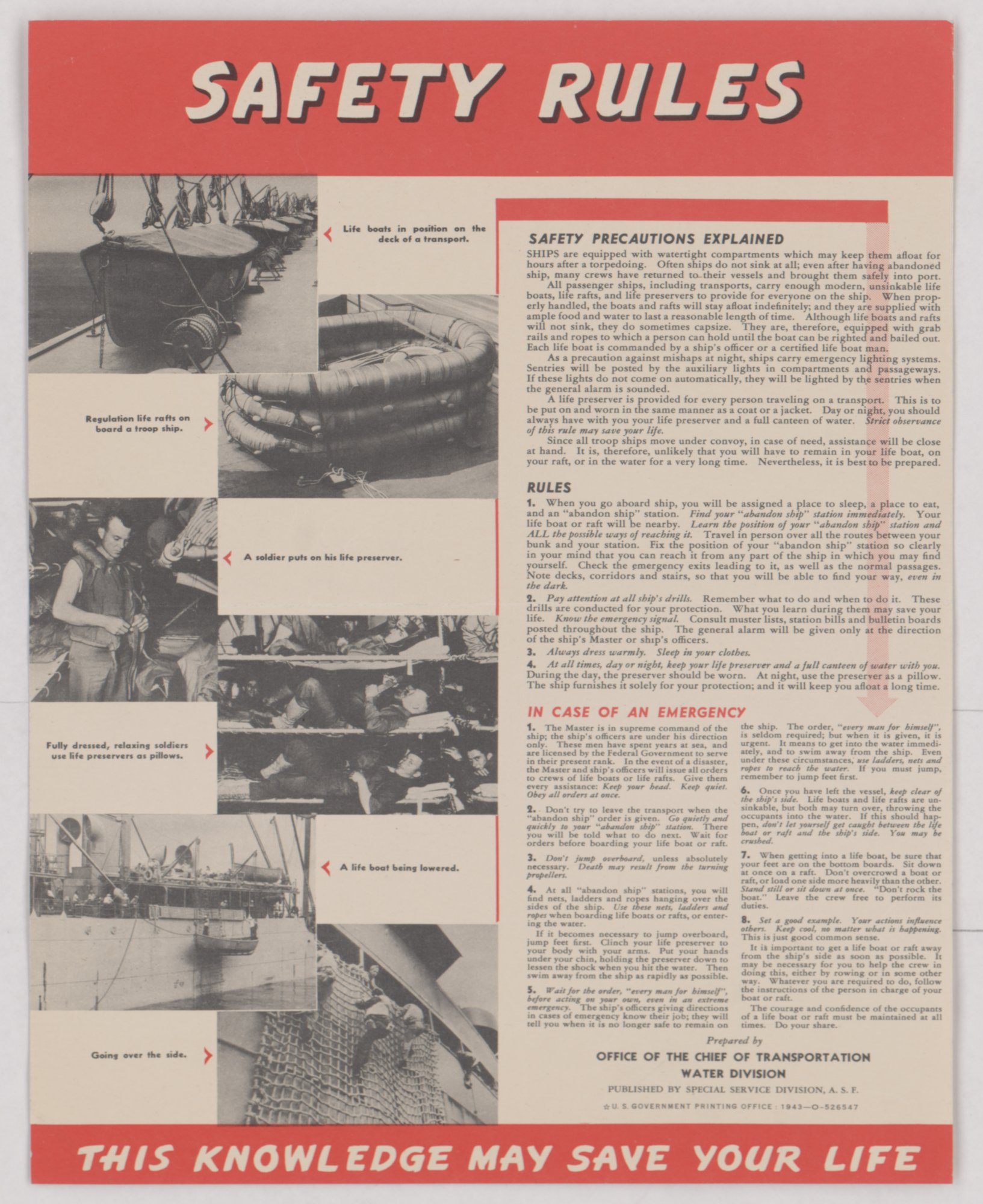
Army instruction sheet for troops aboard transport ships: seven captioned photographs of lifeboats, rafts and life preservers beside long columns of rules and emergency steps, under the headline 'Safety Rules' and the line 'This Knowledge May Save Your Life'. Its appeal is mainly practical; the fear-appeal is faint and rests on the closing slogan.
Propaganda techniques used in this poster
- Date
- 1943
- Period
- Second World War
- Made by
- U.S. Army, Office of the Chief of Transportation, Water Division (published by Special Service Division, Army Service Forces)
- Region
- North America
- Country
- United States
- Medium
- Poster
- Issuer type
- Military
- Regime
- Roosevelt Administration
- Leader
- Franklin D. Roosevelt
- Audience
- Own forces
- Purpose
- Warn or inform
- Themes
- War and the military, Security and surveillance
- Event
- World War II
- Regime
- Roosevelt administration
- Leader
- Franklin D. Roosevelt
- Source
- Identified Openly sourced: the speaker is who they say they are
- Source
- U.S. National Archives and Records Administration, Record Group 44, World War II Posters, retrieved October 4, 2026
- Rights
- Public domain (U.S. government work)
U.S. Army, Office of the Chief of Transportation. National Archives and Records Administration, RG 44, 44-PA-1662 (NAID 515330).
Text on the object
SAFETY RULES
Life boats in position on the deck of a transport.
Regulation life rafts on board a troop ship.
A soldier puts on his life preserver.
Fully dressed, relaxing soldiers use life preservers as pillows.
A life boat being lowered.
Going over the side.
SAFETY PRECAUTIONS EXPLAINED
SHIPS are equipped with watertight compartments which may keep them afloat for hours after a torpedoing. Often ships do not sink at all; even after having abandoned ship, many crews have returned to their vessels and brought them safely into port.
All passenger ships, including transports, carry enough modern, unsinkable life boats, life rafts, and life preservers to provide for everyone on the ship. When properly handled, the boats and rafts will stay afloat indefinitely; and they are supplied with ample food and water to last a reasonable length of time. Although life boats and rafts will not sink, they do sometimes capsize. They are, therefore, equipped with grab rails and ropes to which a person can hold until the boat can be righted and bailed out. Each life boat is commanded by a ship's officer or a certified life boat man.
As a precaution against mishaps at night, ships carry emergency lighting systems. Sentries will be posted by the auxiliary lights in compartments and passageways. If these lights do not come on automatically, they will be lighted by the sentries when the general alarm is sounded.
A life preserver is provided for every person traveling on a transport. This is to be put on and worn in the same manner as a coat or a jacket. Day or night, you should always have with you your life preserver and a full canteen of water. Strict observance of this rule may save your life.
Since all troop ships move under convoy, in case of need, assistance will be close at hand. It is, therefore, unlikely that you will have to remain in your life boat, on your raft, or in the water for a very long time. Nevertheless, it is best to be prepared.
RULES
1. When you go aboard ship, you will be assigned a place to sleep, a place to eat, and an "abandon ship" station. Find your "abandon ship" station immediately. Your life boat or raft will be nearby. Learn the position of your "abandon ship" station and ALL the possible ways of reaching it. Travel in person over all the routes between your bunk and your station. Fix the position of your "abandon ship" station so clearly in your mind that you can reach it from any part of the ship in which you may find yourself. Check the emergency exits leading to it, as well as the normal passages. Note decks, corridors and stairs, so that you will be able to find your way, even in the dark.
2. Pay attention at all ship's drills. Remember what to do and when to do it. These drills are conducted for your protection. What you learn during them may save your life. Know the emergency signal. Consult muster lists, station bills and bulletin boards posted throughout the ship. The general alarm will be given only at the direction of the ship's Master or ship's officers.
3. Always dress warmly. Sleep in your clothes.
4. At all times, day or night, keep your life preserver and a full canteen of water with you. During the day, the preserver should be worn. At night, use the preserver as a pillow. The ship furnishes it solely for your protection; and it will keep you afloat a long time.
IN CASE OF AN EMERGENCY
1. The Master is in supreme command of the ship; the ship's officers are under his direction only. These men have spent years at sea, and are licensed by the Federal Government to serve in their present rank. In the event of a disaster, the Master and ship's officers will issue all orders to crews of life boats or life rafts. Give them every assistance: Keep your head. Keep quiet. Obey all orders at once.
[text continues; omitted at the 4000-character cap: emergency points 2 to 8 and the closing paragraphs, the 'Prepared by' credit block, the GPO imprint and the footer line 'THIS KNOWLEDGE MAY SAVE YOUR LIFE']