Content note: Text on deaths of women and children in British camps in South Africa, with mortality rates. This object is shown as it was published. Why
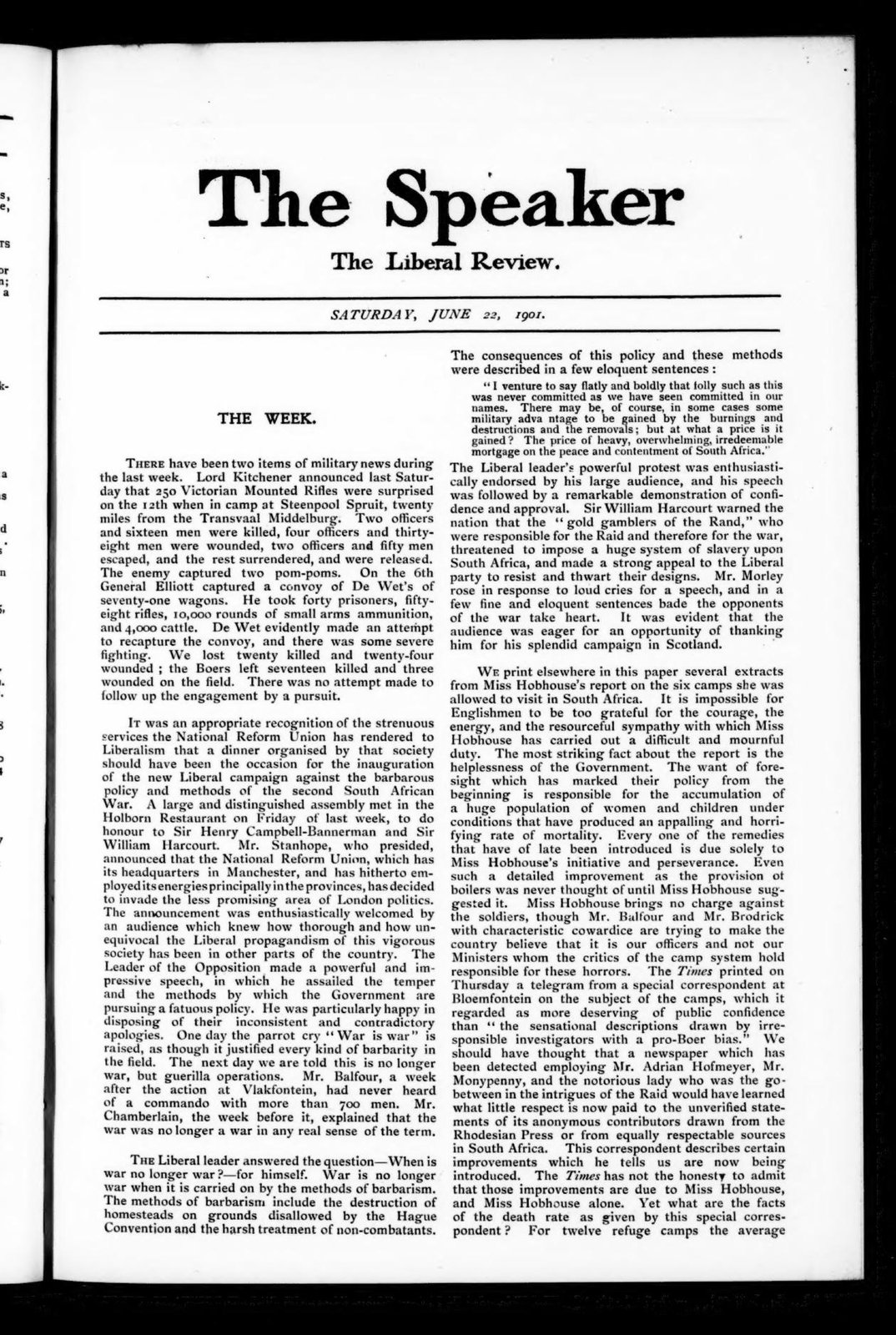
The Speaker, front page 'The Week', 22 June 1901: Hobhouse report and 'methods of barbarism'
Front page of a Liberal weekly eight days after Campbell-Bannerman's 'methods of barbarism' speech. It quotes the Liberal leader, presents Emily Hobhouse's report on the six camps as the authority for its claims ('Every one of the remedies ... is due solely to Miss Hobhouse'), and uses charged labels ('characteristic cowardice', 'gold gamblers of the Rand'). Tells: a named witness vouched for as ending the argument, plus loaded labels for opponents.
- Date
- June 22, 1901
- Period
- Pre-1914
- Made by
- The Speaker: The Liberal Review, London
- Country
- United Kingdom
- Medium
- Newspaper pages
- Issuer type
- Media
- Regime
- Salisbury Government
- Leader
- Robert Gascoyne Cecil
- Audience
- Domestic public
- Purpose
- Persuade or win support
- Event
- Second Boer War
- Techniques
- Name-callingTestimonial
- Source
- Identified Openly sourced: the speaker is who they say they are
- Source
- Internet Archive (Serials in Microfilm, The Speaker), retrieved October 2, 2026
- Rights
- Public domain (published in London before 1931; US public domain by publication date)
Archive item carries no separate rights line. The Speaker: The Liberal Review, 22 June 1901, vol. 4, p. 317; digitised by the Internet Archive from microfilm
Text on the object
The Speaker
The Liberal Review.
SATURDAY, JUNE 22, 1901.

THE WEEK.

The Liberal leader answered the question—When is war no longer war?—for himself. War is no longer war when it is carried on by the methods of barbarism. The methods of barbarism include the destruction of homesteads on grounds disallowed by the Hague Convention and the harsh treatment of non-combatants. The consequences of this policy and these methods were described in a few eloquent sentences:

"I venture to say flatly and boldly that folly such as this was never committed as we have seen committed in our names. There may be, of course, in some cases some military advantage to be gained by the burnings and destructions and the removals; but at what a price is it gained? The price of heavy, overwhelming, irredeemable mortgage on the peace and contentment of South Africa."

We print elsewhere in this paper several extracts from Miss Hobhouse's report on the six camps she was allowed to visit in South Africa. It is impossible for Englishmen to be too grateful for the courage, the energy, and the resourceful sympathy with which Miss Hobhouse has carried out a difficult and mournful duty. The most striking fact about the report is the helplessness of the Government. The want of foresight which has marked their policy from the beginning is responsible for the accumulation of a huge population of women and children under conditions that have produced an appalling and horrifying rate of mortality. Every one of the remedies that have of late been introduced is due solely to Miss Hobhouse's initiative and perseverance. [...] Miss Hobhouse brings no charge against the soldiers, though Mr. Balfour and Mr. Brodrick with characteristic cowardice are trying to make the country believe that it is our officers and not our Ministers whom the critics of the camp system hold responsible for these horrors.
Selected passages from the right-hand column and the second paragraph of the left, read from the OCR layer and checked against the rendered page. The military-news paragraphs, the National Reform Union dinner report and the continuation are not transcribed.