Stay on the job! Processed food is ammunition
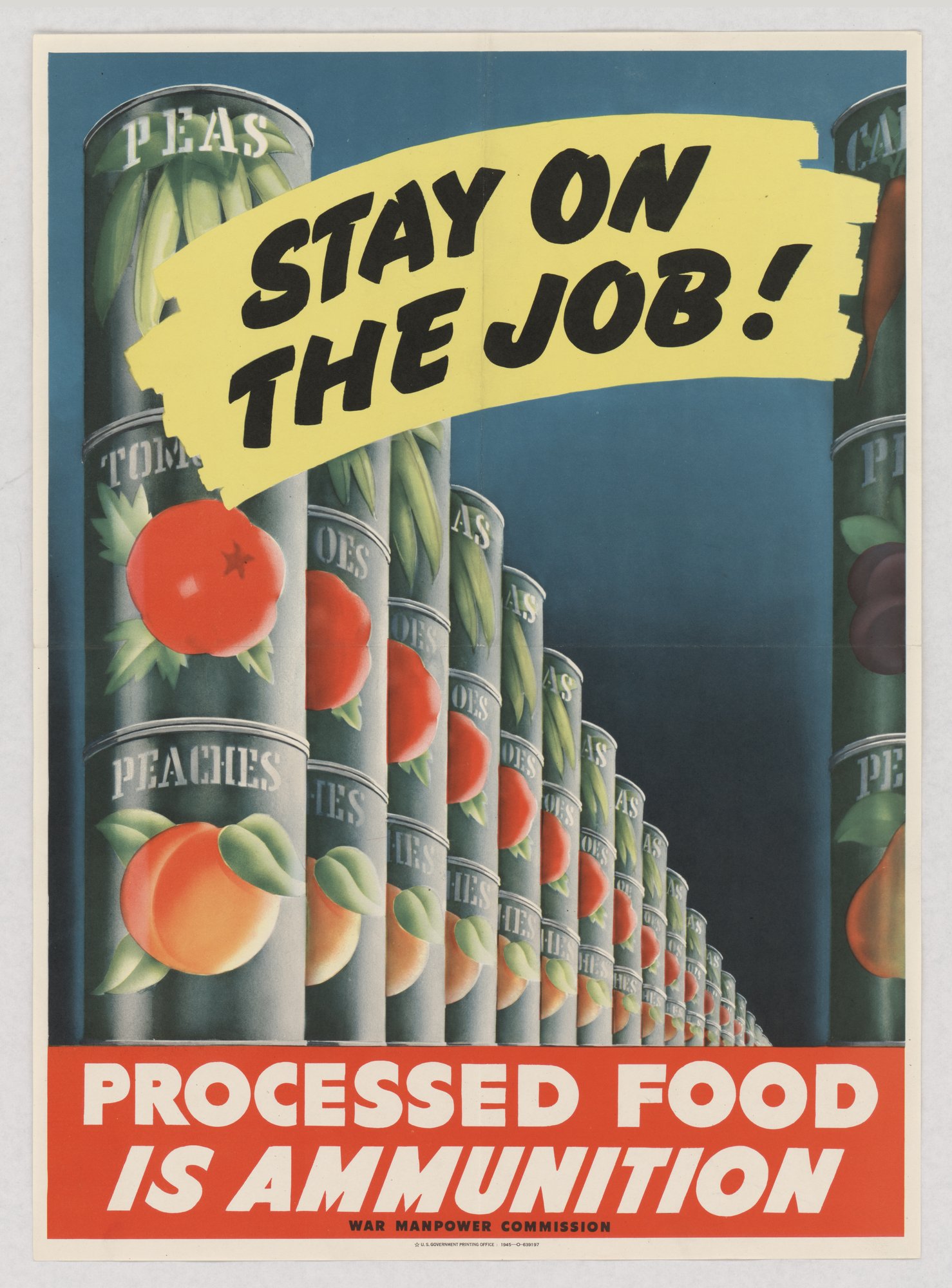
Blue poster showing tall, receding columns of stacked cans labelled PEAS, TOMATOES and PEACHES, with a yellow brush-stroke 'Stay on the job!' over them and 'Processed food is ammunition' on a red band. The tell is transfer: the military word 'ammunition' and the massed rows lend a munitions meaning to cannery work.
A 1945 War Manpower Commission poster printed with a Government Printing Office imprint. Tall, receding columns of stacked cans labelled peas, tomatoes and peaches stand in blue, with a yellow brush-stroke "Stay on the job!" across them and "Processed food is ammunition" on a red band. It asks cannery workers to remain at their posts. This is transfer: the military word "ammunition" and the massed rows give cannery work a munitions meaning.
Propaganda techniques used in this poster
- Date
- 1945
- Period
- Second World War
- Made by
- War Manpower Commission
Full record
Region, Country, Medium, Issuer type, Regime, Leader, Audience, Purpose, Themes, Event, Source, Rights
- Region
- North America
- Country
- United States
- Medium
- Poster
- Issuer type
- State
- Regime
- Roosevelt Administration
- Leader
- Franklin D. Roosevelt
- Audience
- Domestic public
- Purpose
- Mobilize or secure compliance
- Themes
- Home front, Labor, Economy and finance
- Event
- World War II
- Regime
- Roosevelt administration
- Leader
- Franklin D. Roosevelt
- Source
- Identified Openly sourced: the speaker is who they say they are
- Source
- U.S. National Archives and Records Administration, Record Group 44, World War II Posters, retrieved October 4, 2026
- Rights
- Public domain (U.S. government work)
War Manpower Commission. National Archives and Records Administration, RG 44, 44-PA-1803 (NAID 515482).
Text on the object
Original (English) · read from the image, not independently checked
PEAS
TOM[ATOES]
PEACHES
CA[...]
STAY ON
THE JOB!
PROCESSED FOOD
IS AMMUNITION
WAR MANPOWER COMMISSION
[imprint: U.S. GOVERNMENT PRINTING OFFICE : 1945—O-639197]
Several can labels are cut off by overlapping cans or the sheet edge; only the visible letters are given.