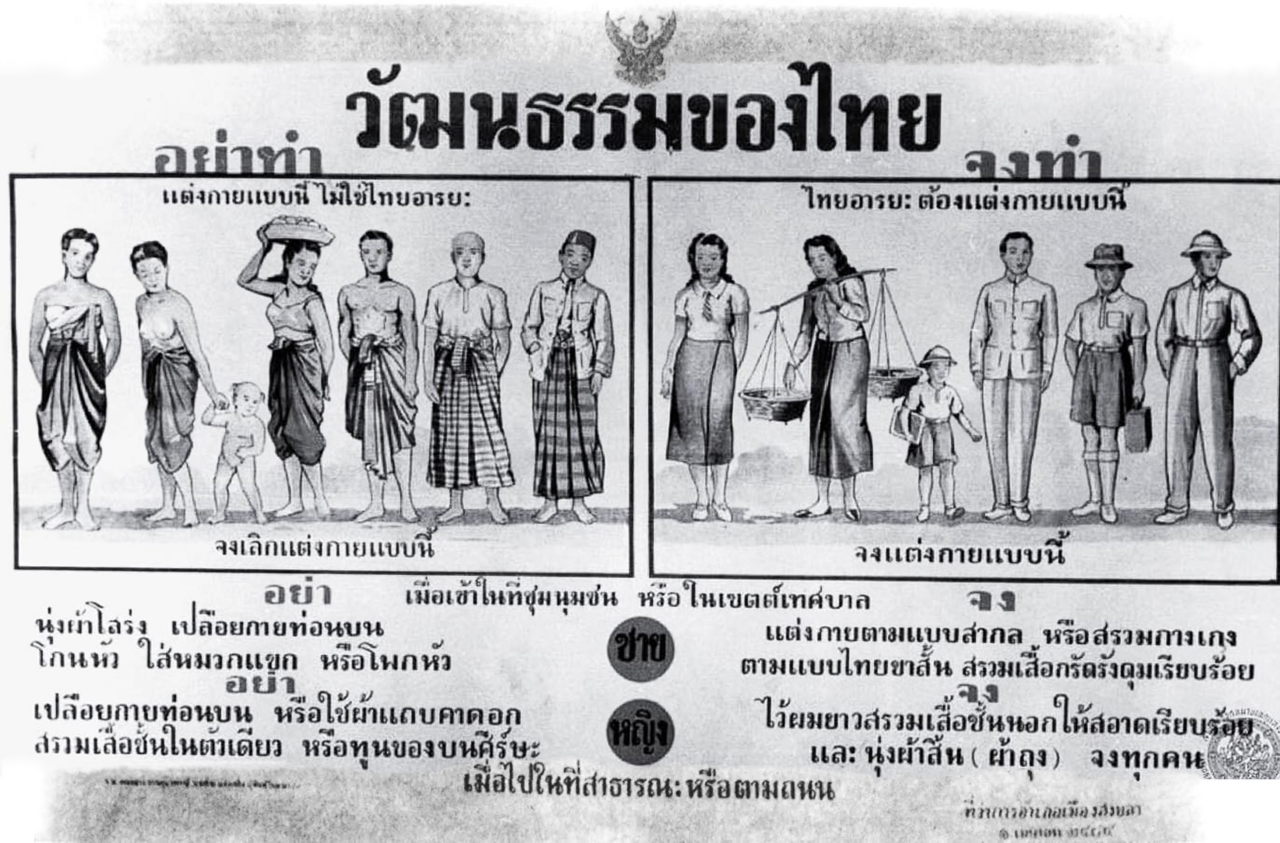
วัฒนธรรมของไทย (Thai Culture), dress-code poster of the Phibunsongkhram government
Two-panel poster under the state emblem and the title 'Thai Culture'. The left panel, headed 'Don't', shows people in sarongs, bare-chested or with head cloths and captions the dress 'not civilised Thai'; the right panel, headed 'Do', shows shirts, trousers, skirts and hats as what a 'civilised Thai' must wear. The label 'not civilised Thai' is applied to a way of dressing (name-calling), and 'Thai culture' and 'civilised Thai' stand in for a specific dress code (glittering generalities).
- Date
- 1940
- Period
- Second World War
- Made by
- Government of Thailand under Prime Minister Plaek Phibunsongkhram (cultural mandates, Ratthaniyom); copy stamped by the Songkhla district office
- Region
- Southeast Asia
- Country
- Thailand
- Medium
- Poster
- Issuer type
- State
- Regime
- Phibunsongkhram Government
- Leader
- Plaek Phibunsongkhram
- Audience
- Domestic public
- Purpose
- Mobilize or secure compliance
- Themes
- Race and ethnicity, Home front
- Event
- Thai Cultural Mandates
- Techniques
- Name-callingGlittering generalities
- Source
- Identified Openly sourced: the speaker is who they say they are
- Source
- Wikimedia Commons (image from the 1997 memorial book for Plaek Phibunsongkhram's centenary), retrieved September 29, 2026
- Rights
- Public domain (Commons PD-Thailand: Thai government work over 50 years old; c. 1940)
Government of Thailand, c. 1940; via Wikimedia Commons
Text on the object
[state emblem (Garuda) at top]
วัฒนธรรมของไทย

อย่าทำ                                      จงทำ

[left box] แต่งกายแบบนี้ ไม่ใช่ไทยอารยะ:
[left caption] จงเลิกแต่งกายแบบนี้

[right box] ไทยอารยะ: ต้องแต่งกายแบบนี้
[right caption] จงแต่งกายแบบนี้

เมื่อเข้าในที่ชุมนุมชน หรือ ในเขตต์เทศบาล
เมื่อไปในที่สาธารณะ หรือตามถนน

[roundel] ชาย
อย่า นุ่งผ้าโสร่ง เปลือยกายท่อนบน โกนหัว ใส่หมวกแขก หรือโพกหัว
จง แต่งกายตามแบบสากล หรือสวมกางเกงตามแบบไทยขาสั้น สวมเสื้อรัดรั้งดุมเรียบร้อย

[roundel] หญิง
อย่า เปลือยกายท่อนบน หรือใช้ผ้าแถบคาดอก สวมเสื้อชั้นในตัวเดียว หรือทูนของบนศีรษะ
จง ไว้ผมยาวสวมเสื้อชั้นนอกให้สอาดเรียบร้อย และ นุ่งผ้าสิ้น (ผ้าถุง) จงทุกคน

[stamp, lower right] ที่ว่าการอำเภอเมืองสงขลา [date line partly legible] [illegible]
[round seal at right edge] [illegible]
[small printed line, lower left] [illegible]
[state emblem at top]
THAI CULTURE

Don't                                      Do

[left box] Dressing like this is not civilised Thai:
[left caption] Give up dressing like this

[right box] Civilised Thai: must dress like this
[right caption] Dress like this

When entering a gathering of people or the municipal area
When going to a public place or along the road

[roundel] MEN
Don't wear a sarong, go bare-chested, shave the head, wear a 'Khaek' hat or wrap a cloth around the head.
Do dress in the international style, or wear Thai-style short trousers, and wear a neatly buttoned shirt.

[roundel] WOMEN
Don't go bare-chested or use a cloth band across the chest, wear an undergarment as the only garment, or carry things on the head.
Do keep the hair long, wear a neat outer blouse, and wear a skirt (tube skirt), everyone.

[stamp, lower right] Songkhla District Office [date partly legible]
Read from the 1280 px image with enlarged crops. The stamp, seal and small printed line at the bottom are too faint to read reliably. The women's line is transcribed as printed ('ผ้าสิ้น (ผ้าถุง)'), taken as the skirt cloth; the translation is a literal machine translation.