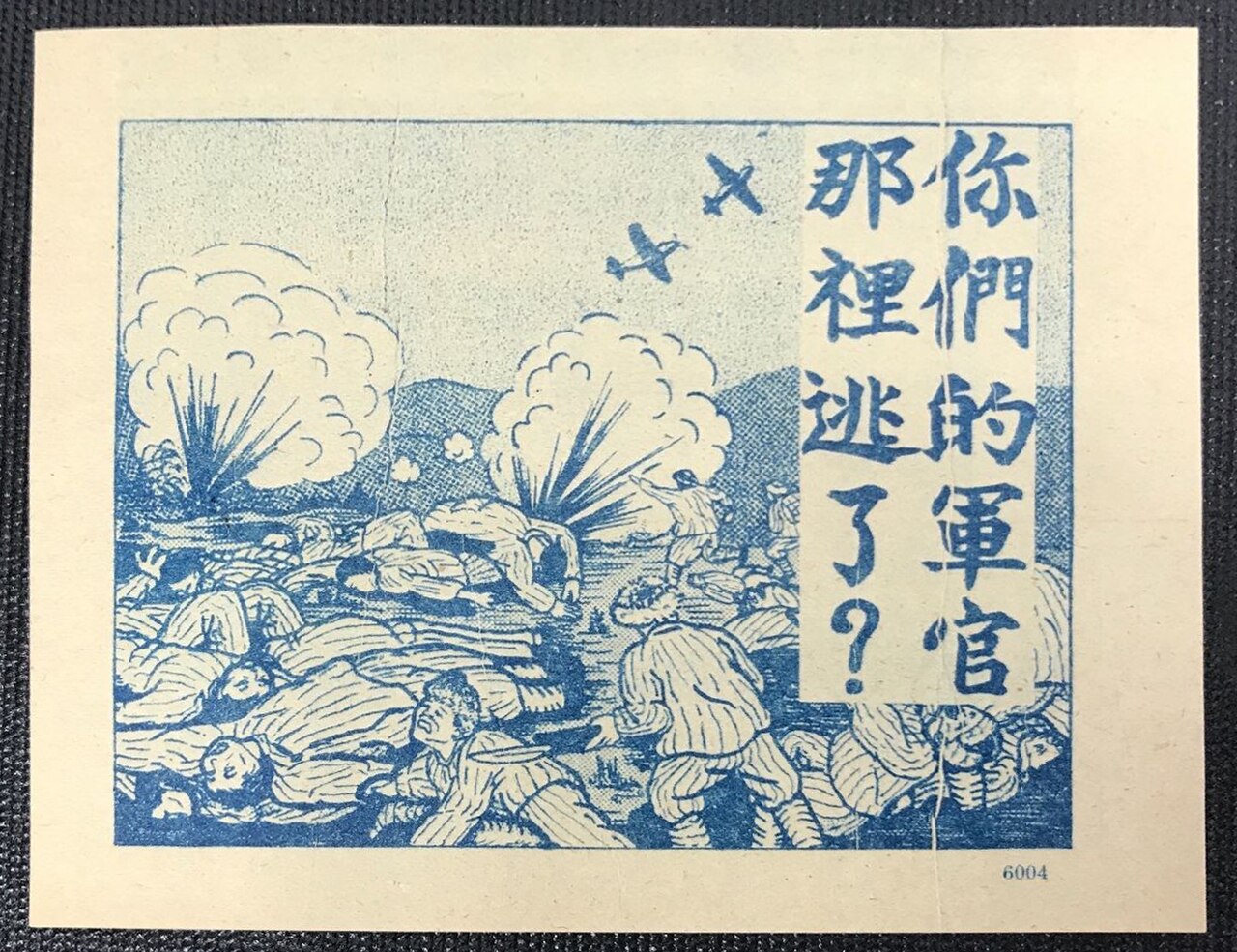
Where have your officers fled to?
A blue-ink Chinese-language leaflet aimed at Chinese soldiers in Korea. The front shows aircraft overhead, shell bursts and a field of fallen soldiers, under the question 'Where have your officers fled to?'. The reverse, in a wounded soldier's voice, says officers always run during air attacks and leave the men behind, and asks why the men should fight and die for them. The tell: fear of air attack is joined to a grievance against the soldiers' own officers, with no alternative offered on the sheet.
- Date
- 1951
- Period
- Cold War
- Made by
- United Nations Command psychological warfare
- Region
- North America
- Country
- United States
- Medium
- Leaflet
- Issuer type
- Military
- Regime
- Truman Administration
- Leader
- Harry S. Truman
- Audience
- Enemy forces
- Theme
- War and the military
- Event
- Korean War
- Techniques
- Fear appealScapegoating
- Source
- Unidentified Source blurred: contractors, cutouts, buried disclosure
- Source
- Wikimedia Commons, retrieved October 2, 2026
- Rights
- Openly licensed (CC BY 4.0; Korea Copyright Commission, Gongu Madang, per Wikimedia Commons)
Korea Copyright Commission (Gongu Madang, gongu.copyright.or.kr); co-author U&People Co., Ltd.; contributor Busan Modern History Research Institute (Kim Han-geun); via Wikimedia Commons (File:BK한국전쟁삐라 199 6004 앞 1951-1-31.jpg), CC BY 4.0.
Text on the object
你們的軍官
那裡逃
了?

[reverse]
中國士兵们:
你们受了傷的跟被俘虜的
战友们常常說:
飛機來轟炸掃射的時候,我
们的軍官總是逃的光光,把我们
丟下來。他們逃了那裡呢?
我们為什麼要執行逃了的人
的命令呢?
我们為什麼要
為逃了的幽鬼來打仗呢?
你們的軍官既然卑怯地把你們
丟下來不管,為什麼你们還要
打仗,把命兒送呢?
6004
Where have your officers fled to?

[reverse]
Chinese soldiers: Your wounded and captured comrades often say: when the planes come to bomb and strafe, our officers always run away completely and abandon us. Where do they run to? Why should we carry out the orders of men who have run away? Why should we fight for ghosts who have run away? Since your officers have cowardly abandoned you and left you, why do you still fight and throw your lives away?
Read from 1280 px scans of both sides. The reverse is in handwritten-style characters, read in columns right to left; the line breaks follow the printed columns. 幽鬼 is read as written ('ghosts'); the final printed number 6004 is the leaflet number.