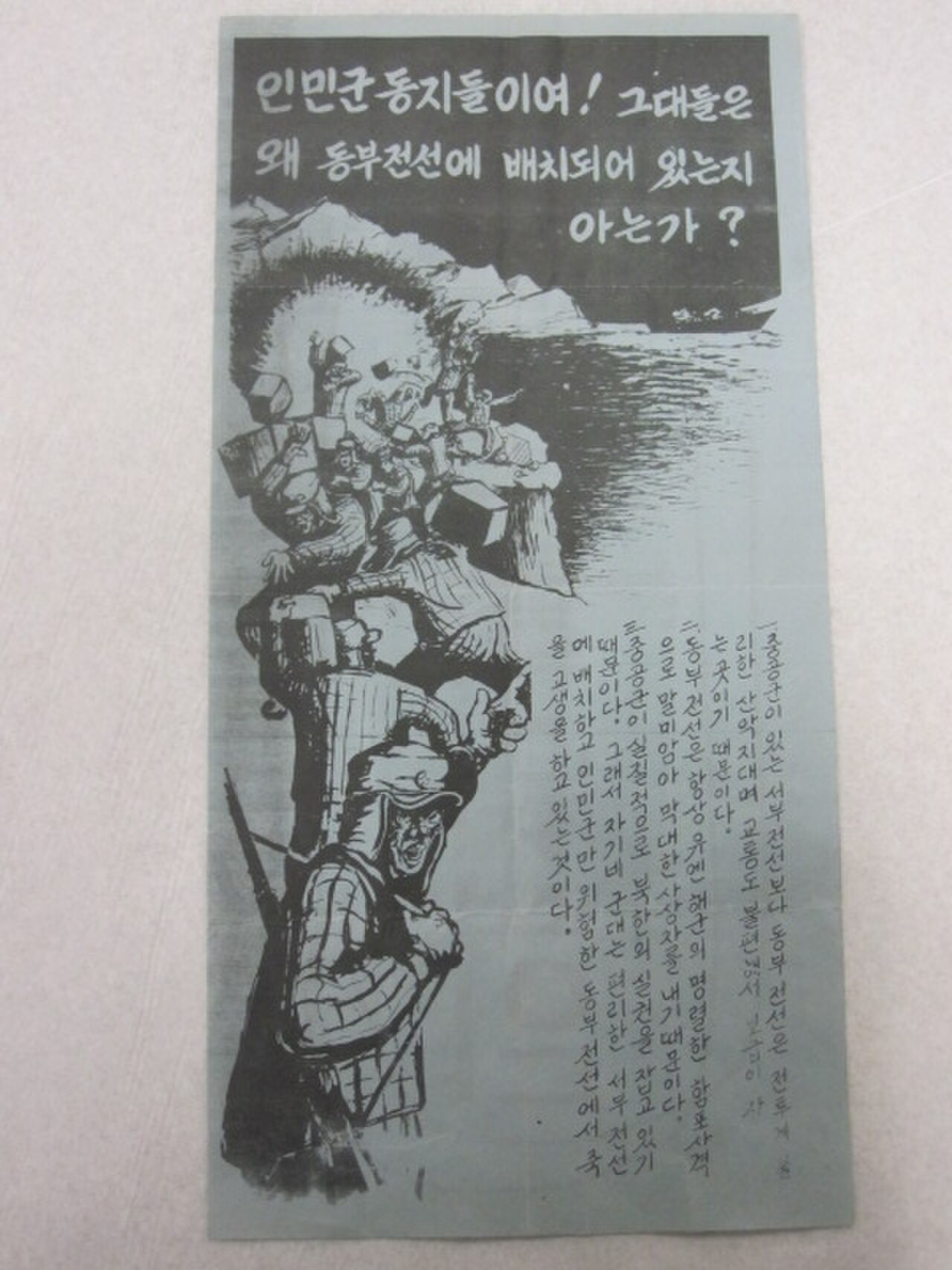
Comrades of the People's Army! Do you know why you are posted on the east front?
A blue-grey Korean-language leaflet asking North Korean soldiers why they are posted on the east front. The drawing shows a naval shell bursting on a cliff, soldiers hurled among supply crates, and a grimacing soldier in the foreground. The text answers: the east front is mountainous, hard to supply and under heavy naval gunfire, while Chinese forces hold the easier west front and effectively control North Korea. The tell: fear of bombardment is joined to a claim that the Chinese are spending North Korean lives.
- Date
- 1951
- Period
- Cold War
- Made by
- U.S. Navy (USS Los Angeles, CA-135) for United Nations Command
- Region
- North America
- Country
- United States
- Medium
- Leaflet
- Issuer type
- Military
- Regime
- Truman Administration
- Leader
- Harry S. Truman
- Audience
- Enemy forces
- Theme
- War and the military
- Event
- Korean War
- Techniques
- Fear appealScapegoating
- Source
- Identified Openly sourced: the speaker is who they say they are
- Source
- Wikimedia Commons, retrieved October 2, 2026
- Rights
- Openly licensed (CC BY 2.0; Naval History and Heritage Command Flickr upload, reviewed on Commons)
Naval History and Heritage Command (accession 96-46-A), via Flickr; Wikimedia Commons, CC BY 2.0.
Text on the object
인민군 동지들이여! 그대들은
왜 동부전선에 배치되어 있는지
아는가?

1. 중공군이 있는 서부전선보다 동부전선은 전투(…)리한 산악지대며 교통도 불편해서 보급이 자(…)는 곳이기 때문이다.
2. 동부전선은 항상 위에 해군의 (맹)렬한 함포사격으로 말미암아 막대한 사상자를 내기 때문이다.
3. 중공군이 실질적으로 북한의 실권을 잡고 있기 때문이다. 그래서 자기네 군대는 편리한 서부전선에 배치하고 인민군만 위험한 동부전선에서 죽을 고생을 하고 있는 것이다.
Comrades of the People's Army! Do you know why you are posted on the east front?

1. Because the east front, compared with the west front where the Chinese Communist army is, is mountainous country [text unclear] and poor in transport, so that supply [text unclear].
2. Because the east front always suffers enormous casualties from the fierce naval gunfire of the Navy.
3. Because the Chinese Communist army in practice holds the real power in North Korea. So it places its own troops on the comfortable west front, and only the People's Army is suffering hard on the dangerous east front.
Read from a 1280 x 1707 px museum photograph. Parentheses mark characters that are cut by the fold or too blurred to read; in point 1 about six syllables (between 전투 and 리한, and after 자) are not legible, and the translation says so rather than guessing. In point 2 the second syllable run is read as '해군의 (맹)렬한' (the Navy's fierce); the first character of 맹 is faint.
.jpg)