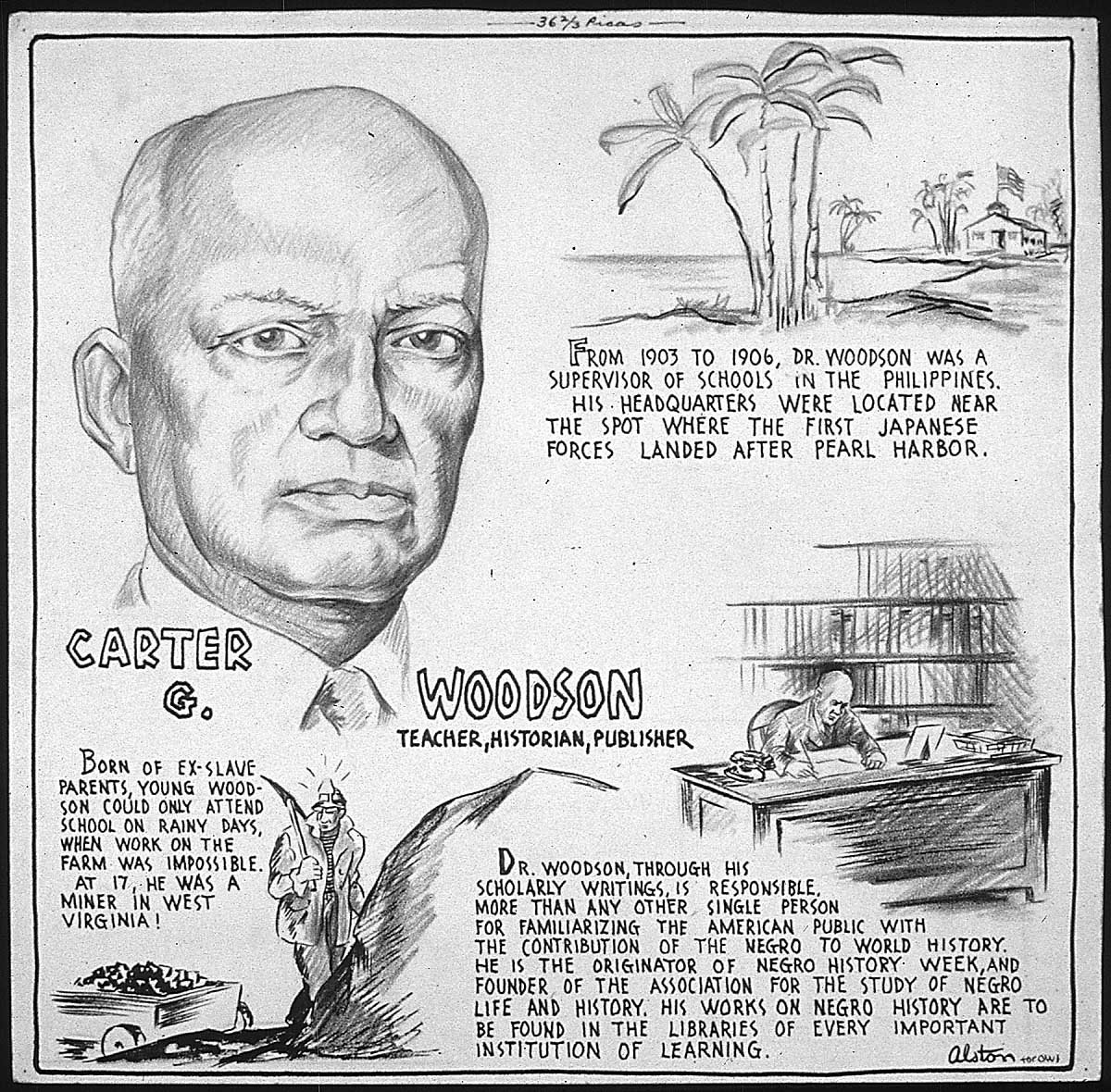
Carter G. Woodson - Teacher, Historian, Publisher
A pencil-drawn page with a large portrait of Carter G. Woodson and four small panels (a Philippine schoolhouse under a US flag, a young miner, a man writing at a desk) with biographical captions. The technique is a weak fit: it works by transfer, associating a respected Black scholar's record with the American war effort, and is otherwise a biographical profile.
Propaganda techniques used in this cartoon
- Date
- 1943
- Period
- Second World War
- Made by
- Office of War Information (cartoon artwork; artist Charles Alston)
- Region
- North America
- Country
- United States
- Medium
- Cartoon
- Issuer type
- State
- Regime
- Roosevelt Administration
- Leader
- Franklin D. Roosevelt
- Audience
- Domestic public
- Purpose
- Persuade or win support
- Themes
- Race and ethnicity, War and the military, Science and technology
- Event
- World War II
- Regime
- Roosevelt administration
- Leader
- Franklin D. Roosevelt
- Source
- Identified Openly sourced: the speaker is who they say they are
- Source
- U.S. National Archives (NARA), RG 208, Cartoons Promoting the War Effort (NAID 535594), retrieved October 3, 2026
- Rights
- Public domain (U.S. government work)
Office of War Information. National Archives and Records Administration, RG 208, 208-COM-78 (NAID 535622).
Text on the object
36 2/3 Picas

CARTER G. WOODSON
TEACHER, HISTORIAN, PUBLISHER

From 1903 to 1906, Dr. Woodson was a supervisor of schools in the Philippines. His headquarters were located near the spot where the first Japanese forces landed after Pearl Harbor.

Born of ex-slave parents, young Woodson could only attend school on rainy days, when work on the farm was impossible. At 17, he was a miner in West Virginia!

Dr. Woodson, through his scholarly writings, is responsible, more than any other single person for familiarizing the American public with the contribution of the Negro to world history. He is the originator of Negro History Week, and founder of the Association for the Study of Negro Life and History. His works on Negro history are to be found in the libraries of every important institution of learning.

Alston for OWI