Content note: White-press sketch calling Kerensky 'Khlestakov', blaming him for Trotsky, and calling Bolshevik guns 'tools of Satan'. This object is shown as it was published. Why
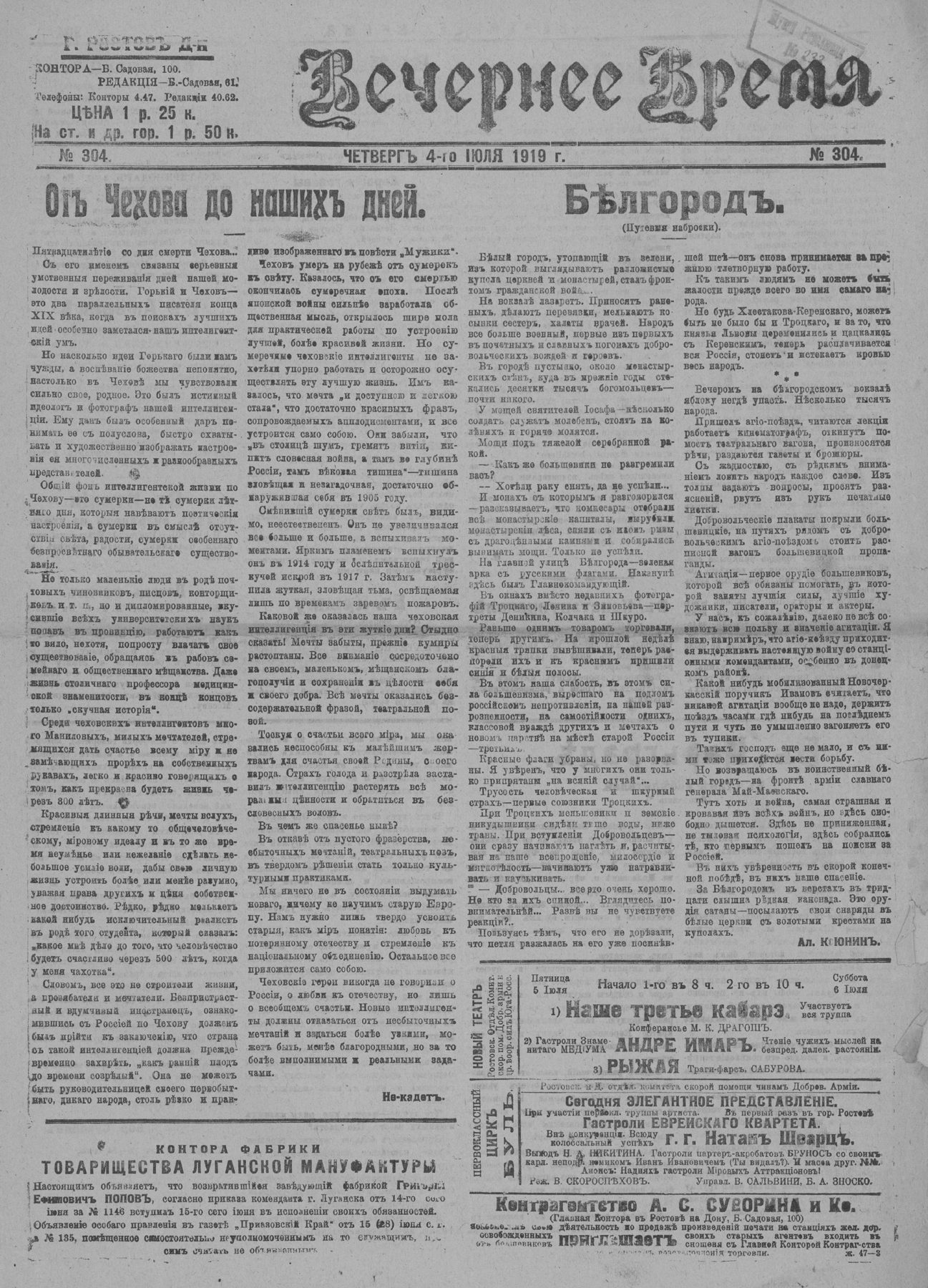
Vechernee Vremya (Rostov-on-Don), front page, 4 July 1919: 'Belgorod'
Front page of the Suvorin family's evening paper in Denikin's Rostov, with a travel sketch 'Belgorod' signed Al. K[Yu]nin from the newly taken front town. It calls Kerensky 'Khlestakov' and blames him and the princes Lvov for Trotsky and for Russia 'bleeding', and describes the Bolsheviks' agitation as their 'first weapon' beside a Volunteer Army agitation train. Tells: a label (Khlestakov, 'tools of Satan') and a single-cause blame for the country's suffering.
- Date
- July 4, 1919
- Period
- Interwar
- Made by
- Vechernee Vremya (editor B. A. Suvorin; Suvorin partnership, Rostov-on-Don)
- Country
- Russia White Movement
- Medium
- Newspaper pages
- Issuer type
- Media
- Regime
- White Movement
- Leader
- Anton Denikin
- Audience
- Domestic public
- Event
- Russian Civil War
- Techniques
- Name-callingScapegoating
- Source
- Identified Openly sourced: the speaker is who they say they are
- Source
- Internet Archive (copy from the Russian National Library, RNB), retrieved October 2, 2026
- Rights
- Public domain (published in Rostov-on-Don, 4 July 1919, before 1931; U.S. public domain by date)
Vechernee Vremya, no. 304, 4 July 1919 (RNB copy), via the Internet Archive
Text on the object
Г. РОСТОВЪ Н/Д.
ВЕЧЕРНЕЕ ВРЕМЯ
№ 304. ЧЕТВЕРГЪ 4-го ИЮЛЯ 1919 г. № 304.

Отъ Чехова до нашихъ дней.

БѢЛГОРОДЪ.
(Путевыя наброски)

Бѣлый городъ, утопающій въ зелени, изъ которой выглядываютъ разлогистыя купола церквей и монастырей, сталъ фронтомъ гражданской войны.
[...]
Въ окнахъ вмѣсто недавнихъ фотографій Троцкаго, Ленина и Зиновьева—портреты Деникина, Колчака и Шкуро.
[...]
Не будь Хлестакова-Керенскаго, можетъ быть не было бы и Троцкаго, и за то, что князья Львовы церемонились и цацкались съ Керенскимъ, теперь расплачивается вся Россія, стонетъ и истекаетъ кровью весь народъ.
[...]
Агитація—первое орудіе большевиковъ, которой всѣ обязаны помогать, въ которой заняты лучшія силы, лучшіе художники, писатели, ораторы и актеры.
[...]
За Бѣлгородомъ въ верстахъ въ тридцати слышна рѣдкая канонада. Это орудія сатаны—посылаютъ свои снаряды въ бѣлыя церкви съ золотыми крестами на куполахъ.

Ал. К[illegible]ЮНИНЪ.
ROSTOV-ON-DON
EVENING TIME
No. 304. THURSDAY 4 JULY 1919. No. 304.

From Chekhov to our days.

BELGOROD.
(Travel sketches)

The white town, drowning in greenery from which the domes of churches and monasteries peep out, has become a front of the civil war.
[...]
In the windows, in place of the recent photographs of Trotsky, Lenin and Zinoviev, are portraits of Denikin, Kolchak and Shkuro.
[...]
Were it not for the Khlestakov-Kerensky, perhaps there would have been no Trotsky either, and for the fact that the princes Lvov stood on ceremony and fussed over Kerensky, all Russia now pays, the whole people groans and bleeds.
[...]
Agitation is the Bolsheviks' first weapon, which everyone is obliged to help, in which the best forces are engaged, the best artists, writers, orators and actors.
[...]
Beyond Belgorod, some thirty versts off, a sparse cannonade is heard. These are the guns of Satan, sending their shells into the white churches with golden crosses on their domes.

Al. K[illegible]YUNIN.
Excerpts of the 'Belgorod' sketch, marked [...]; the 'From Chekhov to our days' essay is not transcribed. Old orthography with hard signs as printed. The byline's second letter is damaged ('К?ЮНИНЪ'). 'Разлогистыя' is read from a faint line and may be 'разлапистыя'.