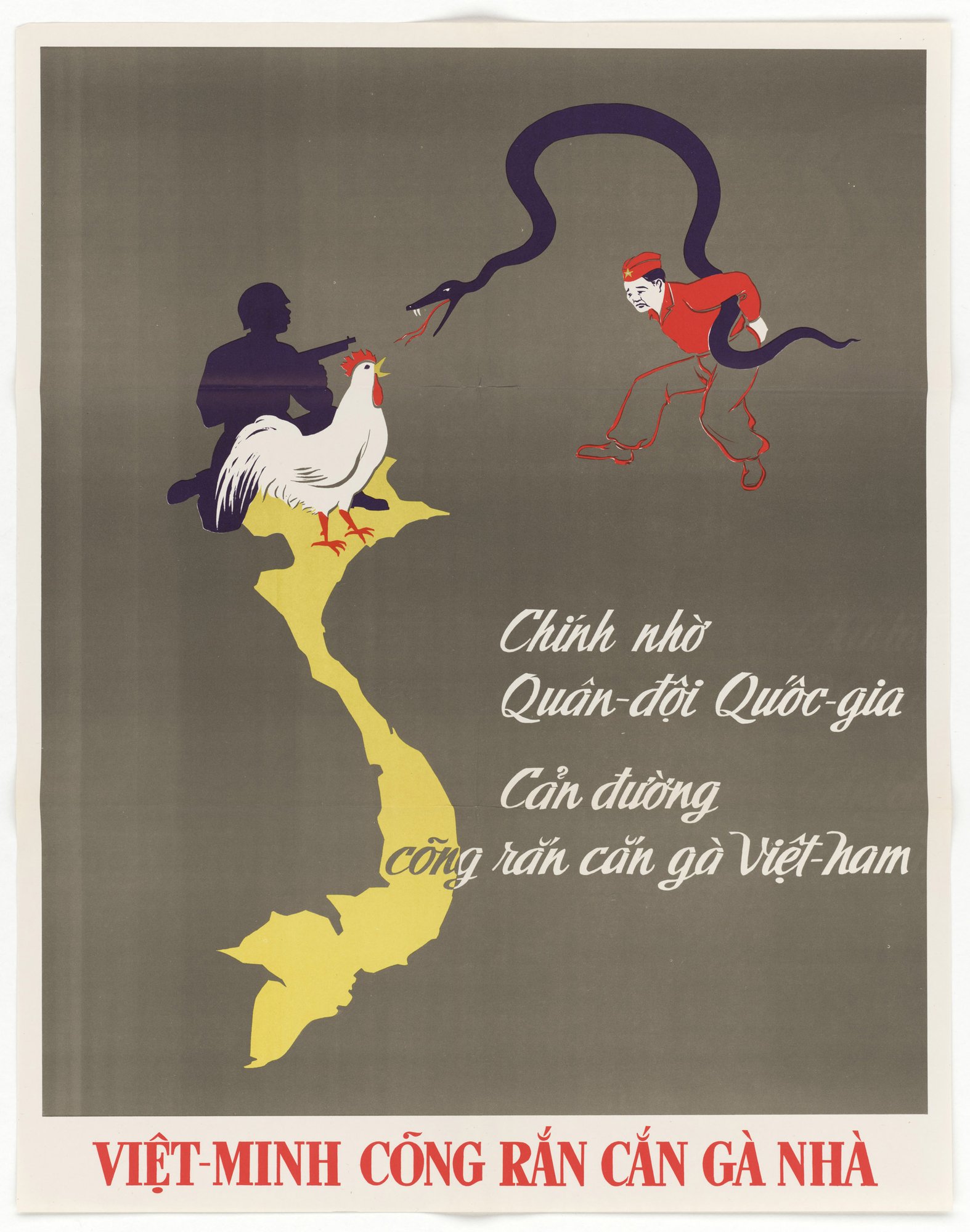
Việt-Minh cõng rắn cắn gà nhà (The Viet Minh carry the snake to bite the home chicken) (Vietnamese poster distributed in Vietnam; NARA title: Viet Army Stops Snake)
A Vietnamese cartoon poster. A white rooster stands on a yellow map of Vietnam beside the silhouette of a helmeted soldier whose gun points at a dark snake. The snake coils round a worried man in a red cap with a star, who bends forward. The text credits the National Army with blocking the snake, and the red headline charges the Viet Minh with bringing the snake to bite the home chicken. The tell is name-calling by animal caricature, using a Vietnamese idiom for inviting in an outside enemy.
Propaganda techniques used in this poster
- Date
- March 27, 1953
- Period
- Cold War
- Made by
- U.S. Information Agency (predecessor: State Department International Information and Educational Exchange Program), Propaganda Posters Distributed in Asia series
- Region
- North America
- Country
- United States
- Medium
- Poster
- Issuer type
- State
- Regime
- Truman Administration
- Leader
- Harry S. Truman
- Audience
- Foreign public
- Purpose
- Persuade or win support
- Themes
- War and the military, Empire and colonialism
- Event
- First Indochina War
- Source
- Unidentified Source blurred: contractors, cutouts, buried disclosure
- Source
- U.S. National Archives (NARA), Record Group 306, Propaganda Posters Distributed in Asia, retrieved October 3, 2026
- Rights
- Public domain (U.S. government work; NARA RG 306)
U.S. Information Agency / Department of State, c. 1953. National Archives, Record Group 306 (NAID 5730132, 306-PPA-231).
Text on the object
Chính nhờ
Quân-đội Quốc-gia
Cản đường
cõng rắn cắn gà Việt-nam

VIỆT-MINH CÕNG RẮN CẮN GÀ NHÀ
It is thanks to the National Army
that the way is blocked for
carrying the snake to bite the Vietnamese chicken

THE VIET MINH CARRY THE SNAKE TO BITE THE HOME CHICKEN
Machine translation, not verified by a fluent reader. The word 'cõng' is printed partly over the map edge in the body text; the headline uses the same phrase.