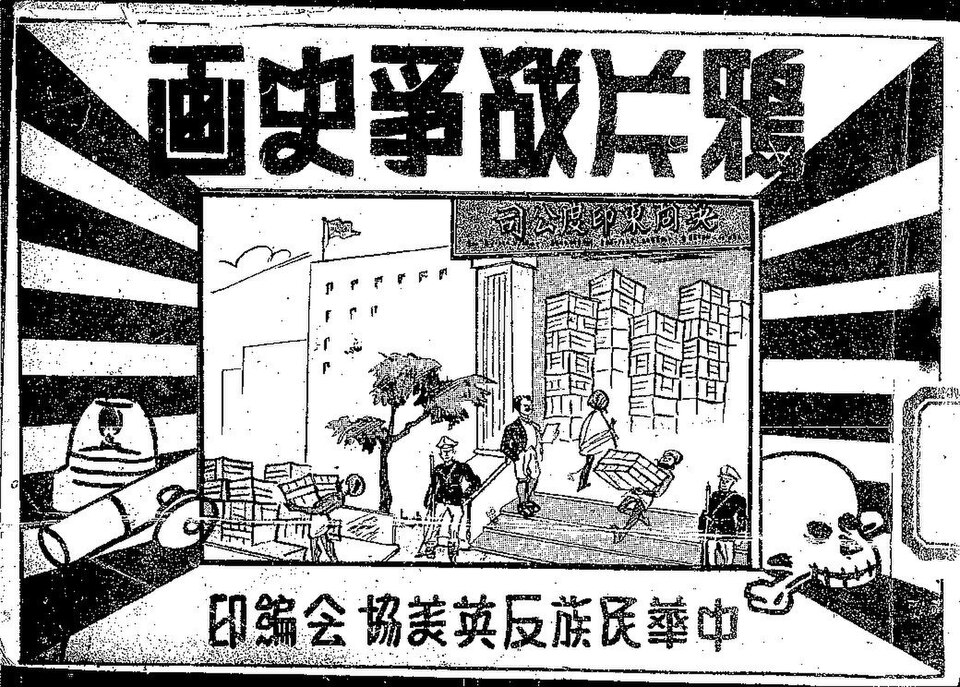
鴉片戰爭史畫 (Pictorial History of the Opium War), cover
Cover of a picture-book history of the Opium War: a cartoon of foreign guards and a Western-dressed trader beside stacked chests under an East India Company sign, with a skull and opium pipe, a cannon and a helmet in the corners and black-and-white rays around the frame. The tell: the 1839-42 opium trade is used as a stigma symbol (skull, pipe, company sign) and attached to Britain and the United States in the middle of the Pacific war.
- Date
- April 1, 1942
- Period
- Second World War
- Made by
- Chinese Nation Anti-British and American Association (中華民族反英美協會), Shanghai
- Region
- East Asia
- Country
- China
- Medium
- Books and pamphlets
- Issuer type
- Movement
- Regime
- Reorganized National Government
- Leader
- Wang Jingwei
- Audience
- Domestic public
- Purpose
- Demonize
- Themes
- Empire and colonialism, War and the military
- Event
- Second Sino Japanese War
- Techniques
- Transfer
- Source
- Identified Openly sourced: the speaker is who they say they are
- Source
- Wikimedia Commons (scan of 鴉片戰爭史畫, Shanghai, 1942), retrieved September 29, 2026
- Rights
- Public domain (1942 anonymous Chinese work; Commons PD-scan / PD-anon-auto-1996)
Chinese Nation Anti-British and American Association, 鴉片戰爭史畫 (Shanghai, 1942), cover; scan via Wikimedia Commons.
Text on the object
[Title, display lettering across the top, right to left:] 鴉片戰爭史画

[Sign on the building in the drawing, right to left:] [英?]東印度公司 [with a line of small Latin letters below the sign: illegible]

[Imprint along the bottom, right to left:] 中華民族反英美協會編印
[Title] Pictorial History of the Opium War. [Sign] (British?) East India Company. [Imprint] Compiled and printed by the Chinese Nation Anti-British and American Association.
Read from a 960 px scan of a coarse halftone. The title is in heavy display lettering in which some characters (such as 画) appear in simplified or variant forms. The first character of the sign is uncertain. Translation is FRAME's own literal rendering, machine-assisted and not verified by a fluent reader.