Content note: 1913 cartoon with racial caricature of Black women and dialect, drawn into the suffrage debate, shown as published. This object is shown as it was published. Why
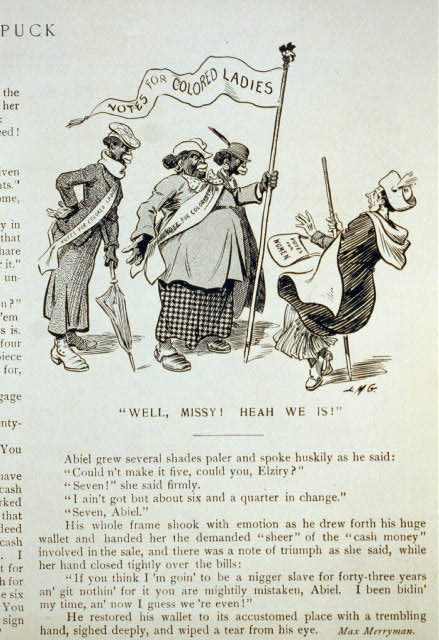
"Well, Missy! Heah we is!" (Puck, 1913)
A white woman with a purse marked 'votes for women' is met by three Black women carrying banners reading 'votes for colored ladies', the caption in imitation Black dialect. The tell: it answers the demand for women's suffrage by setting the Black women's own demand beside it, and mocks the second in a racial caricature.
A wood-engraved cartoon in Puck, published in New York by Keppler & Schwarzmann on 13 March 1913 and signed 'L.M.G.'. A white woman with a purse marked 'votes for women' is met by three Black women carrying banners reading 'votes for colored ladies', with a caption in imitation Black dialect. It answers the demand for women's suffrage by setting the Black women's own demand beside it. The second demand is shown as a racial caricature, which is name-calling, and the setup works as a straw man.
Propaganda techniques used in this cartoon
- Date
- March 13, 1913
- Period
- Pre-1914
- Made by
- Puck (Keppler & Schwarzmann, New York); wood engraving signed 'L.M.G.'
Full record
Region, Country, Medium, Issuer type, Regime, Leader, Audience, Purpose, Themes, Event, Source, Rights
- Region
- North America
- Country
- United States
- Medium
- Cartoon
- Issuer type
- Media
- Regime
- Wilson Administration
- Leader
- Woodrow Wilson
- Audience
- Domestic public
- Purpose
- Persuade or win support
- Themes
- Gender and suffrage, Elections and party politics
- Event
- US Woman Suffrage Campaign
- Regime
- Wilson administration
- Leader
- Woodrow Wilson
- Source
- Identified Openly sourced: the speaker is who they say they are
- Source
- Library of Congress, Prints and Photographs Division, retrieved October 10, 2026
- Rights
- Public domain (published 1913, before 1931); LoC: no known restrictions on publication
Library of Congress, Prints and Photographs Division, LCCN 2002720355. "Well, Missy! Heah we is!" (Puck, 1913)