Also called Strawman, Misrepresentation of a position, Caricaturing the opponent
Restate an opponent's position in a weaker or more extreme form, then refute the restatement.
How to spot Straw man: the tell
Quote the opponent's own words beside the version being attacked and they do not match.
What Straw man is not
An accurate summary of a position, criticized on its merits.
History and effect of Straw man propaganda
The name comes from the image of a figure of straw built to be knocked down: easy to beat, and not the person it stands for. The move is old. A speaker who cannot answer a position can build a weaker one and answer that, and an audience that has not read the original cannot tell the difference. It is most effective when the audience only hears one side, as in an election, a trial or a state broadcast.
Explain moreShow less
A straw man differs from Ad hominem, which attacks the person, and from Red herring, which changes the subject. Here the subject stays the same and the opponent's position is replaced. It is also not the same as a fair argument that a position has bad consequences: arguing that a policy would lead somewhere the proponents deny is an argument about the policy, and it becomes a straw man only when the stated position is described as something other than what was said.
The effect on the audience is a feeling that the opponent has been answered and found foolish or dangerous. The opponent is left to correct the record, and a correction is slower and less shareable than the original charge. See Continued influence effect.
Lineage: Informal logic; Luther's 'straw man' (1520s) usage
How Straw man propaganda works
- An opponent states a position, or has a position imputed to them.
- The position is shortened, hardened or pushed to an extreme: "some" becomes "all", "voluntary" becomes "compulsory", "limits" become "bans", "in a peacetime setting" is left out.
- The reshaped version is refuted, mocked or condemned.
- The audience takes the refutation as a defeat of the opponent.
Why Straw man propaganda works
Audiences rarely check the original. A vivid, simple version is easier to remember than a hedged one, and a person who already dislikes the opponent is ready to believe the worst reading (see Confirmation bias). The wording of the restatement also frames how the audience sees the issue (see Framing effect).
Straw man propaganda examples across eras and sides
Each case records what was said and what the record shows. Both main US parties are represented, and the Russian and French cases are separate from them. None is scored here as a verdict on the policy at issue.
Explain moreShow less
- Greece, 423 and 399 BC. In Plato's Apology, Socrates tells the Athenian jury that his "older" accusers have long circulated a picture of him, and that "you have yourselves seen" it in the comedy of Aristophanes (the Clouds, first staged in 423 BC), in which he "walks in air" and "makes the worse appear the better cause". Socrates answers: "I have nothing to do with physical speculations" (Jowett translation). The source for this case is Socrates' own defence as Plato wrote it, so it is one side's account of how a caricature was used against him.
- France, 1759. In Candide (January 1759), Voltaire gives the character Pangloss the lines that "all is for the best in the best of all possible worlds". The text is built on the optimism associated with Gottfried Wilhelm Leibniz's Theodicy, and mocking Pangloss mocks that philosophy. Whether Pangloss is a fair summary of Leibniz is a question for readers of both authors. A reader who knows the philosophy only from Pangloss meets a compressed and comic version. The case is cited for how the structure works. It is a satire, in a form readers know is exaggerated.
- United States, 1864. The Democratic print in this archive, The abolition catastrophe. Or the November smash-up (G. W. Bromley & Co., 1864, for the McClellan side), captions the Republican passengers "Miscegenationists". The word was coined in a pamphlet published in December 1863 by David Goodman Croly, managing editor of the New York World, and the reporter George Wakeman. It posed as a sincere defence of racial mixing, aimed to turn voters against the Lincoln administration, and was a forgery. A position Republicans did not state was assigned to them and then run against. The print contains a racial slur and caricatures of Black figures, shown as printed.
- United States, 2008. Asked on 3 January 2008 in Derry, New Hampshire, about President Bush's remark on staying in Iraq for 50 years, John McCain said "Make it a hundred." He added that this would be "fine with me, as long as Americans are not being injured or harmed", and compared it to the US presence in Japan and South Korea. On 26 February 2008 Barack Obama said the country was "bogged down in a war that John McCain now suggests might go on for another 100 years." PolitiFact rated that statement False on 5 March 2008. In April 2008 the Democratic National Committee released an ad that cut McCain's answer to "Maybe a hundred" and set it against images of war. FactCheck.org said on 29 April 2008 that the ad "twists the sense of McCain's words", and that it was fair to argue that McCain's policy could prolong the violence.
- United States, 2009. On 7 August 2009, Sarah Palin posted on Facebook that under the health-care bill "my parents or my baby with Down Syndrome will have to stand in front of Obama's 'death panel'". Section 1233 of H.R. 3200 would have paid physicians for voluntary counselling on living wills and end-of-life options. Neither Section 1233 nor any other provision set up a process for deciding who was worthy of care. PolitiFact rated the claim Pants on Fire on 10 August and named it its Lie of the Year for 2009. At a 12 August 2009 town hall, Republican Senator Chuck Grassley said, "We should not have a government program that determines you're going to pull the plug on Grandma", and he later said he did not think the provision would give the government authority to decide who lives and dies. Senator Lisa Murkowski called the death-panel charge baseless.
- Russia, 2022. On 25 March 2022, at a televised meeting with cultural figures, Vladimir Putin said, "Today, they are trying to cancel a thousand-year-old country", and "The proverbial 'cancel culture' has become a cancellation of culture". He compared it to Nazi book burning. The measures that preceded the speech after Russia's invasion of Ukraine on 24 February included the dismissal of the conductor Valery Gergiev as chief conductor of the Munich Philharmonic and the loss of a La Scala engagement after he did not condemn the invasion, the cancellation of later Bolshoi Ballet performances at Madrid's Teatro Real, the cancellation of Russian art sales by London auction houses, and the Cardiff Philharmonic's decision to drop Tchaikovsky's 1812 Overture. Most were aimed at named people and state-linked institutions after the invasion. Some did affect dead Russian composers. The speech describes the whole as a campaign against Russian culture and a thousand-year-old country.
Cases on both sides of one country's politics are given in the same terms: in each, a position was described in a form its holder did not state, and the holder's words or the document were available to check.
How to spot Straw man propaganda
- Find the original. Read the bill, the speech or the transcript and compare it with the description.
- Watch for hardening words in the description: "all", "always", "ban", "force", "abolish", "want to destroy".
- Look for what was dropped: conditions ("voluntary", "as long as"), time limits and scope.
- Ask whether the opponent would sign the summary. If not, the summary is not theirs.
- Check whether the description comes only from the side attacking the position.
Where Straw man propaganda ends: edge cases and legitimate persuasion
Accurate summary followed by criticism is the basis of argument.
Accurate summary followed by criticism is the basis of argument. So is a reductio ad absurdum ("if that principle were applied everywhere, it would require X"), provided it is labelled as an inference from the principle and not presented as the opponent's stated view. An argument that a position has consequences its proponents do not intend is also fair, and so is a dispute about what a text really means. The line is crossed when the speaker states a position as the opponent's own, and it does not match what the opponent said. Satire is a separate case when the audience knows it is exaggeration, as with Voltaire. A rival may also fairly describe what a policy would do in numbers, as long as the scenario is flagged as one and not presented as the text.
Gaps. Only two objects in the archive's current holdings were clear enough to tag with this technique. A fuller set of dated, sourced objects from outside the United States is still wanted. Two further candidate cases, the 2019 Hong Kong protests and the UK press stories about banana regulation, were left out because the sources checked did not support a clean description.
Sources and further reading
Sources
7 items · Plato, Apology , trans. Benjamin Jowett, Project Gutenberg .
- Plato, Apology, trans. Benjamin Jowett, Project Gutenberg.
- Wikipedia, "Candide" (publication January 1759; Pangloss's maxim; the relation to Leibniz's Theodicy).
- Wikipedia, "Miscegenation (pamphlet)" (authors, December 1863, purpose); Library of Congress catalogue entry for the 1864 print, linked from the archive entry.
- PolitiFact, 5 March 2008: "Straight talk twisted"; FactCheck.org, 29 April 2008: "DNC vs. McCain".
- Wikipedia, "Death panel" (Palin post of 7 August 2009; Section 1233; PolitiFact rulings; Grassley and Murkowski).
- Al Jazeera, 25 March 2022: "Putin says West trying to 'cancel' Russian culture".
- Archive entries for the 14 August 1800 Gazette of the United States and the 24 February 2022 address, with the source pages named in each entry.
Sourcing note (7 October 2026): quotations were checked against the linked pages as retrieved by the build environment. Wikipedia pages are cited for what they state. The Leibniz comparison rests on the Candide page alone and is stated as a reading, not a settled finding.
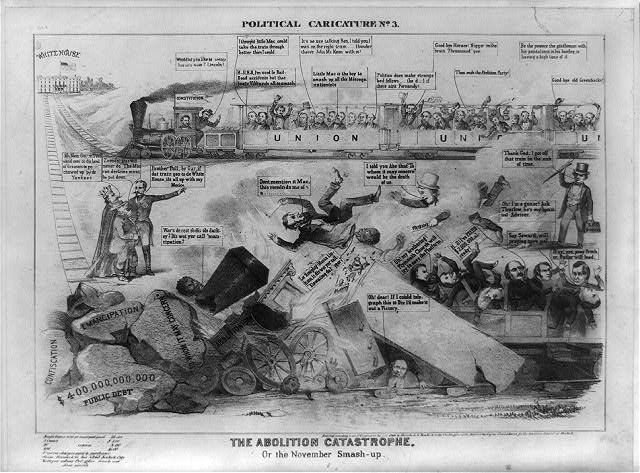
"The abolition catastrophe. Or the November smash-up", lithograph, G. W. Bromley & Co., New York, 1864, for the McClellan (Democratic) side. Library of Congress Prints and Photographs Division. Public domain (published 1864). Contains a racial slur and caricatures of Black figures, shown as printed.
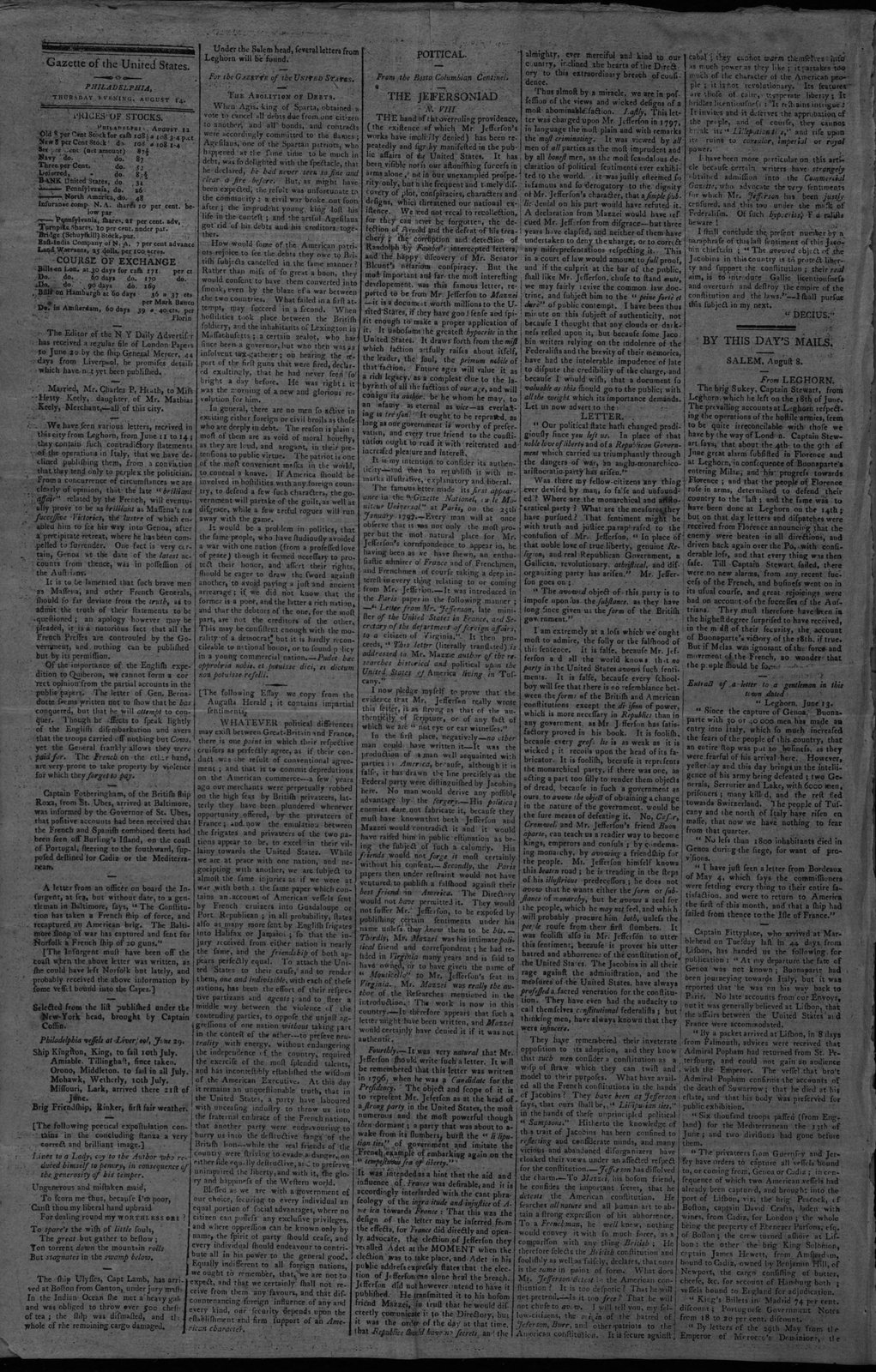
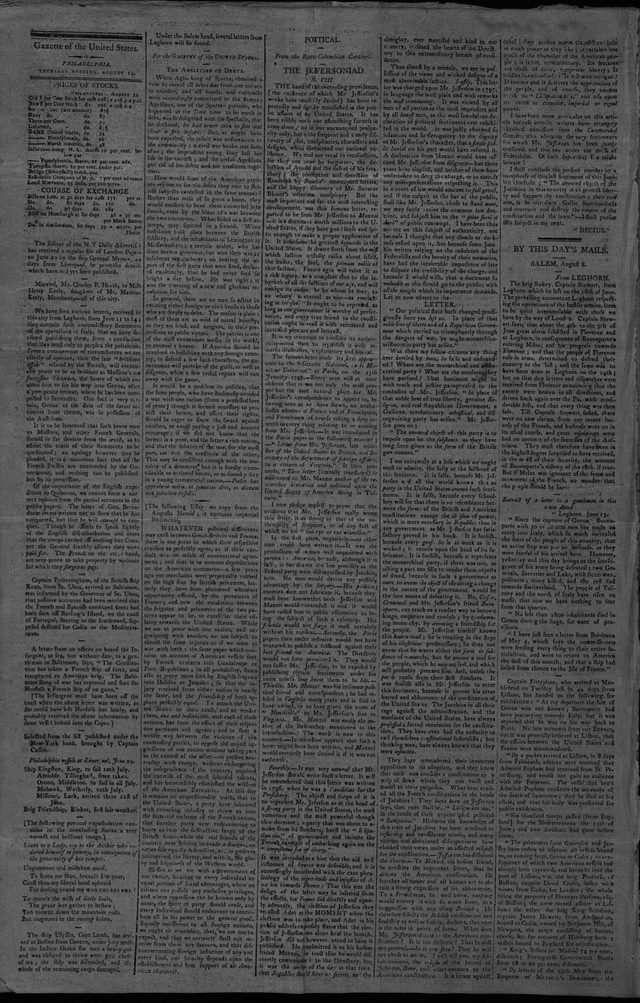
Gazette of the United States & Daily Advertiser, Philadelphia, 14 August 1800, page 2. Its closing warning says the opposing party's real aim is to "overturn and destroy" the constitution, an aim attributed to the party, not stated by it. Internet Archive / Library of Congress Chronicling America scan. Public domain (published 1800).
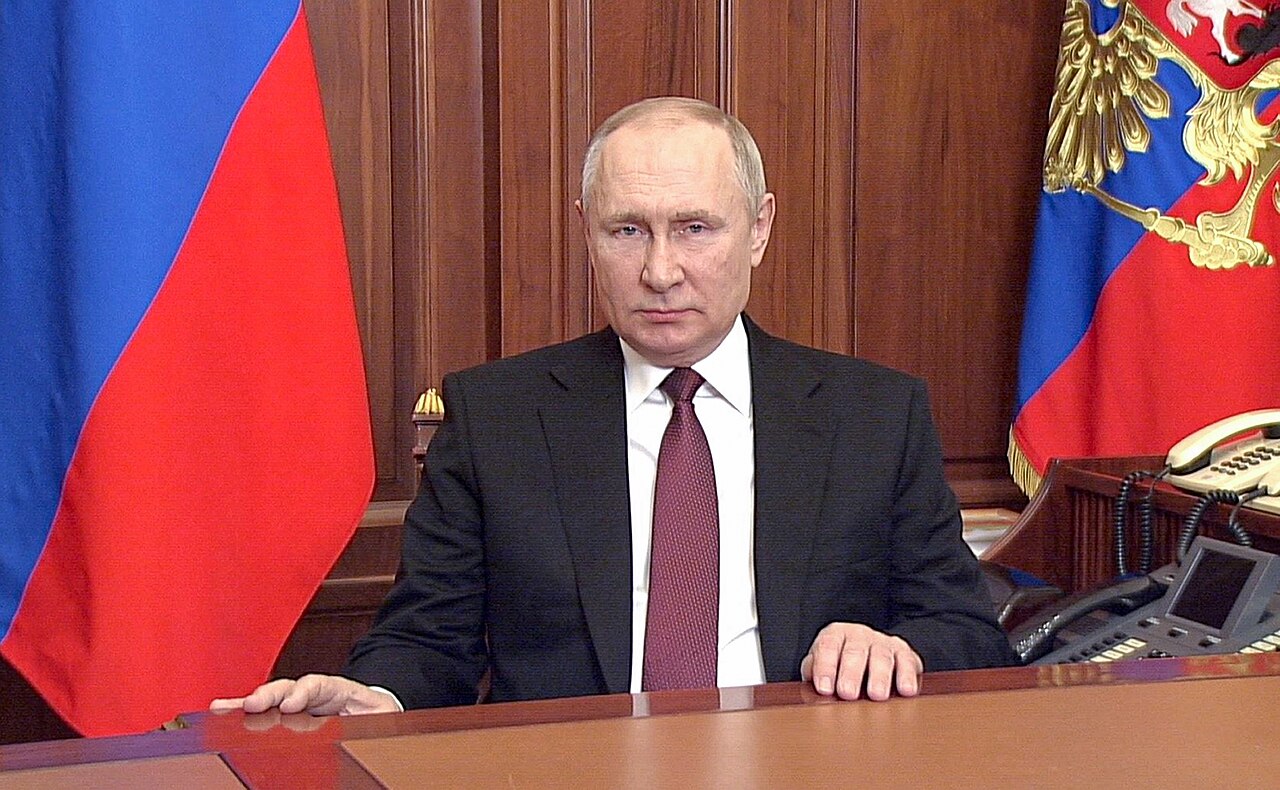
President Putin during the televised address of 24 February 2022 announcing the "special military operation". It shows the speaker one month before the 25 March 2022 remarks described above, not those remarks. Kremlin.ru via Wikimedia Commons, CC BY 4.0.
The science
Research on the psychology this technique relies on, from the Learn library:
Research on the psychology this technique relies on, from the Learn library:
- Continued influence effect — Continued influence effect
- Confirmation bias — Confirmation bias
- Framing effect — Framing effect