Content note: Racial caricatures of colonised peoples carried in baskets. This object is shown as it was published. Why
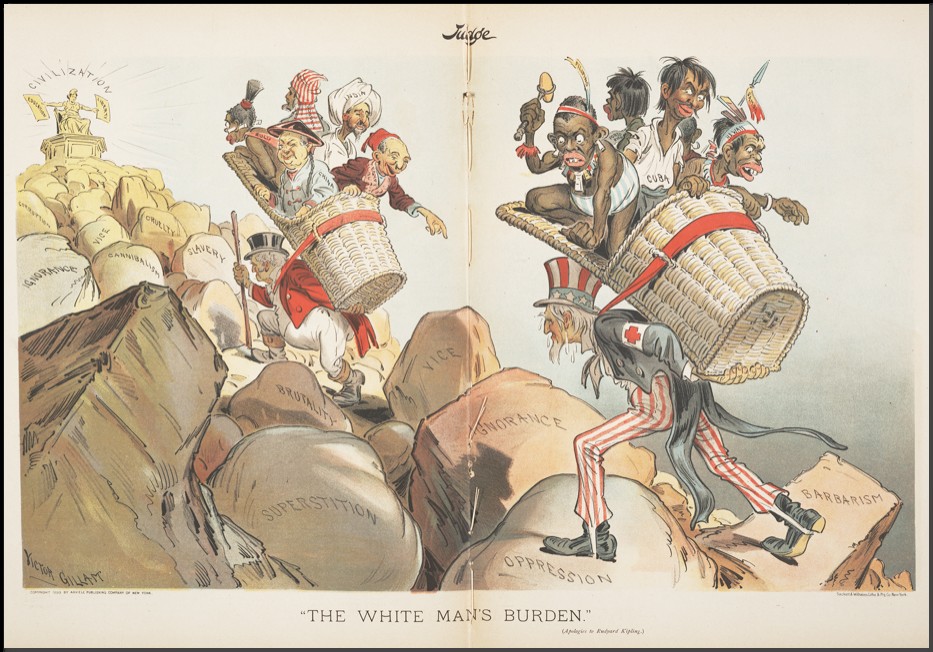
"The White Man's Burden (Apologies to Rudyard Kipling)" (Judge, 1899)
Uncle Sam and John Bull carry racially caricatured figures labelled the new colonial subjects up a hill marked civilization, borrowing the prestige of Kipling's 1899 poem to cast annexation as a burden willingly shouldered rather than a war being fought.
- Date
- April 1, 1899
- Period
- Pre-1914
- Made by
- Judge magazine
- Region
- North America
- Country
- United States
- Medium
- Cartoon
- Issuer type
- Media
- Regime
- Mckinley Administration
- Leader
- William Mckinley
- Audience
- Domestic public
- Purpose
- Persuade or win support
- Themes
- Empire and colonialism, Race and ethnicity
- Event
- Philippine American War
- Techniques
- TransferGlittering generalities
- Source
- Identified Openly sourced: the speaker is who they say they are
- Source
- Wikimedia Commons, retrieved September 27, 2026
- Rights
- Public domain (published in the U.S. in 1899)
Victor Gillam, "The White Man's Burden (Apologies to Rudyard Kipling)", Judge, 1 April 1899
Text on the object
Judge

CIVILIZATION
EDUCATION          LIBERTY

ZULU

INDIA

CHINA

HAWAII

CUBA

PORTO RICO

CORRUPTION
VICE
CRUELTY
IGNORANCE
CANNIBALISM
SLAVERY
BRUTALITY
SUPERSTITION
VICE
IGNORANCE
OPPRESSION
BARBARISM

"THE WHITE MAN'S BURDEN."
(Apologies to Rudyard Kipling.)

Victor Gillam

Sackett & Wilhelms Litho. & Ptg. Co., New York
Rock and basket-passenger labels are scattered across the composition; grouped by type rather than left-to-right, since the object has no single reading order. 'PORTO RICO' and the bottom-right printer's credit are tiny, low-contrast script read with only moderate confidence. The basket figures are racist caricatures of the people of these countries/territories, shown as printed per the no-sanitising rule; two further ribbon labels (one per basket) are illegible cursive script too small to read.