Content note: 1915 suffragette-paper text describing anti-German riot violence after the Lusitania sinking and the forcible feeding of imprisoned suffragettes. This object is shown as it was published. Why
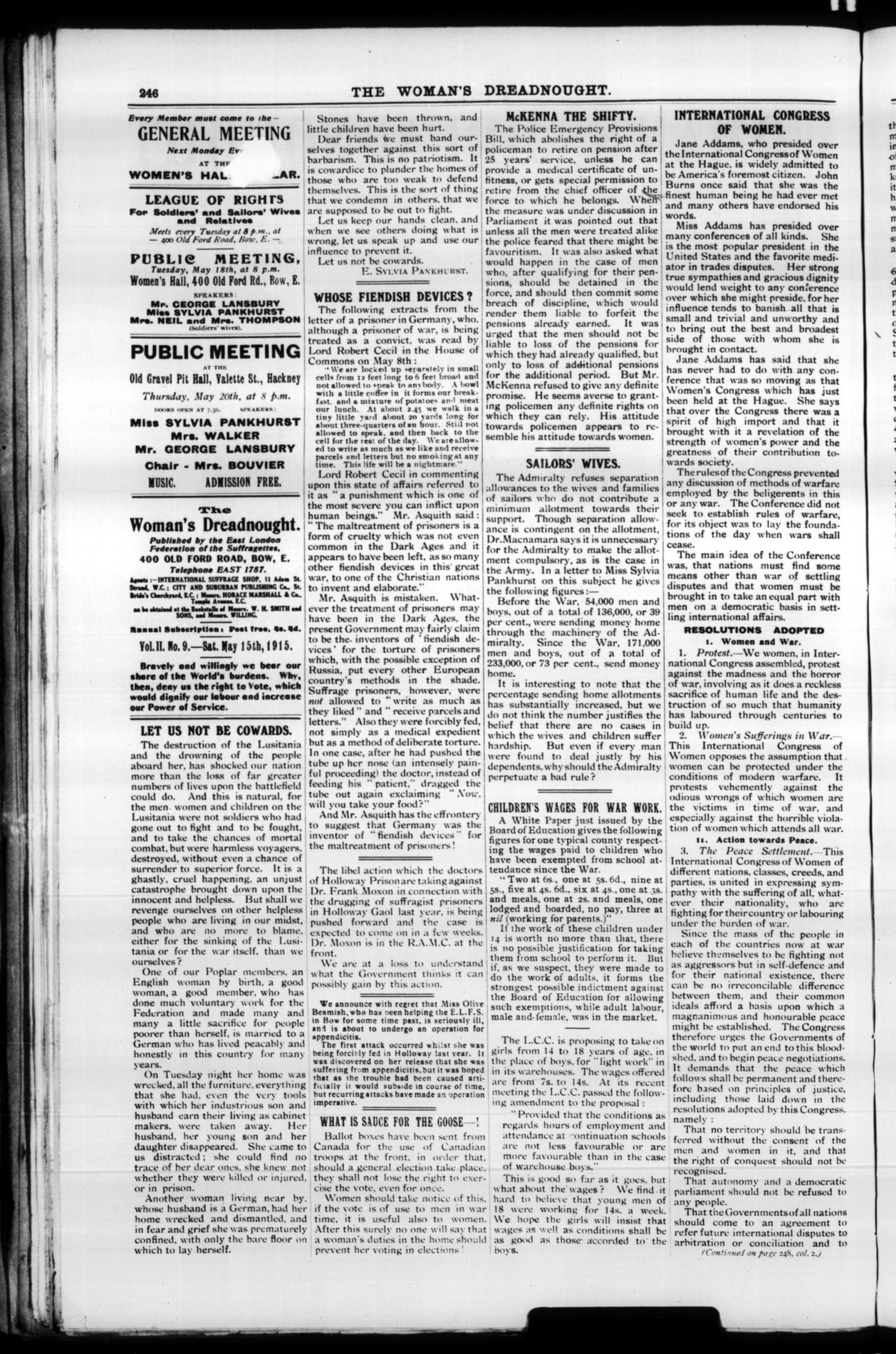
The Woman's Dreadnought, 15 May 1915, p. 246: "Let Us Not Be Cowards" and "Whose Fiendish Devices?"
Page 246 of a suffragette weekly. 'Let Us Not Be Cowards' calls the Lusitania sinking 'a ghastly, cruel happening' and condemns attacks on German-owned homes in Poplar; 'Whose Fiendish Devices?' answers the Prime Minister's remark on the treatment of prisoners of war by citing the forcible feeding of suffrage prisoners. Tell: the reply moves from German treatment of prisoners to British treatment of suffragettes.
- Date
- May 15, 1915
- Period
- First World War
- Made by
- The Woman's Dreadnought, East London Federation of the Suffragettes (editor Sylvia Pankhurst), Bow, London
- Country
- United Kingdom
- Medium
- Newspaper pages
- Issuer type
- Movement
- Regime
- Asquith Government
- Leader
- Herbert Henry Asquith
- Audience
- Domestic public
- Purpose
- Persuade or win support
- Themes
- Home front, Gender and suffrage
- Event
- World War I
- Techniques
- Whataboutism
- Regime
- Asquith government
- Leader
- H. H. Asquith
- Source
- Identified Openly sourced: the speaker is who they say they are
- Source
- Internet Archive (Periodicals collection, The Woman's Dreadnought, digitised from microfilm), retrieved October 2, 2026
- Rights
- US public domain (published London 1915, before 1931); IA item has no rights field
The Woman's Dreadnought, vol. II no. 9, 15 May 1915, p. 246, East London Federation of the Suffragettes, London. Internet Archive item per_workers-dreadnought_the-womans-dreadnought_1915-05-15_2_9 (microfilm scan).
Text on the object
246 THE WOMAN'S DREADNOUGHT.

[Two columns transcribed; the rest of the page is not.]

LET US NOT BE COWARDS.

The destruction of the Lusitania and the drowning of the people aboard her, has shocked our nation more than the loss of far greater numbers of lives upon the battlefield could do. And this is natural, for the men, women and children on the Lusitania were not soldiers who had gone out to fight and to be fought, and to take the chances of mortal combat, but were harmless voyagers, destroyed, without even a chance of surrender to superior force. It is a ghastly, cruel happening, an unjust catastrophe brought down upon the innocent and helpless. But shall we revenge ourselves on other helpless people who are living in our midst, and who are no more to blame, either for the sinking of the Lusitania or for the war itself, than we ourselves?

[Two paragraphs describing the wrecking of two Poplar homes of German-born husbands are not transcribed.]

Stones have been thrown, and little children have been hurt.

Dear friends We must band ourselves together against this sort of barbarism. This is no patriotism. It is cowardice to plunder the homes of those who are too weak to defend themselves. This is the sort of thing that we condemn in others, that we are supposed to be out to fight. Let us keep our hands clean, and when we see others doing what is wrong, let us speak up and use our influence to prevent it.

Let us not be cowards.
E. SYLVIA PANKHURST.

WHOSE FIENDISH DEVICES?

The following extracts from the letter of a prisoner in Germany, who, although a prisoner of war, is being treated as a convict, was read by Lord Robert Cecil in the House of Commons on May 8th:

"We are locked up separately in small cells from 12 feet long to 6 feet broad and not allowed to speak to anybody. A bowl with a little coffee in it forms our breakfast, and a mixture of potatoes and meat our lunch. At about 2.45 we walk in a tiny little yard about 20 yards long for about three-quarters of an hour. Still not allowed to speak, and then back to the cell for the rest of the day. We are allowed to write as much as we like and receive parcels and letters but no smoking at any time. This life will be a nightmare."

Lord Robert Cecil in commenting upon this state of affairs referred to it as "a punishment which is one of the most severe you can inflict upon human beings." Mr. Asquith said: "The maltreatment of prisoners is a form of cruelty which was not even common in the Dark Ages and it appears to have been left, as so many other fiendish devices in this great war, to one of the Christian nations to invent and elaborate."

Mr. Asquith is mistaken. Whatever the treatment of prisoners may have been in the Dark Ages, the present Government may fairly claim to be the inventors of "fiendish devices" for the torture of prisoners which, with the possible exception of Russia, put every other European country's methods in the shade. Suffrage prisoners, however, were not allowed to "write as much as they liked" and "receive parcels and letters." Also they were forcibly fed, not simply as a medical expedient but as a method of deliberate torture. In one case, after he had pushed the tube up her nose (an intensely painful proceeding) the doctor, instead of feeding his "patient," dragged the tube out again exclaiming "Now, will you take your food?"

And Mr. Asquith has the effrontery to suggest that Germany was the inventor of "fiendish devices" for the maltreatment of prisoners!
Read from the 1900-pixel committed image; the microfilm scan is clear in these two columns. The masthead slogan, advertisements and remaining columns (including 'International Congress of Women' and 'Sailors' Wives') are not transcribed.