Also called Tu quoque, And-you-are-lynching-Negroes
Answer an accusation with a different accusation so the original claim is never tried.
The tell
The reply cannot be true or false about the first claim; it only changes the subject.
Not this
A relevant comparison that uses the same standard on both sides.
History and effect
Named in Western Cold War commentary for a recurring Soviet rhetorical move; the retort "and you are lynching Negroes" became its best-known example. The lynchings it pointed to were real. What makes the retort whataboutism is that it was used to avoid answering the original charge, not that the counter-charge was false. The label grew up in commentary about Soviet and later Russian officials, but the move is not specific to any state or bloc, and the definition above applies to every speaker. Documented cases from the Soviet Union, the United States, Russia and China are listed under "Documented cases" below, and Then and now: "and what about you?" (Soviet Union, Cold War; US, China and Russia, 2017–21) sets three of the modern ones beside the Soviet retort.
It redirects the audience's evaluative energy onto a new accusation, so the original claim is never actually tried.
Lineage: Soviet 'and you are lynching Negroes'
Documented cases
- Soviet Union, Cold War. The retort in the lineage above: charges about Soviet human rights answered with charges about racial violence in the United States.
- United States, 2017. In a Fox News interview broadcast on 5 February 2017, Bill O'Reilly told President Donald Trump, "Putin's a killer." Trump replied, "There are a lot of killers. We've got a lot of killers," asked whether O'Reilly thought "our country's so innocent", and pointed to the Iraq war. The reply answers a charge about Russia's president with a charge about the United States, and the charge about Putin is not taken up. The comparison itself is not scored here as true or false. Members of both parties objected, among them Senate Majority Leader Mitch McConnell. On 15 August 2017, at Trump Tower, reporters asked Trump about his response to the white-nationalist rally in Charlottesville, Virginia, where a counter-protester had been killed. He answered, "What about the alt-left that came charging at, as you say, the alt-right? Do they have any semblance of guilt?" The question about the rally is answered with a charge about the counter-protesters, and that charge is not scored here as true or false either. In the same remarks he said that neo-Nazis and white nationalists "should be condemned totally" and that there was "blame on both sides".
- Russia, 2014 and 2021. After the annexation of Crimea, Russian officials answered Western criticism by pointing to NATO's 1999 Kosovo campaign and the 2003 invasion of Iraq, answering a charge about Crimea with charges about NATO and the United States. President Barack Obama replied to those comparisons in a speech in Brussels on 26 March 2014. As with the case above, the comparisons themselves are not scored here as true or false. On 16 June 2021, at his press conference in Geneva after meeting President Joe Biden, President Vladimir Putin was asked by ABC News's Rachel Scott about the long list of his political opponents who were dead or imprisoned. Rather than address the list, he turned to the prosecution of people who entered the U.S. Capitol on 6 January 2021 and to the Black Lives Matter protests after George Floyd's death, which he described as "disorder" and "destruction".
- China, 2020. On 30 May 2020 U.S. State Department spokesperson Morgan Ortagus posted that the Chinese Communist Party had "flagrantly broken its promises to the people of Hong Kong". Chinese Foreign Ministry spokesperson Hua Chunying reposted it with the caption "I can't breathe", George Floyd's words before his death in Minneapolis police custody five days earlier. A charge about Hong Kong is answered with a charge about U.S. policing, and the Hong Kong charge is not taken up; the comparison itself is not scored here as true or false.
- United States, 2024. On 28 February 2024, Hunter Biden gave a closed-door deposition to the House Oversight and Judiciary committees as part of the Republican-led impeachment inquiry into President Biden, answering questions about his own foreign business dealings that Republicans said pointed to influence peddling. Rather than address those dealings, he told the committees, "How come they're not curious about the $2 billion Jared Kushner got from the Saudis?" and "Unlike Jared Kushner, I've never received money from a foreign government" — pointing to a Saudi sovereign-wealth fund's investment in Jared Kushner's Affinity Partners, which Democrats noted came months after Kushner left his post as a senior White House adviser to President Trump. Representative Robert Garcia (D-California), who sits on the Oversight Committee, made the same point on the House floor afterward: "Why did Saudi Arabia give Jared Kushner $2 billion — billion with a b — just months after he left the Trump White House?" Neither statement disputes the dealings under investigation; both redirect to Kushner's, and that comparison itself is not scored here as true or false either.
Then and now: "and what about you?" (Soviet Union, Cold War; US, China and Russia, 2017–21) sets the Charlottesville, Hong Kong and Geneva cases beside the Soviet retort.
Gaps. No documented case from a Western government answering foreign criticism outside the U.S.-Russia and U.S.-China rivalries has been sourced for this page yet. The definition applies unchanged, and a sourced case will be added when one is found.
The label has critics too. The media-criticism podcast Citations Needed (episode 66, 2019) argues that calling a comparison "whataboutism" can itself be used to wave away fair comparisons with U.S. policy. That is the boundary the "Not this" section draws: a comparison that holds both sides to the same standard is not whataboutism.
A survey experiment by Wilfred Chow and Dov Levin (International Organization, 2024) found that when a country answered U.S. criticism with a whataboutist retort, support among Americans for penalising that country fell. Retorts citing similar, recent misdeeds had the strongest effect, and U.S. counter-messaging often did not undo it.
Content note: Segregation sign using the racial term 'Colored' of its period. This object is shown as it was published. Why 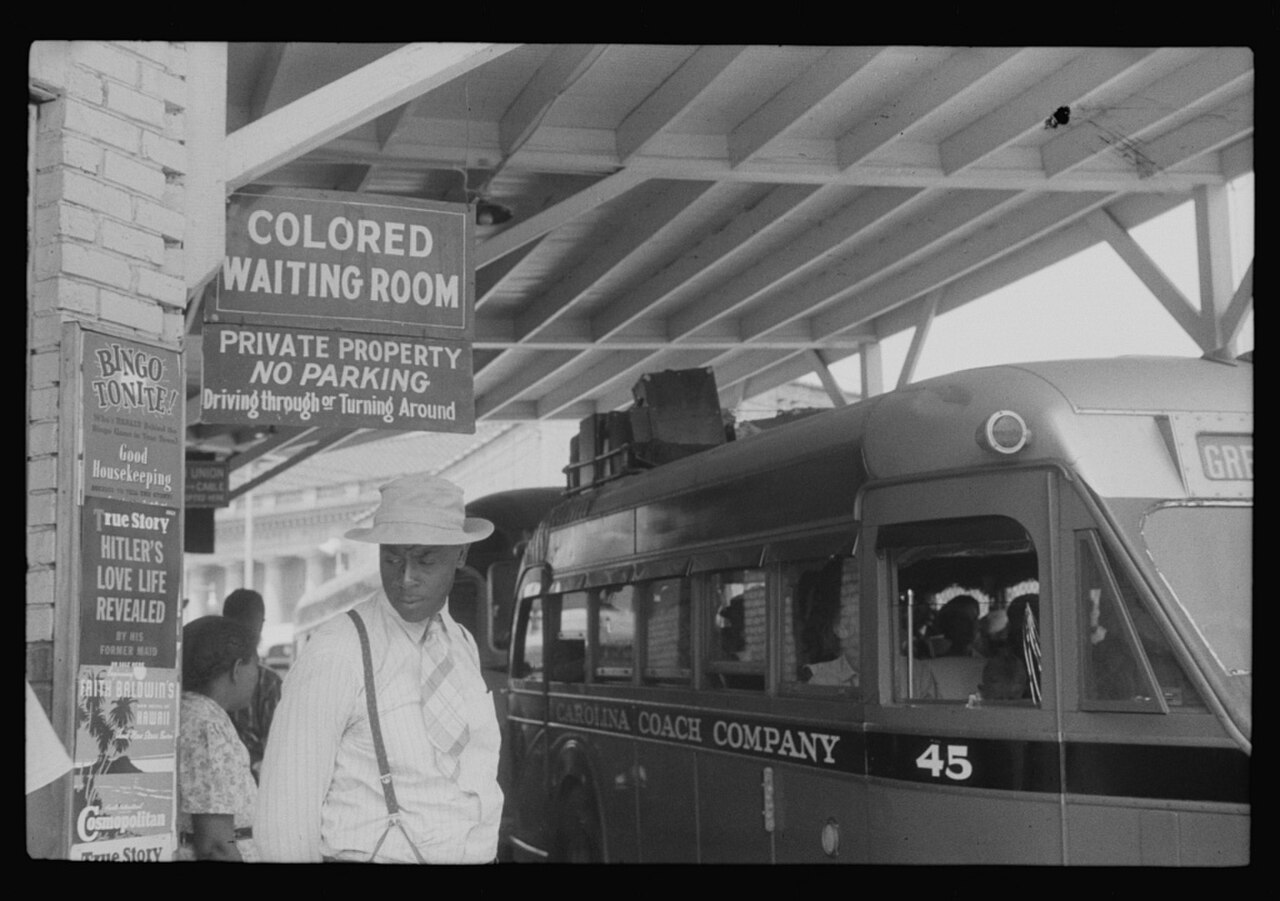
A 'Colored Waiting Room' sign at the bus station in Durham, North Carolina, May 1940. Photograph by Jack Delano for the Farm Security Administration, Library of Congress (fsa.8a33837). Public domain (U.S. government work). It shows the segregation that Soviet officials pointed to in the stock retort.
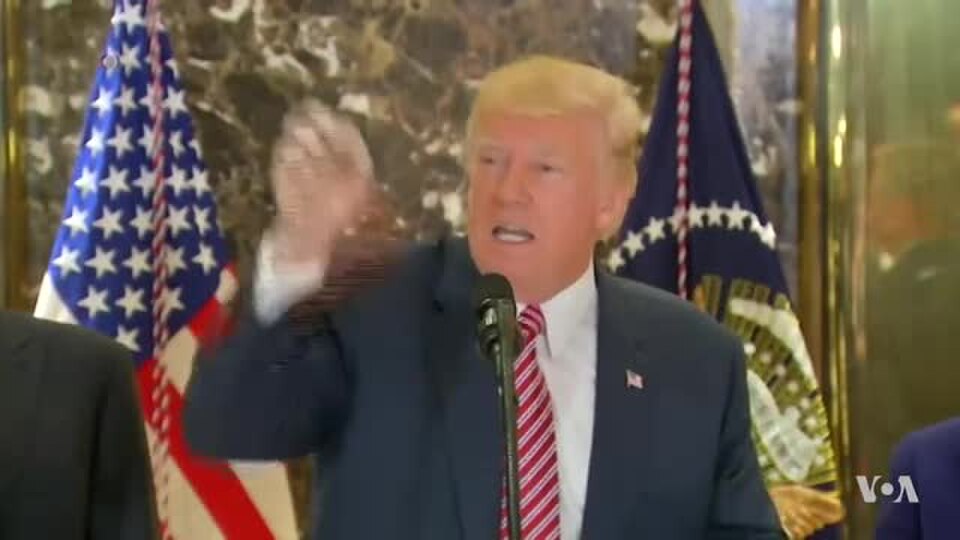
President Trump answering questions at the 15 August 2017 news conference at Trump Tower, New York, in a still from a Voice of America report. The moment within the news conference is not identified. Public domain (Voice of America, U.S. government work).
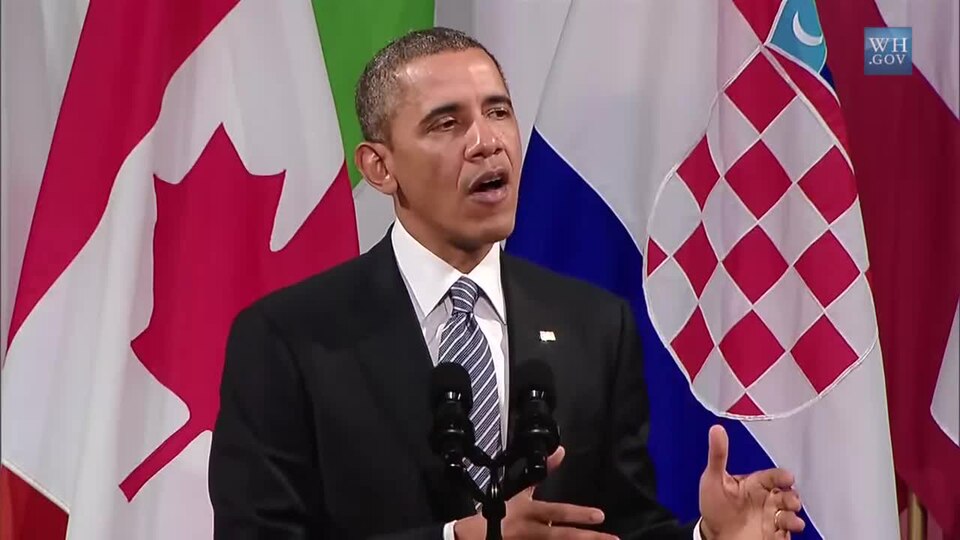
President Barack Obama speaking at the Palais des Beaux-Arts in Brussels on 26 March 2014, the speech that replied to the Russian comparisons with Kosovo and Iraq described above. Still from a White House video; the moment within the speech is not identified. Public domain (U.S. government work).
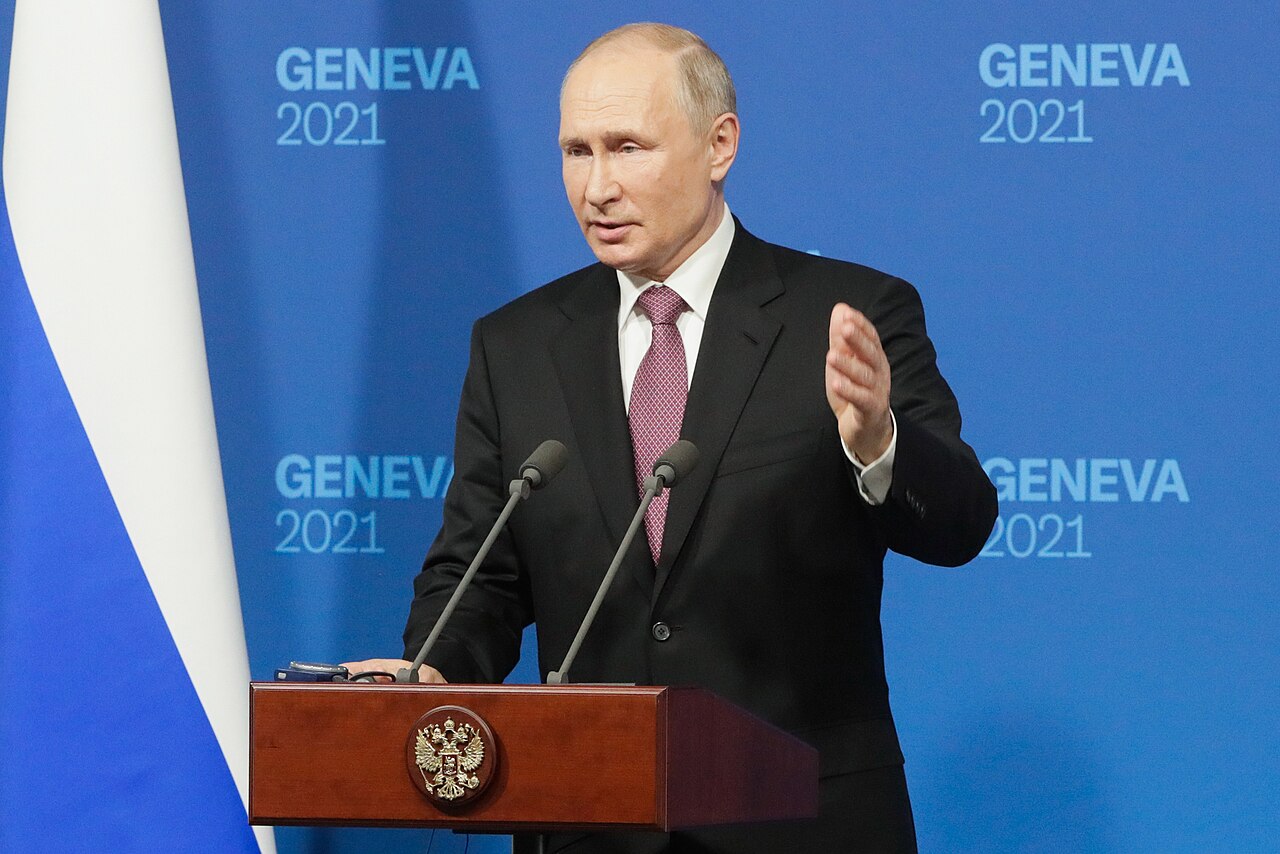
President Putin at the news conference after his meeting with President Biden in Geneva, 16 June 2021, where he was asked about jailed and murdered Kremlin critics. Presidential Executive Office of Russia (kremlin.ru), CC BY 4.0.
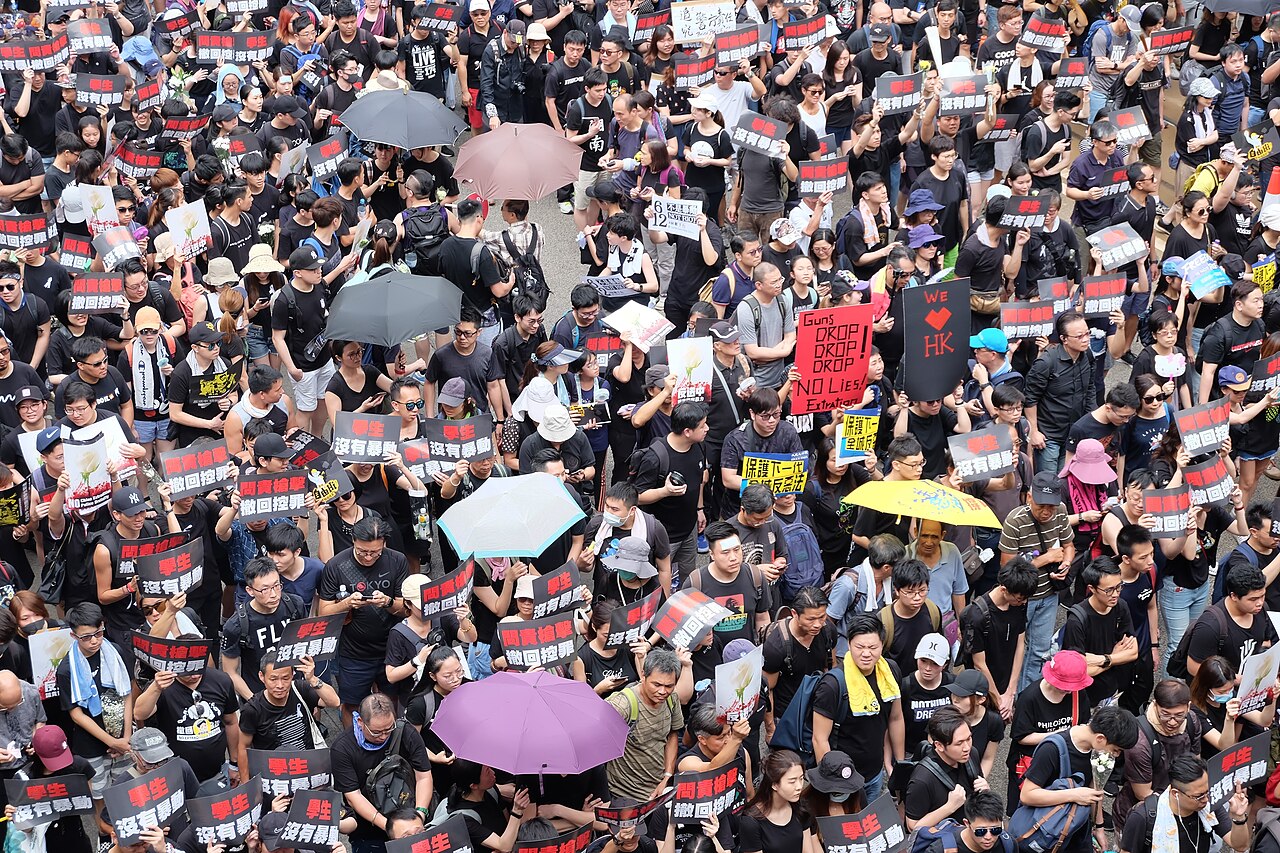
Marchers in Hong Kong on 16 June 2019 during protests against the extradition bill, a year before the 2020 exchange described above. It shows the protests, not the exchange. Voice of America. Public domain (U.S. government work).
Sources
- PBS NewsHour / AP, 5 February 2017: "Asked about Putin, Trump says U.S. isn't 'so innocent'"; CNN, 4 February 2017.
- The Hill, 5 February 2017: "McConnell breaks with Trump on Putin".
- TIME, 15 August 2017: "President Trump Again Blames 'Both Sides' for Charlottesville Violence".
- RFE/RL, 17 June 2021: "Putin's Performance At Geneva Summit Seen As A Master Class In 'Whataboutism'"; ABC7 / ABC News, 16 June 2021.
- CBS News, 31 May 2020: "China uses U.S. protests to cry hypocrisy amid Hong Kong standoff"; Hong Kong Free Press, 31 May 2020.
- Citations Needed, episode 66: "Whataboutism: The Media's Favorite Rhetorical Shield Against Criticism of US Policy".
- Britannica, "Whataboutism" (Soviet usage; Russian comparisons with Kosovo and Iraq after Crimea; Obama's Brussels speech).
- Chow and Levin, "The Diplomacy of Whataboutism and US Foreign Policy Attitudes", International Organization (2024).
- Newsweek, 29 February 2024: "Hunter Biden Turns Tables on GOP with Jared Kushner Counter".
- TIME, 2024: "Biden Allies Cite Kushner in Discrediting Impeachment Push".
- Wire-service report on Representative Robert Garcia's House-floor remarks, via WFLA and ABC27 (also linked from Rep. Garcia's own site, robertgarcia.house.gov).
Sourcing note (27 September 2026): the build environment could not open these pages directly; the quotations were checked against search-engine indexes of the linked reports, which agree across outlets. The exception is the TIME, RFE/RL and ABC7 reports, which were added on 28 September 2026 and read directly. The Hunter Biden / Jared Kushner case (29 September 2026) was checked the same way, against Newsweek, TIME, The New Republic and the WFLA/ABC27 wire report, which agree on the quotes; the underlying House transcript (oversight.house.gov) and Rep. Garcia's own site were not directly reachable.
Case studies
- Octavian, Antony and the Res Gestae: how Augustus wrote his own reign — Octavian, Antony and the Res Gestae: how Augustus wrote his own reign
- Abolitionist and pro-slavery print, 1787-1860 — Abolitionist and pro-slavery print, 1787-1860
- Xinjiang's 'vocational training centres': the government's messaging and its critics' — Xinjiang's 'vocational training centres': the government's messaging and its critics'
- Germany answers back: the Manifesto of the 93 and the Lusitania medal (1914-1916) — Germany answers back: the Manifesto of the 93 and the Lusitania medal (1914-1916)
- The 1990-91 Gulf crisis: Iraq's 'guests' and 'linkage', and Washington's Hitler analogy — The 1990-91 Gulf crisis: Iraq's 'guests' and 'linkage', and Washington's Hitler analogy
- Fascist Italy's propaganda machine: from the Duce's Press Office to the Ministry of Popular Culture — Fascist Italy's propaganda machine: from the Duce's Press Office to the Ministry of Popular Culture
Then and now
- Then and now: "and what about you?" (Soviet Union, Cold War; US, China and Russia, 2017–21) — "And what about you?": the Soviet lynching retort and US, Chinese and Russian examples, 2017–21
Images
| Image | Source | Licence |
|---|---|---|
| Durham bus station sign, 1940 (reused from Then and now: "and what about you?" (Soviet Union, Cold War; US, China and Russia, 2017–21)) | Wikimedia Commons / LOC fsa.8a33837 | Public domain (U.S. government work) |
| Trump Tower news conference, 2017 (reused) | Wikimedia Commons (Voice of America) | Public domain (Voice of America) |
| Obama in Brussels, 2014 | Wikimedia Commons (The White House) | Public domain (U.S. government work) |
| Putin in Geneva, 2021 (reused) | Wikimedia Commons (kremlin.ru) | CC BY 4.0 (kremlin.ru) |
| Hong Kong protest, 2019 (reused) | Wikimedia Commons (Voice of America) | Public domain (Voice of America) |