Content note: Soviet state-agency statement on a civilian airliner shot down with 269 people aboard; the text calls the flight a 'pre-planned act' and omits its destruction. This object is shown as it was published. Why
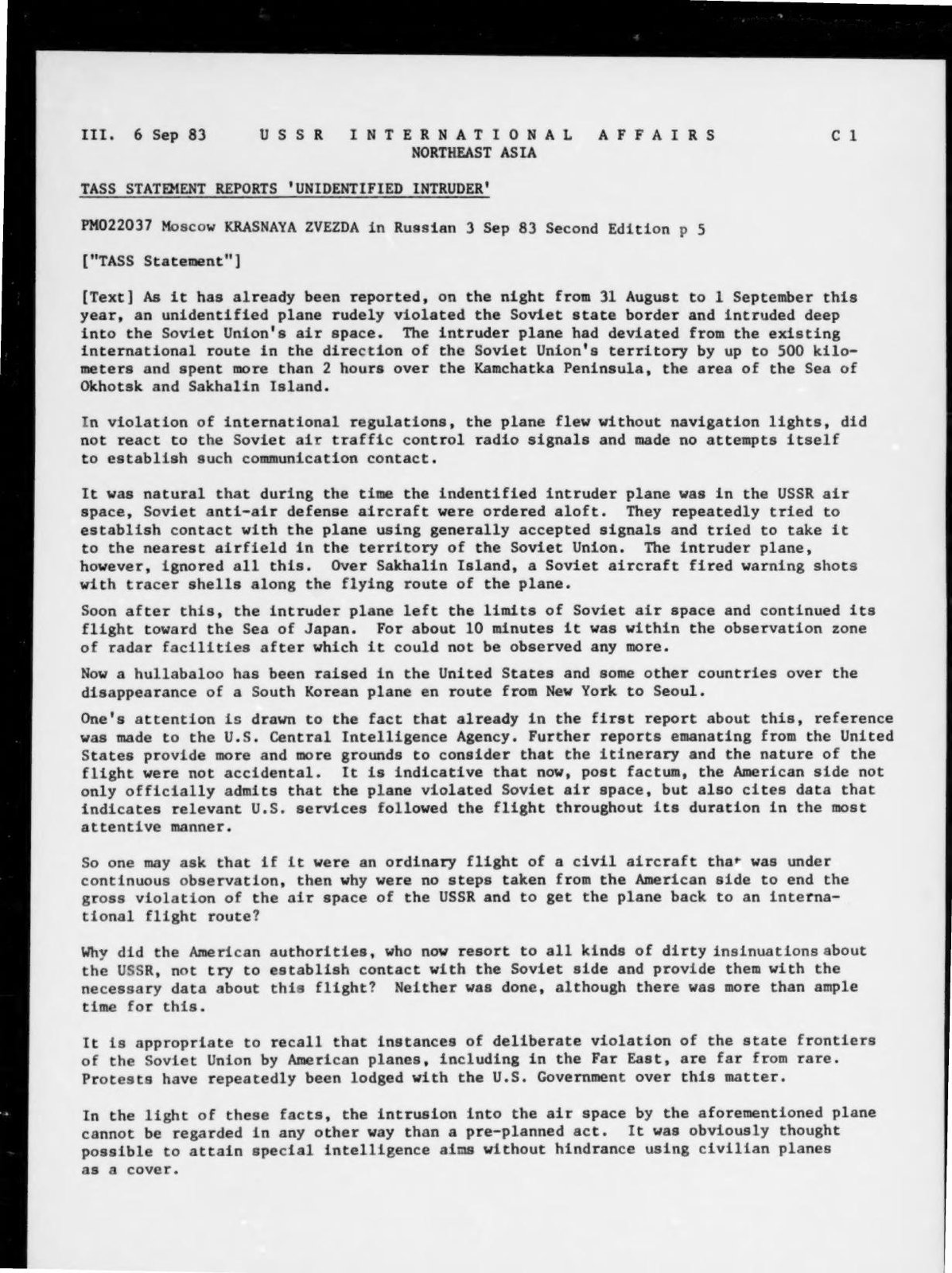
TASS statement on the 'unidentified intruder' (Korean Air Lines Flight 007), FBIS Daily Report, 6 September 1983
FBIS Daily Report page translating the TASS statement printed in Krasnaya Zvezda on 3 September 1983, two days after Soviet interceptors shot down Korean Air Lines Flight 007 (269 killed). It speaks of an 'unidentified plane' and 'warning shots', says the plane left Soviet airspace, and omits its destruction, then cites past U.S. overflights and calls the flight 'a pre-planned act'.
- Date
- September 6, 1983
- Period
- Cold War
- Made by
- TASS (Soviet state news agency), statement printed in Krasnaya Zvezda (USSR Ministry of Defense newspaper); FBIS (U.S.) translation
- Country
- Soviet Union
- Medium
- Broadcast
- Issuer type
- State
- Regime
- Soviet Union
- Leader
- Yuri Andropov
- Audience
- Mixed
- Purpose
- Deceive or deny
- Techniques
- Card stackingWhataboutism
- Source
- Identified Openly sourced: the speaker is who they say they are
- Source
- Internet Archive (US FBIS collection, scan of CIA/FBIS microfiche), retrieved October 2, 2026
- Rights
- Public domain (U.S. government work)
U.S. government work (CIA Foreign Broadcast Information Service, Daily Report). Internet Archive item micro_IA1176914_0312: collection 'US FBIS' describes 'United States government documents published by FBIS'; no restrictive terms stated.
Text on the object
III. 6 Sep 83 USSR INTERNATIONAL AFFAIRS NORTHEAST ASIA C 1
TASS STATEMENT REPORTS 'UNIDENTIFIED INTRUDER'
PM022037 Moscow KRASNAYA ZVEZDA in Russian 3 Sep 83 Second Edition p 5
["TASS Statement"]
[Text] As it has already been reported, on the night from 31 August to 1 September this year, an unidentified plane rudely violated the Soviet state border and intruded deep into the Soviet Union's air space. The intruder plane had deviated from the existing international route in the direction of the Soviet Union's territory by up to 500 kilometers and spent more than 2 hours over the Kamchatka Peninsula, the area of the Sea of Okhotsk and Sakhalin Island.
In violation of international regulations, the plane flew without navigation lights, did not react to the Soviet air traffic control radio signals and made no attempts itself to establish such communication contact.
It was natural that during the time the indentified intruder plane was in the USSR air space, Soviet anti-air defense aircraft were ordered aloft. They repeatedly tried to establish contact with the plane using generally accepted signals and tried to take it to the nearest airfield in the territory of the Soviet Union. The intruder plane, however, ignored all this. Over Sakhalin Island, a Soviet aircraft fired warning shots with tracer shells along the flying route of the plane.
Soon after this, the intruder plane left the limits of Soviet air space and continued its flight toward the Sea of Japan. For about 10 minutes it was within the observation zone of radar facilities after which it could not be observed any more.
Now a hullabaloo has been raised in the United States and some other countries over the disappearance of a South Korean plane en route from New York to Seoul.
One's attention is drawn to the fact that already in the first report about this, reference was made to the U.S. Central Intelligence Agency. Further reports emanating from the United States provide more and more grounds to consider that the itinerary and the nature of the flight were not accidental. It is indicative that now, post factum, the American side not only officially admits that the plane violated Soviet air space, but also cites data that indicates relevant U.S. services followed the flight throughout its duration in the most attentive manner.
So one may ask that if it were an ordinary flight of a civil aircraft that was under continuous observation, then why were no steps taken from the American side to end the gross violation of the air space of the USSR and to get the plane back to an international flight route?
Why did the American authorities, who now resort to all kinds of dirty insinuations about the USSR, not try to establish contact with the Soviet side and provide them with the necessary data about this flight? Neither was done, although there was more than ample time for this.
It is appropriate to recall that instances of deliberate violation of the state frontiers of the Soviet Union by American planes, including in the Far East, are far from rare. Protests have repeatedly been lodged with the U.S. Government over this matter.
In the light of these facts, the intrusion into the air space by the aforementioned plane cannot be regarded in any other way than a pre-planned act. It was obviously thought possible to attain special intelligence aims without hindrance using civilian planes as a cover.
The page is FBIS's English translation of a Russian-language TASS statement as printed in Krasnaya Zvezda on 3 September 1983; the English above is that translation, not a FRAME translation. One letter is blotted in the scan ('tha[t]').Transcribed from the page image, typing errors of the FBIS typescript retained ('indentified'). The marked section heading and source line are FBIS's. One letter of 'that' is blotted on the scan and is read as 't'.