In one line: Grover Cleveland (Democratic), a former president, defeated the sitting president Benjamin Harrison (Republican) and the People's Party candidate James B. Weaver in a campaign whose surviving prints argue mostly about the tariff, with a third party printing its own platform and newspaper for the first time at national scale.
Context
Three tickets took the bulk of the votes. The Democrats nominated Grover Cleveland of New York for president and Adlai E. Stevenson of Illinois for vice president. The Republicans renominated President Benjamin Harrison of Indiana with Whitelaw Reid of New York. The People's Party (often called the Populists), nominated James B. Weaver of Iowa and James G. Field of Virginia; its Omaha convention adopted a preamble and platform on 4 July 1892 [3]. Cleveland won 277 electoral votes, Harrison 145 and Weaver 22, out of 444 [1]. In the popular vote Cleveland took 46.0 per cent, Harrison 43.0 per cent and Weaver 8.5 per cent [2]. Weaver carried Colorado, Idaho, Kansas and Nevada and won single electors in North Dakota and Oregon [1].
The Prohibition Party also ran a ticket. No Prohibition campaign print of 1892 was found in the collections searched for this page (see "Gaps" below).
The objects below come from one set of searches of the Library of Congress digital collections, so they show what happened to be digitised, not a measured sample of what each campaign printed. The Democratic side has fewer hostable objects than the other two; the page says so rather than padding it.
Campaign literature
Grover Cleveland and Adlai E. Stevenson (Democratic)
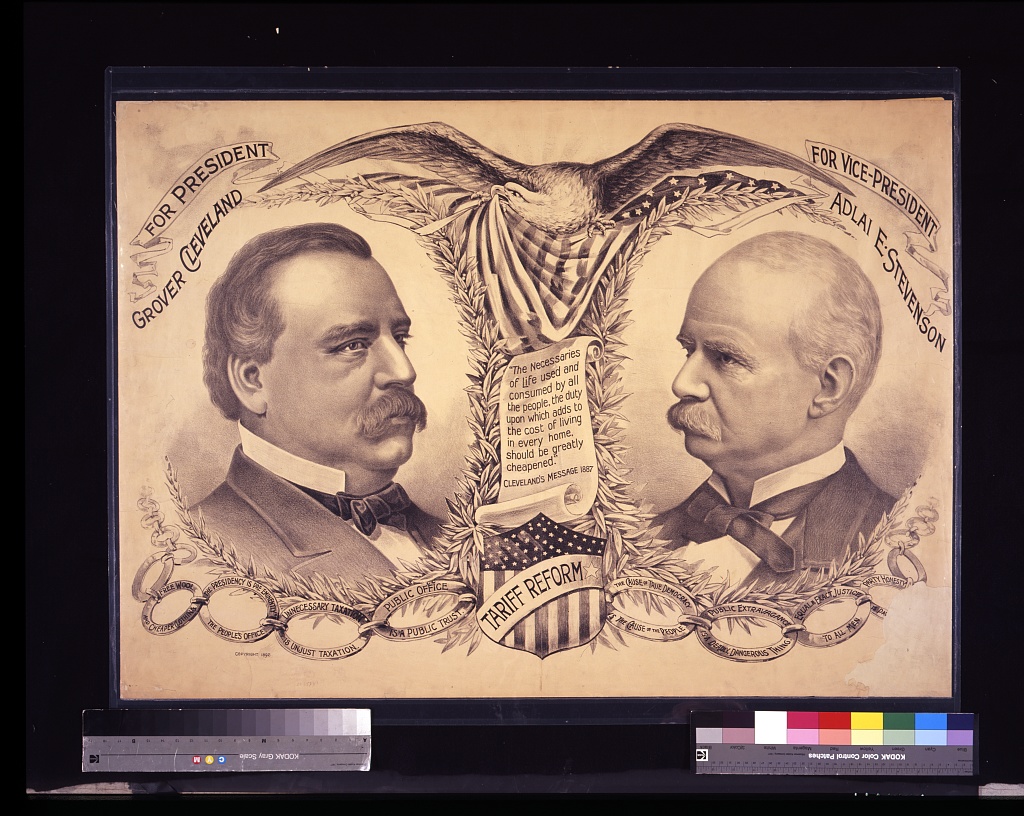
For President Grover Cleveland, for Vice-President Adlai E. Stevenson. Publisher not named, 1892. Public domain by age; Library of Congress [3]. The poster pairs the two portraits with a quotation from "Cleveland's Message 1887" on lowering the cost of necessaries, a shield lettered "Tariff Reform" and a chain of phrases including "Public office is a public trust". The abstract slogans are Glittering generalities, and the eagle, flag and laurel are Transfer of national symbols onto the ticket.
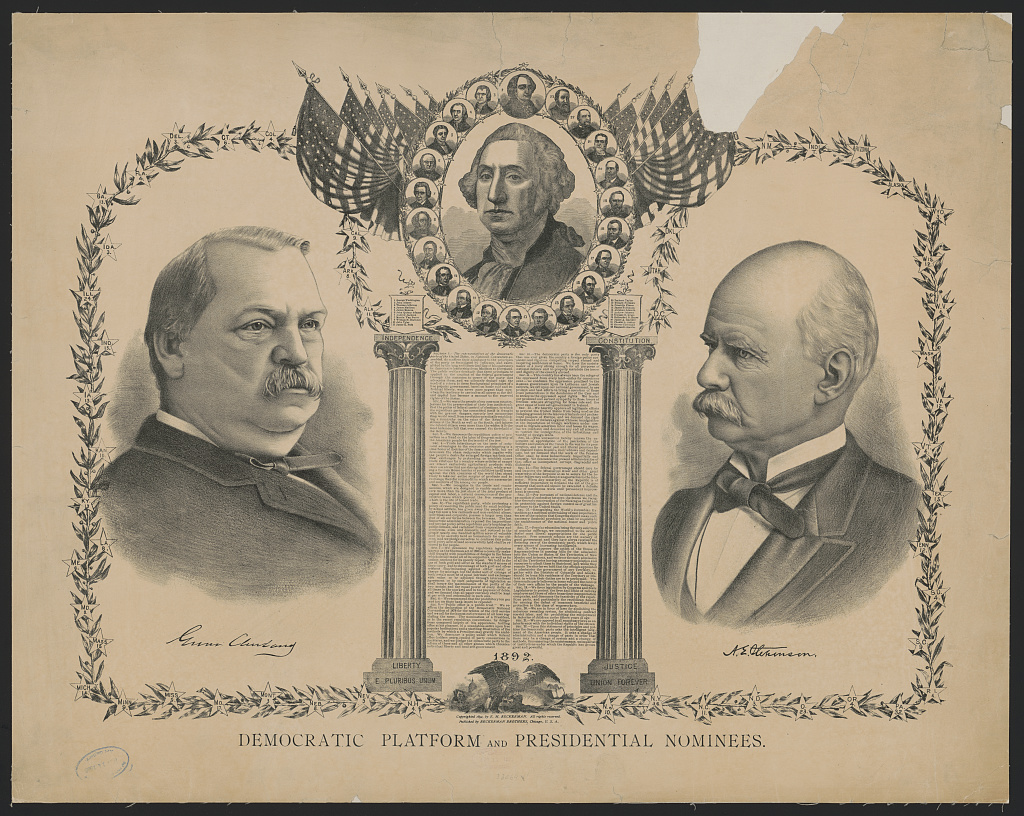
Democratic platform and presidential nominees, Grover Cleveland, A. E. Stevenson. Beckerman Brothers, Chicago, 1892. Public domain by age; Library of Congress [3]. The platform text sits between pillars marked "Independence" and "Constitution", under a central portrait of Washington ringed by later presidents. Placing the nominees beneath the founders is Transfer, and the mottoes "Liberty", "Justice" and "Union Forever" are Glittering generalities.
No further Democratic-issued print was found with a downloadable image. The Library of Congress catalogues an 1892 Cleveland-Stevenson campaign advertisement card and an 1892 campaign dinner plate, but no usable image could be retrieved for them (the card's record lists no image file), so they are cited and not hosted [3]. The Democratic National Committee's 1892 campaign text book is digitised at the Internet Archive but is text pages, not graphics [5].
Benjamin Harrison and Whitelaw Reid (Republican)
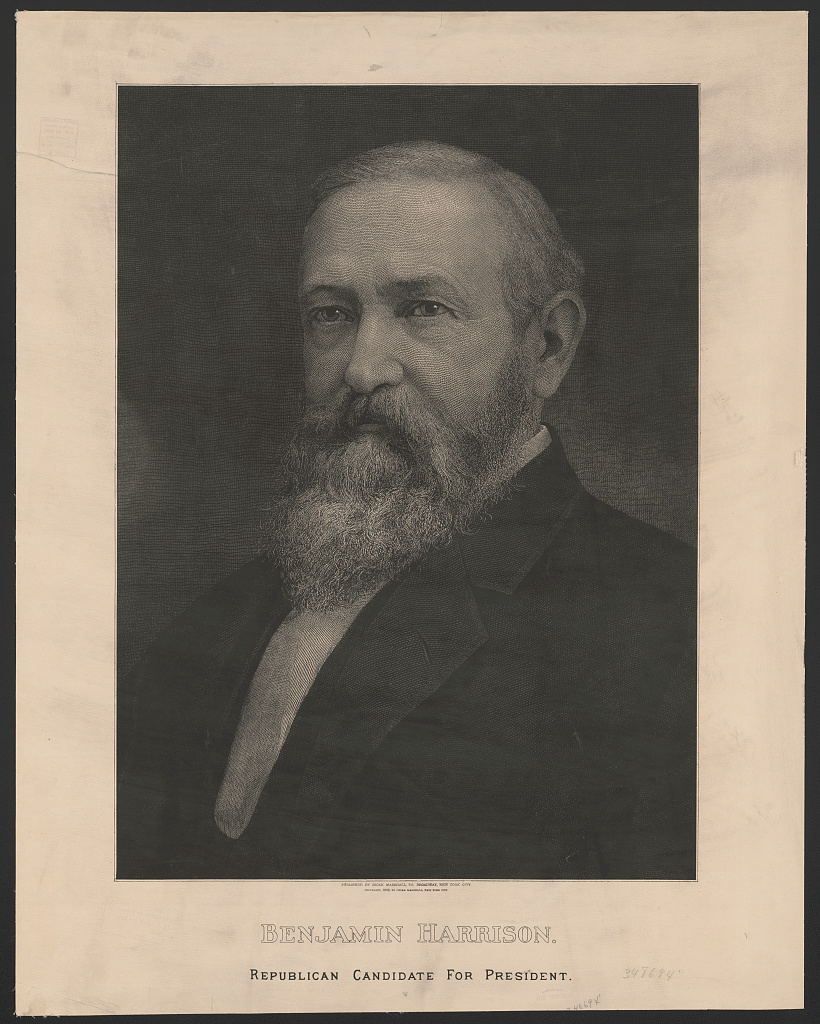
Benjamin Harrison, Republican candidate for president. Oscar Marshall, New York, 1892. Public domain by age; Library of Congress [3]. A formal engraved portrait with the office printed beneath it and no slogan. The one technique present is Transfer: the sober portrait format carries the authority of the presidency onto the candidate.
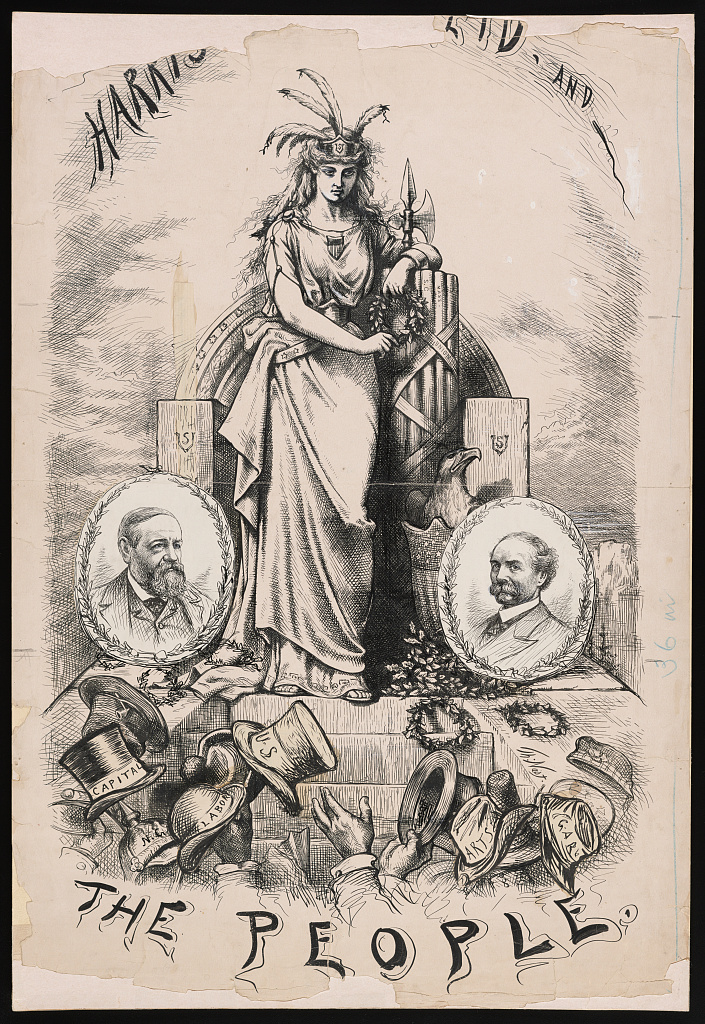
Harrison and Reid, and the people. Thomas Nast, Nast's Weekly, 15 October 1892. Public domain by age; Library of Congress [3]. Columbia holds a wreath between the two medallions while hats lettered "Capital", "Labor" and "G.A.R." are raised towards her. It is Transfer (the national figure, fasces and eagle) and Bandwagon (every interest cheering the ticket). The Library of Congress record states that Nast endorsed the Republican ticket in 1892 and that the committee guaranteed his weekly a circulation of 100,000 [3].
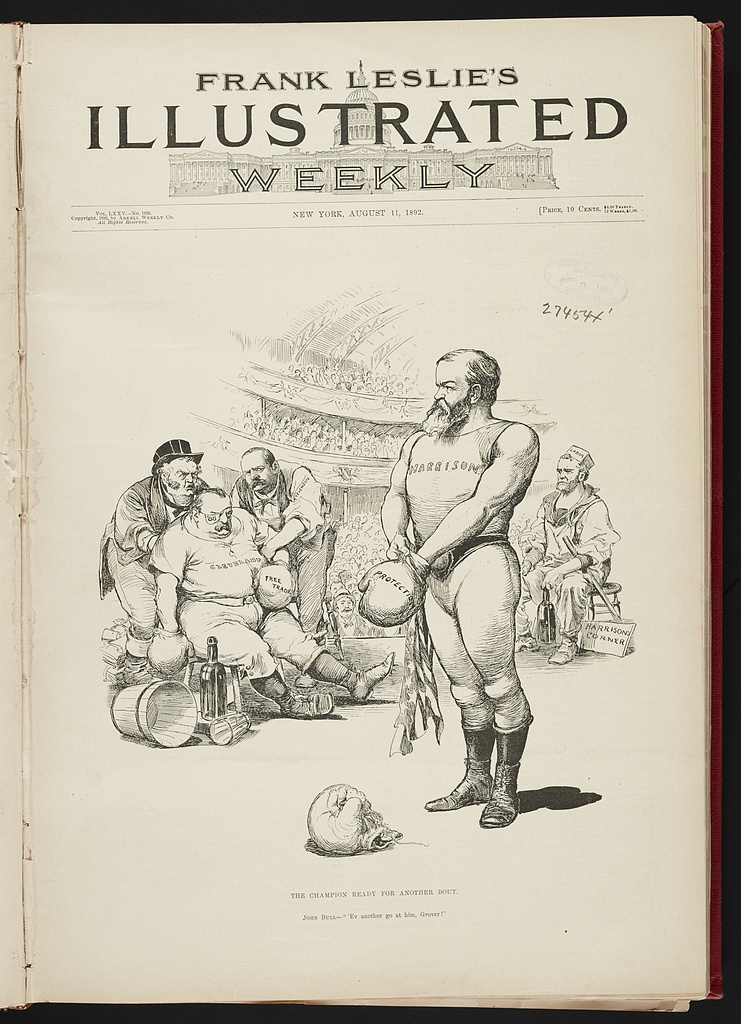
The champion ready for another bout. Frank Leslie's Illustrated Newspaper, 11 August 1892. Public domain by age; Library of Congress [3]. Harrison pulls on a glove labelled "Protection" with "Labor" in his corner, while Cleveland, in a "Free Trade" glove, is coached by Stevenson and by John Bull, who calls "'Ev another go at him, Grover!" The cover reduces the contest to a single tariff question (Card stacking) and attaches a foreign figure to one side (Transfer of stigma).
Unattributed tariff print
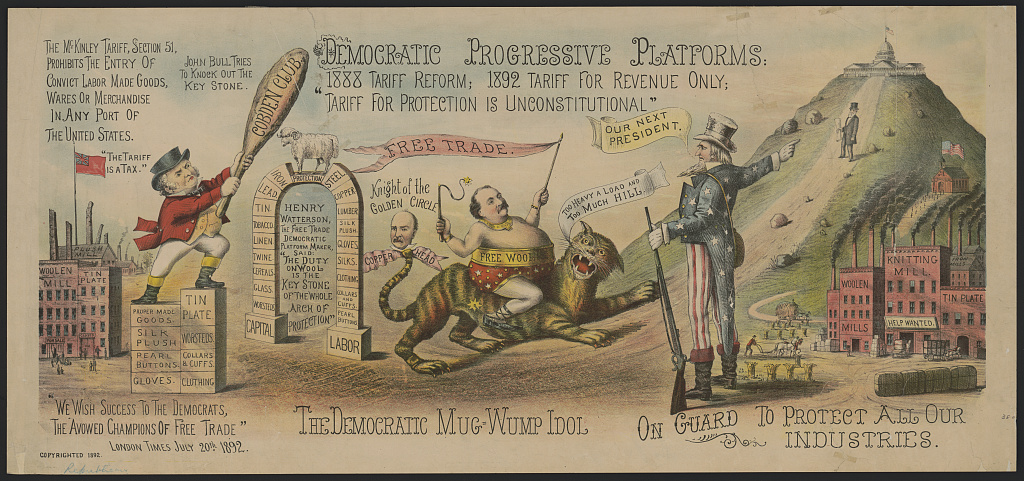
Democratic progressive platforms: 1888 tariff reform; 1892 tariff for revenue only; "tariff for protection is unconstitutional". Publisher not named, copyright 1892. Public domain by age; Library of Congress [3]. This print argues for protective tariffs and against the Democratic platform, quoting the London Times of 20 July 1892 ("We wish success to the Democrats, the avowed champions of free trade") and showing John Bull swinging a "Cobden Club" club at the tariff "key-stone". Its label "The Democratic Mug-wump Idol" is Name-calling, the British figures are Transfer of stigma, and the quotation is selected to support one reading (Card stacking). No issuer is named in the catalogue record, so it is not assigned to a party committee here. An earlier catalogue entry in this archive had filed it as Democratic material; the sheet's content is the reverse.
James B. Weaver and James G. Field (People's Party)
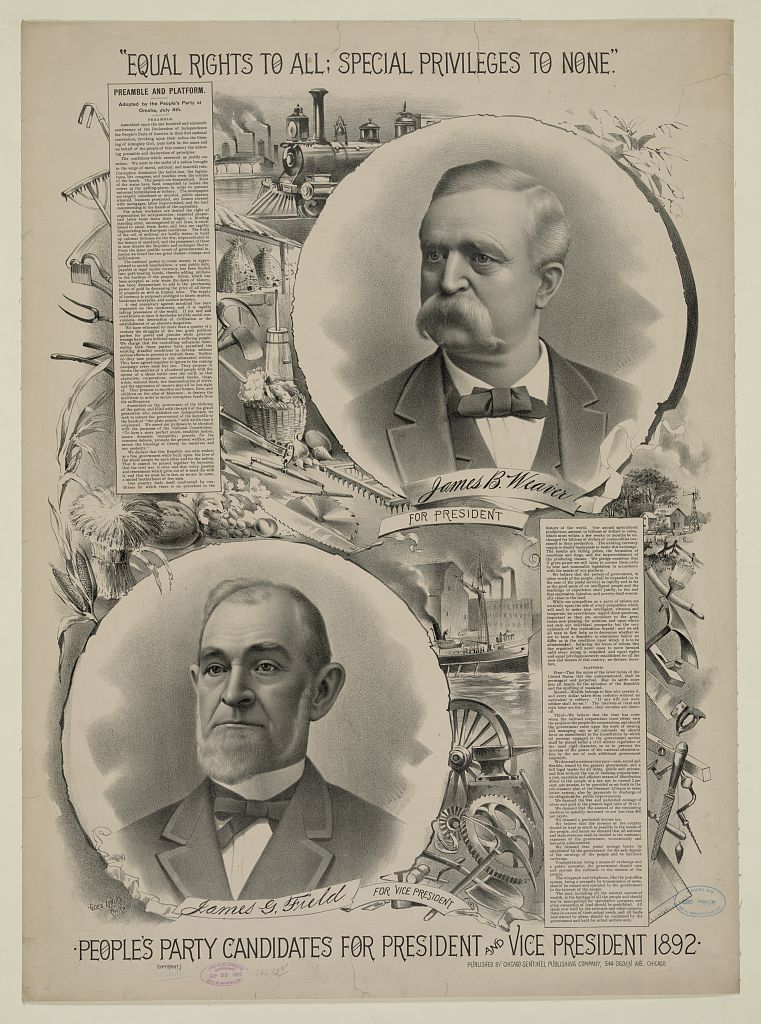
People's party candidates for president and vice president 1892. Chicago-Sentinel Publishing Company, Chicago, 1892. Public domain by age; Library of Congress [3]. Under the motto "Equal rights to all; special privileges to none" the sheet prints the Omaha preamble and platform around the two portraits, with farm tools, produce, a locomotive, a steamship and machinery. The motto is Glittering generalities; the farm and workshop imagery is Plain folks. It is the only People's Party ticket print found in the Library of Congress digital collections.
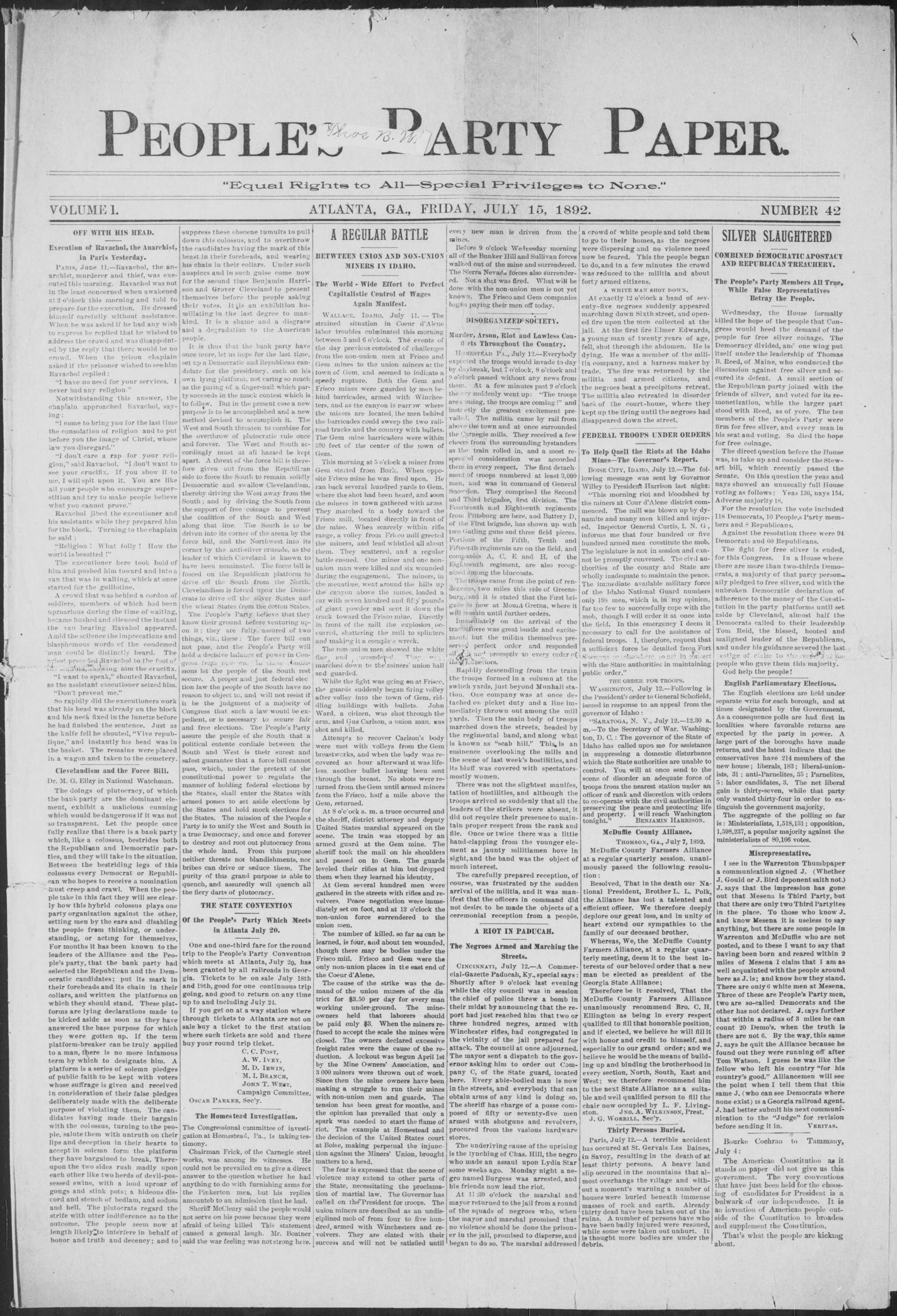
People's Party Paper (Atlanta, Ga.), 15 July 1892, page 1. People's Party Paper, Atlanta, 15 July 1892. Public domain by age; Library of Congress, Chronicling America [4]. The weekly's front page carries the headline "Silver Slaughtered: Combined Democratic Apostasy and Republican Treachery", news of troops sent to the Coeur d'Alene mining district, and a call to the Georgia state convention of 20 July. Naming both older parties as betrayers is Name-calling; the strike and troop reports are Fear appeal. The same page also carries a headline "A Riot in Paducah. The Negroes Armed and Marching the Streets", shown as printed.
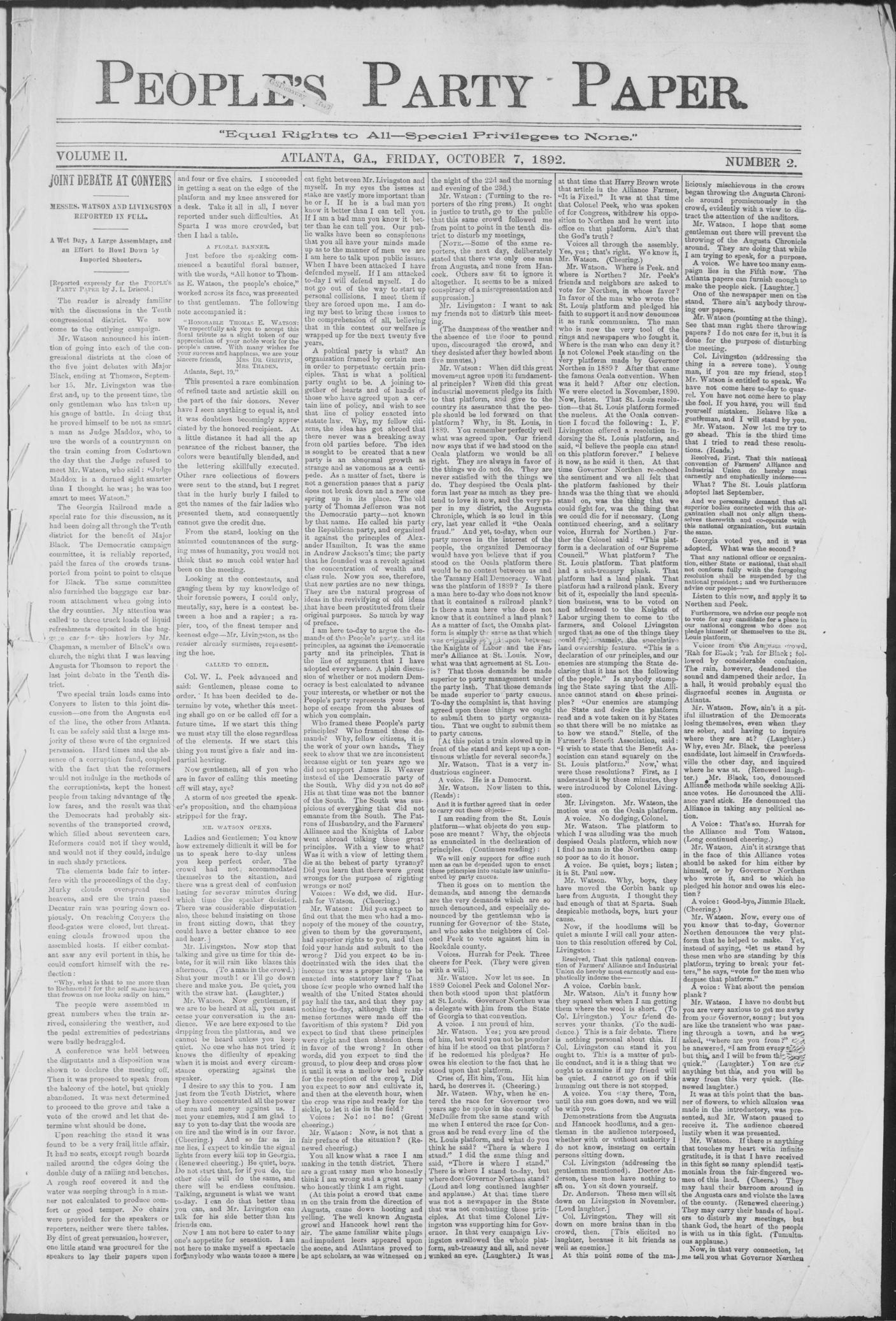
People's Party Paper (Atlanta, Ga.), 7 October 1892, page 1. People's Party Paper, Atlanta, 7 October 1892. Public domain by age; Library of Congress, Chronicling America [4]. The front page is given over to "Joint Debate at Conyers", an account of the debate between the People's Party congressional candidate Thomas E. Watson and Colonel L. F. Livingston, "reported in full". A party organ giving its own account of its own candidate at length is Card stacking.
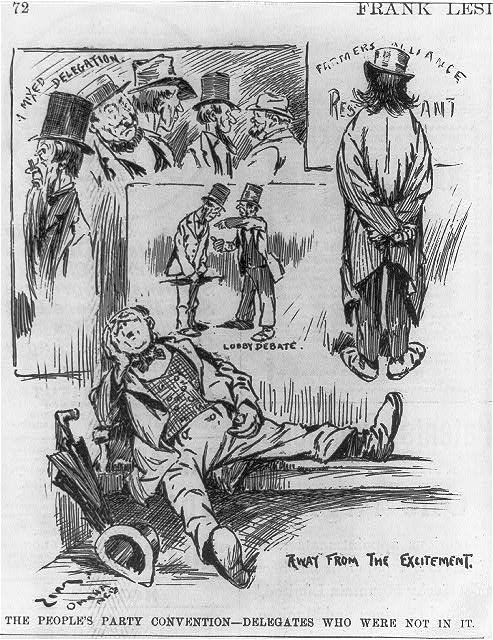
The People's Party Convention - delegates who were not in it. Frank Leslie's Illustrated Newspaper, 21 July 1892. Public domain by age; Library of Congress [3]. An outside, hostile view of the new party: delegates in a "Mixed Delegation", a "Lobby Debate", and a sprawled figure captioned "Away from the excitement". Ridiculing delegates by their appearance and dress is Name-calling. It is included beside the party's own prints so that the third party is shown both as it presented itself and as it was drawn by others.
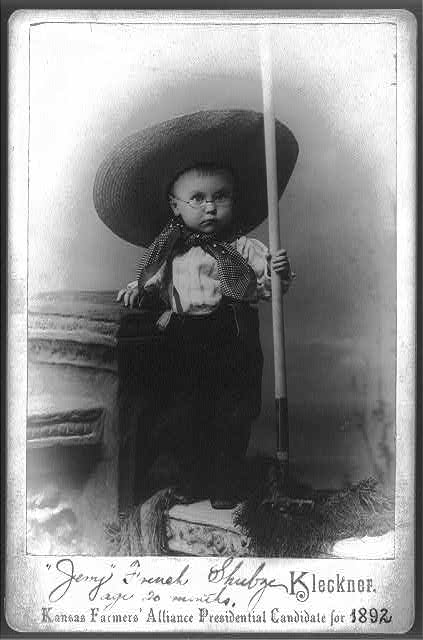
"Jimy" French Schulze, age 20 months, Kansas Farmers' Alliance presidential candidate for 1892. Photographer not named, 1892. Public domain by age; Library of Congress [3]. A humorous novelty portrait of "Jimy" French Schulze, age 20 months, labelled a Farmers' Alliance presidential candidate. It performs farm identity through costume and pitchfork (Plain folks) and nominates no one.
Gaps
- Prohibition Party (John Bidwell). No Prohibition campaign print, ribbon or songster for 1892 was found in the Library of Congress searches used for this page, so none is shown.
- Democratic side. Two hosted objects, against three for the Republicans and five for the People's Party. The LOC records for a Cleveland-Stevenson advertisement card and a campaign dinner plate yielded no hostable image [3].
- Resolution. Two People's Party items (the Leslie's drawing and the Schulze photograph) are available from the Library of Congress only as 640-pixel-tall derivatives.
- Not hosted: the Democratic and Republican 1892 campaign text books, digitised at the Internet Archive as text pages [5].
Techniques visible
Both older parties used Transfer (flags, eagles, the founders, Columbia) and Glittering generalities (liberty, justice, "tariff reform", "protection"), and the tariff dominates their prints: it is the explicit subject of the Cleveland poster, the Leslie's cover and the unattributed protection print. The tariff prints on the protection side use Name-calling and foreign-figure Transfer (John Bull) against free trade; the Democratic poster argues through quotation and slogan. The People's Party material uses Plain folks imagery and the Omaha motto, and its newspaper uses Name-calling against both older parties; the one hostile outside print of the party uses Name-calling by caricature. Scale differs: the two older parties' prints are more numerous in the collections searched, and the third party's surviving objects include a newspaper, which the others do not, so no conclusion about relative output is drawn here.
Sources
- National Archives, "1892 Electoral College Results", https://www.archives.gov/electoral-college/1892
- The American Presidency Project, "Presidential Elections Data: 1892", https://www.presidency.ucsb.edu/statistics/elections/1892
- Library of Congress Prints and Photographs Division catalogue records: https://www.loc.gov/item/2002719958/ (Cleveland-Stevenson poster); https://www.loc.gov/item/2018695406/ (Democratic platform and nominees); https://www.loc.gov/item/2018697332/ (Harrison portrait); https://www.loc.gov/item/2009617074/ (Nast); https://www.loc.gov/item/93513569/ (Frank Leslie's cover); https://www.loc.gov/item/2018695403/ (tariff print); https://www.loc.gov/item/2003688689/ (Weaver and Field); https://www.loc.gov/item/2004677367/ (convention caricature); https://www.loc.gov/item/2005686617/ (Schulze); https://www.loc.gov/item/2016652481/ (Cleveland-Stevenson card, no image); https://www.loc.gov/item/2021647120/ (dinner plate, no image)
- Library of Congress, Chronicling America, People's Party Paper (Atlanta, Ga.), 15 July and 7 October 1892, https://www.loc.gov/item/sn83016235/1892-07-15/ed-1/ and https://www.loc.gov/item/sn83016235/1892-10-07/ed-1/ (digitised by the Digital Library of Georgia)
- Internet Archive catalogue records, "The campaign text book of the Democratic party for the presidential election of 1892" (https://archive.org/details/cu31924011450263) and "The Republican campaign text-book for 1892" (https://archive.org/details/cu31924030484996)