
Card stacking: true facts, chosen to mislead
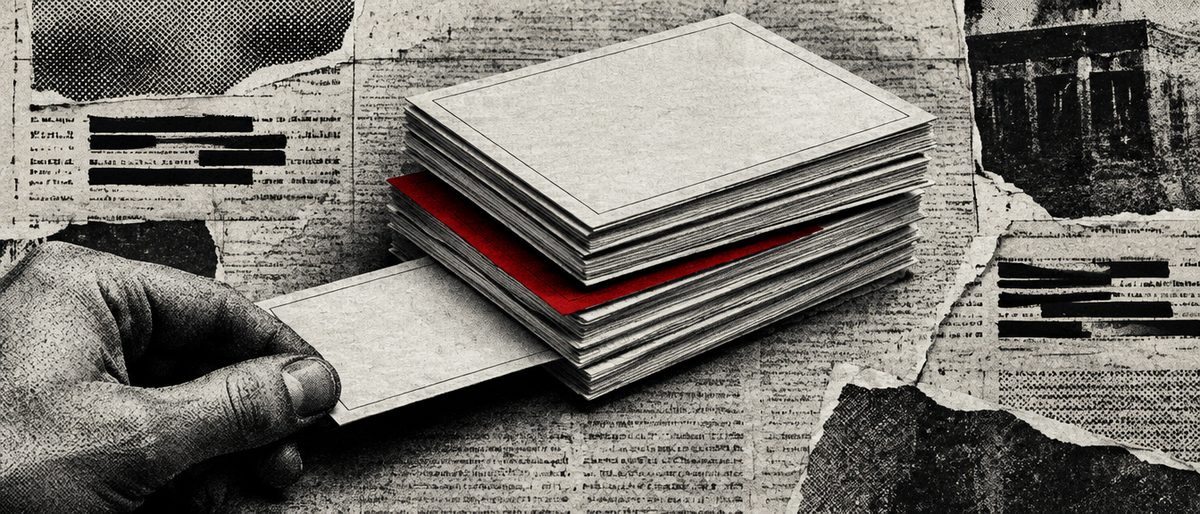
Illustration, not an archive object
By the end: Tell a one-sided selection presented as complete from an open case for one side, and check what is missing: the denominator, the counter-evidence and the dates. About 8 minutes.
What it is
Definition
Select, omit, or order facts so the remaining pile can only be read one way.
The tell
Missing denominator, missing counterexample, missing dates.
Not this
A short item that flags its own limits.
Card stacking works on the pile, not on the single card. Each fact can be accurate. The distortion lies in which facts were chosen, which were left out and the order they are laid down in.
It was one of the seven devices named by the Institute for Propaganda Analysis in 1937. The tell is a missing denominator, a missing counterexample or missing dates.
The look-alike that is not card stacking is a short item that flags its own limits.
Illustration, not an archive object How it works
The moving parts recur across eras.
- Selection. Favourable cases, studies or witnesses appear; unfavourable ones are dropped.
- Missing context. A count without its denominator, a change without its baseline, a figure without its date range. Darrell Huff (How to Lie with Statistics, 1954) catalogued the statistical forms.
- Ordering. A strong verified item placed first lends credibility to weaker ones after it.
- Choice of comparison. The categories are picked so that one side wins.
Two variants need institutional power. In suppression, unfavourable evidence is removed from public view. In the structural variant, no single author need intend it: many separate decisions about what is published or passed upward add up to a skewed record, as with unpublished drug trials.
Why it works on people
Readers judge from what is in front of them. Daniel Kahneman (2011) calls this "what you see is all there is": fast judgement builds the most coherent story from the evidence at hand and does not ask how much is missing.
- Vivid counts. Base-rate neglect (Kahneman and Tversky, 1973) explains why a striking number without a denominator persuades.
- No trigger. A reader who spot-checks finds each item true. Timothy Levine's truth-default theory (2014) notes that people assume honesty until something triggers suspicion.
- Agreement. For audiences already inclined to the conclusion, confirmation bias (reviewed by Raymond Nickerson, 1998) makes a one-sided pile feel like confirmation, not selection.
Same device, different stakes (1 of 3)
Three real objects from the archive. The technique is the same in each; the setting, the choice the audience had and what was at stake are not.
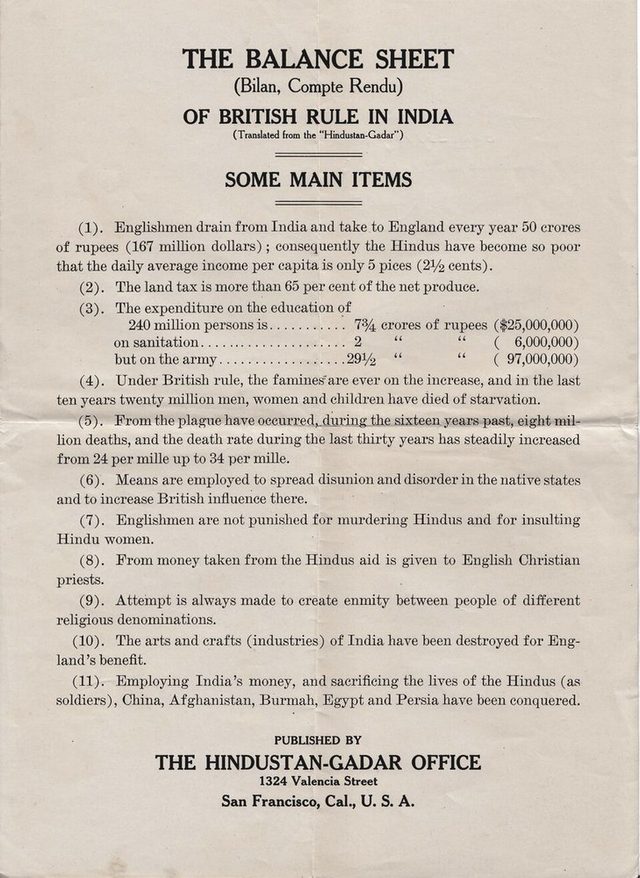
The Balance Sheet of British Rule in India (Hindustan-Gadar broadside) · 1917 · Hindustan-Gadar Office, San Francisco (Ghadar Party) · Full record Notice: A Ghadar Party broadside lays out eleven numbered charges against British rule in India in the form of a ledger. Every entry is a charge and none is a credit, so a selected list is presented as a complete audit. The figures are the publisher's own and are recorded, not verified. The sender is a movement founded by Punjabi emigrants to end British rule.
Same device, different stakes (2 of 3)
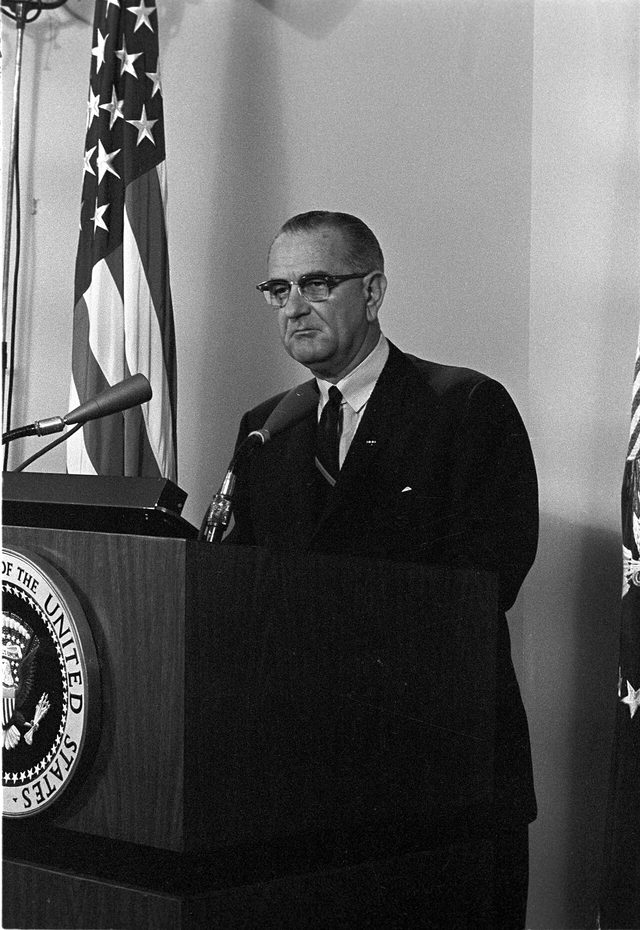
President Johnson's Gulf of Tonkin 'Midnight Address' · Aug 4, 1964 · U.S. government (President Lyndon B. Johnson) · Full record Notice: The photograph shows President Johnson giving his televised address of 4 August 1964 on a second attack on U.S. destroyers. The NSA's own historian later concluded that the attack did not take place and that signals intelligence was presented so as to deny decision makers the complete picture. The selection happened inside government, and the resolution that followed passed the Senate 88-2 and the House 416-0.
Same device, different stakes (3 of 3)
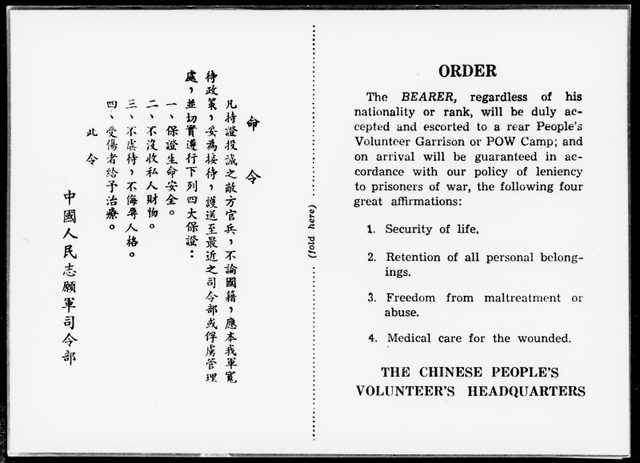
ORDER: safe-conduct pass of the Chinese People's Volunteers' Headquarters · 1951 · Headquarters of the Chinese People's Volunteers (PRC), Korean War · Full record Notice: A Chinese People's Volunteers surrender pass lists four affirmations to United Nations soldiers: security of life, belongings, freedom from maltreatment and medical care. Only the favourable terms are stated. The archive's tag is narrow: it covers what the pass leaves out, not how the terms were kept, and both sides in Korea issued safe-conduct passes. It is addressed to a United Nations soldier who might surrender.
Check yourself
A campaign advertisement shows only the strongest facts in favour of its candidate. It is signed by the campaign and everyone can see it is an advertisement. Is that card stacking?
Show the answer
No. It is open advocacy in a recognised genre. It would become card stacking if the one-sided selection were presented as neutral or complete, or if a material omitted fact would reverse the conclusion. Right. The test is materiality: would the omitted fact reverse or substantially weaken the conclusion, and does the sender pretend the pile is the whole?
Spot it in the archive
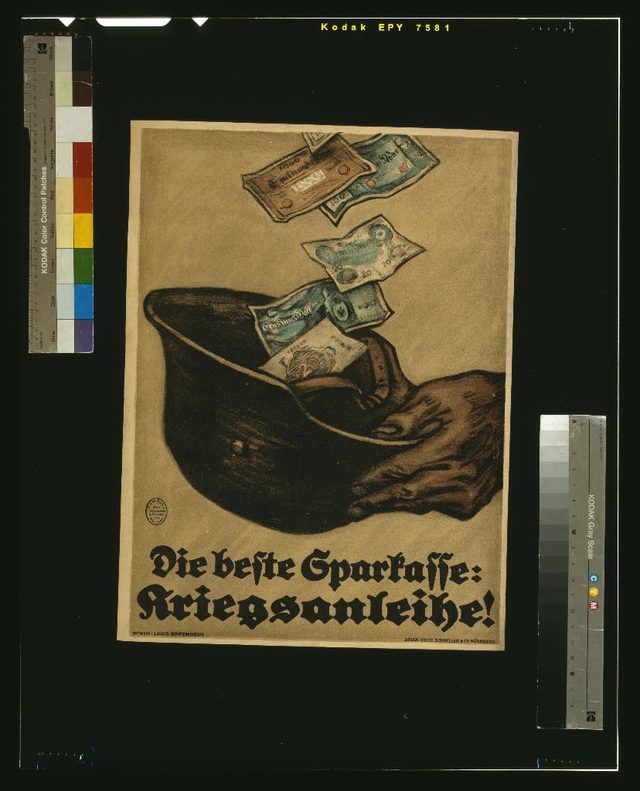
Die beste Sparkasse: Kriegsanleihe! (The Best Savings Bank: War Loan!) · 1917 · Imperial German war-loan campaign; artist Louis Oppenheim · Full record In 1917 a German war-loan poster shows a hand holding out a steel helmet as banknotes fall into it, under the line 'The best savings bank: war loan!' Which technique is doing the work?
The word 'best' comes with no rate, term or comparison, and nothing says that repayment depended on the outcome of the war and on the state's finances afterward. Notice what is missing: the risk. Only the reassurance remains, and the loan is presented as a savings account by label alone.
Show the answer
Card stacking The word 'best' comes with no rate, term or comparison, and nothing says that repayment depended on the outcome of the war and on the state's finances afterward. Notice what is missing: the risk. Only the reassurance remains, and the loan is presented as a savings account by label alone.
How to spot it, and what next
- What is the denominator: the population, period and rate the count belongs to?
- What is the strongest opposing evidence, and is it mentioned at all?
- Who chose the comparison, time window and baseline, and would another reasonable choice reverse the picture?
- Is the missing evidence merely absent here, or removed from view, and can the full set be checked?
Read the full page: Card stacking in the technique library · All 49 examples in the collection