Area: Emotion and fear · Evidence: mixed (How we rate the evidence). Classic experiments show people give more to one named victim than to a statistic, but a meta-analysis finds the average effect is small and depends heavily on how the appeal is built.
In brief
A single, named, pictured person in trouble tends to move people more than a large number of anonymous victims. Research has documented this, and the related finding that concern can fall as numbers rise. The effect is real in many studies, but smaller and less reliable than its fame suggests. Political messaging on every side builds appeals around one face for exactly this reason.
What the research shows
Karen Jenni and George Loewenstein set out to explain why people respond more strongly to identified victims than to statistical ones [1]. They tested several explanations, including vividness and certainty, and found the strongest was what they called the reference-group effect: a victim who is one of a small group at risk, where helping makes a large proportional difference, draws more concern than one lost in a vast number.
Tehila Kogut and Ilana Ritov asked whether identification works for groups as well as individuals [2]. Giving a single sick child a name and a photograph raised contributions compared with an unidentified child. Identifying a group of eight children, each with a name and photo, did not produce the same boost. The pull of identification seemed to depend on there being one person to focus on.
Deborah Small, George Loewenstein and Paul Slovic ran a set of donation experiments that became the most cited demonstration [3]. Participants who read about Rokia, a seven-year-old girl in Mali facing hunger, gave more than twice as much as those who read statistics about millions of people facing food shortages in southern Africa. Giving the statistics alongside Rokia's story reduced donations to her. Prompting people to think analytically before deciding also reduced giving to the identified child, while leaving giving to the statistical appeal about the same.
Slovic later drew these findings together under the term "psychic numbing": the tendency for feeling to fail to grow, and sometimes to shrink, as the number of victims rises [4]. He took his title from a line attributed to Mother Teresa: "If I look at the mass I will never act. If I look at the one, I will." He argued that this pattern helps explain weak public responses to genocide and mass atrocity.
The strongest real-world evidence came in 2015. On September 2, a photograph of the body of Aylan Kurdi, a small Syrian boy drowned off the Turkish coast, spread worldwide. Slovic and colleagues tracked what followed [5]. Web searches for terms such as "Syria" and "refugees" surged, and daily donations to a Swedish Red Cross fund for Syrian refugees jumped sharply in the days after the photo, far beyond the response to years of reported death tolls. Within weeks, both searches and donations had largely fallen back.
Has it held up?
Less cleanly than the textbook version suggests, which is why this page is rated mixed.
Seyoung Lee and Thomas Hugh Feeley pooled the experimental literature in a meta-analysis [6]. They found a real but small average identifiable victim effect, and considerable variation across studies. Whether identification increased giving depended on how the victim and the need were presented, and in some conditions the effect was absent. The lesson from the meta-analysis is that "one named victim always beats a statistic" is too strong; a single victim helps some appeals and not others.
The Aylan Kurdi study is observational: it tracks donations and searches over time rather than randomly assigning people to see the photo. It shows an unusually large and brief surge, but cannot separate the photo's effect from the news coverage and political events that surrounded it [5].
How it shows up in political messaging
- Wartime atrocity posters. British recruiting posters built on the 1914 invasion of Belgium, such as Remember Belgium — Enlist To-Day, compress a documented mass atrocity into one fleeing woman and child. The archive entry notes that the underlying events were real; the method is to let one figure stand for the whole and to make enlistment the single response (see Fear appeal).
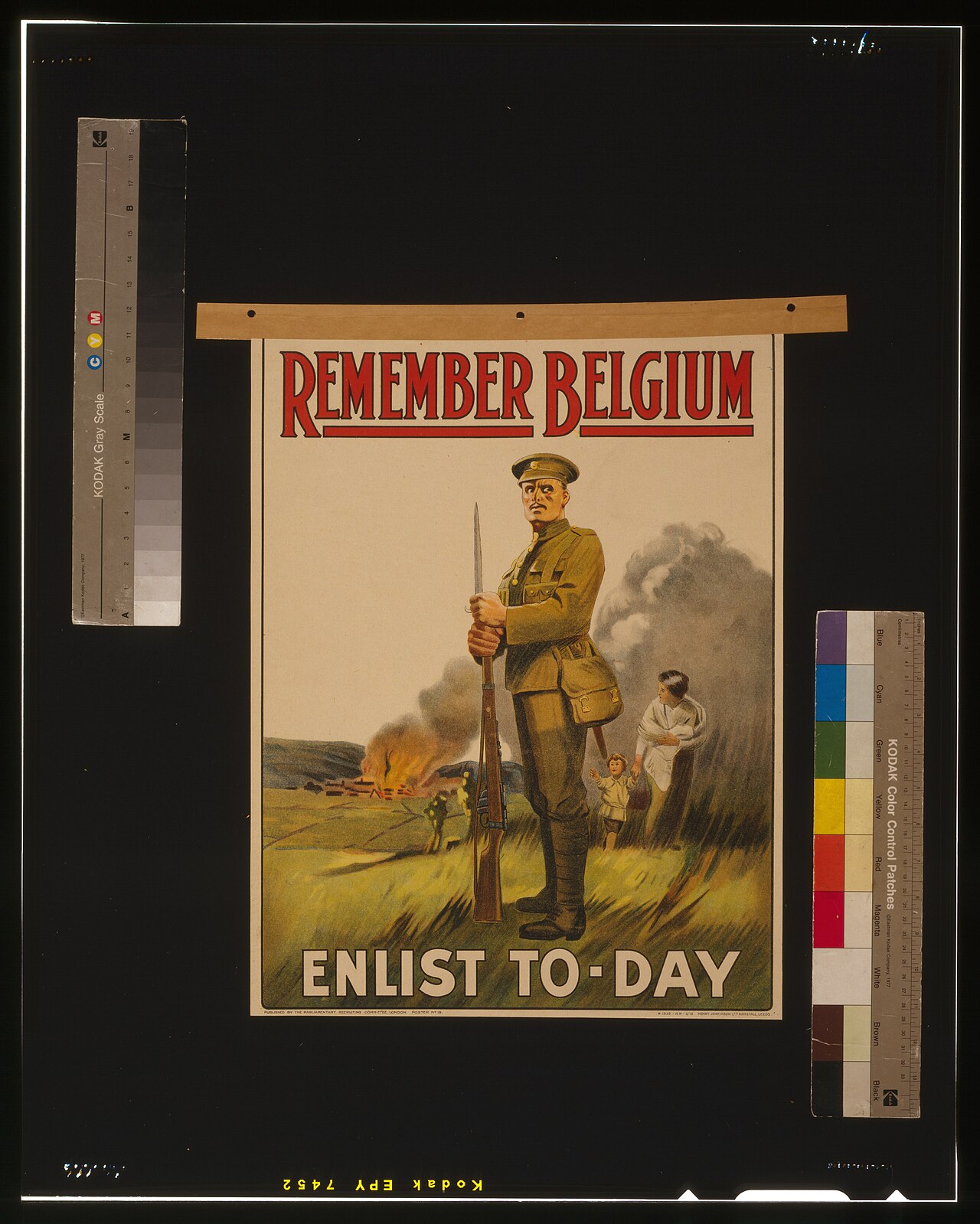
"Remember Belgium: Enlist To-Day," British recruiting poster, 1915. From the FRAME gallery: Remember Belgium — Enlist To-Day
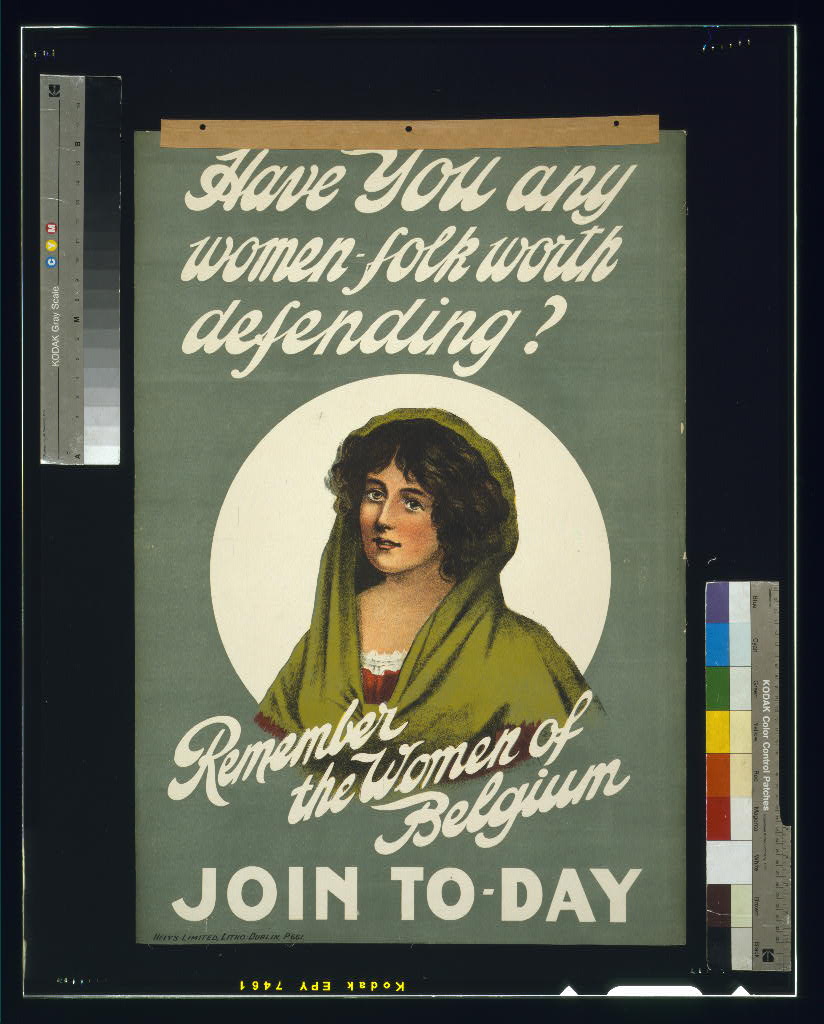
"Have You Any Women-Folk Worth Defending? Remember the Women of Belgium," British recruiting poster, 1915. From the FRAME gallery: Have You Any Women-Folk Worth Defending? Remember the Women of Belgium. Join To-Day
- Martyr cults. After Horst Wessel, a young Nazi stormtrooper, was shot by Communist opponents in Berlin in 1930, Joseph Goebbels built a martyr cult around him. A song Wessel had written became the Nazi Party anthem, and his individual death was used to stand for the movement's cause [7].
- The incubator testimony. On October 10, 1990, a 15-year-old identified only as "Nayirah" told members of the US Congressional Human Rights Caucus that she had seen Iraqi soldiers take babies from hospital incubators in occupied Kuwait. The account was widely repeated as the United States weighed war. It later emerged that she was the daughter of Kuwait's ambassador to the United States, that her appearance had been arranged with help from a public relations firm working for a Kuwaiti-funded group, and that later inquiries could not substantiate her account as she gave it [8]. The case is a textbook misuse of the Testimonial form: a single, sympathetic witness whose identity was concealed.
- A photograph and refugee policy. The Aylan Kurdi photograph became a reference point in the European debate over refugee admissions; the brief surge of attention and giving it produced is documented above [5].
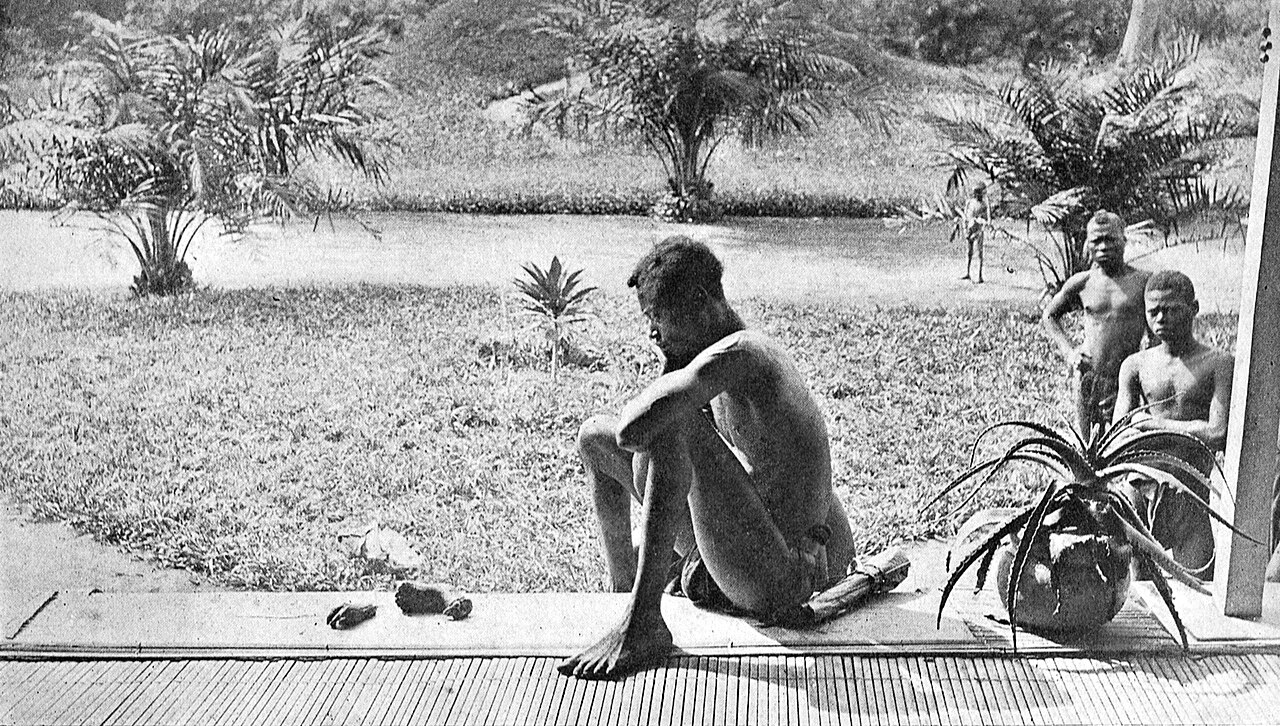
Nsala of Wala with the remains of his daughter, photographed by Alice Seeley Harris, May 1904, and circulated by the Congo Reform Association. From the FRAME gallery: Nsala of Wala, with his daughter's hand and foot (1904)
- Laws named for victims. US legislators of both parties name bills after individual victims. The Matthew Shepard and James Byrd Jr. Hate Crimes Prevention Act, passed by a Democratic-led Congress in 2009, was named for Matthew Shepard, a gay student, and James Byrd Jr., a Black man, both killed in 1998 in attacks the law treats as hate crimes [9]. The Laken Riley Act, the first bill signed in President Trump's second term in 2025, was named for a Georgia nursing student killed in 2024 by a man who had entered the country illegally [10]. In each case one person's story frames a debate about policies affecting many.
How to spot it
- One face, one name, one story carrying the whole argument.
- No figure for how many people are affected, or how the case compares with the typical one (a form of Card stacking).
- A witness or victim whose identity and account cannot be checked.
- A surge of attention that fades quickly once the image leaves the news.
- A useful question: would the policy being urged help this person, and what does it do for the many who are not pictured?
Persuasion or manipulation?
Telling one person's true story is often the most honest way to make a real problem visible; statistics alone can hide human stakes, and a single case can help readers grasp them. Honest use pairs the story with the scale: how many people, how typical this case is, and what the proposal would actually change. It becomes manipulation when the story is false or unverifiable, when the victim's identity or the teller's interest is concealed, or when one exceptional case is presented as the norm so that readers never ask about the rest.
Archive techniques that lean on this
- Fear appeal — Fear appeal: atrocity posters stage harm to one pictured victim so the prescribed response is accepted on reflex.
- Testimonial — Testimonial: a single sympathetic witness vouches, and the vouch is meant to end checking.
- Card stacking — Card stacking: a single case stands in for the denominator, so the missing numbers are never asked for.
Related topics
- Narrative transportation — Narrative transportation
- Affect heuristic — Affect heuristic
- Base-rate neglect — Base-rate neglect
- Moral outrage — Moral outrage
- Fear messaging — Fear messaging
Sources
- Jenni, K. E., & Loewenstein, G. (1997). Explaining "the identifiable victim effect." Journal of Risk and Uncertainty, 14(3), 235–257.
- Kogut, T., & Ritov, I. (2005). The "identified victim" effect: An identified group, or just a single individual? Journal of Behavioral Decision Making, 18(3), 157–167. https://doi.org/10.1002/bdm.492
- Small, D. A., Loewenstein, G., & Slovic, P. (2007). Sympathy and callousness: The impact of deliberative thought on donations to identifiable and statistical victims. Organizational Behavior and Human Decision Processes, 102(2), 143–153. https://doi.org/10.1016/j.obhdp.2006.01.005
- Slovic, P. (2007). "If I look at the mass I will never act": Psychic numbing and genocide. Judgment and Decision Making, 2(2), 79–95.
- Slovic, P., Västfjäll, D., Erlandsson, A., & Gregory, R. (2017). Iconic photographs and the ebb and flow of empathic response to humanitarian disasters. Proceedings of the National Academy of Sciences, 114(4), 640–644. https://doi.org/10.1073/pnas.1613977114
- Lee, S., & Feeley, T. H. (2016). The identifiable victim effect: A meta-analytic review. Social Influence, 11(3), 199–215. https://doi.org/10.1080/15534510.2016.1216891
- Siemens, D. (2013). The making of a Nazi hero: The murder and myth of Horst Wessel. I.B. Tauris.
- MacArthur, J. R. (1992). Second front: Censorship and propaganda in the Gulf War. Hill and Wang.
- National Defense Authorization Act for Fiscal Year 2010, Pub. L. No. 111-84, Division E (Matthew Shepard and James Byrd, Jr. Hate Crimes Prevention Act), 2009.
- Laken Riley Act, Pub. L. No. 119-1 (2025). Congress.gov, S.5, 119th Congress. https://www.congress.gov/bill/119th-congress/senate-bill/5
Images
| Image | Source | Licence |
|---|---|---|
| Remember Belgium, 1915 | FRAME gallery, Remember Belgium — Enlist To-Day (provenance in the entry) | See entry |
| Have You Any Women-Folk Worth Defending?, 1915 | FRAME gallery, Have You Any Women-Folk Worth Defending? Remember the Women of Belgium. Join To-Day (provenance in the entry) | See entry |
| Nsala of Wala, 1904 | FRAME gallery, Nsala of Wala, with his daughter's hand and foot (1904) (provenance in the entry) | See entry |
Image gaps
- The Aylan Kurdi photograph (2015) and the 1990 "Nayirah" testimony footage: press and broadcast material in copyright, not hosted. Photographs of Horst Wessel: not verified as open, not hosted.