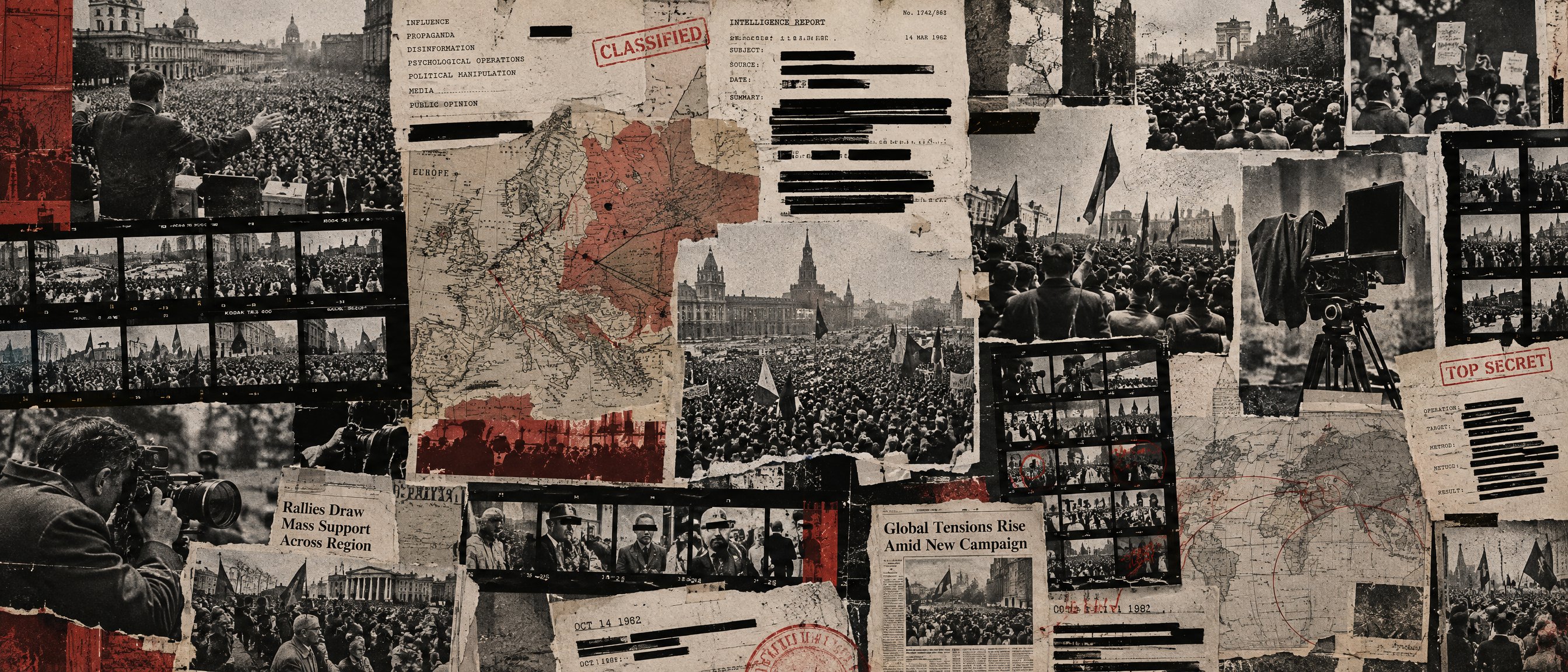
Scapegoating:when one group carries every blame
Illustration, not an archive object
By the end: Tell blame parked on a whole group from blame attached to named people and specific acts, and check what the message leaves out about the audience's own side. About 8 minutes.
What it is
Definition
Park blame for a complex harm on a bounded out-group so the in-group stays clean.
The tell
One villain class for many causes; the in-group's agency disappears.
Not this
Attributing a specific act to a named perpetrator with evidence.
Scapegoating starts from a real harm: a lost war, a shortage, a wave of crime. It does not deny the harm. It changes the causal story.
A tangle of causes, including the decisions of the audience's own leaders, is replaced by one bounded group. Every member shares the blame, whether or not any member did anything.
The tell is a single villain class and the disappearance of the in-group's own agency. The look-alike that is not scapegoating is blame attached to a named person or state, for a specific act, with evidence.
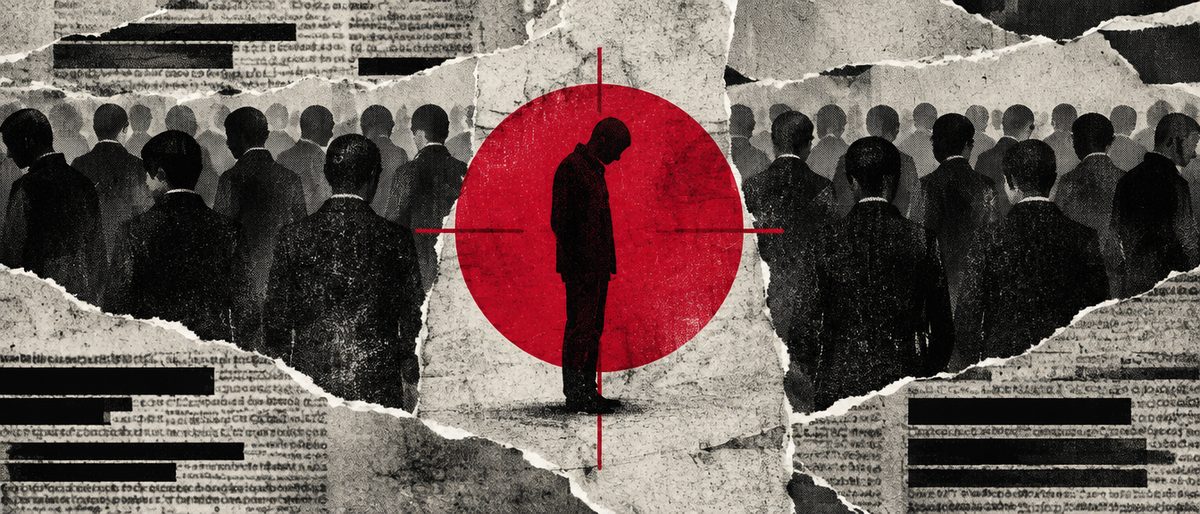
Illustration, not an archive object How it works
The technique runs in three steps.
- Locate. A harm with many causes is given one cause: a group that is already visible and somewhat distrusted, such as a minority, a foreign population, a class or a profession.
- Compress. Many unrelated harms are routed to the same target. Posters reduce millions of people to one figure: an ape in a helmet, a pair of eyes, a shadow. One alleged crime, often unverified, stands for the whole group.
- Offer. The remedy is action against the group: exclude it, report it, remove it, fight it.
It depends on three things: a harm the audience really feels, a target that cannot easily answer back in the same channel, and repetition until the link feels like common knowledge.
Why it works on people
The oldest account is frustration-aggression theory (Dollard and colleagues, 1939): when the true source of frustration cannot be attacked, aggression is displaced onto a safer target. The famous lynching-and-cotton-prices finding (Hovland and Sears, 1940) has not held up well, so displacement is one mechanism among several.
- Prejudice. Gordon Allport (The Nature of Prejudice, 1954) described blame settling on groups that are visible, relatively weak and already stereotyped.
- Self-image. Social identity theory (Tajfel and Turner, 1979): a story in which our group is blameless and theirs is guilty protects self-esteem.
- Guilt and control. Rothschild and colleagues (2012) reported laboratory experiments suggesting that blaming an out-group can reduce guilt and restore a sense of control.
Same device, different stakes (1 of 3)
Three real objects from the archive. The technique is the same in each; the setting, the choice the audience had and what was at stake are not.
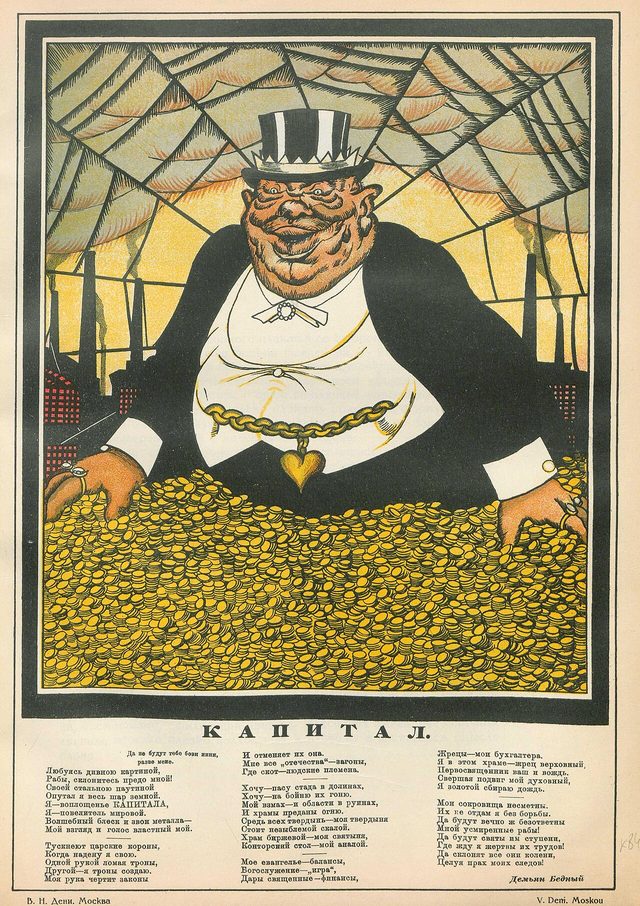
Капитал (Capital) · 1919 · Russian Soviet Federative Socialist Republic (Bolshevik state agitprop); artist Viktor Deni, verse by Demyan Bedny · Full record Notice: A Soviet state poster shows one top-hatted capitalist on heaps of gold, boasting that crowns, courts, church and war answer to him. The single body stands in for an entire class, so anger has one target rather than a documented mechanism. It was issued by a state, and the target is a class defined by ownership.
Same device, different stakes (2 of 3)
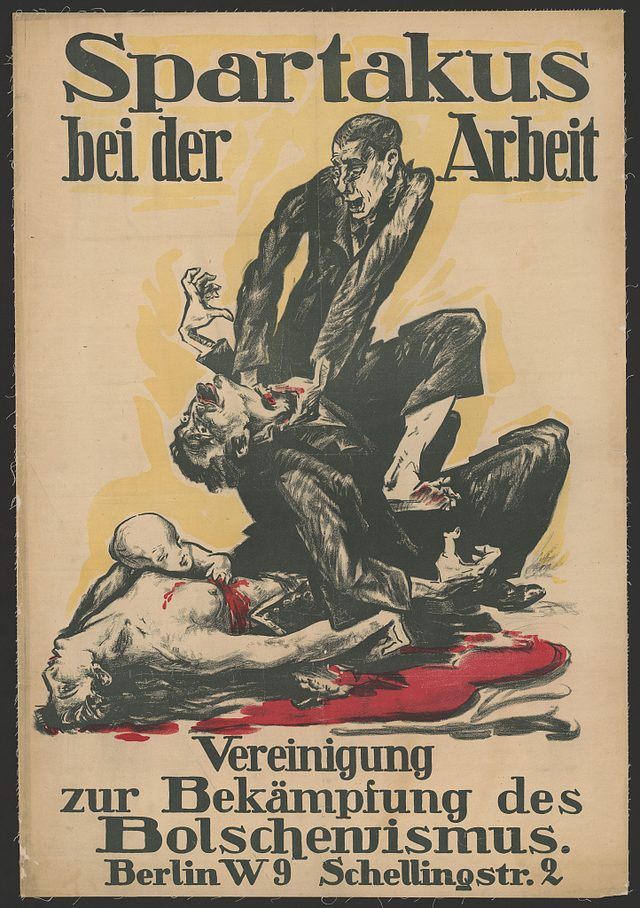
Spartakus bei der Arbeit (Spartacus at Work) · 1919 · Vereinigung zur Bekämpfung des Bolschewismus, Berlin; artist unknown · Full recordContent note: Graphic violence: a strangling above a woman and infant lying in blood. Notice: A Berlin anti-Bolshevik league prints a strangling above a mother and infant lying in blood, titled 'Spartacus at Work'. No incident, place or date is named, so one political faction becomes the author of a generic murder, and the league is the only remedy shown. The sponsor is a league named on the poster, and the target is a named political movement, not a class or an ethnic group.
Same device, different stakes (3 of 3)
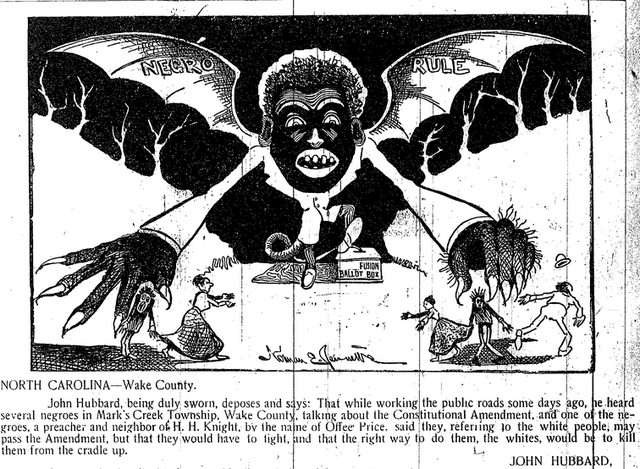
"Negro Rule" vampire cartoon with sworn affidavit · Jul 4, 1900 · The News & Observer (Raleigh, N.C.), Democratic Party white-supremacy and disfranchisement campaigns; cartoonist Norman E. Jennett · Full recordContent note: Racist "Negro Rule" caricature. Notice: A Raleigh newspaper, part of the Democratic Party's white-supremacy campaign, draws a bat-winged Black figure rising from a ballot box, with a sworn statement below it. The target is a racial group that the suffrage amendment then disfranchised, and two years earlier the same campaign ended in the Wilmington coup of November 1898, in which armed white men killed Black residents. Here the stakes were the vote and lives.
Check yourself
A wartime poster says that a named government invaded its neighbour and that its army carried out the attack. The invasion is on record. Is that scapegoating?
Show the answer
No. It attributes a specific act to a named perpetrator with evidence. It would become scapegoating if the blame spread from the state or army to a whole people, or to everything that is wrong. Right. The edge is attribution. Ask whether the claim survives if the group label is replaced by the list of people actually shown to have done the thing.
Spot it in the archive
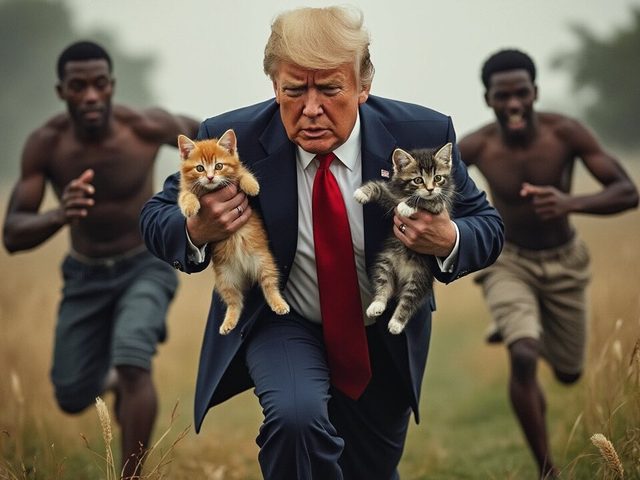
AI-generated image from the Springfield pet-eating claim · Sep 9, 2024 · Unknown creator; circulated by pro-Trump accounts on X · Full recordContent note: Racist caricature: an AI-generated image depicting Haitian immigrants as pet-eaters. In September 2024 this AI-generated image circulated on social media. Donald Trump carries two kittens away from two shirtless Black men, amid a claim about a town's immigrant residents. City officials said they had no credible reports of the claim. Which technique is doing the work?
A local set of tensions over rapid population change is pinned on one named immigrant group through a single anecdote that city officials said they had no credible reports of. Notice the one group, the one alleged act and the missing evidence. The image compresses that claim into a single picture.
Show the answer
Scapegoating A local set of tensions over rapid population change is pinned on one named immigrant group through a single anecdote that city officials said they had no credible reports of. Notice the one group, the one alleged act and the missing evidence. The image compresses that claim into a single picture.
How to spot it, and what next
- Count the causes. If one group is blamed for several unrelated harms, the story is doing emotional work, not causal work.
- Does the blame attach to named people and specific acts, or to everyone who shares an ethnicity, religion, nationality, class or political label?
- What decisions by the audience's own side are missing from the account?
- Could the group answer back in the same channel, and is the remedy aimed at the group as such rather than at a specific wrong?
Read the full page: Scapegoating in the technique library · All 33 examples in the collection