Area: Group identity · Evidence: moderate (How we rate the evidence). Dehumanizing perceptions are reliably measured and predict support for harsh treatment, but how much they cause violence, rather than accompany it, is debated.
In brief
Dehumanization means seeing or portraying other people as less than fully human: as animals, vermin, disease, machines or monsters. Surveys find that a surprising number of people will openly rate some groups as less evolved than others, and those ratings predict support for torture, collective punishment and exclusion. Propaganda that prepares or excuses mass violence has used dehumanizing imagery in every era, on every side. Researchers still disagree about whether it is the engine of cruelty or mainly its justification.
What the research shows
Nick Haslam's influential 2006 review proposed two forms [1]. Animalistic dehumanization denies people the traits we treat as uniquely human, such as refinement, self-control and reason, and pictures them as beasts or vermin. Mechanistic dehumanization denies them the warmth, emotion and individuality of human nature, and pictures them as objects, machines or interchangeable units. Haslam argued that milder versions of both are ordinary features of how people think about others, not only something that appears in war.
For decades researchers mostly studied subtle forms, because they assumed few modern respondents would admit to blatant ones. Nour Kteily, Emile Bruneau, Adam Waytz and Sarah Cotterill tested that assumption with the "Ascent of Man" measure: the familiar drawing of a stooped ape-like figure evolving into an upright human, with a slider on which respondents place various groups [2]. Many American respondents rated some groups, including Muslims and Arabs, noticeably short of "fully evolved." These blatant ratings predicted support for torture, retaliatory violence and hostile policies over and above ordinary dislike, and they rose sharply after episodes of real intergroup violence.
Kteily and Bruneau then studied the 2016 US Republican primaries [3]. Americans who blatantly dehumanized Mexican immigrants and Muslims were more likely to support restrictive policies toward those groups proposed by candidates, especially Donald Trump. Latinos and Muslims in the US, in turn, reported feeling heavily dehumanized, and that feeling (called meta-dehumanization) predicted their own support for hostile, including violent, collective responses. Dehumanization, on this evidence, can run in a loop between groups.
It is not confined to ethnic or religious lines. In three large surveys over four years and two presidencies, James Martherus and colleagues found that many Democrats and Republicans were willing to describe members of the other party in dehumanizing terms, and that this was most common among the most affectively polarized (those with the strongest dislike of the other side) [4].
Evidence on real-world effects comes from Rwanda. David Yanagizawa-Drott compared villages that could and could not receive the extremist radio station RTLM because of hills blocking the signal. He estimated that the broadcasts increased participation in killings by militias and civilians, and attributed roughly 10 percent of the genocide's violence, about 51,000 perpetrators, to the station [5].
Has it held up?
The measurement findings are robust: blatant dehumanization is common enough to be measured and consistently tracks support for aggression. The causal story is more contested.
Harriet Over has argued that even in textbook cases, perpetrators do not treat victims as literal animals; they humiliate, blame and punish them in ways that presuppose they are human, so "dehumanizing" language may express hatred rather than a real belief that the target is not a person [6]. Tage Rai, Piercarlo Valdesolo and Jesse Graham found that dehumanization increased willingness to harm others for gain (instrumental violence) but not violence seen as morally deserved, which is the more common kind in conflict [7]. On the radio evidence, Scott Straus's interviews with perpetrators and study of broadcast timing led him to conclude that RTLM mattered mainly in combination with a wider context of organized violence, not as the primary cause [8]. Kelman and Hamilton's study of "crimes of obedience" similarly treats dehumanization as one ingredient alongside authorization and routinization, rather than a sufficient cause on its own [9].
How it shows up in political messaging
- US First World War posters. American recruitment and bond posters showed Germany as a club-wielding ape or a blood-stained brute under the label "the Hun." See Destroy This Mad Brute — Enlist and Beat Back the Hun with Liberty Bonds.
- Nazi Germany. The 1940 pseudo-documentary Der ewige Jude (The Eternal Jew), directed by Fritz Hippler with input from Joseph Goebbels, intercut footage of Jews with swarming rats presented as carriers of plague that flood a continent and devour its resources [10].
- The Soviet show trials. At the 1936 Moscow trial of Grigory Zinoviev, Lev Kamenev and others, prosecutor Andrei Vyshinsky ended his closing speech by demanding that "dogs gone mad should be shot – every one of them!" [11]. The defendants, former Bolshevik leaders, were executed days later.
- US Second World War imagery of Japan. John Dower documented how American cartoons, films and posters routinely drew the Japanese as monkeys, apes, rats and insects, while Japanese wartime media more often cast Americans and Britons as demons and ogres [12].
- Rwanda. RTLM and the newspaper Kangura called Tutsi "inyenzi" (cockroaches). The International Criminal Tribunal for Rwanda convicted the outlets' leaders in the 2003 "Media Case," including for direct and public incitement to commit genocide; the 2007 appeal narrowed several convictions but upheld incitement convictions against two of the three defendants [13][14].
- Present-day partisanship. In the survey research above, dehumanizing views of opponents appear among Democrats and Republicans alike [4], and in attitudes toward immigrants and religious minorities [3].
Content note: Dehumanizing caricature of Germans as an ape, implied sexual violence and partial nudity. This object is shown as it was published. Why 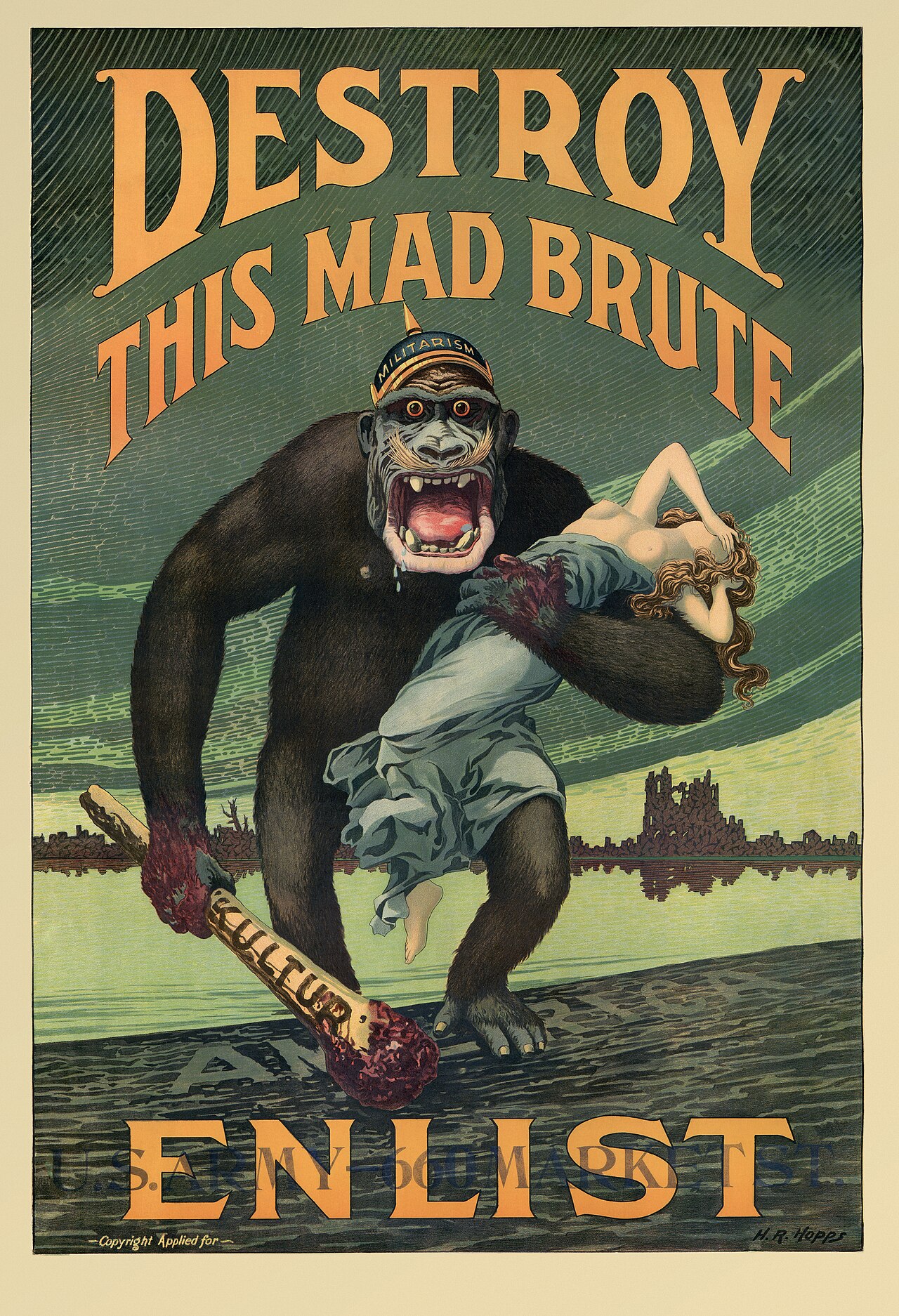
Destroy This Mad Brute — Enlist: "Destroy This Mad Brute — Enlist", U.S. Army recruiting poster, 1917, artist Harry Ryle Hopps. Germany shown as an ape. Public domain.
Content note: Wartime caricature of a Japanese leader as a rodent, with an ethnic slur in the title. This object is shown as it was published. Why 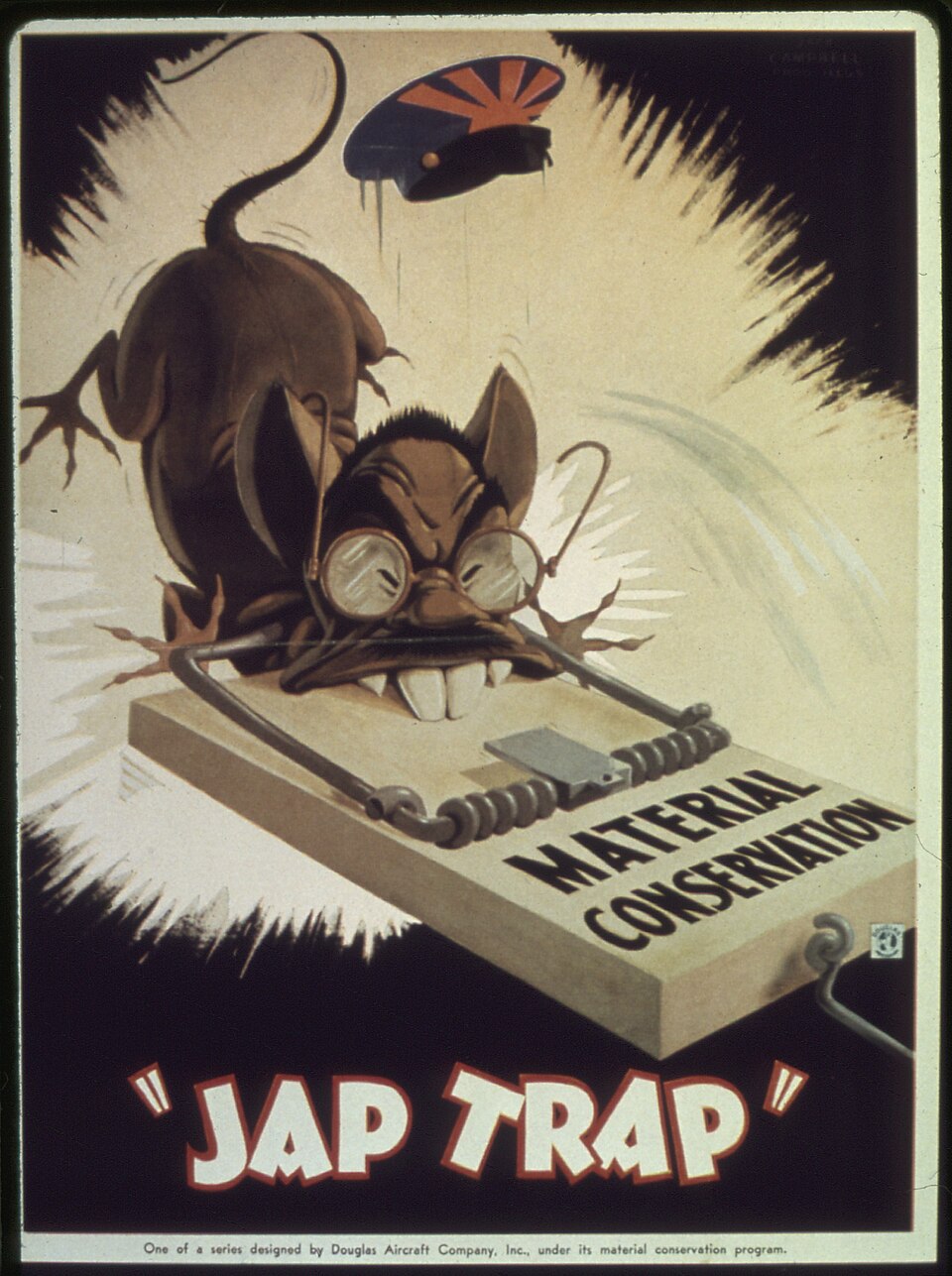
"Jap Trap", poster from a Douglas Aircraft Company material-conservation series, held by the U.S. National Archives (NARA 515862), 1941–45, artist Jack Campbell; Commons describes the rodent as resembling Hideki Tōjō. Japan shown as a rodent. Public domain (per Wikimedia Commons).
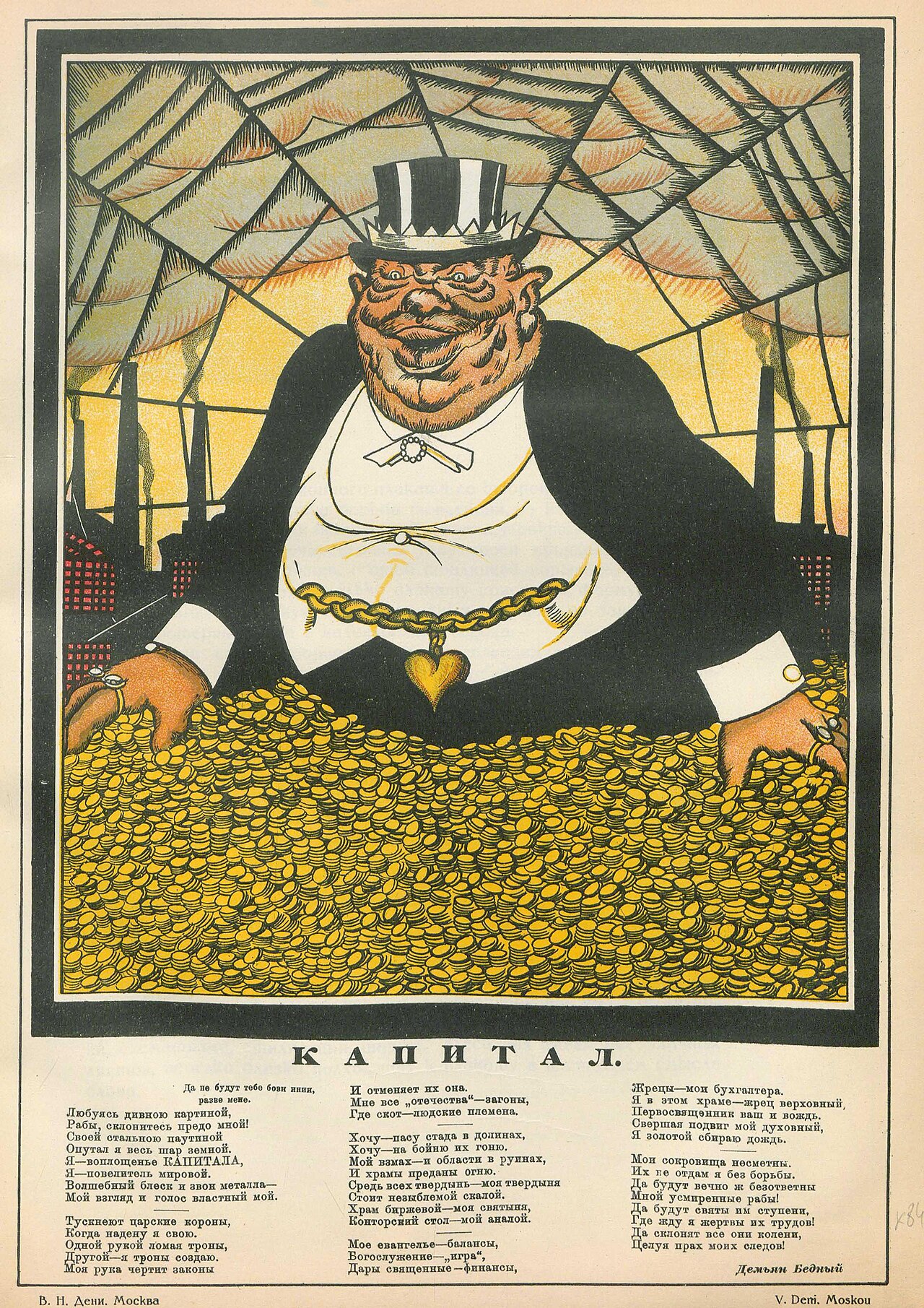
Капитал (Capital): "Kapital" (Capital), Russian Soviet Federative Socialist Republic, 1919, artist Viktor Deni, verse by Demyan Bedny. A class shown as one grotesque figure. Public domain.
How to spot it
- A group is described with animal, insect, vermin, disease or contamination words ("infestation," "swarm," "plague," "cancer").
- Members of the group appear as a faceless mass, never as individuals with names and families.
- The group is shown as monstrous, sub-human or mechanical in images, even when the text is mild.
- The language treats removal or extermination as hygiene rather than as harm to people.
- Metaphors escalate over time from "wrong" to "dangerous" to "not like us" to "not people."
Persuasion or manipulation?
Honest political writing can condemn actions, name perpetrators and describe real atrocities in blunt terms. It can call a crime monstrous. What it does not do is transfer that judgment to a whole category of people or describe them as animals, disease or objects. Dehumanizing language bypasses judgment by making the target seem outside the circle of moral concern, so the reader never weighs what is being done to actual human beings. A useful self-check is whether the sentence would still work if it named a specific person instead of a group.
Archive techniques that lean on this
- Name-calling — Name-calling: dehumanizing labels ("the Hun," "inyenzi") are name-calling at its most extreme.
- Scapegoating — Scapegoating: a dehumanized group is an easy place to park blame for complex harms.
- Fear appeal — Fear appeal: the brute or the plague is presented as an imminent threat, so fear licenses harsh remedies.
Related topics
- Out-group homogeneity — Out-group homogeneity
- In-group favoritism — In-group favoritism
- Disgust — Disgust
- Moral outrage — Moral outrage
- Obedience to authority — Obedience to authority
Sources
- Haslam, N. (2006). Dehumanization: An integrative review. Personality and Social Psychology Review, 10(3), 252–264. https://doi.org/10.1207/s15327957pspr1003_4
- Kteily, N., Bruneau, E., Waytz, A., & Cotterill, S. (2015). The ascent of man: Theoretical and empirical evidence for blatant dehumanization. Journal of Personality and Social Psychology, 109(5), 901–931.
- Kteily, N., & Bruneau, E. (2017). Backlash: The politics and real-world consequences of minority group dehumanization. Personality and Social Psychology Bulletin, 43(1), 87–104. https://doi.org/10.1177/0146167216675334
- Martherus, J. L., Martinez, A. G., Piff, P. K., & Theodoridis, A. G. (2021). Party animals? Extreme partisan polarization and dehumanization. Political Behavior, 43, 517–540. https://doi.org/10.1007/s11109-019-09559-4
- Yanagizawa-Drott, D. (2014). Propaganda and conflict: Evidence from the Rwandan genocide. Quarterly Journal of Economics, 129(4), 1947–1994. https://doi.org/10.1093/qje/qju020
- Over, H. (2021). Seven challenges for the dehumanization hypothesis. Perspectives on Psychological Science, 16(1), 3–13. https://doi.org/10.1177/1745691620902133
- Rai, T. S., Valdesolo, P., & Graham, J. (2017). Dehumanization increases instrumental violence, but not moral violence. Proceedings of the National Academy of Sciences, 114(32), 8511–8516. https://doi.org/10.1073/pnas.1705238114
- Straus, S. (2007). What is the relationship between hate radio and violence? Rethinking Rwanda's "Radio Machete." Politics & Society, 35(4), 609–637. https://doi.org/10.1177/0032329207308181
- Kelman, H. C., & Hamilton, V. L. (1989). Crimes of obedience: Toward a social psychology of authority and responsibility. New Haven: Yale University Press.
- United States Holocaust Memorial Museum. Der ewige Jude. Holocaust Encyclopedia. https://encyclopedia.ushmm.org/content/en/article/der-ewige-jude
- People's Commissariat of Justice of the USSR. (1936). Report of court proceedings: The case of the Trotskyite-Zinovievite terrorist centre (heard before the Military Collegium of the Supreme Court of the USSR, 19–24 August 1936; Vyshinsky's speech for the prosecution, 22 August). Reprint, New York: Howard Fertig, 1967. https://archive.org/details/reportofcourtpro0000grig
- Dower, J. W. (1986). War without mercy: Race and power in the Pacific War. New York: Pantheon.
- United Nations International Criminal Tribunal for Rwanda. (2003). Three media leaders convicted for genocide [press release on Prosecutor v. Nahimana, Barayagwiza and Ngeze, ICTR-99-52]. https://unictr.irmct.org/en/news/three-media-leaders-convicted-genocide
- Center for Global Law and Justice. Nahimana et al. (ICTR-99-52) "Media Case": Case summary. https://cgljresourcehub.law.northeastern.edu/human-rights-law/international-criminal-law/ictr/case-summaries/nahimana/
Images
| Image | Source | Licence |
|---|---|---|
| Destroy This Mad Brute (1917) | FRAME gallery, Destroy This Mad Brute — Enlist | Public domain |
| "Jap Trap" (1941–45) | NARA 515862 via Wikimedia Commons | Public domain (U.S. government work, per Commons) |
| Kapital (1919) | FRAME gallery, Капитал (Capital) | Public domain |

Image gaps
Rwandan Kangura covers and RTLM material, the 1940 film Der ewige Jude, and Japanese wartime images of Americans and Britons as demons and ogres (the reverse case in Dower [12]). None was verified as public domain or openly licensed, so they are cited, not hosted; one Japanese 1944 cartoon of an ogre unmasking as Roosevelt was seen on Wikimedia Commons, but its licence basis could not be confirmed here. That leaves the imagery on this page weighted toward U.S. and Soviet sources.