Content note: Quotes wartime anti-German language, including "Hun", and period terms for racial and national groups. This object is shown as it was published. Why
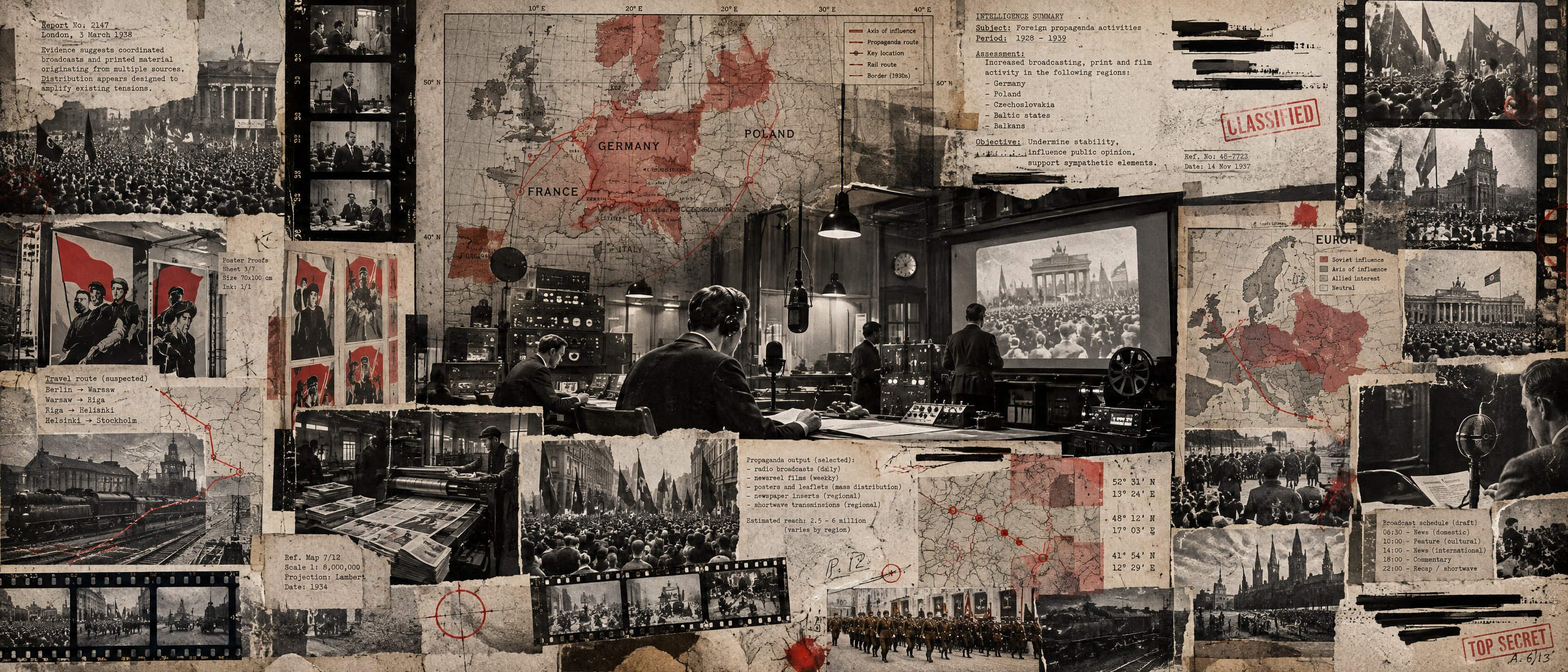
At the very outset the Committee on Public Information made the decision that the three great agencies of appeal in the fight for public opinion were: The Written Word, the Spoken Word, and the Motion Picture. Even as the speaking forces and the writers of the Nation were mobilized, so were stej)s taken in the very first days to utilize every resource of the camera.
In the beginning the Film Division contented itself with taking the war material made by the Signal Corps, at home and abroad, and distributing it fairly, and at a nominal price, to the weekly film services for distribution. Expert camera men were also employed with the production of feature pictures to be distributed by the various patriotic societies, and State councils of defense, in such manner as to avoid competition with the commercial motion picture industry. Among the early pictures thus produced were :
The 1917 Recruit, 2 editions (training of the' National Army).
The Second Liberty Loan.
Ready for the Fight (Artillery and Cavalry maneuvers).
Soldiers of the Sea (Marine Corps in training).
Torpedo Boat Destroyers (naval maneuvers). Submarines. Army and Navy Sports.
The Spirit of 1917 ( the largest maneuver staged in America ; an attack by the Jackies at Lake Bluff upon Fort Sheridan, 111. ) .
In a Southern Camp (general Army maneuvers).
The Lumber Jack (showing the growth of the Lumber Jack Regiment for reconstruction work in Europe). The Medical Officers' Reserve Corps in Action (sliowing the development of the Medical Corps and training).,
Fire and Gas (showing maneuvers of the new Thirtieth Engineer Regiment ) .
American Ambulances (complete display of ambulance work).
Labor's Part in Democracy's War (labor-union activities in the war).
Annapolis (naval officers in the making).
Ship Building (construction of all types of ships).
Making of Big Guns. Making of Small Arms. Making of Uniforms for the Soldiers. Activities of the Engineers. Woman's Part in the War.
Men Who Are Doing Things (portraying upon the screen, as far as possible, every person who is mentioned in public print as being active in war preparations).
The Conquest of the Air (airplane and balloon maneuvers).
These pictures were not put in motion-picture theaters, except when especially engaged for the purposes of some war benefit; they were shown free, except when used for such benefits. As time went on, however, it was seen that this method of distribution not only put an unnecessary burden of expense upon the Government, but that it was failing absolutely to place the pictorial record of America's war progress before more than a small percentage of the motion-picture audiences of the world. The growth of the Signal Corps' great photographic section was producing an enormous amount of material, both in the United States and France, possessed of the very highest propaganda value, and for purposes of 100 per cent utilization, the policies of the Film Division were subjected to a radical reorganization under Mr. Charles S. Hart. Great feature films, like Pershing's Crusaders, America's Answer, and Under Four Flags, were made, given impressive showings under governmental auspices in the larger cities, and then distributed under an equitable commercial arrangement that returned to the Government the full cost of production.
' England, France, and Italy were drawn into partnership with us, and an Official War Eeview, issued weekly, carried to every part of the world a weekly presentation of the fighting on every front, and the story of each nation's efforts and determinations.
The congressional appropriation for the work of the Film Division was $205,000, given June 30, 1918. By March, 1919, over $400,000 had been turned into the Treasury of the United States by the Film Division. In addition to this showing of profit, receipts were generous enough to meet much of the cost of the free distribution of these films in the neutral countries of the world, as well as enabling the educational department to furnish free service to training camps and base hospitals, as well as to a great number of patriotic organizations and institutions.
In June, 1918, the Bureau of Allied War Expositions was organized as a bureau in the Division of Films, and on September 1, 1918, the division absorbed the Bureau of War Photographs.
The Bureau of War Photographs is the only department of this division which does not show a profit. This has been due to the fact that we have made every effort to furnish a service to the families of the boys overseas who were interested in securing official pictures at an extremely low rate. Gross income report for the period ended May 31, 1919.
Income from Division of Films : Pershing's Crusaders $181, 741. 69 America's Answer 185, 144. 30 Under Four Flags 63, 946. 48 Official War Review 334, 622. 3-5 Our Bridge of Ships 992. 41 U. S. A. Series 13, 864. 98 Our Colored Fighters 640.60 News Weekly 15, 150. 00 Miscellaneous sales -^ 56, 641. 58 Total sales from films 852, 744. 39 Sale of property -.— 2, 685. 45 Interest and discount-: 4,564.51 859, 994. 35 Income from Expositions : S'an Francisco $54, 274. 80 Los Angeles 65, 375. 75 Cliicago 583, 731. 24 Cleveland 167, 355. 51 Waco • 16, 904. 70 Pittsburgh 147, 804. 16 Kansas City 28, 646. 20 Cincinnati 66,541.20 Bufealo 60, 354. 27 St. Louis ^ 23, 570. 40 New Orleans 14,439.20 Toledo 50, 003. 02 Detroit 63, 470. 74 Houston 22, 684. 05 Milwaukee ., 49, 372. 02 St. Paul (small exhibit) 9, 065. 34 Jackson (small exhibit) 5,169.29 Little Rock (small exhibit) 2,458.72 Oklahoma (smtai exhibit) 4,664.71 Great Falls (small exhibit) 996.07 Waterloo (small exhibit) 1,122.85 Total income, Expositions 1, 438, 004. 24 Income from Bureau of War Photographs :
Sales of photographs and slides 68, 857. 38
Sales of property 1, 196. 56
Interest and discount 546. 16
Total income, Bureau of War Photographs 70, 600. 10
Receipts from Foreign Section : Archangel 1 3, 928. 00 Argentina . 3, 293. 49 China 2, 055. 88 Holland 58, 698. 93 Italy 29, 729. 49 Mexico 25, 423. 29 Spain 14, 000. 00 Sweden 6, 441. 38 Switzerland 11, 196. 69 Miscellaneous 24, 287. 86 179, 155. 01 Interest 284. 69 179, 439. 70 Total income 2, 548, 038. 39
(Vladivostok and Harbin reports not yet received.)
Personnel of the Division of Films
Director. — Charles S. Hart. Domestic Distribution. — Denis J. Sullivan. Educational Bureau. — Miss Clare de Lissa Berg. Bureau of War Expositions. — Chester I. Campbell, William Ganson Rose, Dean C. Mathews, directors.
Bureau of War Photographs. — William A. Grant.
Department of Scenarios and Doinestic Production. — Rufus Steele^
Aiiditing Department. — T. S. Barrett.
Foreign Film Distribution. — Marcus A. Beeman, E. M. Anderson.
Distribution feature pictures. — George Bowles.
Laboratory. — Robert Rinehart.
Complete Report of the Chairman of the Committee on Public Information, George Creel, Chairman, Committee on Public Information. A work of the United States government, printed by the Government Printing Office in 1920, so not protected by copyright in the United States (17 U.S.C. 105) and in the public domain by age as well. The Library of Congress states that it is unaware of any copyright restrictions on the item. Provenance and rights.