Content note: Quotes wartime anti-German language, including "Hun", and period terms for racial and national groups. This object is shown as it was published. Why
(By James Kerney, Commissioner.)
(Note. — In addition to intelligently employing all possible agencies for the sustaining of the morale of the French people, the headquarters of the committee in Paris was the clearing house for the diffusion into the allied, neutral, and enemy countries of Europe of fullest information, compatible with military considerations, regarding the activities of the American Naval and Expeditionary Forces as well as the American war effort at home. The work was under the direction of James Kerney, editor of the Trenton Evening Times, who went overseas in February, 1918, remaining until shortly before the signing of the armistice.)
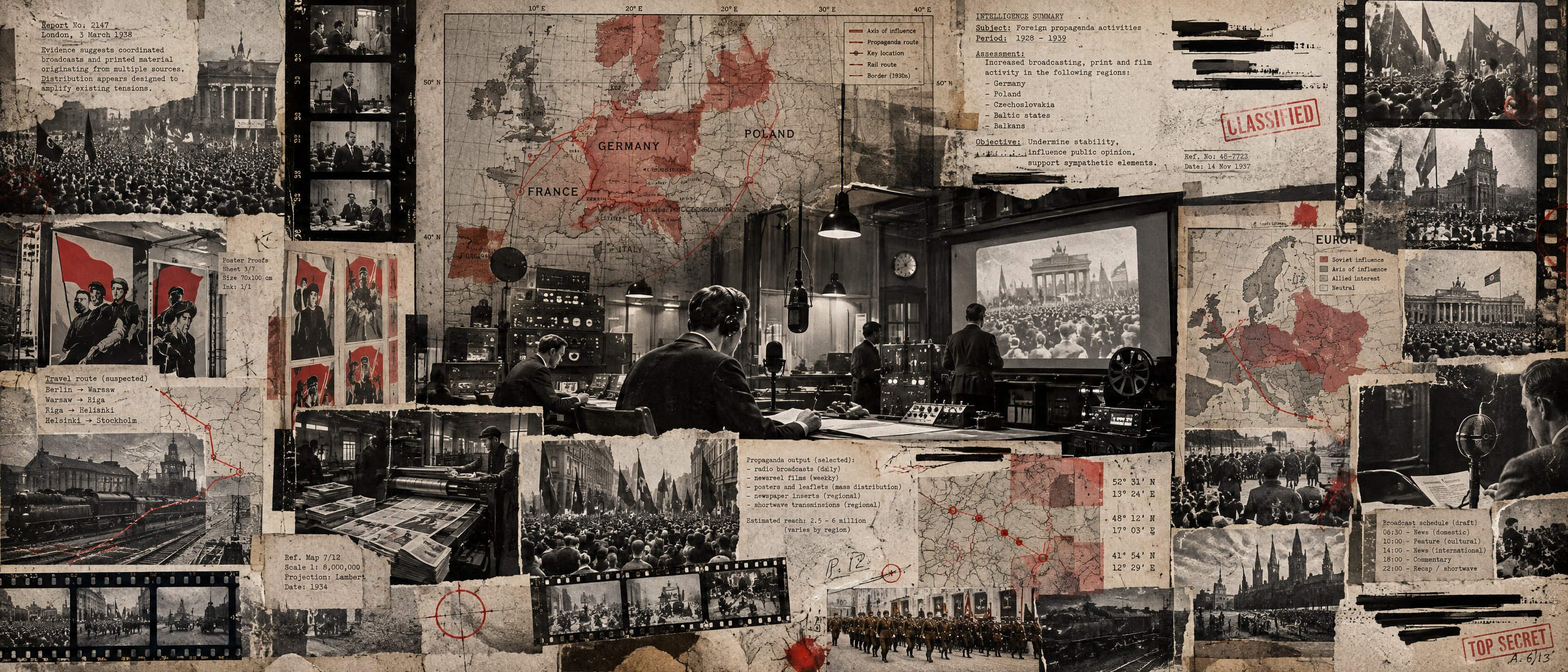
France was naturally badly nerve racked following the military reverses of 1917. An aggressive defeatist offensive, aimed directly at America, had been made during the winter of 1917-18. The constant air raids and shelling of the big gun, coupled with the proximity of the enemy in the spring fighting, served to intensify the anxiety in Paris during the spring and early summer of 1918. This was reflected in the unrest and uncertainty existing evei"ywhere in the industrial plants engaged in producing war supplies. " Can America get here in time to be effective ? " was the ever-present query. In this situation it was highly desirable that an energetic and convincing educational campaign as to our progress and aims should be speedily launched. The press, magazines, universities, lecture platforms, moving pictures, posters, leaflets — all were employed in making known our grim determination, as well as our capacity, to see it through.
An efficient staff, including newspaper and magazine writers, university and other lecturers, translators, and clerks, was quickly assembled. I was given the fullest cooperation at all times by Gen. Pershing, Admiral Wilson, and Ambassador Sharp, each of whom has paid a generous tribute to the committee's accomplishments in France.
At first the Paris offices were at 37 Rue Laperouse, but wdien, in June, the Army headquarters were removed to the Elysee Palace Hotel, space was assigned the committee in that building. This greatly facilitated the work. An office was also provided for us in the Maison de la Presse, the official propaganda division of the French Ministry of Foreign Affairs. At all times the most cordial relationship was maintained with the information sections of the British, French, and Italian Governments.
Associated with me were : Martin Egan, at General Pershing's headquarters; M. Firman Roz, of the University of Paris (Sorbonne), and Herbert Adams Gibbons, the principal lecturers for the committee ; Madame Edith Biigues, an American, who acted as executive secretary; Wilmot H. Lewis, in charge of press matters and who likewise served as liaison officer with the French propaganda officials ; Edgar B. Hatrick, who supervised and planned moving and still picture productions ; Frank Fayant and Maximilian Foster, press representatives of the committee at Great Headquarters and the fighting front, respectively; Frank M. Mansfield and A. M. Brace, news editors ; Claude Berton and M. Beryl, French journalists and translators ; besides the stenographic and clerical force. James H. Hyde, an American residing in France, by reason of his wide and favorable acquaintance in French governmental, university, and journalistic circles, rendered the cause a voluntary service of inestimable value. The Marquise de Polignac, also an American, was likewise a very useful volunteer on the staff. Hugh Gibson, First Secretary of Embassy, was loaned to the committee for a part of the time by the State Department, and, as occasion demanded, the personnel included Army officers specially detailed to serve under Maj. A. L. James, jr., who, for several months, as chief of the Press and Censorship Division of the Intelligence Section, had offices immediately adjoining those of the committee in Paris. Maj. James, representing the General Staff, gave the committee the most complete cooperation, as did his immediate superior,. Gen. Denis E. Nolan, chief of the Intelligence Section, and likewise Gen. Edgar E. Eussell, chief of the Signal Corps. In so far as it was practicable, with the already overburdened wires, the Paris office sought to link up the folks at home with the Army each day by relaying to Great Headquarters and the various bases in France copies of the daily wireless service from America (containing about 1,500 words summarization of the news), which service was likewise furnished, for the accommodation and comfort of the soldier, to the Paris editions of the London Daily Mail, the New York Herald, and the Chicago Tribune, as well as the Stars and Stripes. All of these publications made liberal use of this home news, and so much as was available was translated into French and published in both the Parisian and provincial press.
This service was also transmitted to the bureau of the committee at Berne, Rome, Lisbon, and Madrid, supplemented by a daily service telling of the activities of the American f orceson the fighting front. The news reports from the front were written by the representative of the committee attached to the press headquarters in the zone of advance, and, in addition to being sent to the above-named capitals, were wired to London for distribution in Great Britain, Holland, and the Scandinavian countries, as well as to South America.
In order to get an adequate presentation of work of preparation that America found necessary, before troops could be landed and fought to the best advantage and in keeping^ with American standards, it was necessary to overcome some drastic existing French censorship regulations. When I had formulated a program for the work in France, I talked it over with Gen. Pershing, Premier Clemenceau, and Capt. Tardieu, head of American relations for the French Government. They gave the program their entire approval, and M. Clemenceau promptly had the French censorship rules so modified as to freely permit of the publication of the story of " America in France," without so localizing it as to give information to the enemy. Leading writers for the French magazines and reviews, with illustrators, as well as many famous journalists, accepted invitations to visit the American work, and the publications were soon crowded with the remarkable accomplishments of our Army and Navy. This liberal treatment of the work continuecl until accounts of the glorious conduct of the troops at the fighting front produced the finest propaganda that ever appeared in any country. I personally visited the newspaper publishers of the big provincial cities, and these powerful journals accorded America the same generous and enthusiastic treatment as was given by the Parisian press. Writers from Spain, Switzerland, Italy, Holland, and the Scandinavian countries were brought to France and shown over the sectors in which the Americans were operating and the reports they published were exceedingly useful in their effect not only in Uieir home countries but upon the civilian morale of Germany. This was particularly the case with the publication of American news in Switzerland, which occupied the most advantageous position in the matter of enemy propaganda. Photographs of the American work and of the American fighters were supplied in great quantities, through the Signal Corps of the Army, and were likewise dispatched weekly to the committee's representatives all over Europe, with the result that American pictures and American news filled the reviews and journals everywhere.
The production and distribution of still photographs and moving pictures was of major importance. In addition to the weekly shipments of photographs to London, Berne, Kome, Madrid, Lisbon, and other points, moving pictures were sent for use in the governmental and commercial cinema houses. The first big production of exclusively American films was entitled "America's Answer to the Hun " and was assembled by Edgar B. Hatrick, who spent six months with the committee supervising the motion and still picture work. The initial showing of the film was made at the Gaumont Palace, Paris, June 26, 1918 — the first anniversary of the landing of our troops at St. Nazaire. It was witnessed by practically all of the members of the Senate and Chamber of Deputies, the diplomatic representatives of Great Britain, Italy, and Japan, as well as many of the allied military and naval chiefs, and was given a mighty reception. This film, in four reels, depicted the protection afforded by the American Navy to transports, disembarking of troops, our construction and installations at ' ports and along the lines of communication right up to the fighting front, the ambulance " and supply services. It concluded with a number of scenes showing the American fighters in action at Chateau Thierry, and one section of the theater was reserved for wounded doughboys from the hospitals in and about Paris. Columns of space were devoted to the event in the newspapers of France and England, and copies of the film were promptly sent to all the allied and neutral countries for showing there. The big commercial producers, Gaumont and Pathe, arranged at once to send it into all their houses in France, and it was used most successfully among the troops, in factories, universities, schools, etc. • »
The Lecture Campaign
One of the most enduring features of the work was the system of university and university extension lectures that was carried on throughout the spring and summer of 1918. Shortly after my arrival, I met the presidents of all of the French universities and presented to them a plan aimed at combating the wide-spread anti-American propaganda throughout France, by making known the spirit and extent of America's part in the war. These lectures were further framed to put the story of America's greatness, in some permanent form, into the minds of the local leaders of thought, as well as into the minds of the people. The committee was able to get into personal touch with more than 200 qualified lecturers, furnishing them with literature and documents, a,s well as lantern slides, with the result that practically every part of France was reached. The presidents of the universities gave their heartiest cooperation and 150,000 copies of a pamphlet containing a summarization of American information was distributed to the school teachers. The university presidents, together with the Ministry of Public Instruction, agreed upon M. Firman Roz, of the University of Paris, as a man most eminently fitted to inaugurate the American lectures. Mr. Eoz, together with some other university representatives and writers, was taken over the American lines of communication and supplies, as well as to the front lines. The series of lectures began at the Sorbonne on May 21, M. Lucien Poincaire, brother of the President of the Republic, presiding. Immediately after this initial lecture M. Firman Roz began his tour of the universities, sx)eaking at Bordeaux, Toulouse, Montpellier, Marseille, Grenoble, Ohambery, Lyon, Djon. Besancon, Caen, Rennes, Px)itiers, and Claremont-Ferand.
These lectures gave America much publicity in the provincial press and had an especially good influence on the editorial columns. The presidents of the respective universities had invited to the lectures leading professors from each town in the educational district under the control of the university. In this way the university extension lectures were developed, the local professors organizing lecture centers. A complete list of these lectures was kept in Paris and fresh literature, giving the latest information about America, regularly mailed to them. Local lectures were also given in many of the big provincial towns, the conunittee receiving fine cooperation on the part of American consular representatives. Through the consulates, everywhere, printed matter was distributed and in the larger centers such as Havre, Cherbourg, Marseille, Nantes, Tours, St. Nazaire, Lyon, Boulogne, Franco-American demonstrations, including lectures and production of movie films, were provided.
At the urgent request of the French Minister of Munitions, lectures on the American participation in the war were given in the various industrial plants in France engaged in manufacturing war supplies. The purpose of these lectures was to stem the unrest that was constantly cropping up. These lectures were given by Dr. Herbert Adams Gibbons. At the same time the film "America's Answer to the Hun " was shown. Both the French Government officials and the manufacturers pronounced this work as highly valuable in its effect on the industrial situation. The proprietors and managers of the big steel and munitions plants were brought together in Paris on July 5, the meeting being presided over by M. Loucheur, Minister of Munitions, who dwelt upon the importance of the lecture and cinematographic work of the committee in France.
Dr. Gibbons's first lecture in this unique course was at the factory of Louis Renault, where aeroplane motors, motor trucks, tanks, cannon and shells were being produced. The lecture was given twice in this plant, being recorded both stenographically and on the phonograph in order that it might get the most complete distribution among the 25,000 emj^loyees. M. Renault subsequently declared that this exposition of America's part insured his plant against any labor disturbances for at least six months. The film was shown and the lecture given in all of the large plants engaged in the manufacture of war materials throughout France. Upwards of 100,000 copies of the lecture were printed at the expense of the manufacturers for distribution among their employees.
On the invitation of the official French Propaganda Bureau, Dr. Gibbons spent several days lecturing in the mining country and, at the instance of the same organization, went for 10 days into Alsace, explaining the American situation to the populations of the reconquered regions and, in turn, explaining the Alsatian question to the American troops occupying sectors on that front. Dr. Gibbons, working in conjunction Avith the Marquise de Polignac, arranged for the distribution among the peasants of France of 100,000 copies of a special leaflet, and otherwise rendered worthy service by reason of his knowledge of the country, resulting from his long residence there.
The committee likewise cooperated with the ministries of labor and of agriculture and in conjunction with these departments of the French Government, several hundred thousand posters were put out, together with many leaflets. Altogether the committee, directly, and in association with the French Government, distributed more than 1,000,000 pamphlets, posters, and leaflets bearing on America.
Besides the pamphlets and leaflets specifically noted above, the committee published a French translation, in booklet form, of the report of the first year's work of American preparation, 10,000 copies being distributed among the newspapers and through the American consuls and the numerous French propaganda agencies. Upward of 200,000 copies of a special resume of the American effort were put out in the month of July ; and as the news and opportunity presented, other thousands of brochures and posters were distributed.
Educating the Enemy
For the first five months that the committee operated in ! Paris there was close cooperation with the French bureau •having directly in charge the dissemination into Germany -- and among the German troops of facts to combat false in^ \ formation regarding America. Shortly after he" opened his offices, I had assigned to me by the Intelligence Section of the A. E. F., Lieut. Harry A. Franck, who was familiar -, with the German language and conditions and who kept in touch with the French Department of Enemy Propaganda. Despite the difficulties resulting from the lack of adequate aeroplanes, there was at all times a reasonable i flow into Germany of facts, printed in German, regarding , America and American ideals. The newspapers from Ger-'V; many were carefully watched and their misrepresentations i were met with tracts and pamphlets, sent over the lines both ' by plane and balloon and dropped on the cities. It was the practice of the German press, for example, to so distort the speeches of President Wilson as to give .an entirely erroneous meaning to the excerpts used. This character of deception was overcome, as far as possible, by the immediate flooding of Germany, from the air, with pamphlets giving in parallel columns the German version and the correct version of the speech, the portions altered or deleted by the Germans, in their original publications, being emphasized. The Germans had kept up, both at home and in France, a terrific \ propaganda that our participation was all " Yankee bluff," iX I and the committee kept diligently hammering away to offset I these charges in both countries. It was the opinion of the French governmental chiefs that the most effective method of reaching the German civilian population was through the Swiss newspapers, printed in German, and every effort was made to keep the Berne office of the committee fully supplied with American information. That office, under the direction of Mrs. Vera B. Whitehouse, was doubtless the greatest single factor in getting the story of America into Germany.
With the enormous influx of American troops and the victories along the Mame, it became apparent during the month of June that, for diffusion into Germany, information regarding the United States had a preponderant value. The French bureau was reorganized and Commandant Chaix, a thorough-going business man, placed at its head. A most efficient equipment was assembled, and the documents were given a genuine German appearance as to paper, type, typesetting, and the fine points of German diction. The printers were German prisoners chosen for this particular task. For the troops special matter was prepared, according to nationalities. The military authorities, as soon as the presence in certain trenches of Jugo-Slav, Polish, or other elements, or of German troops from disaffected districts, was noted, at once conveyed the information to the end that material specially designed to appeal to these respective forces might be dispatched.
At the end of June and during early July, when some of the German newspapers began to wake up to the fact that there really was more than a million American troops in France and that they were most desperate fighters, there appeared articles indicating war weariness and hints that all might not be going so well on the western front. This material was quickly reproduced in Paris and spread among the German troops. It was along in July that the first genuine effects of the enemy propaganda were felt. On July 18 a conference of heads of the British, French, Belgian, and American services was held in the office of the committee. It was the frank consensus of opinion that the place for concentrated effective work was in front of the American lines, then shortly to be very greatly extended. Gen. Nolan, Maj. James, and Capt. Mark Watson of the Intelligence Section, A. E. F., attended the conference, and soon thereafter a special group of experts, under the immediate direction of Maj. James, took over the American end of the work.
Complete Report of the Chairman of the Committee on Public Information, George Creel, Chairman, Committee on Public Information. A work of the United States government, printed by the Government Printing Office in 1920, so not protected by copyright in the United States (17 U.S.C. 105) and in the public domain by age as well. The Library of Congress states that it is unaware of any copyright restrictions on the item. Provenance and rights.