In one line: Between about 911 and 609 BCE the kings of Assyria, and between 626 and 539 BCE the kings of Babylon, ruled successive Mesopotamian empires that recorded their wars, deportations and building works in royal inscriptions, palace reliefs and, in Babylon, chronicles, and scholars still disagree about how far that record should be called propaganda.
The leader and the people under the leader
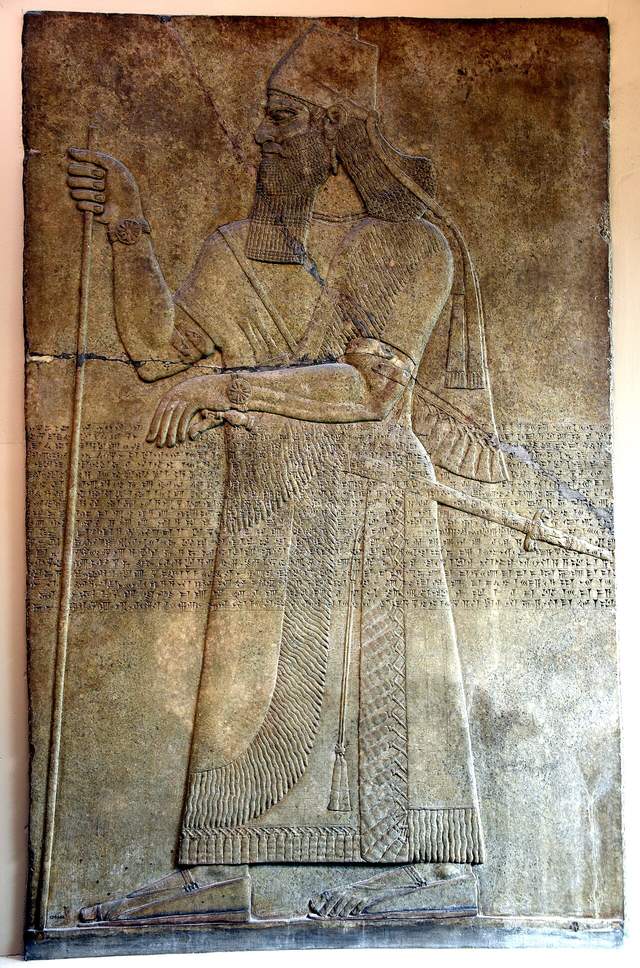
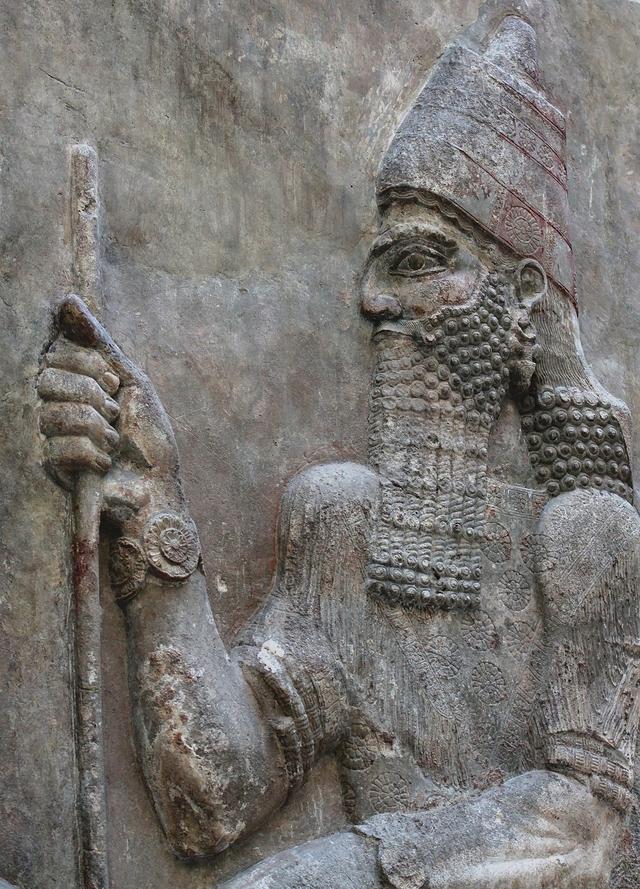
Photo: Osama Shukir Muhammed Amin FRCP(Glasg) (Commons user Neuroforever), CC BY-SA 4.0
Ashurnasirpal II
King of Assyria · 883 to 859 BCE
Ashurnasirpal II: Read more
Rebuilt Kalhu (Nimrud) as a royal city, settled conquered peoples there, and had the Standard Inscription cut across the palace slabs.
In their words
“I built a pillar over against his city gate, and I flayed all the chief men who had revolted, and I covered the pillar with their skins; some I walled up within the pillar, some I impaled upon the pillar on stakes, and others I bound to stakes round about the pillar”
“When Assur, the lord who called me by my name and has made great my kingdom, intrusted his merciless weapon unto my lordly power, I overthrew in battle the widespreading hosts of the Lulumé.”
“That city I built anew, and the peoples whom my hand had conquered, from the lands which I had brought under my sway, [...] I took and I settled them therein.”
Assyrian kings, ninth century
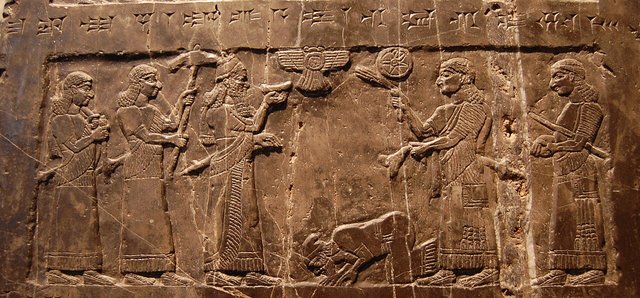
Photo: Steven G. Johnson (Commons user Stevenj), extracted from another file, CC BY-SA 3.0
Shalmaneser III
King of Assyria · 858 to 824 BCE
Shalmaneser III: Read more
Led annual campaigns into Syria, including Qarqar, and set up the Black Obelisk with a caption for each tribute scene.
In their words
“Karkar, his royal city, I destroyed, I devastated, I burned with fire. [...] 14,000 of their warriors I slew with the sword. Like Adad, I rained destruction upon them.”
“Tribute of Iaua (Jehu), son of Omri (mâr Humri). Silver, gold, a golden bowl, a golden beaker, golden goblets, pitchers of gold, lead, staves for the hand of the king, javelins, I received from him.”
Assyrian kings, eighth century
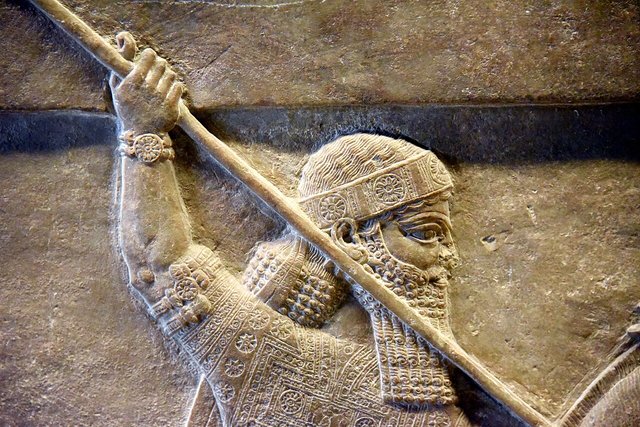
Photo: Unknown ancient sculptor; photograph by Jastrow (2005), Public domain (Commons tag)
Tiglath-pileser III
King of Assyria · 745 to 727 BCE
Tiglath-pileser III: Read more
Took the throne in 745 BCE; his annals record settling deportees and counting them with the people of Assyria.
In their words
“[I settled in it. I laid tribute and tax(es)] upon them; with the people of Assyria I counted them.”
His Khorsabad inscriptions record the taking of Samaria and the deportation of 27,290 of its people.
In their words
“I besieged and captured Samaria, carrying off 27,290 of the people who dwelt therein. 50 chariots I gathered from among them, I caused others to take their (the deported inhabitants') portion, I set my officers over them and imposed upon them the tribute of the former king.”
Assyrian kings, seventh century
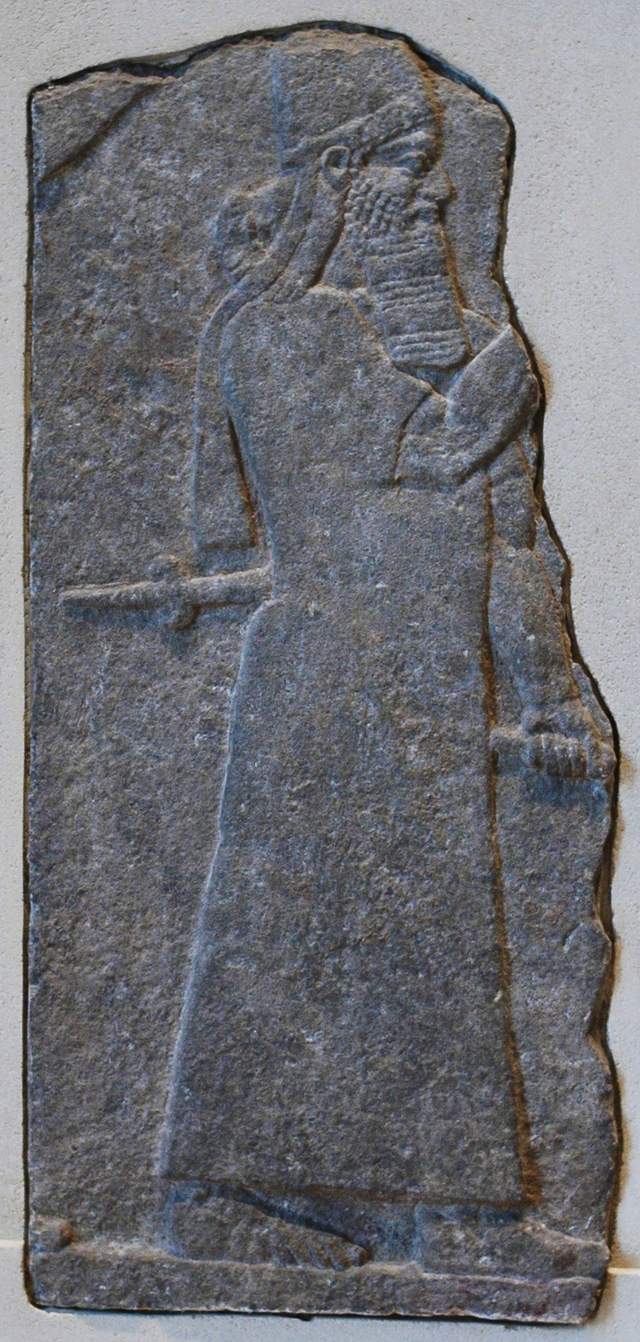
SNo public-domain or openly licensed portrait of Sennacherib found in the sources checked. Nearest: the Met relief of his reign linked on this page, CC0 (Met Open Access); the Lachish relief in the British Museum is not hosted.
Sennacherib
King of Assyria · 705 to 681 BCE
Sennacherib: Read more
Built at Nineveh, recorded the third campaign against Judah and Lachish, and took and destroyed Babylon in 689 BCE.
In their words
“Himself, like a caged bird, I shut up in Jerusalem, his royal city. Earthworks I threw up against him,—the one coming out of his city gate I turned back to his misery.”
“Sennacherib, king of the universe, king of Assyria, sat upon a house chair (while) the booty of Lachish passed before him.”
“After I had destroyed Babylon, had smashed the gods thereof, and had struck down its people with the sword,—that the ground of that city might be carried off, I removed its ground and had it carried to the Euphrates (and on) to the sea.”
ENo separate portrait hosted. Nearest: his victory stele from Sam'al, shown as a body figure on this page (Commons photograph, CC BY-SA 4.0); the one Commons detail photograph checked cuts off the king's face.
Esarhaddon
King of Assyria · 681 to 669 BCE
Esarhaddon: Read more
Rebuilt Babylon, set up the Senjirli victory stele, and imposed the 672 BCE succession oaths for Ashurbanipal and Shamash-shum-ukin.
In their words
“I had a stele made with my name inscribed (thereon) and on it I caused to be written the glory of the valor of Assur, my lord, my mighty deeds,—how I went to and fro under the protection of Assur, my lord, and the might of my conquering hand. For the gaze of all my foes, to the end of days, I set it up.”
“I made them carry the basket and laid the headpad upon them. [...] I raised the headpad to my own head and carried it.”
“Seventy years as the period of its desolation he wrote (down in the Book of Fate). But the merciful Marduk—his anger lasted but a moment—turned (the book) upside down and ordered its (the city's) restoration in the eleventh year.”
Photo: Osama Shukir Muhammed Amin FRCP(Glasg) (Commons user Neuroforever), CC BY-SA 4.0
Ashurbanipal
King of Assyria · 669 to about 631 BCE
Ashurbanipal: Read more
Last king to rule the empire at its widest; his own texts describe his scribal education and the beheading of the Elamite king Teumman.
In their words
“With their corpses I blocked the Ulai. With their bodies I filled the plain about Susa as with baliu and ashagu. The head of Teumman, king of Elam, at the command of Assur and Marduk, the great gods, my lords, [I cut off] in the presence of [his] armies.”
“The art (lit., work) of the Master Adapa I learned (lit., acquired),—the hidden treasure of all scribal knowledge, the 'signs' of heaven and earth.”
Babylonian kings
NNo public-domain or openly licensed portrait found; no contemporary portrait of Nabopolassar was located in the sources checked.
Nabopolassar
King of Babylon · 626 to 605 BCE
Nabopolassar: Read more
Crowned king of Babylon in 626 BCE and, with the Medes, took Nineveh in 612 BCE.
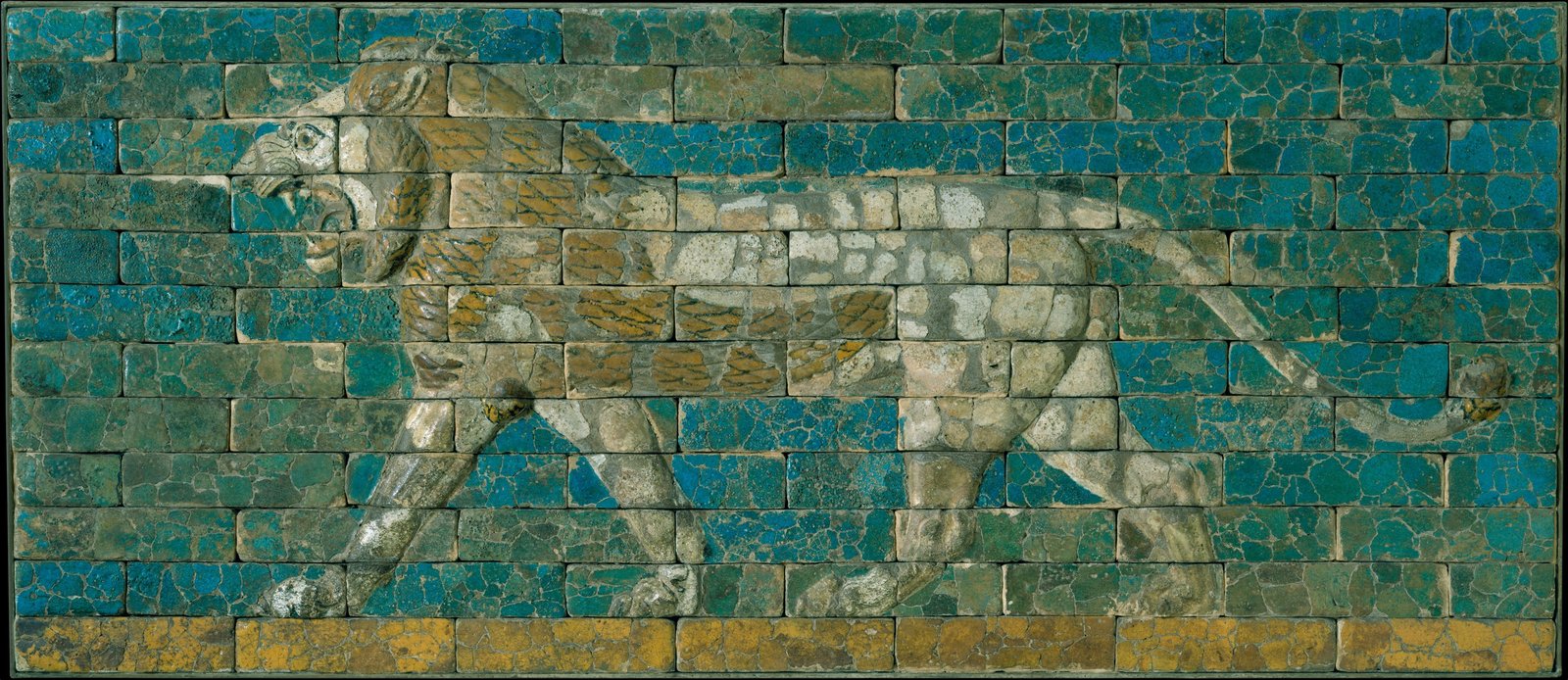
NINo public-domain or openly licensed portrait found; no contemporary portrait of Nebuchadnezzar II was located in the sources checked. Nearest: the Met glazed-brick lion panel of his reign linked on this page, CC0 (Met Open Access).
Nebuchadnezzar II
King of Babylon · 605 to 562 BCE
Nebuchadnezzar II: Read more
Took Jerusalem in 597 BCE and left mostly building inscriptions on the walls and temples of Babylon.
In their words
“A great wall, which like a mountain cannot be moved, of mortar and brick I built”
“The fortifications of Esagila and of Babylon I strengthened and made an everlasting name for my reign.”
“which Marduk the Lord had entrusted to me, among all lands, the totality of dwelling places, I exalted Babylon to the first place.”
Photo: BabelStone (Commons user BabelStone), CC0 1.0
Nabonidus
King of Babylon · 556 to 539 BCE
Nabonidus: Read more
Rebuilt the Ehulhul temple of the moon god Sin at Harran and spent years at Tayma; deposed by Cyrus of Persia in 539 BCE.
In their words
“Nabonidus, king of Babylon, supporter of E-sagila and E-zida, who fears the great gods, am I.”
“As for me, Nabonidus, king of Babylon, save me from sinning against thy great godhead. A life of far days as a gift grant unto me. And as for Belshazzar, the first-born son, the issue of my body, do thou implant in his heart the fear of thy great divinity.”
Background and rise to power
Assyria's heartland lay on the upper Tigris. The Neo-Assyrian period is conventionally dated from the accession of Adad-nirari II in 911 BCE; at its height in the seventh century the empire reached from the Zagros mountains to the Levant and, for a time, much of Egypt, the largest state western Asia had yet seen (Bedford 2009). Ashurnasirpal II (883 to 859 BCE) rebuilt the old town of Kalhu (Nimrud) as a royal city. His own text says: "That city I built anew, and the peoples whom my hand had conquered [...] I took and I settled them therein" (Luckenbill 1926, sec. 489). Shalmaneser III fought a coalition in Syria at Qarqar. Tiglath-pileser III, who took the throne in 745 BCE (Babylonian Chronicle 1), and Sargon II (722 to 705 BCE) put conquered lands under appointed officers and moved their people; Sargon records carrying off 27,290 people from Samaria (Luckenbill 1927, sec. 55). Sennacherib (705 to 681 BCE) campaigned in Judah and Babylonia; his son Esarhaddon (681 to 669 BCE) came to the throne after a struggle with rivals and rebuilt Babylon; under Ashurbanipal (669 to about 631 BCE) the empire stood at its widest.
Babylonia had been fought over and ruled from Assyria for generations when Nabopolassar was crowned king of Babylon in 626 BCE. With Median help he took Nineveh in 612 BCE; the Fall of Nineveh Chronicle records a siege of three months there and a last Assyrian stand at Harran in 610 to 609 BCE. His son Nebuchadnezzar II (605 to 562 BCE) took Jerusalem in 597 BCE (Babylonian Chronicle 5) and rebuilt the walls and temples of Babylon. Nabonidus, son of a man named Nabu-balatsu-iqbi (Rogers 1912), ruled from 556 BCE; Cyrus of Persia took Babylon in October 539 BCE.
How power was organized
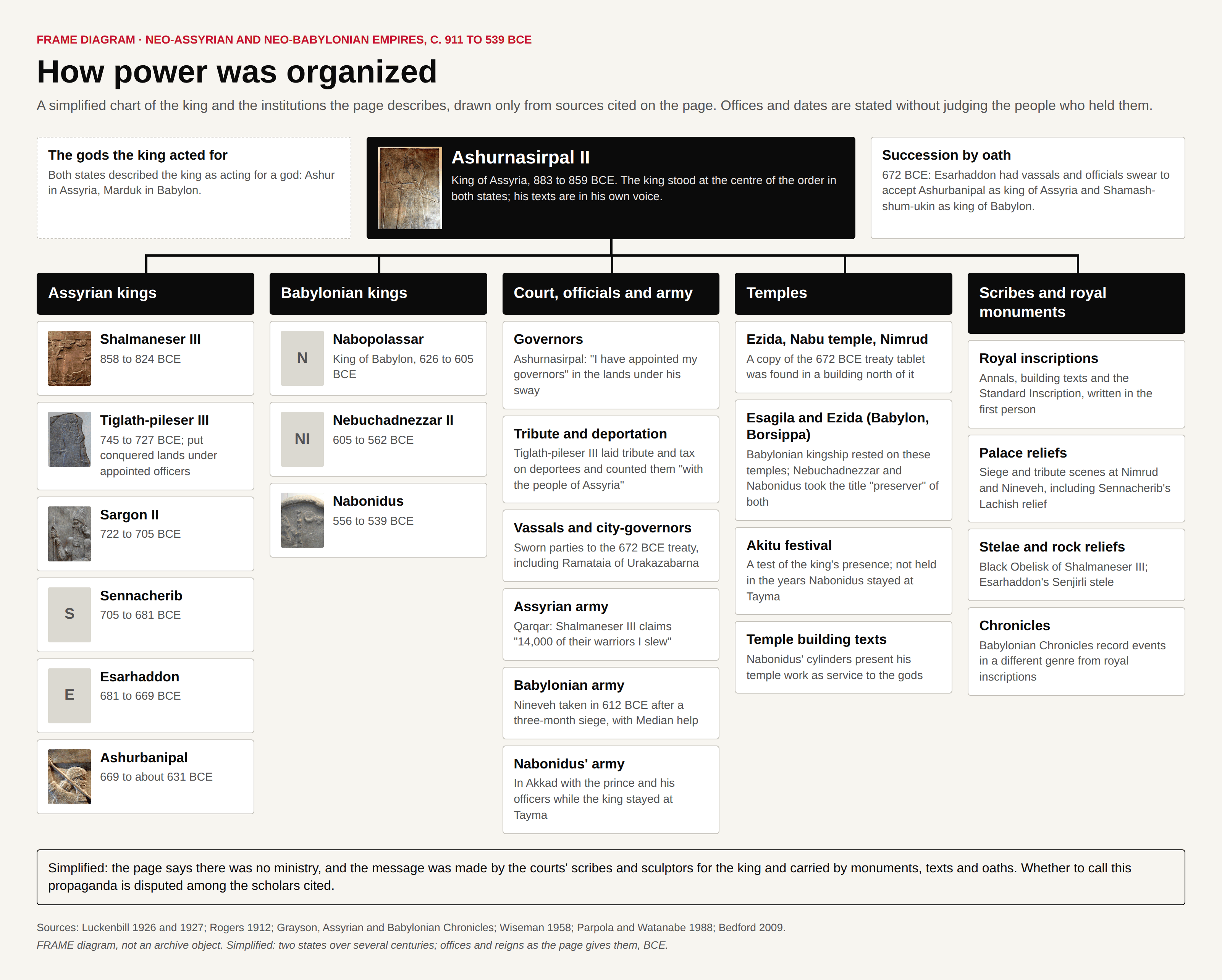
In both states the king stood at the centre of the order, and both described him as acting for a god: Ashur in Assyria, Marduk in Babylon. Assyrian royal titulary names the king "king of the universe, king of Assyria" and credits Ashur with the "merciless weapon" he used (Luckenbill 1926, secs. 486 to 487). The king's own texts show the working parts of the empire as governors, tribute and deportation: Ashurnasirpal writes "In the lands which I have brought under my sway I have appointed my governors" (sec. 487), and Tiglath-pileser III records that he laid tribute and tax on deportees and counted them "with the people of Assyria" (sec. 763).
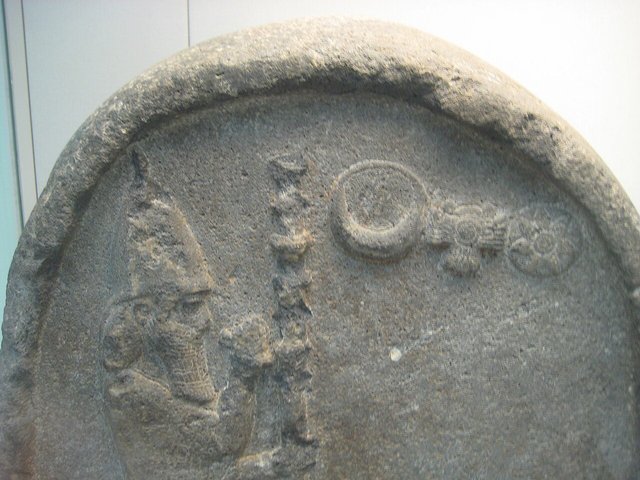
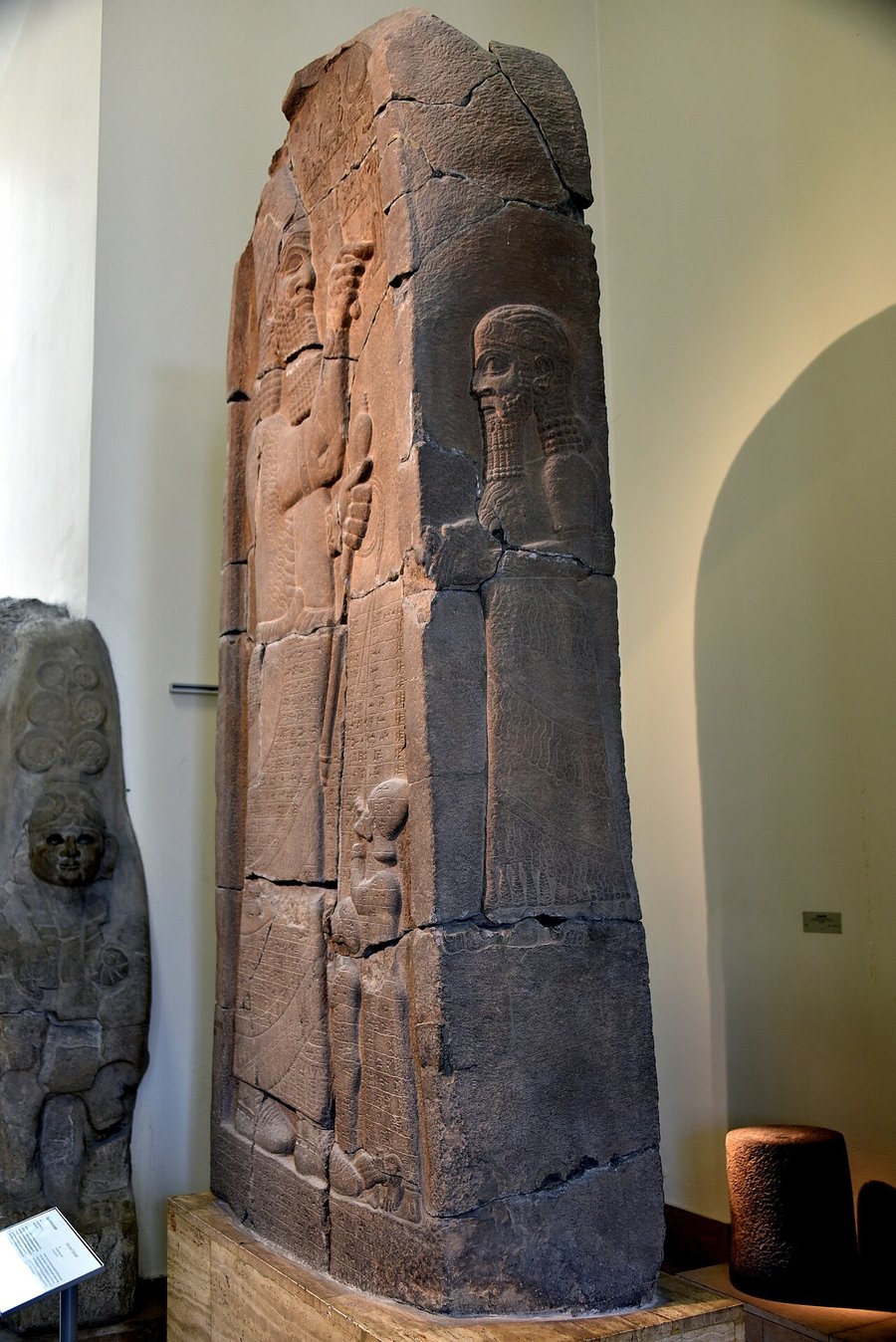
Esarhaddon's victory stele from Senjirli (Sam'al), 671 BCE, now in the Pergamon Museum, Berlin; in its text the king says it was set up "for the gaze of all my foes". Source: Photograph by Osama Shukir Muhammed Amin FRCP(Glasg) (Commons user Neuroforever), via Wikimedia Commons, CC BY-SA 4.0, CC BY-SA 4.0 (Commons file page, extmetadata LicenseShortName).
How power was organized in the Neo-Assyrian and Neo-Babylonian empires, simplified from the sources cited on this page. Source: FRAME diagram. Portraits, cropped to thumbnails: Photograph by Osama Shukir Muhammed Amin FRCP(Glasg), via Wikimedia Commons, CC BY-SA 4.0; relief in the British Museum; Photograph by Osama Shukir Muhammed Amin FRCP(Glasg), via Wikimedia Commons, CC BY-SA 4.0; relief in the British Museum; Photograph by BabelStone, via Wikimedia Commons, CC0 1.0; stele in the British Museum; Photograph by Vassil, via Wikimedia Commons, CC0 1.0; relief in the Louvre; Photograph by Steven G. Johnson, via Wikimedia Commons, CC BY-SA 3.0; Black Obelisk in the British Museum; Photograph by Jastrow (2005), via Wikimedia Commons, public domain; relief AO 19853 in the Louvre, CC BY-SA 3.0 / CC BY-SA 4.0 (the portraits that carry it); other portraits: CC0 1.0; Public domain (Commons tag).
Succession was secured by oath. In 672 BCE Esarhaddon had his vassals and officials swear to accept Ashurbanipal as king of Assyria and Shamash-shum-ukin as king of Babylon. Copies of the treaty tablet were found in 1955 at Nimrud, in a building north of Ezida, the temple of Nabu, naming a Median chieftain, Ramataia of Urakazabarna, and other city-governors as the sworn parties (Wiseman 1958; edition by Parpola and Watanabe 1988).
Babylonian kingship rested on the temples of Babylon and Borsippa. Both Nebuchadnezzar and Nabonidus took the title translated "preserver" or "supporter" of Esagila and Ezida (Rogers 1912, pp. 368, 378). The New Year festival (Akitu) was therefore a test of the king's presence: the Nabonidus Chronicle says it was not held in the years the king stayed at Tayma in Arabia while "the prince, his officers, (and) his army" were in Akkad (Grayson, as on Livius.org).
Illustration, not an archive object
The propaganda apparatus
There was no ministry. The message was made by the courts' scribes and sculptors for the king and carried by monuments, texts and oaths. Assyria used four main channels, each in the king's own voice.
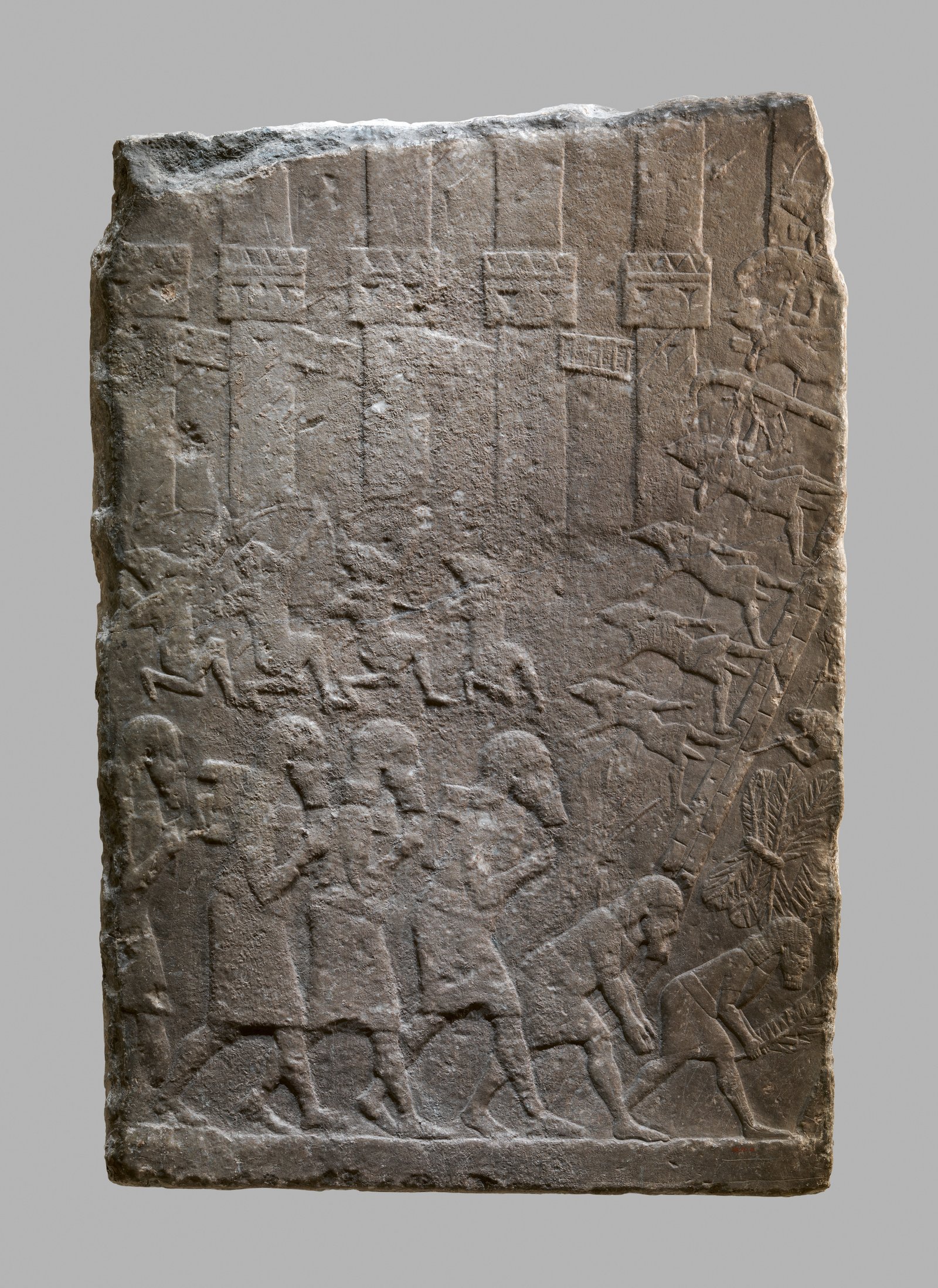
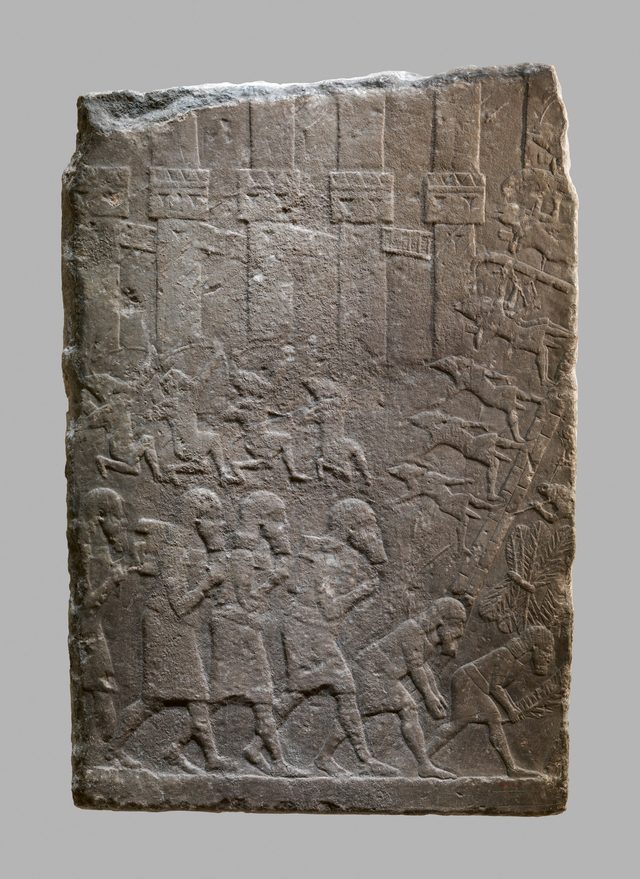
Content note: An Assyrian palace relief of troops storming a fortified city, with a file of figures below; Assyrian royal reliefs and texts record killing, mutilation and deportation, shown as carved, with the historical context and scholarly dispute on the regime page. This object is shown as it was published. Why
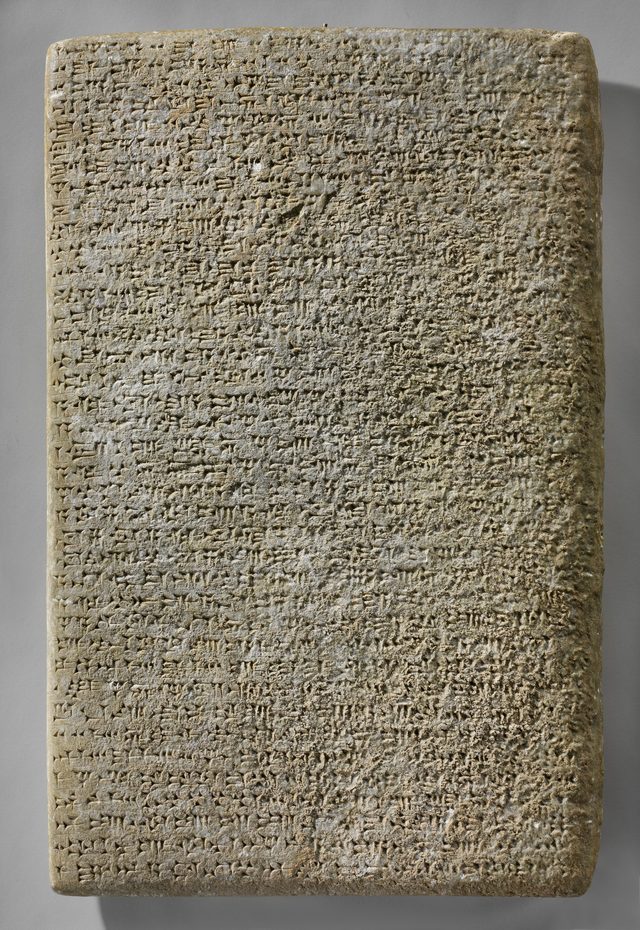
Royal inscriptions. Annals, building inscriptions and standard texts were written in the first person. The "Standard Inscription" of Ashurnasirpal II was engraved on the slabs of the palace at Nimrud, sculptured or plain (Luckenbill 1926, sec. 485; a Nimrud slab in the Met). The annals describe violence in detail. Ashurnasirpal writes that he "flayed all the chief men who had revolted" and "covered the pillar with their skins" (sec. 443; the passage is offensive and is quoted as the text has it). Shalmaneser III claims "14,000 of their warriors I slew with the sword" at Qarqar (sec. 611).
Palace reliefs. Siege and tribute scenes covered the walls of the palaces at Nimrud and Nineveh (a relief of troops storming a citadel, from Nineveh, in the Met). The most elaborate is Sennacherib's relief of Lachish, now in the British Museum, with an epigraph: "Sennacherib, king of the universe, king of Assyria, sat upon a house chair (while) the booty of Lachish passed before him" (Luckenbill 1927, sec. 489; Ussishkin 1982 on the siege and the relief).
Stelae and rock reliefs. The Black Obelisk of Shalmaneser III carries a caption for each tribute scene, including "Tribute of Iaua (Jehu), son of Omri" (Luckenbill 1926, sec. 590). Esarhaddon's victory stele from Senjirli shows him with ropes passing through the lips of two figures at his feet (Luckenbill 1927, sec. 573), and its text says it was set up "for the gaze of all my foes, to the end of days" (sec. 580), a claim about audience that bears on the dispute set out below.
Oaths and treaties. The 672 BCE oaths were addressed to vassals and governors, not to a general public, and a copy lay in the Nabu temple precinct at Nimrud (Wiseman 1958; Parpola 1987).
What each side said about Babylon. Sennacherib's text for the Akitu house at Assur says: "After I had destroyed Babylon, had smashed the gods thereof, and had struck down its people with the sword" he had its soil carried to the sea (Luckenbill 1927, sec. 438). The Babylonian Chronicle records that the city of Babylon was captured on the first of Kislimu in 689/688 BCE and its king taken to Assyria (Chronicle 1). Esarhaddon's Babylon inscription gives a third account: in "the reign of a former king" the people of Babylon split into factions and plundered the temple treasure, Marduk's anger brought a flood, and he "wrote" seventy years of desolation and then "turned (the book) upside down" in the eleventh year (sec. 650). It does not name Sennacherib. The three texts differ in who acts and why.
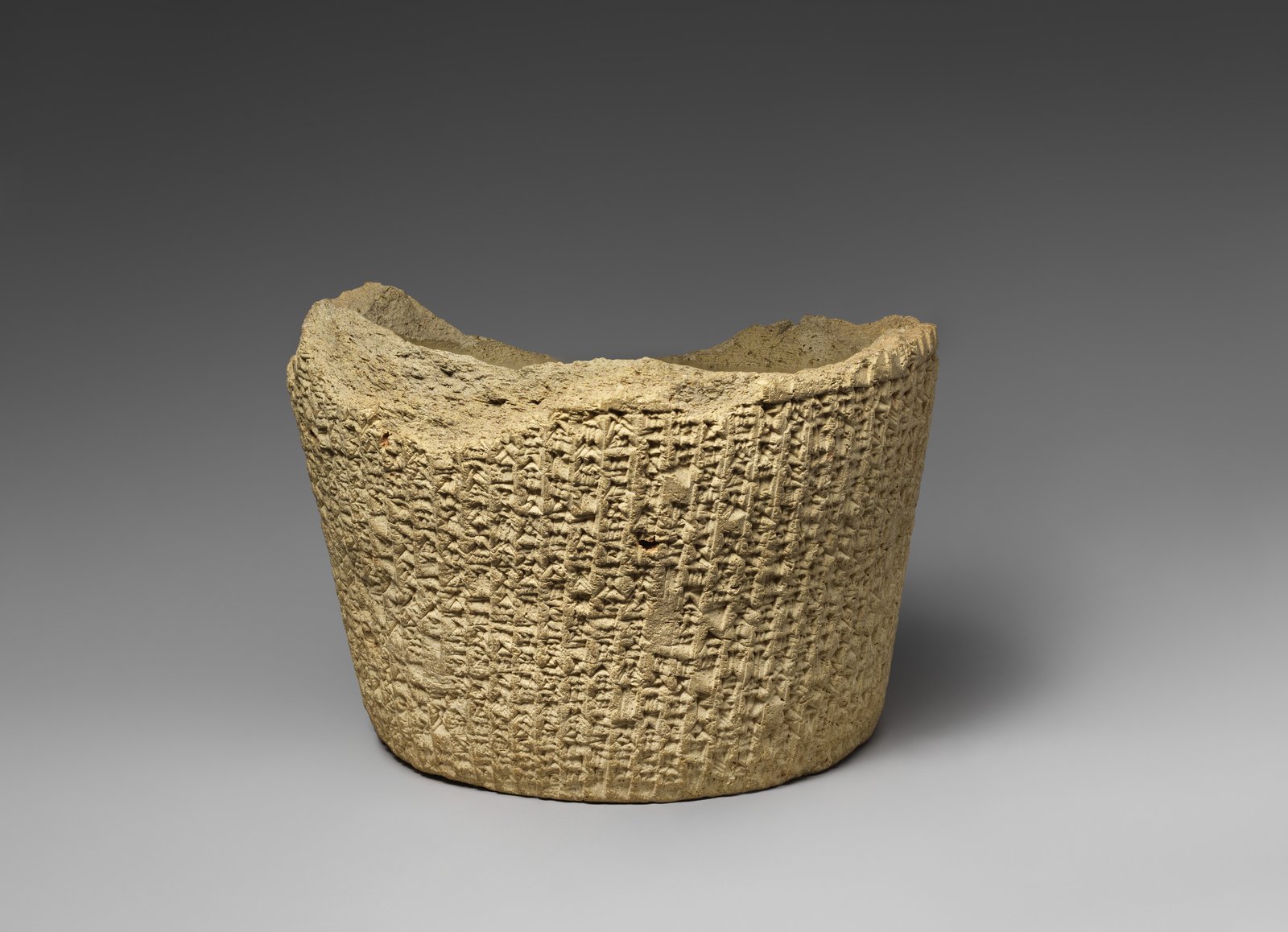
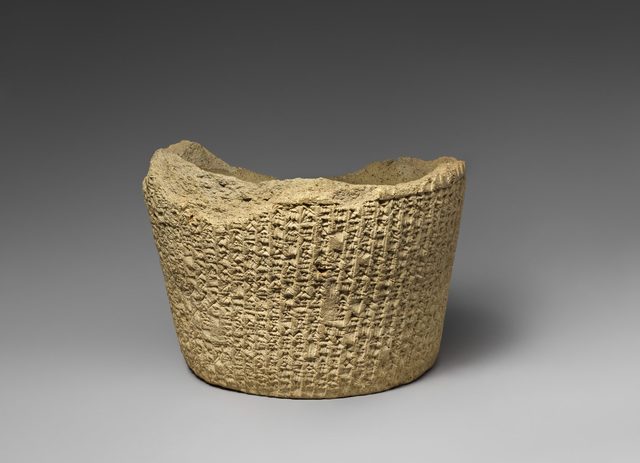
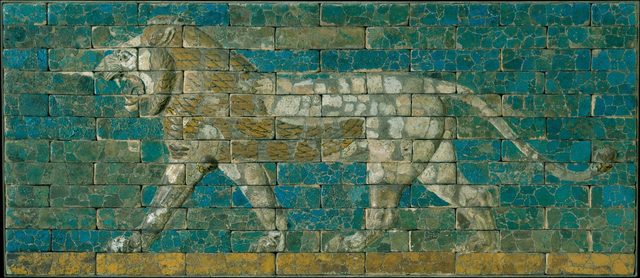
Babylon. Nebuchadnezzar's inscriptions are mostly building texts. Rogers (1912, p. 360) notes that few give accounts of campaigns, and one reads "A great wall, which like a mountain cannot be moved, of mortar and brick I built" (p. 368). A glazed lion panel from Babylon in the Met dates to his reign (panel). The Babylonian Chronicle, a different genre, records a campaign in his fourth year that ended with both armies suffering "great havoc" and "the king of Akkad turned back" (Chronicle 5). Nabonidus' cylinders present his temple work as service to the gods, and the Ur cylinders end with a prayer that includes his son Belshazzar (Rogers 1912, p. 379; the Ehulhul cylinder in the Met). Cylinders like these were buried in the building, found at the four corners of the Sin temple at Ur (Rogers 1912, p. 378), where only later builders would read them. The accounts that blame him are Persian-side or written after the conquest. The Cyrus Cylinder, in Cyrus's name, says Marduk "looked with gladness upon his good deeds and upright heart" and that Cyrus entered Babylon "without fighting or battle". The Nabonidus Chronicle, a Babylonian text, also says Cyrus's army entered the city "without battle", and it records the lapsed festivals and the earlier fighting at Opis, in which Cyrus "carried off the plunder (and) slaughtered the people".
Where "propaganda" is used, and what is disputed. The word is modern. Larsen's 1979 volume Power and Propaganda: A Symposium on Ancient Empires applied it to ancient empires, Assyria among them, and Liverani's chapter in it prefers "ideology": the themes, images and oppositions used to present events in the light of the official political interpretation (Liverani 1979, reprinted 2021). Oded (1998) uses "propaganda" of the Assyrian royal inscriptions in general and Laato (1995) of Sennacherib's, which he also calls a "falsification of history"; Galter (2022) sets "royal propaganda" against "historical positioning", and Karlsson (2022) treats "ideology and propaganda" together in the Neo-Assyrian and Neo-Babylonian empires. The titles show the questions in dispute: whether the royal inscriptions are reliable history or distorted, whether the violent scenes were meant for foreigners or for the Assyrian court and elite (Bagg 2016 asks "Where is the Public?"), and whether "ideology" is a better word than "propaganda". Two examples show why the first question is live. Shalmaneser's Qarqar claim comes from his own monolith, and Sennacherib's text says he shut Hezekiah up in Jerusalem "like a caged bird" without claiming to have taken the city (Luckenbill 1927, sec. 240). For Babylon, Beaulieu (1989) and Wiseman differ on whether Nabonidus was a religious reformer who raised the moon god Sin above Marduk, and the texts that say so, the Verse Account and the Cyrus Cylinder, were written under Persian rule.
The archive's definitions fit as follows. Transfer applies where the king's acts are credited to Ashur or Marduk. Glittering generalities applies where titles and virtue-words stand in for a claim. Card-stacking applies where a defeat appears in a chronicle, as in 601 BCE, but not in royal inscriptions. Testimonial applies where a god or oracle is made to vouch for a campaign.
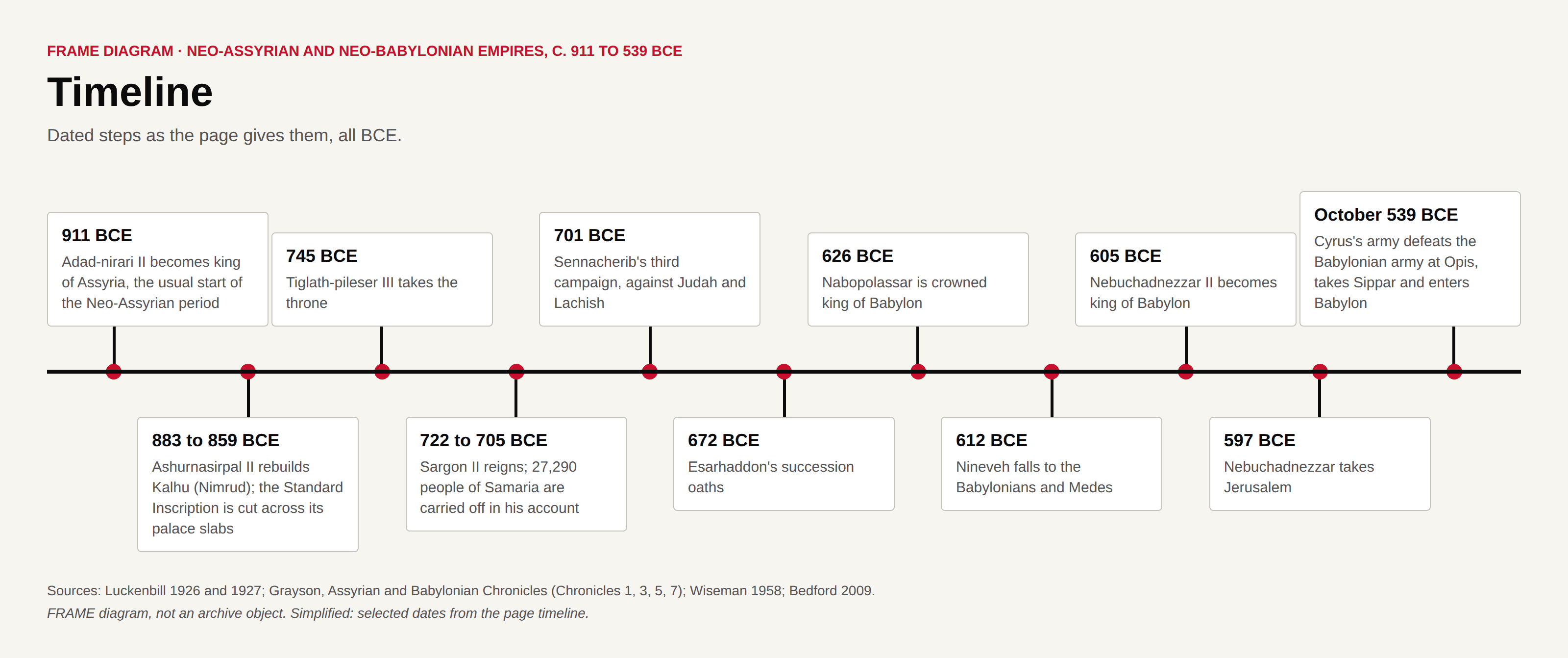
Timeline
911 BCE: Adad-nirari II becomes king of Assyria, the usual start of the Neo-Assyrian period.
883 to 859 BCE: Ashurnasirpal II rebuilds Kalhu (Nimrud); the Standard Inscription is cut across its palace slabs.
745 BCE: Tiglath-pileser III takes the throne.
722 to 705 BCE: Sargon II reigns; Samaria is taken and 27,290 of its people are carried off in his account.
701 BCE: Sennacherib's third campaign, against Judah and Lachish.
689 BCE: Babylon is captured by Sennacherib.
681 BCE: Esarhaddon succeeds Sennacherib.
672 BCE: Esarhaddon's succession oaths.
669 BCE: Ashurbanipal succeeds; in 668 BCE Shamash-shum-ukin becomes king of Babylon.
626 BCE: Nabopolassar is crowned king of Babylon.
612 BCE: Nineveh falls to the Babylonians and Medes.
610 to 609 BCE: Harran falls; Assyria disappears from the record.
605 BCE: Nebuchadnezzar II becomes king of Babylon.
597 BCE: Nebuchadnezzar takes Jerusalem.
556 BCE: Nabonidus takes the throne.
October 539 BCE: Cyrus's army defeats the Babylonian army at Opis, takes Sippar and enters Babylon.
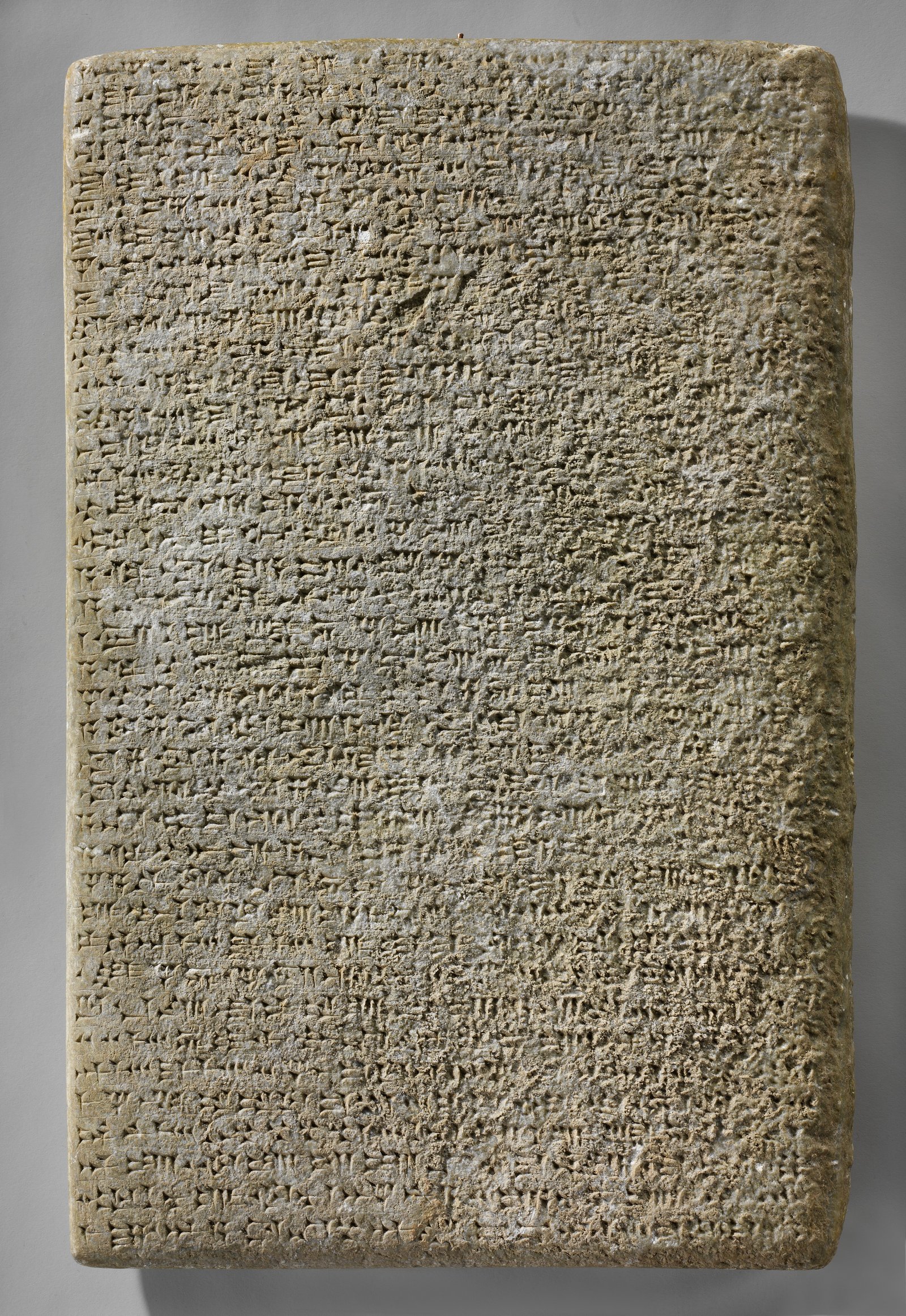
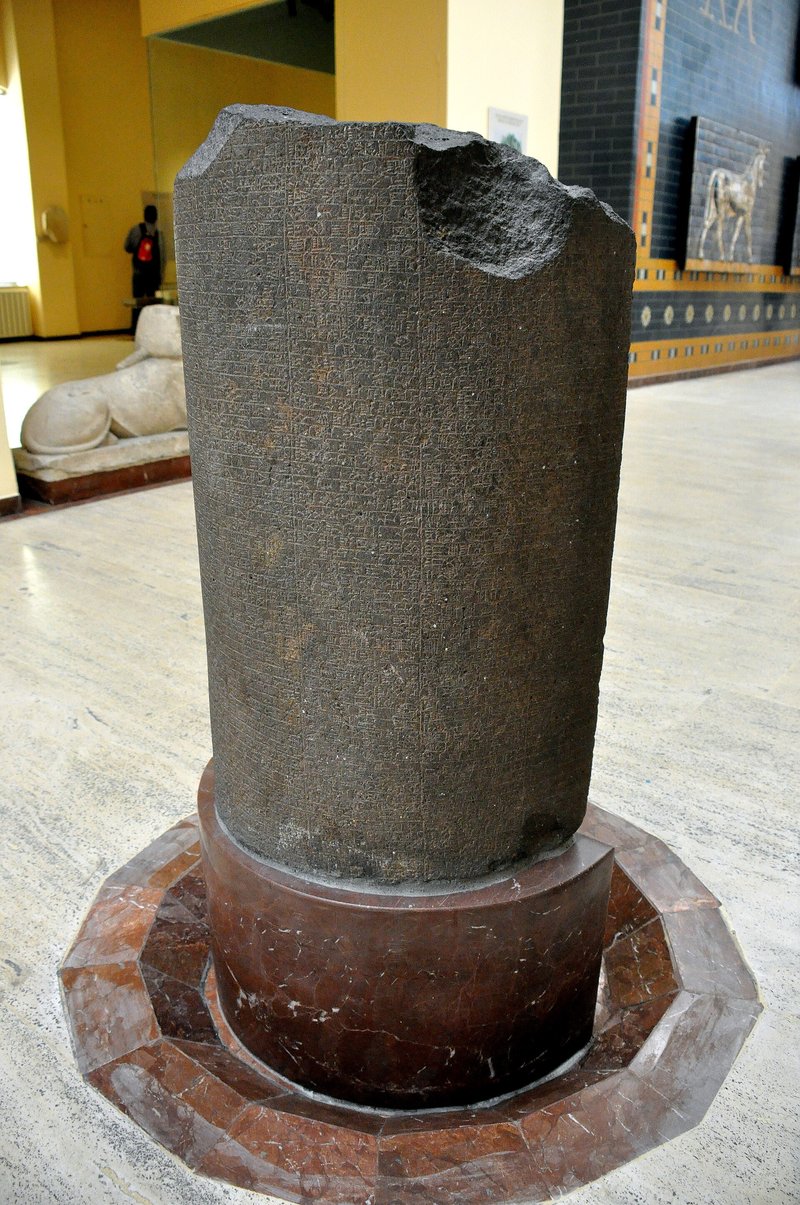
Clay cylinder with the Ehulhul inscription of Nabonidus, king of Babylon, describing work on three temples, 0000. From the collection. Nabonidus' own building text; the accounts that criticise him are Persian-side or written after the conquest.A granite stele of Nabonidus from Babylon, covered in cuneiform, in the Istanbul Archaeology Museums; its top is broken. Photograph CC BY-SA 4.0. Source: Photograph by Osama Shukir Muhammed Amin FRCP(Glasg) (Commons user Neuroforever), via Wikimedia Commons, CC BY-SA 4.0, CC BY-SA 4.0 (Commons file page, extmetadata LicenseShortName).
Key dates, 911 to 539 BCE, simplified from the sources cited on this page. Source: FRAME diagram, drawn from the sources listed on this page, CC BY 4.0 (FRAME archive content).
How it ended
Assyria was broken by the Babylonian and Median campaigns recorded in the Fall of Nineveh Chronicle: Nineveh fell after a three-month siege in 612 BCE, and Ashur-uballit II, the last Assyrian king named in the sources, abandoned Harran in 610 or 609 BCE. Babylon fell to Cyrus in October 539 BCE: the Nabonidus Chronicle says Cyrus's army entered "without battle", Nabonidus "was captured in Babylon" and Cyrus himself entered on the third day of Arahsamna. Babylonia then came under Persian rule.
Same-standard note
This page uses the same definitions and structure as every other regime page, applied to two ancient empires whose evidence is first-person royal texts, carved reliefs and chronicles rather than newspapers or broadcasts. The word "propaganda" is used here only as the cited scholars use it, with the dispute stated, and the texts are read for what they say, not for what the king meant. Scale and context differ from modern states: these were pre-modern monarchies with no mass media, whose records mix religious, administrative and ideological purposes, and the page does not imply that any technique had the same effect, reach or intent as in a modern regime. Atrocity descriptions are quoted as the texts have them, and the sources that criticise Nabonidus are Persian-side or later and are marked as such.
Sources
Daniel David Luckenbill, Ancient Records of Assyria and Babylonia, vol. 1 (Chicago, 1926), secs. 443, 485 to 489, 590, 611, 763; vol. 2 (Chicago, 1927), secs. 55, 240, 438, 489, 573, 580, 646, 650, 863.
Robert William Rogers, Cuneiform Parallels to the Old Testament (Oxford, 1912), pp. 360 to 369, 373, 378 to 379.
A. K. Grayson, Assyrian and Babylonian Chronicles (Locust Valley, 1975), as translated on Livius.org: Chronicles 1 (tablet B), 3 (Fall of Nineveh), 5 (Jerusalem) and 7 (Nabonidus). D. J. Wiseman, Chronicles of Chaldaean Kings (626 to 556 BC) in the British Museum (London, 1956).
The Cyrus Cylinder, a Persian-side text: translation after Mordechai Cogan in The Context of Scripture II and the edition of Hanspeter Schaudig (2001), as on Livius.org; Irving Finkel (ed.), The Cyrus Cylinder (London, 2013).
D. J. Wiseman, "The Vassal-Treaties of Esarhaddon," Iraq 20 (1958), 1 to 99; Simo Parpola, "Neo-Assyrian Treaties from the Royal Archives of Nineveh," Journal of Cuneiform Studies 39 (1987), 161 to 189; Simo Parpola and Kazuko Watanabe, Neo-Assyrian Treaties and Loyalty Oaths (Helsinki, 1988).
Peter Ross Bedford, "The Neo-Assyrian Empire," in Ian Morris and Walter Scheidel (eds.), The Dynamics of Ancient Empires (Oxford, 2009), 30 to 65. Mogens Trolle Larsen (ed.), Power and Propaganda: A Symposium on Ancient Empires (Copenhagen, 1979); Mario Liverani, "The Ideology of the Assyrian Empire," in that volume, reprinted in his Historiography, Ideology and Politics in the Ancient Near East and Israel (London, 2021), 135 to 154.
Ariel M. Bagg, "Where is the Public? A New Look at the Brutality Scenes in Neo-Assyrian Royal Inscriptions and Art," in Making Pictures of War (Oxford, 2016), 57 to 82. Oded, "History Vis-à-vis Propaganda in the Assyrian Royal Inscriptions," Vetus Testamentum 48 (1998), 423 to 425. Antti Laato, "Assyrian Propaganda and the Falsification of History in the Royal Inscriptions of Sennacherib," Vetus Testamentum 45 (1995), 198 to 226. Galter, "Assyrian Royal Inscriptions between Royal Propaganda and Historical Positioning" (2022), 87 to 114, and Karlsson, "'An object of wonder for all of the people': Ideology and Propaganda in the Neo-Assyrian and Neo-Babylonian Empires" (2022), 245 to 269, both in Ancient Near Eastern Weltanschauungen in Contact and in Contrast.
David Ussishkin, The Conquest of Lachish by Sennacherib (Tel Aviv, 1982). Paul-Alain Beaulieu, The Reign of Nabonidus, King of Babylon, 556 to 539 BC (New Haven, 1989).
Object records: The Metropolitan Museum of Art Open Access, accession numbers 58.31.57, 55.121.4a-b, 31.13.1 and 86.11.281.