- Actor
- The Islamic State's central media bodies (al-Furqan, al-Hayat Media Center, al-Bayan radio, Amaq News Agency, the al-Himma Library) and its provincial media offices; the state, coalition, platform and law-enforcement actors that worked against them are scored under the same definitions below
- Target
- Arabic-speaking populations in and near its territory, Muslims and potential recruits abroad in several languages, and enemy governments and publics
- Source
- Identified white to black (white for the attributed official outlets; black only for the layer that presented centrally directed output as unofficial or spontaneous, which is documented for Amaq's self-description and the "media operative" supporter network; black here means concealed direction, not fabricated content)
- Techniques
- Fear appealIdentity fusionGlittering generalitiesScapegoatingTestimonialNarrative laundering
- First seen
- 2013 (media branch inherited from the group's predecessor, whose al-Furqan institute released its first product on 31 October 2006); peak output 2015; decline 2016-2019
- Status
- disrupted November 22, 2019 (last large coordinated referral action against its distribution network; the territorial "caliphate" ended March 23, 2019; a reduced, dispersed output continued)
- Related briefs
- none
Case study: The Islamic State's media machine: Dabiq, Rumiyah, Amaq and the 'virtual caliphate' tells the story of the magazines and the videos. This file gives the structured record of the apparatus and the counter-effort, and follows the primary reports cited here where a figure differs.
Scope note, stated once. Killings of hostages and prisoners were published by this apparatus as video, and its recruitment material is a live product. This page describes and cites that material and does not host or embed it. The footage is documented in the research cited below. Hosting it would amplify a recruitment product that still circulates, and that is a scope-boundary decision, not a decision to leave the record out. The images on this page show the counter-effort, because the apparatus's own imagery is the part that cannot be shown.
Mechanism
Structure. Captured documents examined by Daniel Milton (Combating Terrorism Center, West Point, 2016) show that the group's predecessor set up al-Furqan when it became the Islamic State of Iraq, releasing its first product on 31 October 2006, and treated media as a way to win or frighten the population. By 2016 the "Ministry of Media" in Milton's chart included al-Hayat (all non-Arabic translation and the magazines Dabiq and Rumiyah), al-Bayan radio, Amaq, and a set of geographic media bureaus. Charlie Winter's 2015 archive named the provincial offices and the al-Furqan, al-I'tisam and Ajnad foundations. English-language magazine output ran to fifteen issues of Dabiq and thirteen of Rumiyah between June 2014 and September 2017, per Haroro Ingram.
What it produced. In one lunar month (17 July to 15 August 2015) Winter recorded 1,146 official "events", 38.2 a day, and reduced them to 892 for analysis. Of those 892, 469 (52.57%) were mainly about civilian life, which he called utopia, 331 (37.12%) were about war, and 19 (2.13%) were brutality. Milton coded more than 9,000 visual releases from January 2015 to August 2016 and found about 9% showed executions or battlefield killings, more than half were outside the battlefield, and about 90% were pictures rather than videos. Both say brutality was a smaller share than commonly assumed in the official channels they sampled. Winter's set leaves out officially prescribed tweets and individual attack claims, and he says the brutality material that month was aimed more at the local population than at foreign audiences.
How the techniques map. - Glittering generalities: markets, harvests, justice and worship offered as proof of a functioning state that outsiders could not check. This is the largest category in both datasets. - Identity fusion: Ingram's "identity-choice" reading is that the core narrative is "we are champions and protectors of Sunni Muslims" and the only hope against enemy-induced crises, so that judging the group is placed inside a choice about who one is. - Scapegoating: the same narrative assigns Sunni crises to enemy out-groups. Ingram quotes Rumiyah issue 4 using dehumanising labels for them. That quotation is in the source and is not reproduced here. - Fear appeal: a threat to Muslims in the West with one prescribed exit (migration), and staged harm aimed at local populations and enemies. - Testimonial: Winter's "belonging" stream, in which fighters of a given nationality address their countrymen. It was under 4% of his sample. This is a partial match. - Narrative laundering: Winter notes Amaq called itself unofficial (ghayr rasmi) on its own website, while Milton's later chart places it inside the Ministry of Media. ICSR's Media Jihad (2017) reports that the group's "media operative" booklet deliberately blurs the line between official and unofficial activism and that output is directed from the central media office. Independence was presented that was not documented.
Distribution. Berger and Morgan (Brookings, March 2015) estimated at least 46,000 Twitter accounts used by supporters between September and December 2014, about 75% selecting Arabic and nearly 20% English, averaging about 1,000 followers, with 500 to 2,000 hyperactive accounts driving bursts. Al-Bayan bulletins ran in Arabic, Turkish, Kurdish, French, English and Russian. After suspensions, distribution moved toward Telegram and file-sharing sites.
Timeline
- October 31, 2006: al-Furqan releases its first product (Milton).
- June 29, 2014: the "caliphate" is declared (Winter).
- July 17, 2015 to August 15, 2015: Winter's monthly archive; Milton's monthly peak of 761 visual releases falls in August 2015.
- 2016-08: 194 releases, the lowest month in Milton's data.
- 2016-08 and 2017-06: first and second Amaq takedowns (Eurojust).
- April 25, 2018: multinational action against IS web infrastructure (Europol).
- March 23, 2019: the SDF declares the end of the group's territorial control at Baghouz.
- November 21, 2019 to 22: 16th Europol Referral Action Day (Eurojust gives 21 to 24 November for the wider action).
The counter-effort, scored the same way
- State counter-messaging. The Center for Strategic Counterterrorism Communications (CSCC) ran the attributed Twitter programme "Think Again Turn Away". VOA reported on 3 September 2014 that the State Department recut clips of the group's own releases into a warning video, a fear-appeal built from the operation's footage. A State official said the aim was to "contrast the gap that exists between ISIL rhetoric and reality". Erin Saltman of Quilliam called it "shock treatment" that might "play into Islamist extremist propaganda"; William Braniff said not to highlight the group's "bankruptcy" would be a greater mistake. On 16 September 2014 Rita Katz of SITE Intelligence called it "embarrassing" in Time and argued it gave jihadists a stage. The programme was white by the scale: attributed and open.
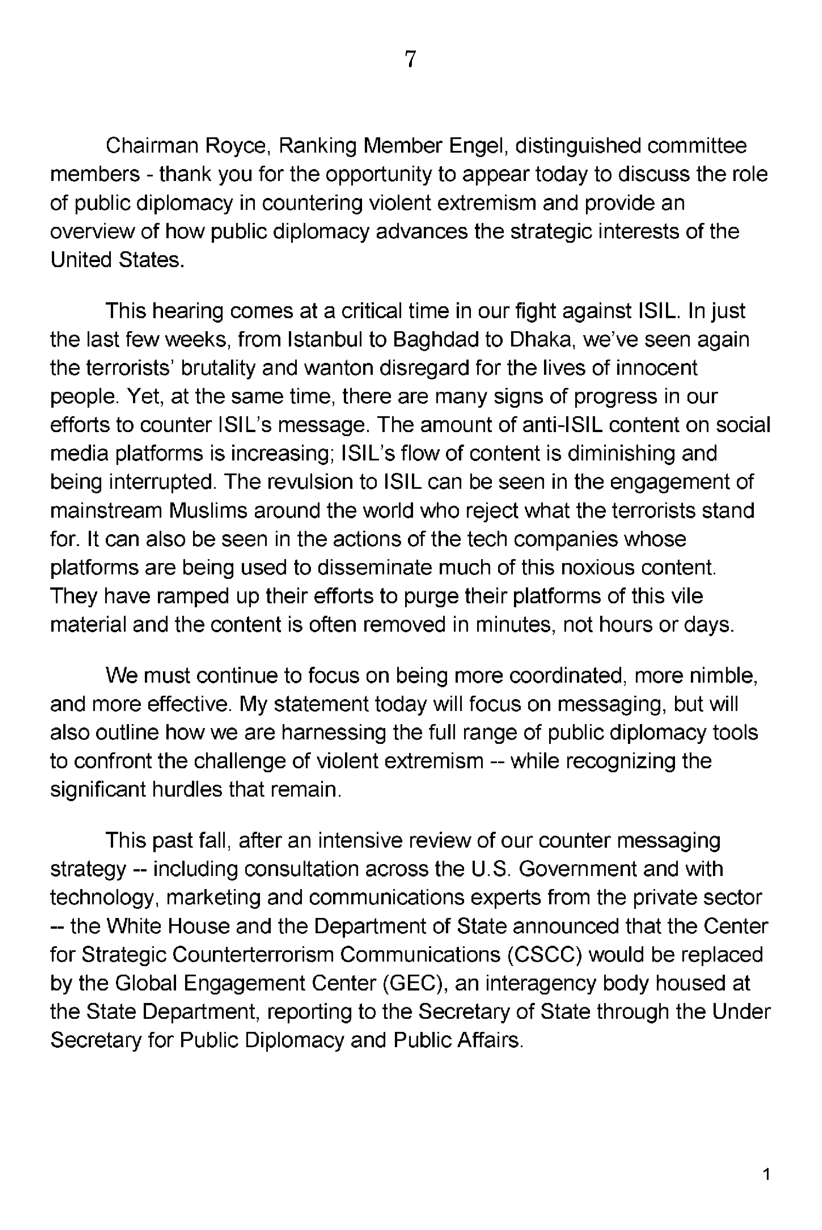
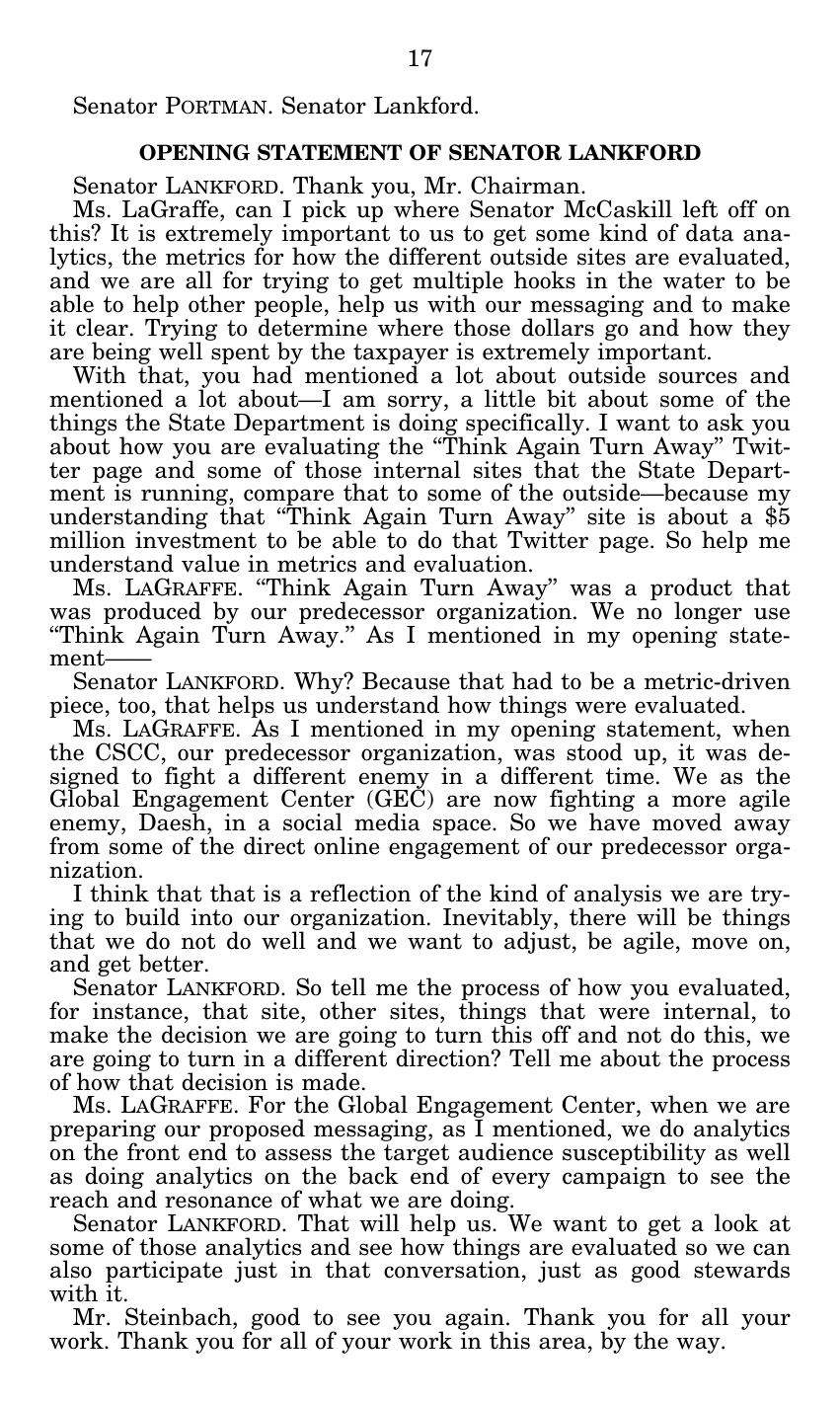
- Its own government's assessment. At a Senate hearing on 6 July 2016 Senator Lankford said the programme was "about a $5 million investment", and Meagan LaGraffe of the Global Engagement Center answered "We no longer use 'Think Again Turn Away.'" On 13 July 2016 House chairman Ed Royce said that because the messages carried the State Department seal "nobody listened", and Under Secretary Stengel said the new approach rested on the view that "our voice is not necessarily the best voice to be out there", and that partners help create and spread content, "Not always in their own name." On the colour scale, content placed under partners' names is less openly sourced than a State-branded feed, and the testimony says so openly. Executive Order 13721 (14 March 2016) replaced the CSCC with the Global Engagement Center.
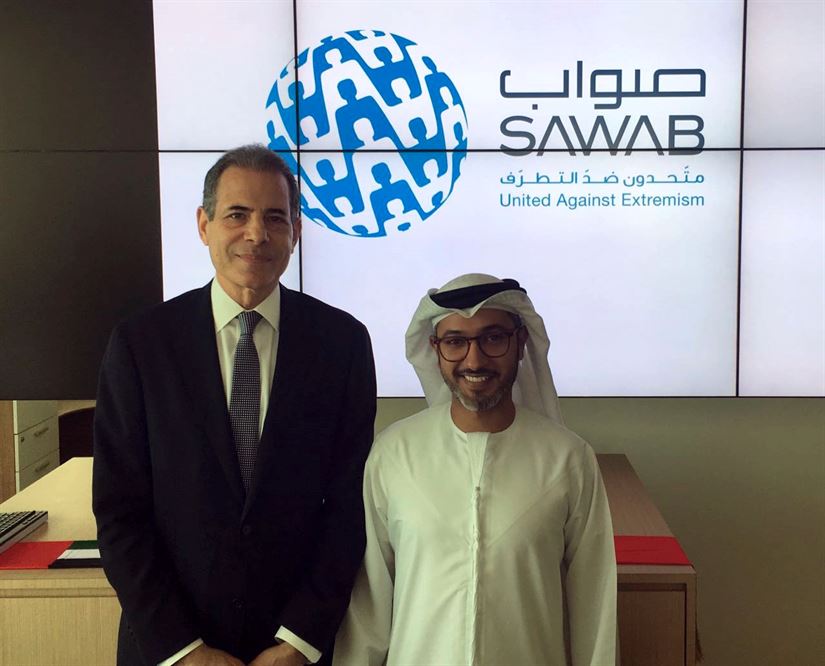
- Coalition. A Coalition Communications Cell in London and the Sawab Center in Abu Dhabi, a joint UAE-U.S. centre, worked under the Global Coalition's communications group. Stengel told the House that Sawab's nine campaigns since July 2015 averaged over 125 million views each; the hearing does not test that figure.
- Platforms and police. Twitter said in August 2016 that it had suspended 360,000 terrorism-related accounts since mid-2015 (Fortune). Facebook, Microsoft, Twitter and YouTube reported a shared database of more than 40,000 hashes by December 2017. The November 2019 action was a referral process: Europol flags branded material and the platforms decide under their own terms of service. Earlier actions included seizures, and Eurojust says the servers seized in June 2017 led to the identification of radicalised individuals in 133 countries and more than 200 million accesses by 52,000 possible consumers.
- Military. A Pentagon statement of 16 September 2016 said a 7 September strike near Raqqa killed Wa'il al-Fayad, described as the group's information minister who oversaw execution videos.
27 April 2016, U.S. Department of State photograph: Under Secretary Rick Stengel's visit to the Sawab Center, Abu Dhabi, the joint UAE-U.S. online messaging centre. Public domain, via Wikimedia Commons.
Evidence
- Charlie Winter, "Documenting the Virtual 'Caliphate'", Quilliam, 2015, 1,146 events, 38.2 a day, percentages of the abridged 892: https://static1.squarespace.com/static/6059d8709ae2c962e9a510db/t/60af681cdf931e6916cbc180/1622108192930/FINAL-documenting-the-virtual-caliphate.pdf
- Aaron Zelin, "Picture or It Didn't Happen", Perspectives on Terrorism 9(4), 2015, one-week snapshot: execution videos "just a fraction" of output: https://pt.icct.nl/article/picture-or-it-didnt-happen-snapshot-islamic-states-official-media-output
- J.M. Berger and Jonathon Morgan, "The ISIS Twitter Census", Brookings, 5 March 2015: https://www.brookings.edu/articles/the-isis-twitter-census-defining-and-describing-the-population-of-isis-supporters-on-twitter/
- Daniel Milton, "Communication Breakdown", CTC West Point, October 2016: https://ctc.westpoint.edu/communication-breakdown-unraveling-the-islamic-states-media-efforts/
- Charlie Winter, "Media Jihad", ICSR, 2017: https://icsr.info/wp-content/uploads/2017/02/ICSR-Report-Media-Jihad-The-Islamic-State%E2%80%99s-Doctrine-for-Information-Warfare.pdf
- Haroro Ingram, "Islamic State's English-language Magazines 2014-2017", ICCT, March 2018: https://icct.nl/publication/islamic-states-english-language-magazines-2014-2017-trends-implications-ct-cve
- Soufan Center, "Foreign Fighters", December 2015: between 27,000 and 31,000 travelled from at least 86 countries to join the Islamic State and other groups; social media "appears more often to prepare the ground for persuasion, rather than to force the decision": https://thesoufancenter.org/wp-content/uploads/2017/05/TSG_ForeignFightersUpdate_format-for-print-120915-REBRAND-031317.pdf
- Eurojust, on the November 2019 action and the 2016-2018 takedowns: https://www.eurojust.europa.eu/news/eu-judicial-and-law-enforcement-authorities-join-forces-disrupt-terrorist-propaganda-online
- Europol, 25 April 2018 and 21-22 November 2019 releases: https://www.europol.europa.eu/media-press/newsroom/news/islamic-state-propaganda-machine-hit-law-enforcement-in-coordinated-takedown-action and https://www.europol.europa.eu/media-press/newsroom/news/referral-action-day-against-islamic-state-online-terrorist-propaganda
- Meili Criezis, GNET, 30 July 2020 (rapid reorganisation on other platforms; some researchers' infiltration accounts lost): https://gnet-research.org/2020/07/30/telegrams-anti-is-campaign-effectiveness-perspectives-and-policy-suggestions/
- Fortune, 18 August 2016, Twitter suspensions: https://fortune.com/2016/08/18/twitter-terrorists
- Microsoft blog, 4 December 2017, hash database: https://blogs.microsoft.com/on-the-issues/2017/12/04/facebook-microsoft-twitter-and-youtube-provide-update-on-global-internet-forum-to-counter-terrorism/
- VOA, 3 September 2014: https://www.voanews.com/a/state-department-recasts-brutal-videos-dissuade-jihadists/2437465.html; Rita Katz, Time, 16 September 2014: https://time.com/3387065/isis-twitter-war-state-department/
- House Foreign Affairs Committee, 13 July 2016: https://www.govinfo.gov/content/pkg/CHRG-114hhrg20744/pdf/CHRG-114hhrg20744.pdf; Senate PSI, S. Hrg. 114-453, 6 July 2016: https://www.govinfo.gov/content/pkg/CHRG-114shrg22476/pdf/CHRG-114shrg22476.pdf
- Executive Order 13721: https://www.presidency.ucsb.edu/documents/executive-order-13721-developing-integrated-global-engagement-center-support-government
- Pentagon statement, 16 September 2016 (mirror): https://www.globalsecurity.org/military/library/news/2016/09/mil-160916-dod01.htm
- Al Jazeera and Long War Journal on Baghouz, 23 March 2019: https://www.aljazeera.com/news/2019/3/23/isil-defeated-in-final-syria-victory-sdf and https://www.longwarjournal.org/archives/2019/03/us-backed-forces-declare-end-to-islamic-states-caliphate.php
13 July 2016, House Committee on Foreign Affairs, "Countering the Virtual Caliphate", printed page 7: Under Secretary Stengel's prepared statement. U.S. Government Publishing Office; public domain.
6 July 2016, Senate Permanent Subcommittee on Investigations, "ISIS Online", printed page 17: questions about the Think Again Turn Away programme and the answer that it is no longer used. U.S. Government Publishing Office; public domain.
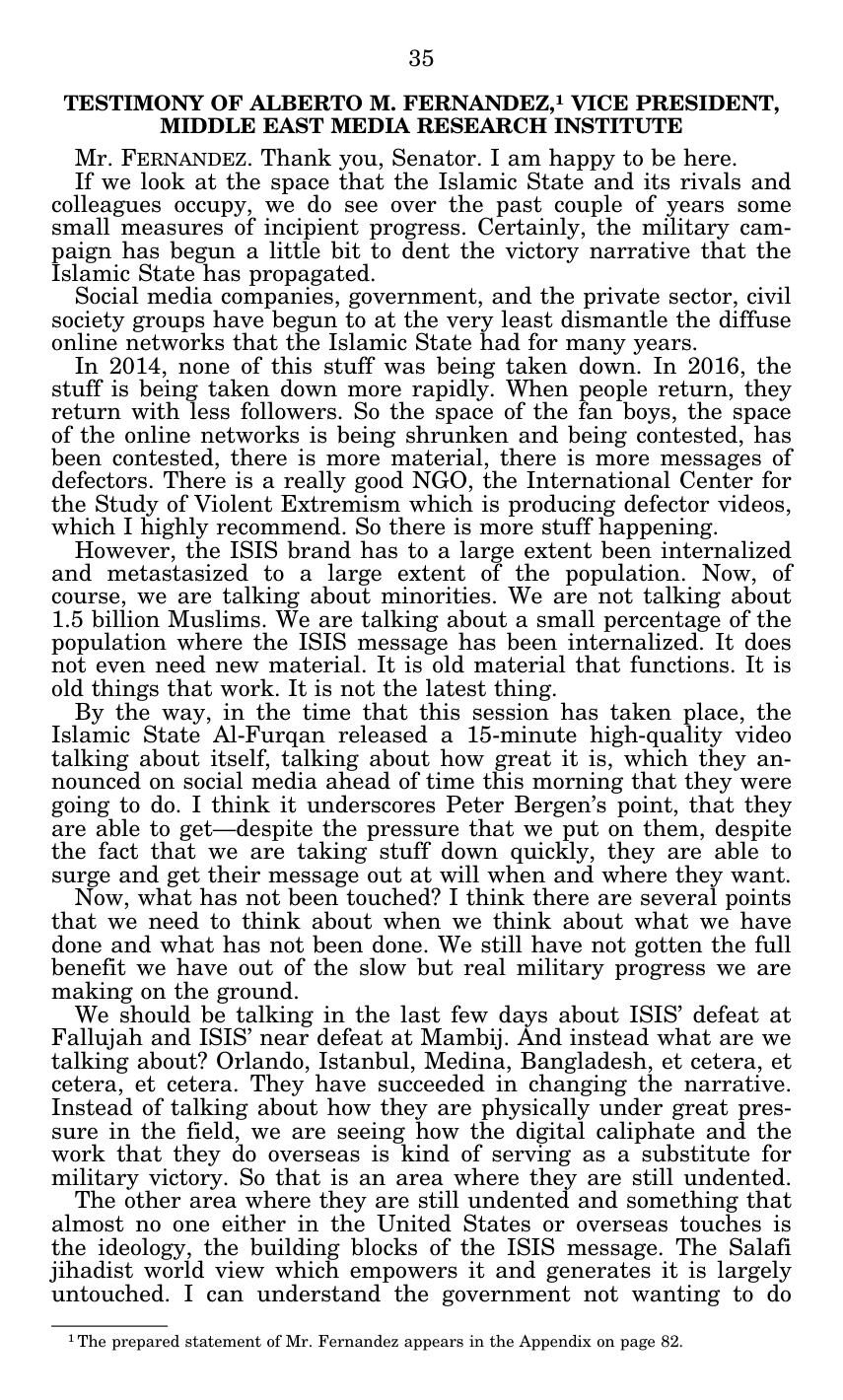
6 July 2016, same hearing, printed page 35: testimony of Alberto Fernandez, a former CSCC coordinator, that takedowns had increased since 2014 and that the brand "has to a large extent been internalized". U.S. Government Publishing Office; public domain.
Sides on the record
- The group's stated position (as reported by Winter and Ingram): a restored caliphate that Muslims were obliged to join, defended against enemies it named, with media work treated as a form of jihad, in some passages of Media Operative as more important than fighting.
- U.S. government position: in July 2016 Stengel said the balance of online content was shifting, citing a RAND study and a State Department (GEC) analysis that he described as finding six times as much anti-ISIL as pro-ISIL content, and 0.0124 percent of Twitter content pro-ISIL. Those are the officials' own figures.
- Critics of the counter-effort: Katz argued direct engagement was counterproductive; Royce said the state seal defeated the message; Fernandez said the Salafi jihadist world view behind the message was "largely untouched"; Bergen asked why Amaq's production facilities were not taken down. Separately, GNET records that mass removal disrupted researchers, and the EFF reports that automated removal on YouTube caught Syrian Archive war-crimes documentation.
- What is measured and what is not: output counts and their decline are measured. That the media caused recruitment is not established; the Soufan Center finds the motive "more personal than political" and social media a preparer of ground.
What would falsify this read
- Evidence that Amaq or the supporter accounts were independent of the central media office. That would move the black layer to white and remove Narrative laundering.
- A larger sample that shows the "utopia" share was not the dominant official category, or that a different lunar month or platform changes the proportions. Winter's month followed Ramadan, and Zelin's is a single week.
- Evidence that the decline from 761 to 194 monthly releases was caused mainly by something other than territorial loss, staff loss and takedowns. Milton himself says the argument is "not that the airstrikes alone were a cause".
- Audience or interview data showing the media had little role in individual decisions to travel. Soufan already points that way.
Literacy counter
- Count what a group's official output is made of before accepting a description of it. In the samples here, most of what an audience sees is pastoral or administrative content offered as proof of order, and that content cannot be checked from outside.
- Separate the label from the structure. A "news agency" that calls itself unofficial but sits inside a ministry is a relay. The same test applies to any state or movement outlet, including counter-messaging that is placed under a partner's name.
- Treat effect claims from any side as claims. Counts of takedowns, views and share of content are the operators' own measures unless an outside study repeats them.
- Removal has costs and displacement effects that the record documents (dispersal to other platforms, lost research access, deleted war-crimes evidence). This archive's counters are checking tools for the reader, and see Platform interventions: labels, nudges, notes, friction and takedowns, Media literacy and Inoculation and prebunking.