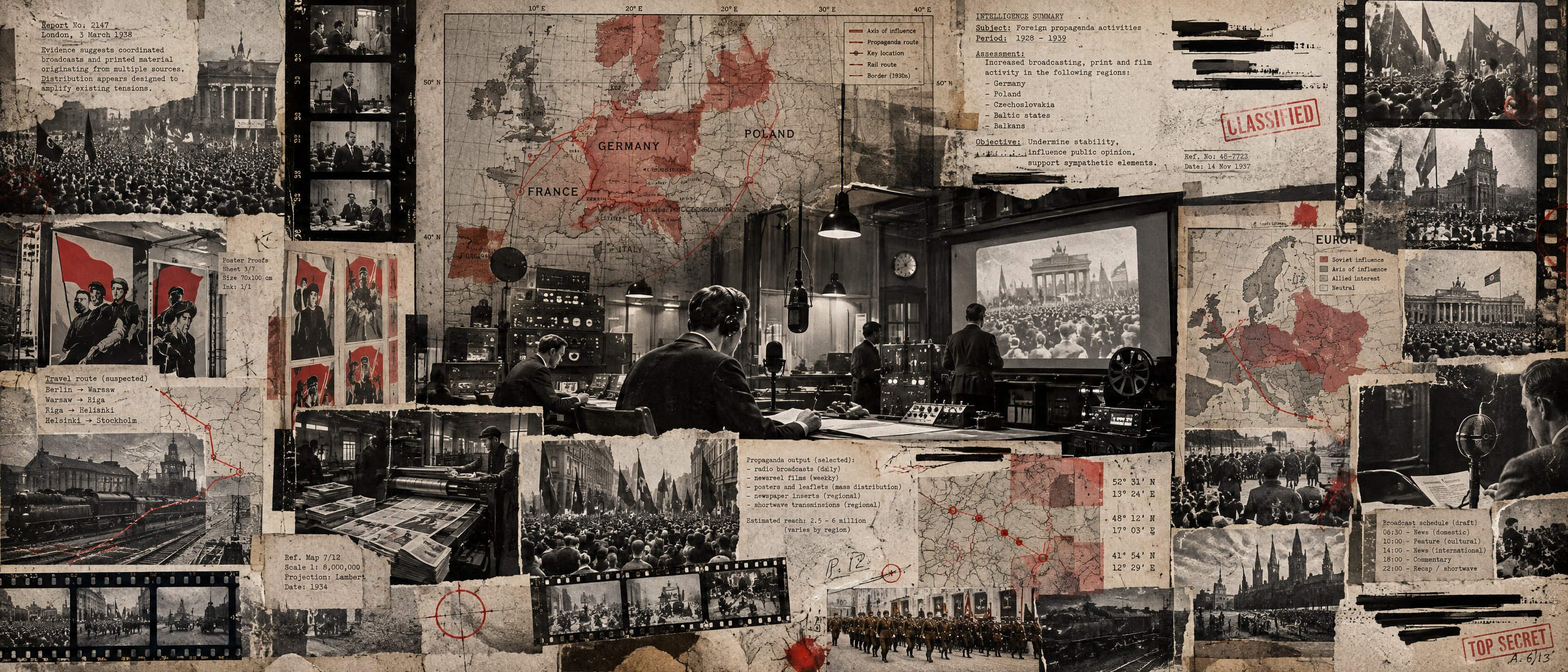
In one line: prebunking warns people in advance about a manipulation technique and shows them a weakened example, on the theory that this builds resistance before the real thing arrives; it reliably teaches people to name techniques in tests, but whether it improves their ability to tell true from false news, and for how long, is disputed in the published record.
Evidence: mixed. Technique recognition is widely replicated, but the claim of better true/false discernment is challenged by signal-detection reanalyses, effects decay without boosters, and one realistic-feed study found no transfer.
Background
William J. McGuire and his Yale collaborator Demetrios Papageorgis set out the idea in experiments published between 1961 and 1964, including papers in Sociometry and the Journal of Abnormal and Social Psychology (1961) and McGuire's 1964 "Inducing resistance to persuasion: Some contemporary approaches". The analogy was medical: a belief that has never met a counter-argument has no defences, so a weakened attack plus its refutation was expected to make it harder to overturn later.
From 2018 researchers at the University of Cambridge Social Decision-Making Lab, led by Sander van der Linden and Jon Roozenbeek, applied the idea to online misinformation. They moved from inoculating against one claim to inoculating against the techniques that recur across many claims, and call this "prebunking". A 2022 review by Cecilie Traberg, Roozenbeek and van der Linden summarises the programme; van der Linden's 2023 book Foolproof presents it to a general audience.
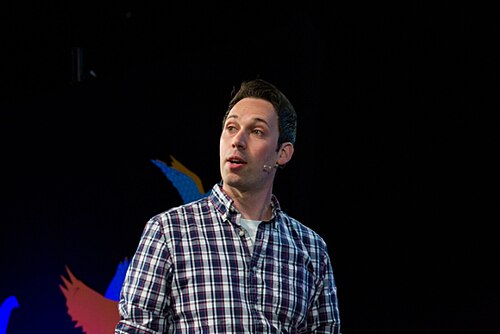
Sander van der Linden, University of Cambridge, at the Hay Festival, 25 May 2019. Photo: LiteraryCritic1, CC BY-SA 4.0, via Wikimedia Commons.
What was tried
- Bad News (February 2018). A browser game built by Cambridge researchers with the Dutch media collective DROG and design agency Gusmanson. Players act as a fake-news producer and practise six techniques: polarisation, invoking emotions, spreading conspiracy theories, trolling, deflecting blame and impersonating fake accounts.
- Go Viral! (October 2020). A shorter game on COVID-19 misinformation, made by the Cambridge lab with the UK Cabinet Office and DROG. Players were linked to the World Health Organization's COVID "mythbusters" pages, and the WHO and United Nations supported translation beyond the first German and French versions.
- Harmony Square (November 2020). A game about political misinformation, made by Cambridge psychologists with support from the US State Department's The State Department's Global Engagement Center (2016 to 2025) and the Department of Homeland Security's Cybersecurity and Infrastructure Security Agency (CISA).
- YouTube videos with Google's Jigsaw (published August 2022). Cambridge and University of Bristol psychologists made five 90-second videos on emotionally manipulative language, incoherence, false dichotomies, Scapegoating and ad hominem attacks.
- Central and Eastern Europe (from September 2022). Jigsaw ran videos in Poland, Czechia and Slovakia on two narratives about Ukrainian refugees that the project classed as manipulative: one blaming them for the rising cost of living (scapegoating, in Jigsaw's terms; see Scapegoating), and one portraying them as violent (fearmongering, in Jigsaw's terms; see Fear appeal). Narratives were chosen after interviews with local experts, including Demagog and Poland's NASK institute. The videos ran on YouTube, Facebook, Twitter and TikTok.
- Germany (announced February 2023, running from 5 June 2023). Jigsaw and the agency Moonshot, with Correctiv, the Alfred Landecker Stiftung, the Amadeu Antonio Stiftung, Das NETTZ, Neue Deutsche Medienmacher:innen and klicksafe, ran videos on decontextualisation, scaremongering and Whataboutism on YouTube, Instagram and Facebook under the line "Don't let yourself be manipulated".
- EU elections (2024). Jigsaw's campaign before the 2024 European Parliament elections reached more than 120 million YouTube users, with videos on scapegoating, decontextualisation and discrediting.
The videos named techniques rather than claims. Three of those techniques (whataboutism, fear appeals and scapegoating) also appear in historical propaganda from several countries. The gallery objects below are historical examples from the German, British and Weimar-era record, chosen because they show these three techniques on the page; the gallery holds examples from other countries and eras too. They are not prebunking material; each caption describes only what the object does. See Whataboutism, Fear appeal and Scapegoating.
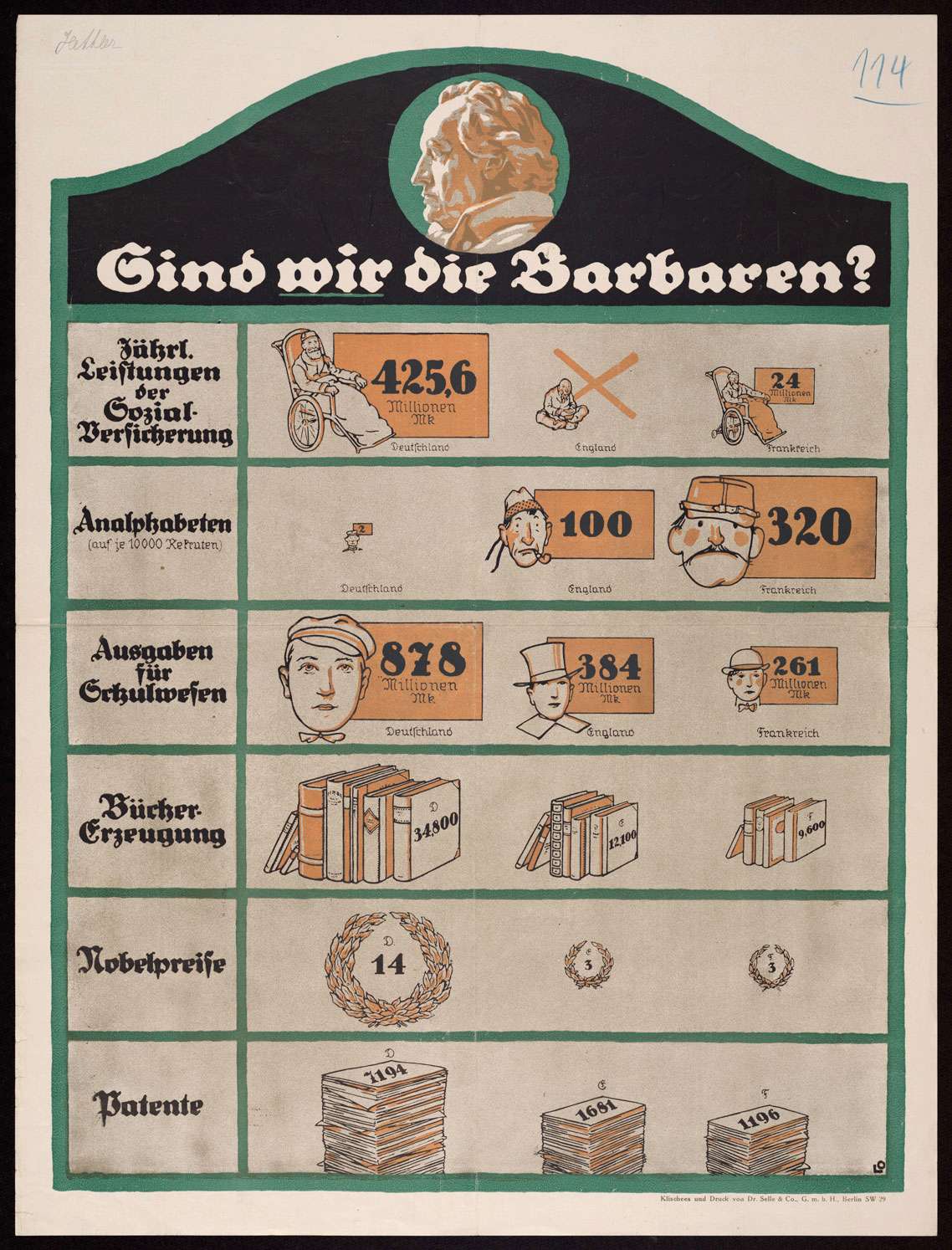
Whataboutism: "Sind wir die Barbaren?" (Are We the Barbarians?), Imperial German government chart by Louis Oppenheim, 1916. It answers an accusation with a different comparison, of social spending and literacy against Britain's and France's. Sind wir die Barbaren? (Are We the Barbarians?)
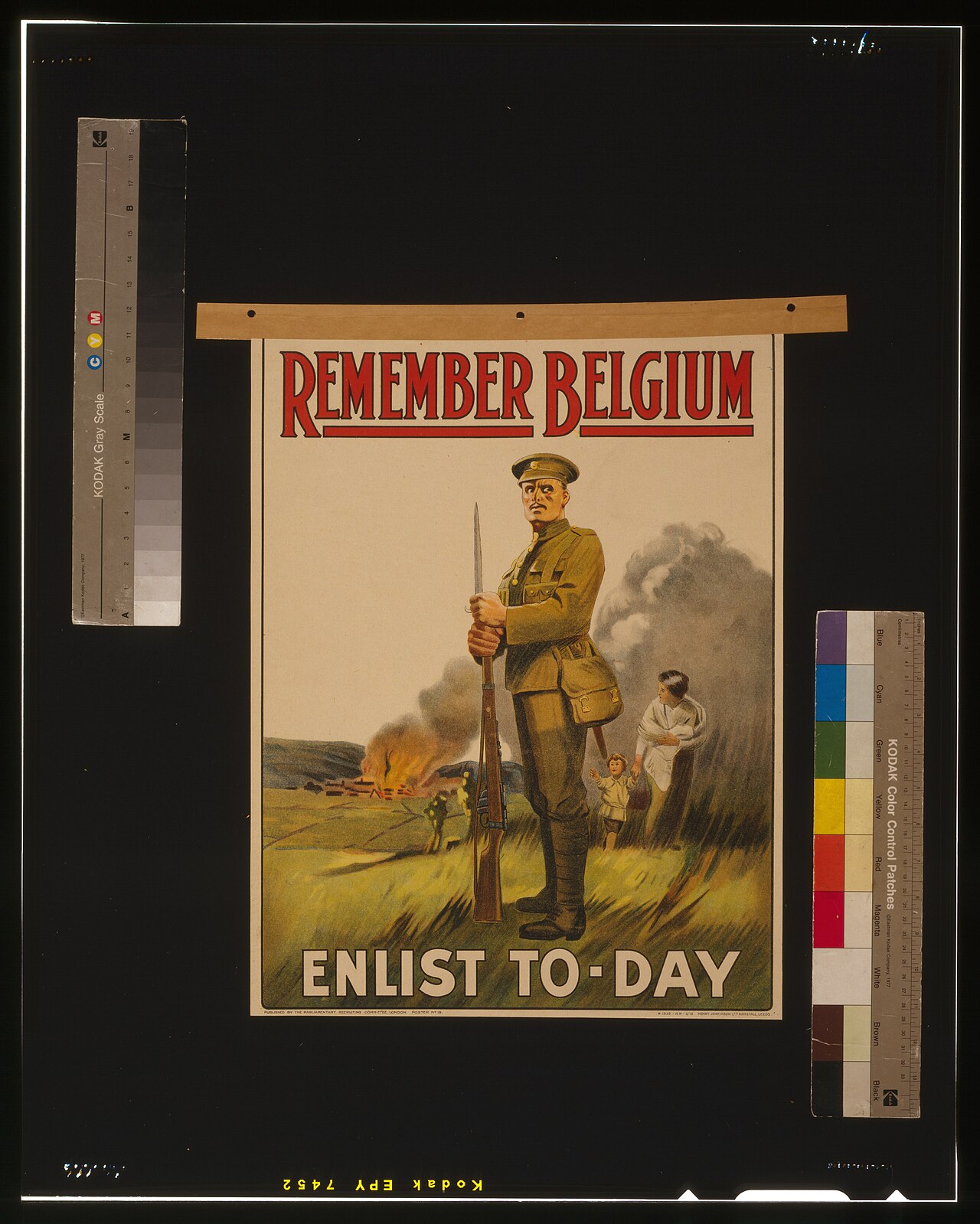
Fear appeal: "Remember Belgium, Enlist To-Day," UK Parliamentary Recruiting Committee, 1915. The atrocity it invokes is documented; the poster reduces it to one silhouette and a call to enlist. Remember Belgium — Enlist To-Day
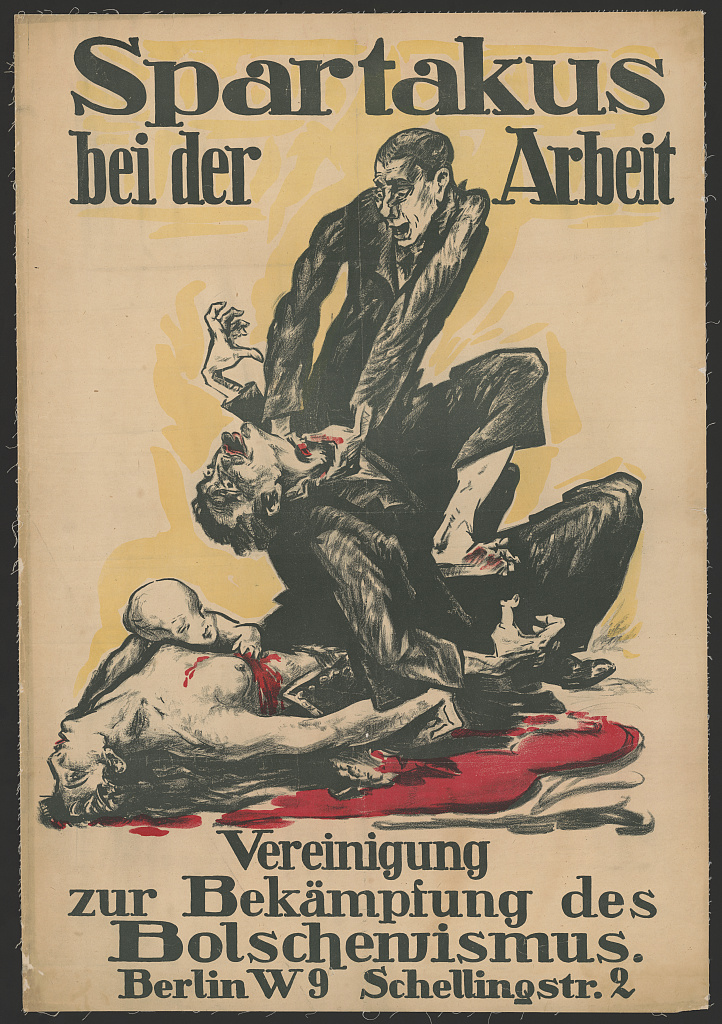
Scapegoating: "Spartakus bei der Arbeit" (Spartacus at Work), Association to Combat Bolshevism, Berlin, 1919. One political faction is made the author of a generic family murder. Spartakus bei der Arbeit (Spartacus at Work)
Measured effects
| Study | Design | N | Finding | Caveats |
|---|---|---|---|---|
| Roozenbeek and van der Linden 2019, Palgrave Communications | Pre-post ratings around one play of Bad News | about 15,000 | Perceived reliability of fake headlines fell by an average of 21% after play (Cambridge release) | Pre-post design; see the response-bias critiques below |
| Roozenbeek and van der Linden 2020, HKS Misinformation Review | Harmony Square vs control | not recorded here | Players shared fake news at a rate 11% lower than control and, in ScienceDaily's summary, "called bullshit on misinformation 16 percent more often" | Evaluated by the game's developers |
| Roozenbeek et al. 2022, Science Advances | Six preregistered RCTs plus a YouTube field study | 6,464 (RCTs); 22,632 (field) | Videos improved technique recognition, confidence, discernment of trustworthy from untrustworthy content and sharing decisions | Field outcome was one quiz question answered within 24 hours (median 18.4 hours) via YouTube's "brand lift" survey tool |
| Maertens et al. 2021, J. Exp. Psych.: Applied | Three longitudinal experiments | not recorded here | Significant decay over two months; effect held for at least three months with regular "booster" testing | Boosters were repeated testing, not new content |
| Maertens et al. 2025, Nature Communications | Five preregistered longitudinal experiments | 11,759 | Text and video effects lasted about a month; game effects decayed faster; memory, more than motivation, predicted how long effects lasted | Boosters targeted memory of the intervention |
| Jigsaw 2022 CEE campaign | Ad campaign plus post-exposure survey | over 38 million views, almost a third of the three populations | Survey after two weeks found improved recognition of the tactics among viewers | Company-reported; not a peer-reviewed paper |
| Jigsaw Germany 2023 | Ad campaign plus survey | not published | Share of viewers correctly identifying the tactics rose by up to eight percentage points | Company and partner reporting |
| 12-country EU study 2025, Communications Psychology | 13 surveys in 12 EU countries | 19,735 | Small but significant gains (d ≈ 0.08 to 0.38) in manipulation and technique discernment and sharing decisions; 50-second videos more consistent than 20-second ones | Effects varied with country education index and personal education |
Null results, decay and critiques
- Response bias versus discernment. Ariana Modirrousta-Galian and Philip Higham (2023, Journal of Experimental Psychology: General) reanalysed five earlier studies with receiver operating characteristic (ROC) analysis from signal detection theory. With comparable true and fake items, Bad News and Go Viral! did not improve discrimination; players answered "false" more often to everything. In 2024 Higham, Modirrousta-Galian and Tina Seabrooke argued that the usual mean-difference measure confounds the two.
- Replications with more true items. In "Mixed News about the Bad News Game" (2023, Journal of Cognition), four student teams replicated the drop in belief in false tweets, but belief in true tweets fell by the same or almost the same amount; their exploratory signal detection analysis found increased response bias and no improved discrimination. Seabrooke, Modirrousta-Galian and Higham (2025, Psychonomic Bulletin & Review) tested Bad News with 150 Indian participants in a preregistered study and found no significant change in discrimination or response bias once both counterbalancing conditions were included.
- The reply. A signal detection meta-analysis by Simchon, Zipori, Teitelbaum, Lewandowsky and van der Linden (Current Opinion in Psychology, 2026) pooled 33 inoculation experiments with about 37,000 participants in a hierarchical Bayesian model. It reports that gamified and video interventions improved discrimination without increasing response bias. Two of its authors are among the developers of the approach.
- Other meta-analytic disputes. A 2023 meta-analysis by Lu and colleagues in the Journal of Medical Internet Research drew a 2025 letter to the editor stating that six sets of extracted data did not represent the effect of interest; the authors published a correction clarifying their methods.
- Field-to-feed transfer. Sze Yuh Nina Wang, Samantha Phillips, Kathleen Carley, Hause Lin and Gordon Pennycook (2025, PNAS Nexus) ran five preregistered studies in a simulated social feed. Inoculation cut engagement with emotionally manipulative posts only when the feed held nothing but synthetic posts about that technique; adding real tweets, or posts using other techniques, appeared to remove the effect.
- Decay. Go Viral!'s launch publicity said one play of a similar game reduced susceptibility "for at least three months". Maertens et al. (2021) found that duration only with regular booster tests, and significant decay over two months without them.
- Data errors. Roozenbeek and colleagues published a 2023 correction to their 2022 Royal Society Open Science paper after pre and post columns for one item were found reversed; means and test statistics changed, and the authors state the conclusions did not.
Who uses it and who criticises it
Users. The UK Cabinet Office (Go Viral!), the WHO (linking Go Viral! to its mythbusters), the US State Department's Global Engagement Center and CISA (Harmony Square), Google's Jigsaw with European NGOs and fact-checkers, and the NATO Strategic Communications Centre of Excellence, which published a report titled Inoculation Theory and Misinformation. Jigsaw's head of research and development, Beth Goldberg, told the Associated Press in 2023: "There's a real appetite for solutions."
Critics on method. Modirrousta-Galian, Higham and Seabrooke (above) argue the measured gains are mainly generic scepticism. Alberto Acerbi, Sacha Altay and colleagues argue that because misinformation is a small share of most people's news diet, raising trust in reliable sources should take priority over fostering distrust in unreliable ones. The philosopher Daniel Williams, reviewing Foolproof, argued that misinformation is not a virus people can be vaccinated against and that, on the book's own narrow definition, misinformation is not widespread. The philosophers Andy Norman and Lee McIntyre replied that Williams' review was "specious" and "one-sided".
Critics on who runs it. The approach's own developers list open ethical questions about who delivers the inoculation (Traberg, Roozenbeek and van der Linden, 2022). Free-expression advocates have mostly treated prebunking as the less restrictive option: The Future of Free Speech, a free-expression think tank, commissioned a 2023 background report from the Aarhus University political scientist Michael Bang Petersen that recommends investing in prebunking. No civil-liberties group or left-wing critic objecting to who runs prebunking campaigns was found on the record for this page. Catherine Salgado of the conservative Media Research Center's NewsBusters described the German campaign in February 2023 as Google's "'Prebunking' Censorship". The Epoch Times' coverage quoted Eric Weinstein, managing director of Thiel Capital, who wrote that "destroying our own citizens sharing skepticism, doubt and information becomes 'Prebunking non-state malinformation.'" Separately, RT, the Russian state broadcaster, covered the 2022 refugee campaign under the headline "Google to 'inoculate' Eastern Europeans against disinformation", putting "inoculate" in quotation marks.
What the evidence supports and doesn't
- Supported: short games and videos raise people's ability to name a manipulation technique in a test soon afterwards, in many countries, and campaigns can reach tens of millions of viewers.
- Disputed: whether this is better discernment or a general tilt towards calling everything false. Independent reanalyses of Bad News say mostly the latter; the developers' signal detection meta-analysis says the former.
- Not shown: that prebunking changes what people believe or share in real feeds over weeks, or that any campaign reduced the spread of the narratives it targeted. Campaign results come mainly from company surveys.
- Not settled by research: who should choose the narratives to prebunk, a political question argued by the named critics above.
See also
- Media literacy, Fact-checking and corrections, Platform interventions: labels, nudges, notes, friction and takedowns, The debate over counter-disinformation
- The State Department's Global Engagement Center (2016 to 2025) (a Harmony Square sponsor)
- Techniques the videos targeted: Scapegoating, Whataboutism, Fear appeal
- Countering propaganda
See also in Learn
Images
| Image | Source | Licence |
|---|---|---|
| Sander van der Linden, Hay Festival, 2019 | Wikimedia Commons, LiteraryCritic1 | CC BY-SA 4.0 |
| Sind wir die Barbaren? (1916), Remember Belgium (1915), Spartakus bei der Arbeit (1919) | Gallery objects; provenance in Sind wir die Barbaren? (Are We the Barbarians?), Remember Belgium — Enlist To-Day and Spartakus bei der Arbeit (Spartacus at Work) | See each entry |

Image gaps
- Photos of McGuire or Roozenbeek. None found on Wikimedia Commons under an open licence.
- Screenshots of the games or Jigsaw videos. Not included: they are copyrighted works and no openly licensed copy was found.
Sources
- The Future of Free Speech: Empowering Audiences Against Misinformation Through 'Prebunking', background report by Michael Bang Petersen (2023)
- McGuire and Papageorgis, and McGuire 1961/1964: bibliography via University of Arizona open textbook, "Inoculation Theory"
- Roozenbeek and van der Linden 2019, Fake news game confers psychological resistance against online misinformation, Palgrave Communications 5, 65
- University of Cambridge, Fake news "vaccine" works (2019 release)
- University of Cambridge, Cambridge game "pre-bunks" coronavirus conspiracies (Go Viral!, 2020)
- WHO, Fighting misinformation in the time of COVID-19, one click at a time
- Roozenbeek and van der Linden 2020, Breaking Harmony Square, HKS Misinformation Review
- ScienceDaily, Game "pre-bunks" political misinformation (November 2020)
- Roozenbeek et al. 2022, Psychological inoculation improves resilience against misinformation on social media, Science Advances
- University of Cambridge, How to "inoculate" millions against misinformation on social media
- Jigsaw, Defanging Disinformation's Threat to Ukrainian Refugees
- Google Safety Center, Defanging Disinformation Campaigns in Central & Eastern Europe
- klicksafe, "Don't be manipulated" prebunking campaign
- AP via PBS NewsHour, Google to expand misinformation prebunking initiative in Europe (February 2023)
- Video inoculation against election misinformation across 12 EU nations, Communications Psychology (2025)
- Maertens et al. 2021, APA spotlight on long-term effectiveness of inoculation
- Maertens et al. 2025, Psychological booster shots targeting memory increase long-term resistance against misinformation, Nature Communications
- Modirrousta-Galian and Higham 2023, Gamified inoculation interventions do not improve discrimination between true and fake news (PubMed)
- Graham et al. 2023, Mixed News about the Bad News Game, Journal of Cognition
- Seabrooke, Modirrousta-Galian and Higham 2025, Re-examining the bad news game, Psychonomic Bulletin & Review
- Simchon et al., A signal detection theory meta-analysis of psychological inoculation against misinformation, Current Opinion in Psychology
- Lu et al. 2023, Psychological Inoculation for Credibility Assessment, Sharing Intention, and Discernment of Misinformation, JMIR
- Letter to the editor: Concerns Regarding the Methodology of a Psychological Inoculation Meta-Analysis on Misinformation, JMIR 2025
- Wang et al. 2025, Limited effectiveness of psychological inoculation against misinformation in a social media feed, PNAS Nexus
- Correction to Technique-based inoculation against real-world misinformation, Royal Society Open Science 2023
- Traberg, Roozenbeek and van der Linden 2022, Psychological Inoculation against Misinformation: Current Evidence and Future Directions
- Acerbi et al. 2022, Research note: Fighting misinformation or fighting for information?, HKS Misinformation Review
- Daniel Williams, Misinformation is not a virus, and you cannot be vaccinated against it
- Foolproof (book), with the Norman and McIntyre reply
- NATO StratCom COE, Inoculation Theory and Misinformation
- NewsBusters, Catherine Salgado, Google Expands Its "Prebunking" Censorship in Germany (13 February 2023)
- The Epoch Times, Google Expanding "Prebunking" Campaign to Germany
- RT, Google to "inoculate" Eastern Europeans against disinformation (2022)