- Actor
- U.S. Department of Defense, Office of the Assistant Secretary of Defense for Public Affairs (OASD-PA), under Secretaries Donald Rumsfeld and, from December 2006, Robert Gates; Assistant Secretaries Victoria (Torie) Clarke and, from 2006, Dorrance Smith
- Target
- U.S. television, radio and newspaper audiences, reached through retired officers who worked as paid network military analysts
- Source
- Unidentified gray (the Pentagon's role was documented and not hidden from reporters who asked, but the briefings did not travel with the analysts' appearances on air; GAO found no violation of the covert-propaganda rule)
- Techniques
- TestimonialNarrative launderingDisclosure theater
- First seen
- March 2002 (Clarke action memo to the Secretary of Defense); first roundtable October 2002; exposed 20 April 2008
- Status
- suspended April 28, 2008 (Pentagon spokesman confirmed the suspension; GAO called the programme "now-terminated" on July 21, 2009); last official finding DODIG-2012-025 issued November 21, 2011; no later activity found
- Related briefs
- none
Mechanism
The outreach ran through a public-affairs office. It gave retired officers who appeared on networks as paid commentators a stream of access: private roundtables with the Secretary of Defense and senior officers, monthly and sometimes weekly conference calls, talking points, and trips to Iraq and Guantanamo Bay. A 2006 DoD document listed at least 16 roundtables, and DoD's trip schedule lists nine trips (four to Iraq, five to Guantanamo). Calls were timed to the budget request, reports to Congress and readiness hearings, and "before or after regular DOD press briefings or in advance of an upcoming evening news cycle." A contractor, Omnitec Solutions, was paid $1,837,989 between November 2004 and October 2007 to report on how coverage "reflected, or failed to reflect" DoD's views, listing which analysts spoke and what they said.
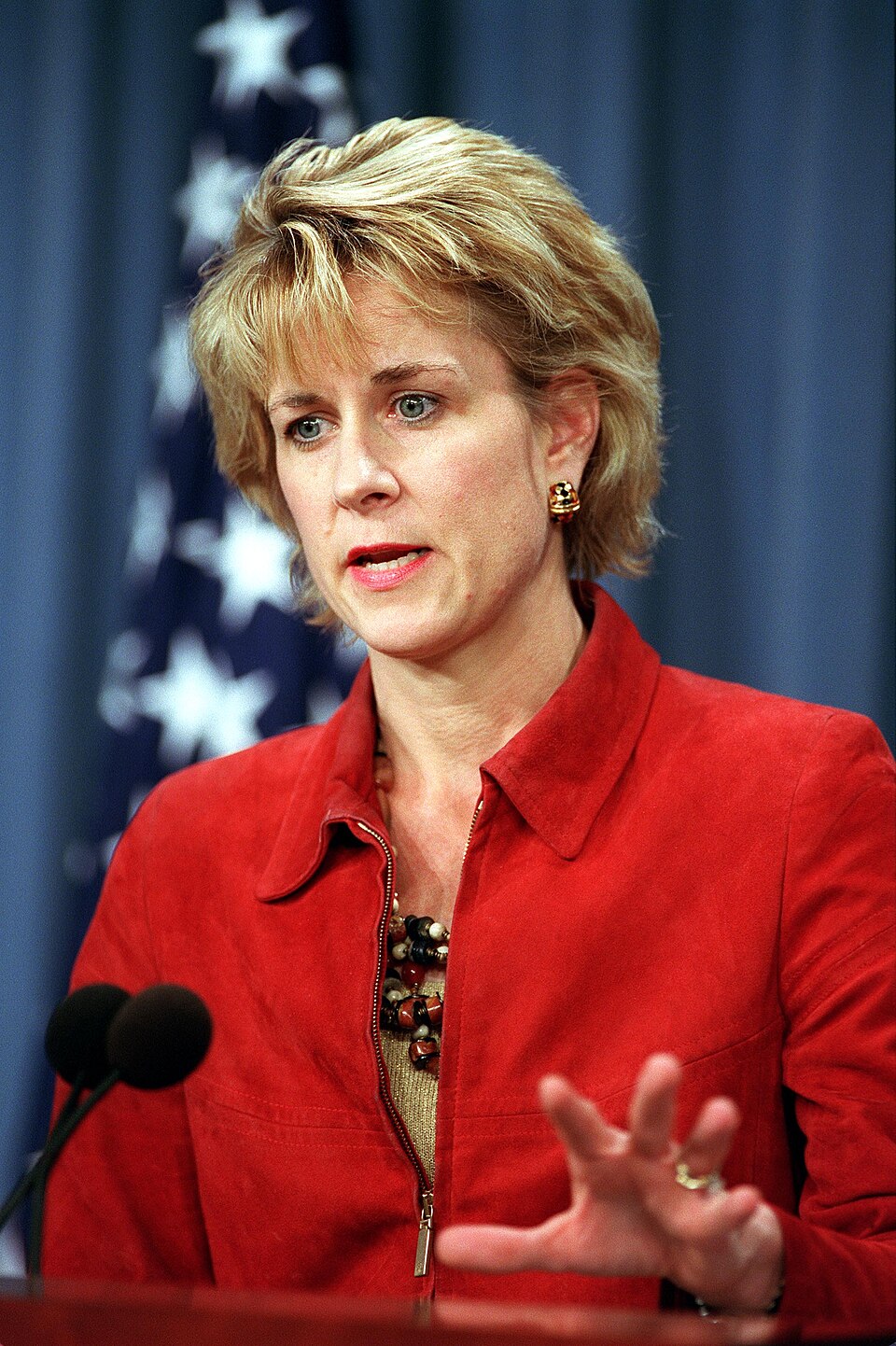
17 October 2001. Victoria Clarke, Assistant Secretary of Defense for Public Affairs, at a Pentagon briefing. DoD photo by R. D. Ward. Public domain. The photo predates the outreach; it shows the office that ran it.
DoD staff described the trips as paying "huge dividends" for media access and proposed limiting later ones to analysts best able to serve as "message force multipliers"; staff also called the analysts "surrogates" (GAO could not tell who introduced that term). On air, the viewer saw a named retired general introduced by rank, which is Testimonial: the vouch is the authority of the uniform. The briefing behind the segment, and often the analyst's commercial ties, were not stated. That is Disclosure theater: the arrangement existed in public-affairs records, transcripts posted for reporters and a 2006 Times story, but did not travel with the broadcast. Narrative laundering is scored on the documents' own terms ("surrogates", "message force multipliers") and on the confirmed talking points. It is not scored on any finding that a given analyst repeated a given line.
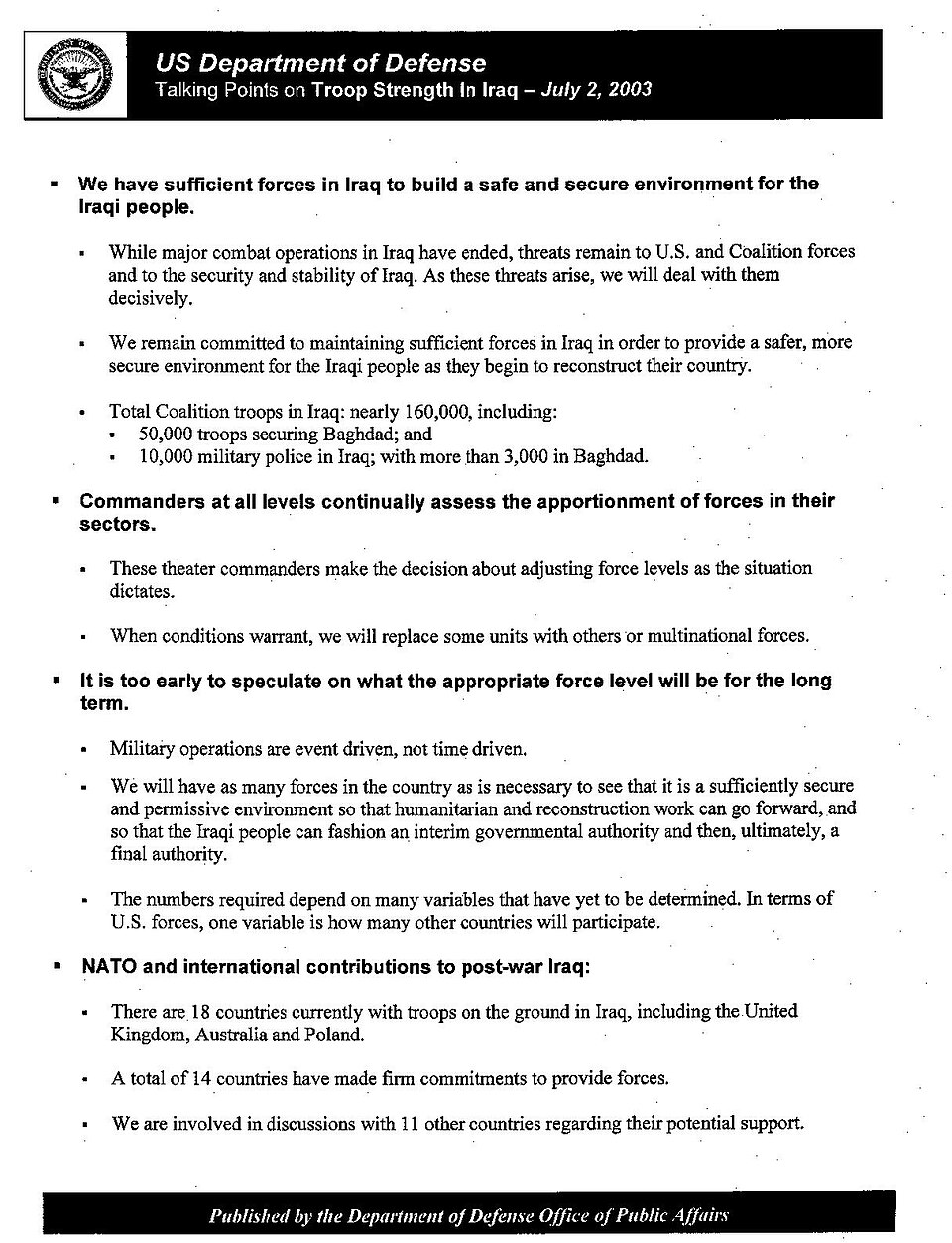
2 July 2003. DoD Office of Public Affairs, "Talking Points on Troop Strength In Iraq", the kind of sheet handed to analysts. The footer reads "Published by the Department of Defense Office of Public Affairs". Public domain (U.S. government work); see the provenance note on the sidecar file.
Two limits on the scoring. The sheet above carries its DoD origin on its face, and GAO found materials given to analysts "were clearly identified as DOD products", so any concealment sits downstream, in what viewers were told. And Card stacking and Transfer are not scored: the talking points are the department's stated positions, and the record cited here does not show them going beyond that.
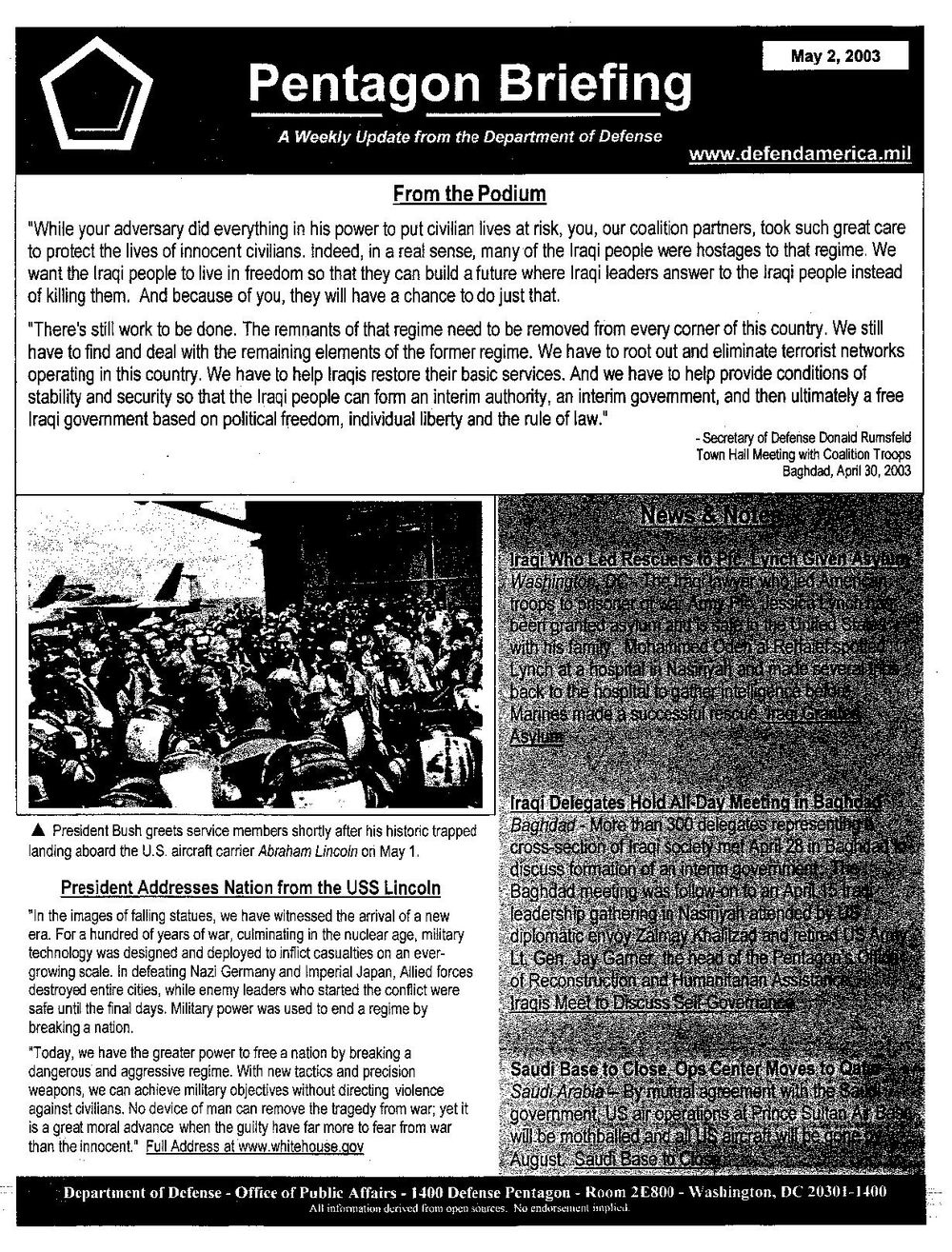
2 May 2003. Page one of DoD's "Pentagon Briefing" weekly update (www.defendamerica.mil), described on Commons as a handout given to military analysts. Public domain (U.S. government work).
Evidence
- 7 March 2002. Clarke's action memo to Secretary Rumsfeld, in GAO's summary, said the retired officers "were active within national politics and policy-making institutions," that their stature "ensured a broad distribution of information regarding DOD's war on terrorism," and that their input would help "ensuring effective outreach." GAO dates the start to an October 2002 roundtable with the Secretary. https://www.gao.gov/assets/b-316443.pdf
- 2007 to 2008. After the Times sued under FOIA (07 Civ. 7481, S.D.N.Y.), DoD released about 12,000 pages by GAO's count (NPR reported 8,000). GAO relied on them.
- 20 April 2008. David Barstow, "Behind TV Analysts, Pentagon's Hidden Hand", New York Times: the administration "used its control over access and information in an effort to transform the analysts into a kind of media Trojan horse", and analysts "echoed administration talking points, sometimes even when they suspected the information was false or inflated. Some analysts acknowledge they suppressed doubts because they feared jeopardizing their access." Text as excerpted in Harper's, https://harpers.org/2011/12/the-pentagon-and-its-sock-puppets/ (the Times page, https://www.nytimes.com/2008/04/20/us/20generals.html, could not be opened here).
- April 2006 meeting. NPR reported, from a transcript, that after the "Generals Revolt" Rumsfeld met about 15 retired officers who were TV commentators, and that CNN's Don Shepperd said on air that day: "Our message to them as analysts was, 'Look, you got to get the importance of this war out to the American people.'" https://www.npr.org/2008/05/01/90111757/pentagon-used-military-analysts-to-deliver-message
- 20 to 28 April 2008. Bryan Whitman, DoD spokesman, told the Times: "The intent and purpose of this is nothing other than an earnest attempt to inform the American people" (as quoted by PBS NewsHour on 24 April, https://www.pbs.org/newshour/show/government-curries-favor-with-military-news-analysts). On 28 April Whitman confirmed the programme was "temporarily suspended so we can take a look at some of the concerns", and Secretary Gates had said only that analysts should say they spoke for themselves (AFP, https://www.marsdaily.com/reports/Pentagon_suspends_program_for_military_media_analysts_999.html).
- 2 and 6 May 2008. 41 members of Congress asked the Inspector General to examine competitive advantage for affiliated contractors (GAO fn. 3). DeLauro and Rep. Dingell asked the FCC to examine sponsorship identification (Variety, https://variety.com/2008/tv/news/fcc-asked-to-probe-tv-surrogates-1117985191/); GAO records the FCC Enforcement Bureau reviewing it in February 2009. No FCC outcome was found.
- 14 January to 5 May 2009. The Inspector General's report IE-2009-004 found no competitive advantage for RMO-affiliated contractors. The Times questioned how it counted analysts with no contractor affiliation. On 5 May the Deputy Inspector General withdrew it, saying the method "would not reasonably yield" the evidence needed, and that no more work would follow because the programme had ended and the officials responsible had left (GAO fn. 3). DeLauro said it was written without interviewing the senior officials who ran the programme, https://delauro.house.gov/media-center/press-releases/delauro-statement-reversal-and-removal-pentagon-propaganda-report
- 21 July 2009. GAO B-316443: "There is no doubt that DOD attempted to favorably influence public opinion with respect to the Administration's war policies in Iraq and Afghanistan through the RMOs", but "we found no evidence that DOD attempted to conceal from the public its outreach", and none that DoD "contracted with or paid RMOs for positive commentary." The opinion states it does not examine analysts' commercial ties or whether they disclosed them to viewers or networks. DoD did not give GAO its legal views; spokesman David Oten said officials "are pleased that (the GAO) found DOD public affairs to be in full compliance with the law" (AP, https://www.nbcnews.com/news/amp/wbna32067331).
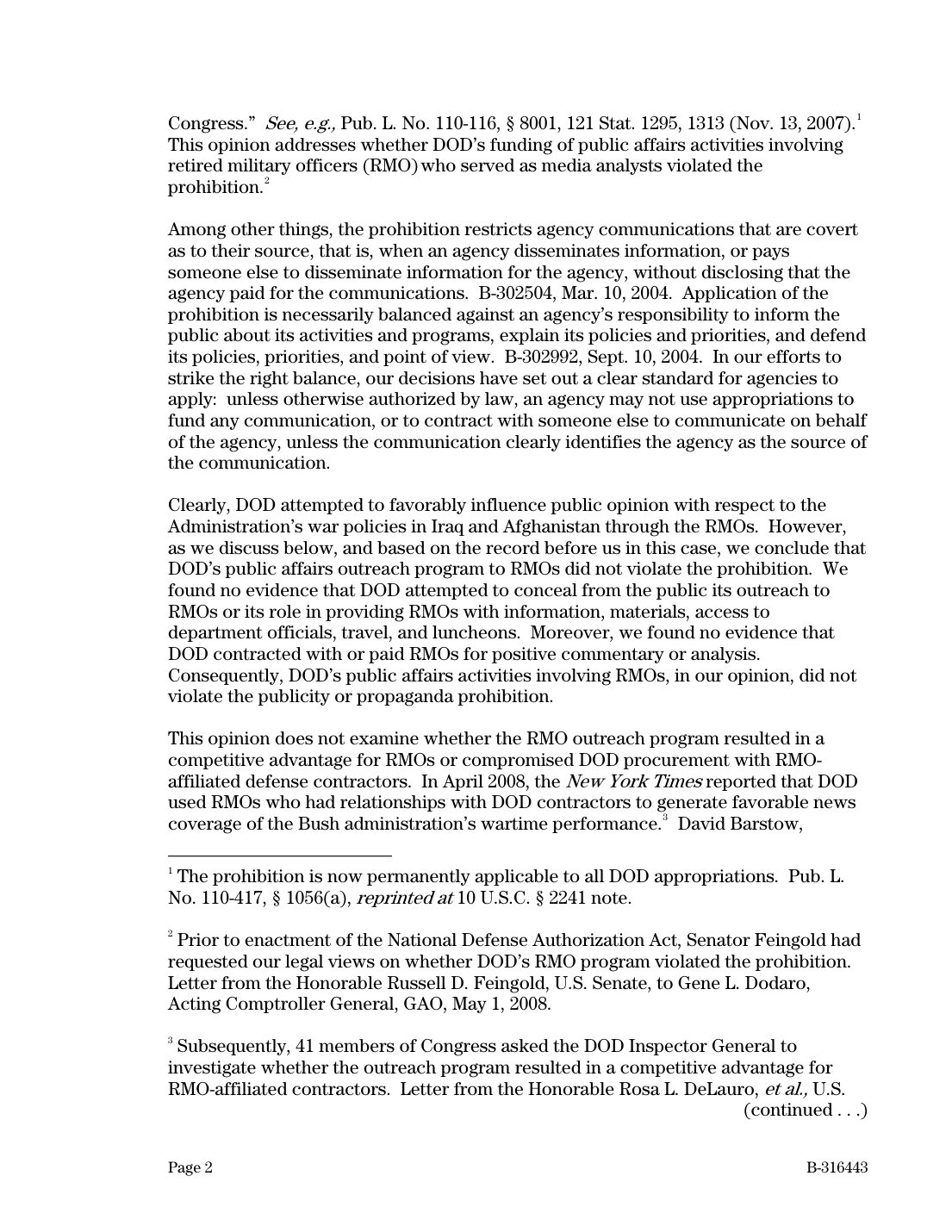
21 July 2009. First page of the opinion text of GAO B-316443, "Department of Defense-Retired Military Officers as Media Analysts". U.S. Government Accountability Office. Public domain (U.S. government work).
- The GAO test. B-302710 (19 May 2004, not 2005): CMS video news releases were "covert as to source" because neither stories nor scripts named the agency and the "reporters" were hired by a subcontractor. B-304228 and B-305368 (both 30 September 2005): an Education Department prepackaged news story and a paid commentator contract. B-316443 uses these to separate paid or concealed communication from the outreach it reviewed.
- 29 November 2008. Barstow on retired Gen. Barry McCaffrey, an NBC analyst who consulted for contractors. McCaffrey's statement called him "an early and serious critic of Rumsfeld's arrogance"; NBC News president Steve Capus said there was "no open microphone that begins with the Pentagon and ends with him going out over our airwaves." https://archive.org/details/onemansmilitaryindustrialmediacomplexthenewyorktimes
- April 2009. Pulitzer Prize for Investigative Reporting to Barstow "for his tenacious reporting that revealed how some retired generals, working as radio and television analysts, had been co-opted by the Pentagon to make its case for the war in Iraq, and how many of them also had undisclosed ties to companies that benefited from policies they defended." https://en.wikipedia.org/wiki/2009_Pulitzer_Prize (quoting the citation)
- 21 November 2011. DODIG-2012-025: "We found that the OASD (PA) conducted the RMA outreach activities in compliance with policy and regulation; and, with the exception of two classified briefings to those with a security clearance, did not provide access for RMA participants to travel, classified information, and senior officials that was special or different relative to other outreach groups or the mainstream media." https://freegovinfo.info/node/3597/ The Times, quoted by Harper's, reported 147 events for 74 analysts; one analyst recalled Rumsfeld saying "You guys influence a wide range of people. We'd like to be sure you have the facts"; another said the intent "was to move everyone's mouth on TV as a sock puppet."
Sides on the record
DoD: the outreach informed the public, and analysts were briefed as other outside groups were. GAO and the 2011 Inspector General report agreed on the legal question. Critics: members of Congress, Harper's (Scott Horton), FAIR and some former analysts called the programme propaganda or a breach of the propaganda rule, and pointed to analysts dropped from briefings after criticising DoD; Gen. Wesley Clark told investigators, as the Times reported and FAIR excerpted, that CNN told him he would no longer be invited to the special briefings. Networks and analysts: Andrew Heyward, CBS News president 1996 to 2005, told NPR "There was a deliberate attempt to deceive the public"; NPR said its own review of analyst Robert Scales, who had contractor clients, found he "wasn't unduly influenced by the Pentagon"; McCaffrey and Capus rejected the influence claim. FAIR quoted CNN's Eason Jordan saying in 2003 that CNN showed the Pentagon its prospective generals and "got a big thumbs-up on all of them."
What is and is not shown about changed views. Shown: DoD tracked analysts' commentary; talking points were given and, per the Inspector General, sometimes requested by analysts; some analysts told the Times they echoed points they suspected were inflated and suppressed doubts to keep access; others, such as McCaffrey and Scales, criticised the war on air. Not shown: that any analyst changed a stated position because of a briefing, that DoD paid for commentary (GAO found no evidence), that any employer won a contract through the access (the January 2009 review said none, and was withdrawn; GAO did not examine it), or that audience belief moved. No official body compared analysts' words with the talking points.
The war itself is covered in How the US and UK governments presented the case for war in Iraq, 2002-03 and the event narrative in The Pentagon's retired military analyst outreach programme (2002-2008). This file scores only the outreach.
What would falsify this read
A finding that the briefings, ties and Pentagon contact were stated on screen with each appearance; a broadcast-by-broadcast comparison showing analysts' commentary diverged from the talking points as often as it matched; or documents showing analysts were told to disclose their briefing role and did. Evidence that DoD paid analysts, or hid the outreach from reporters, would darken the colour and undercut GAO's legal finding.
Literacy counter
When a retired officer comments on a war, ask who briefed them that week, whether the broadcast says so, and what they earn from firms the policy affects. Treat a rank and a network caption as an introduction, not a disclosure. Keep three layers apart: the outreach (documented), the on-air words (checkable against the released talking points), and the claim that the words moved opinion (not measured). The test is the same for any ministry, company or party that briefs outside commentators: an open briefing is not covert, but a legal finding of "not covert" does not say whether viewers could see it. See Media literacy.