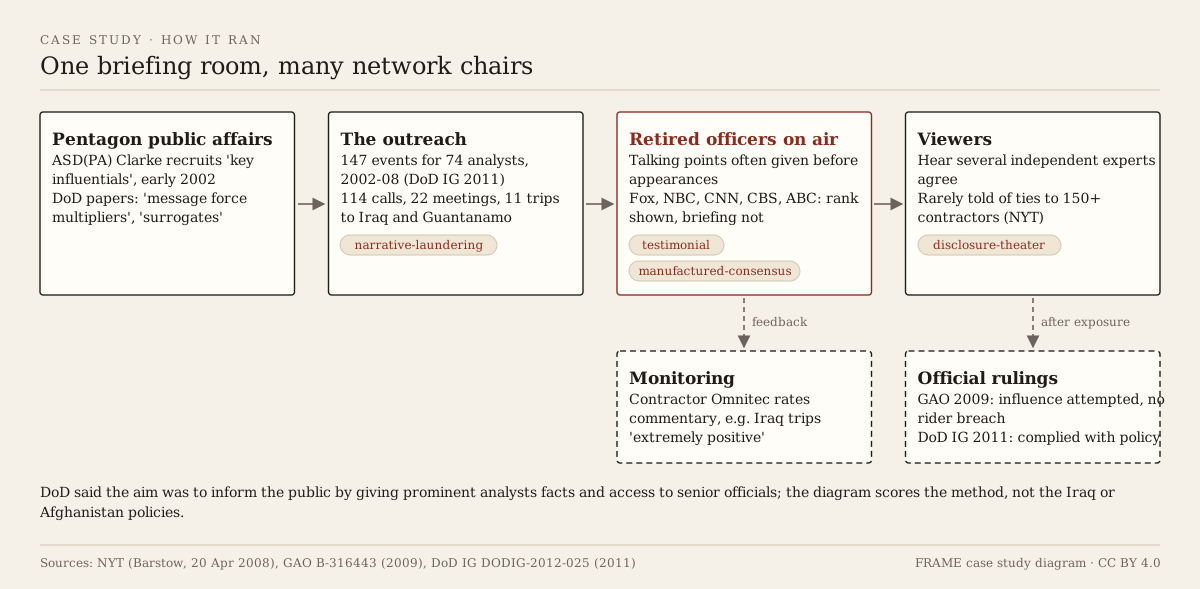
In one line: from 2002 to 2008 the Pentagon's public affairs office gave retired officers who worked as TV and radio analysts private briefings, conference calls, talking points and trips to Iraq and Guantánamo; its own documents called them "message force multipliers" and "surrogates", while viewers saw them as independent experts and were rarely told of their defence-contractor ties.
What happened
- Early 2002. According to the New York Times, Assistant Secretary of Defense for Public Affairs Victoria (Torie) Clarke began recruiting "key influentials" as planning for a possible Iraq invasion got under way. Retired officers who worked as network analysts became the main focus. Clarke and her aide Brent T. Krueger eventually signed up more than 75 of them.
- 2002-2008. What the outreach consisted of. The Pentagon inspector general's 2011 report counted 147 events for 74 analysts between 2002 and 2008: 22 meetings at the Pentagon, 114 conference calls with generals and senior officials, and 11 Pentagon-sponsored trips to Iraq and Guantánamo Bay, Cuba. The same inquiry confirmed that Rumsfeld's staff frequently gave analysts talking points before their network appearances.
- 24 June 2005. The first of six Guantánamo trips, as the Times reported it. It flew a group of retired officers to Cuba on a jet normally used by Vice President Dick Cheney. A monitoring report by the contractor Omnitec Solutions, cited by the Times, rated the 2005 Iraq trips: "Commentary from all three Iraq trips was extremely positive."
- 20 April 2008. The New York Times publishes David Barstow's "Behind TV Analysts, Pentagon's Hidden Hand", a story of more than 7,000 words. It rests on about 8,000 pages of Pentagon records that the paper obtained through a lawsuit. It reports that internal documents repeatedly call the analysts "message force multipliers" or "surrogates" who could deliver administration "themes and messages" to millions of Americans "in the form of their own opinions". It also reports that the analysts together represented more than 150 military contractors, as lobbyists, executives, board members or consultants, and that those ties were rarely disclosed to viewers and sometimes not to the networks. The largest group appeared on Fox News, followed by NBC and CNN; analysts from CBS and ABC were also included.
- 23-25 April 2008. Senator Carl Levin, chairman of the Senate Armed Services Committee, asks the Pentagon to investigate (23 April). Representative Rosa DeLauro writes to five network executives about analysts' undisclosed business and government ties (24 April). On 25 April the Pentagon's public-affairs chief Robert Hastings says the briefings and all other contact with the analysts are suspended indefinitely pending an internal review. Robert Gates had been Secretary of Defense since December 2006. Spokesman Bryan Whitman tells Reuters the suspension is temporary and that he does not think the programme broke any law.
- May 2008. DeLauro and Representative John Dingell ask FCC chairman Kevin Martin to examine whether networks or analysts broke federal law (6 May); the record reviewed for this page does not show the FCC opening a case on it. The House passes an amendment to the defence authorization bill requiring inquiries by the Pentagon inspector general and by the Government Accountability Office (22 May). The inspector general opens a review (23 May). Also in 2008, Senators John Kerry and Russ Feingold write to the GAO, and Kerry, Frank Lautenberg, Robert Menendez and Byron Dorgan introduce S. 3099 to bar the Pentagon from spending funds on propaganda. The FY2009 National Defense Authorization Act, enacted that October, requires a GAO opinion on the 2002-2008 outreach.
- 29-30 November 2008. Barstow's second article, "One Man's Military-Industrial-Media Complex", examines retired General Barry McCaffrey. McCaffrey was an NBC analyst who also consulted for defence contractors. The Times reported that in 2007 Defense Solutions retained him on a proposal to supply armoured vehicles and that he raised it with Gen. David Petraeus.
- 14 January 2009. The inspector general issues report IE-2009-004, Examination of Allegations Involving DoD Office of Public Affairs Outreach Program. It finds no violation of the propaganda rules and no evidence that analysts used their access to win contracts.
- April 2009. Barstow receives the 2009 Pulitzer Prize for Investigative Reporting for the two articles.
- May 2009. The inspector general's office withdraws that report. Deputy Inspector General Donald M. Horstman says an internal review found it "did not meet accepted quality standards" and "relied on a body of testimonial evidence that was insufficient or inconclusive". According to the Times, officials who designed and ran the programme had not spoken to investigators.
- 21 July 2009. GAO opinion B-316443 finds that the outreach did not violate the appropriations ban on "publicity or propaganda". GAO says DoD did attempt to "favorably influence public opinion" on its war policies in Iraq and Afghanistan through the analysts, using conference calls, meetings, travel and access to senior officials. But it found no evidence that DoD hid the outreach from the public, or that it contracted with or paid analysts for positive commentary.
- 21 November 2011. A new inspector general report, DODIG-2012-025, concludes that the public affairs office ran the outreach "in compliance with policy and regulation". With the exception of two classified briefings, it says, analysts were not given travel, classified information or access to senior officials that was special compared with other outreach groups or the news media. It found no evidence that any analyst or his employer got favourable contract treatment. The report also records one analyst telling investigators that the intent "was to move everyone's mouth on TV as a sock puppet", and another describing the talking points as "bullet points given for a political purpose". Investigators reviewed about 25,000 pages and found only one "unsigned, undated, draft memorandum" describing the programme's strategy.
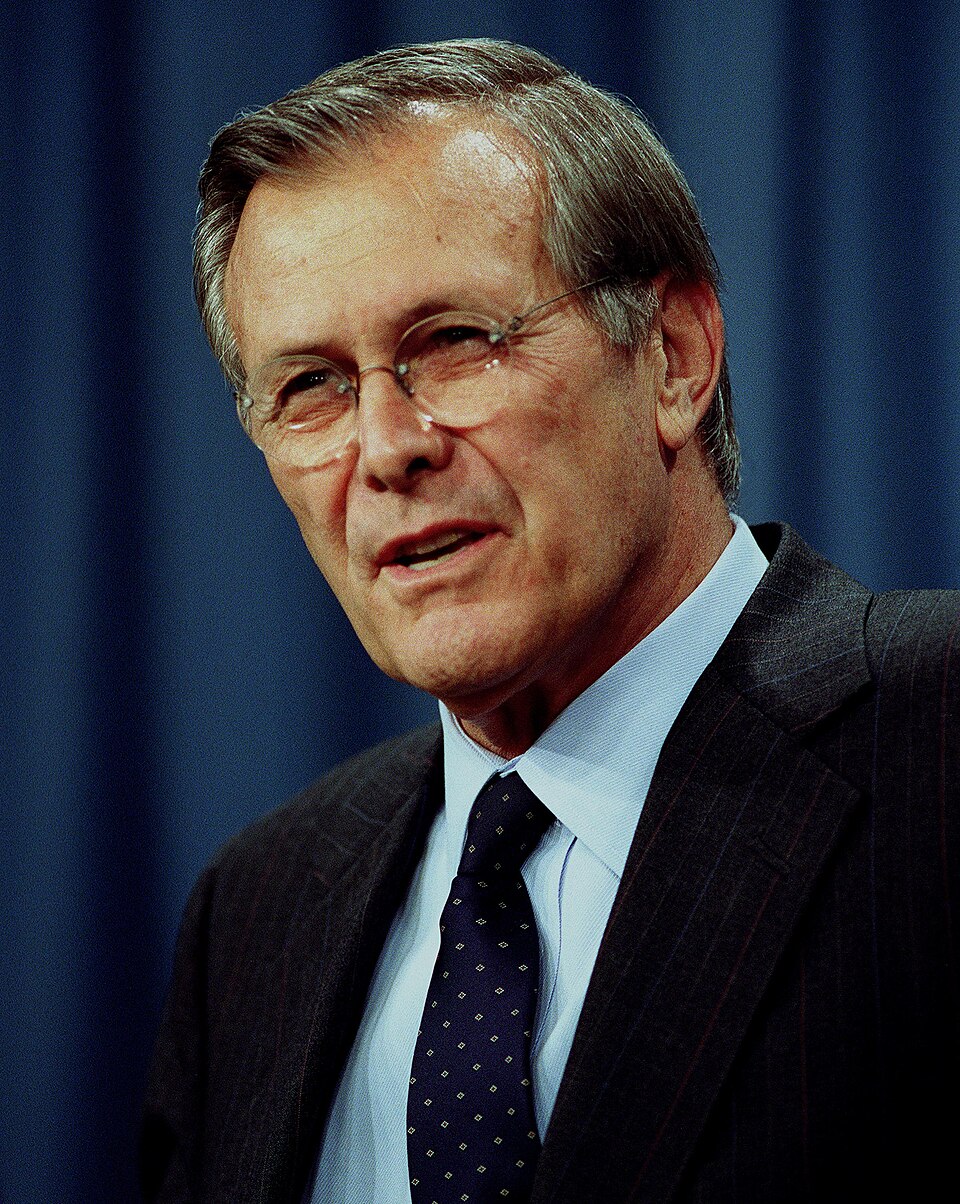
Donald H. Rumsfeld, Secretary of Defense when the outreach ran. U.S. Department of Defense photo. Public domain (work of the U.S. federal government).
How it works
- Testimonial: the programme drew on the authority of rank. According to the Times, Clarke's team saw retired officers as the ultimate "key influential": authoritative, often decorated, and reaching mass audiences. On air, a retired general vouching for the progress of a war stands in for the underlying data, which the viewer cannot check.
- Narrative laundering: the Pentagon's "themes and messages" reached the public through a surface that looked more independent: the network analyst's chair. The department's own planning language, as quoted by the Times, describes the goal as delivering those themes "in the form of their own opinions". This tag rests on the documents' stated aim and the confirmed talking points. It does not rest on any finding that particular analysts repeated them word for word.
- Disclosure theater: GAO found that the outreach was not concealed. Pentagon records existed, and nothing barred reporters from asking. But no disclosure went out with the broadcast. Viewers saw a rank and a network caption, not the briefing that preceded the segment, and, according to the Times, rarely the contractor ties.
- Manufactured consensus: the same briefings and talking points went to analysts at Fox News, NBC, CNN, CBS and ABC, and a contractor tracked what they then said. What viewers heard as several experts on several channels agreeing could come from a single briefing. This is the method the evidence shows. How far it moved coverage was not measured by any of the official reviews.
Then and now
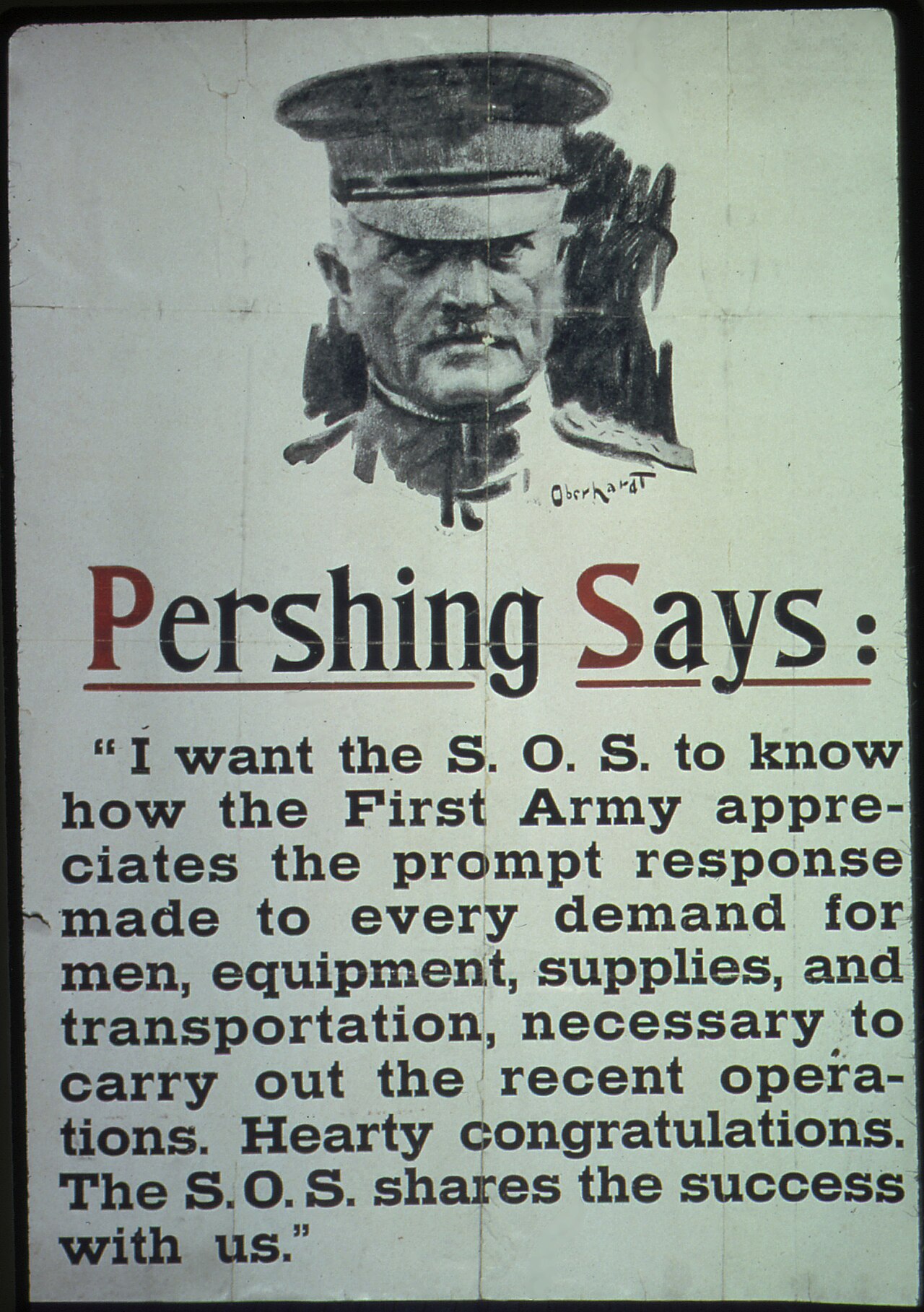
Pershing Says: The S.O.S. Shares the Success With Us, American Expeditionary Forces (Services of Supply), 1918. Public domain.
In 1918 the Army used General Pershing's name to vouch for its supply troops. The endorsement was the whole message, and the poster showed who was speaking: Pershing, by name, on an Army poster. The 2002-2008 outreach kept the Testimonial and moved the source. The retired officers spoke as network analysts, in their own names, and their Pentagon briefings did not appear on screen.
A closer comparison from the same decade is the Department of Education's 2003-2004 contract, through the PR firm Ketchum, with the commentator Armstrong Williams, who received $240,000 to promote the No Child Left Behind Act without disclosing the arrangement. In opinion B-305368 of 30 September 2005, GAO found that to be "covert propaganda" in violation of the same appropriations rider. GAO's two opinions draw the line at payment and concealment. Williams was paid and the sponsorship was hidden. The analysts were not paid by DoD, and the outreach itself was not hidden, even though audiences did not see it.
Positions on the record
- The Department of Defense's stated position. The aim was to keep the public informed about the war on terrorism by giving prominent analysts factual information and frequent, direct access to senior officials, as with other briefings of outside experts. Spokesman Bryan Whitman: "The intent and purpose of this is nothing other than an earnest attempt to inform the American people." The 2011 inspector general report found the outreach complied with DoD policy and regulation. GAO found no violation of the propaganda rider.
- Critics' position. Some participants described it differently. Kenneth Allard, a former NBC analyst, called it "psyops on steroids". Robert Bevelacqua, a former Fox News analyst, said: "It was them saying, 'We need to stick our hands up your back and move your mouth for you.'" Members of Congress (Levin, DeLauro, Dingell, Kerry, Feingold and others) called for investigations. Press critics faulted the networks for not disclosing analysts' business ties and, as NPR reported, for giving the 2008 story little airtime.
- This archive's reading. Documented: the recruitment of more than 70 retired officers; the 147 events; talking points given before appearances; the "message force multipliers" and "surrogates" language in DoD records; contractor ties that viewers were rarely told about; the suspension in April 2008; the withdrawal of the January 2009 report; GAO's finding that DoD attempted to influence public opinion but did not break the rider; and the 2011 finding of compliance. Not shown by the official record: that any analyst was paid by DoD for commentary, that any analyst's employer won a contract because of the access (the 2011 report found no evidence of this), or how much the outreach changed what audiences believed. This page makes no finding on the Iraq or Afghanistan wars themselves.
Same-method test
A defence ministry anywhere that gave retired officers private briefings and talking points, flew them to its bases, logged whether their commentary was favourable, and let them appear on air as independent analysts without disclosing any of it, would be scored the same way, whatever the government or war. The closest officially adjudicated counterpart found for this page is again American: GAO's 2005 Armstrong Williams opinion, which used the same statute and reached the opposite conclusion because payment and concealment were present. No foreign case with a comparable official record (an inspector-general or auditor finding on retired officers used as briefed broadcast analysts) was verified for this page.
How to spot it
- When an expert comments on a war, ask who briefed them that week and whether the broadcast says so.
- Check the analyst's current board seats, consultancies and lobbying registrations against the equipment or policy being discussed.
- Watch for the same phrase from several "independent" experts on different channels within a day or two. That is a pointer to a common source, not proof of one.
- Keep three layers apart: the outreach (documented), the on-air words (checkable against the talking points), and the claim that the words changed public opinion (not measured by any official review).
Images
| Image | Source | Licence |
|---|---|---|
| Mechanism diagram (above) | Drawn for FRAME from this page's sourced facts (make_diagrams.py) |
CC BY 4.0, FRAME |
| Donald Rumsfeld | Wikimedia Commons, U.S. Department of Defense | Public domain (U.S. government work) |
| Pershing Says (1918) | FRAME gallery | Public domain (U.S. government work) |

Image gaps
- Pages from the 8,000 pages of DoD records the Times obtained (for example a memo using "message force multipliers", or an Omnitec monitoring report). As DoD records they are U.S. government works and so public domain, and the Times posted them online, but neither nytimes.com nor the DoD document mirrors could be reached from the environment used to build this page. This gap can be filled.
- The 2011 inspector general report (DODIG-2012-025) and GAO opinion B-316443. Both are public domain. media.defense.gov and gao.gov were blocked from this environment. This gap can be filled with a cover or findings page.
- A photo of a Pentagon briefing or of Victoria Clarke at the podium. DoD photos of Clarke's briefings exist and would be public domain, but Wikimedia Commons was heavily rate-limited while this page was built. This gap can be filled.
- Screenshots of analysts on air. Not included: network broadcasts are copyrighted, and showing individual analysts would imply findings about them that the record does not make.
Sources
- David Barstow, "Behind TV Analysts, Pentagon's Hidden Hand", New York Times, 20 April 2008
- David Barstow, "One Man's Military-Industrial-Media Complex", New York Times, 29 November 2008 (copy at the Internet Archive)
- GAO, B-316443, Department of Defense: Retired Military Officers as Media Analysts, 21 July 2009
- GAO, B-305368, Department of Education: Contract to Obtain Services of Armstrong Williams, 30 September 2005
- DoD Inspector General, DODIG-2012-025, Office of the Assistant Secretary of Defense (Public Affairs) Retired Military Analyst Outreach Activities, 21 November 2011 (redacted)
- Rep. Rosa DeLauro, statement on the reversal and removal of the Pentagon inspector general's report, May 2009
- PR Week, "Pentagon suspends retired military analyst briefings", April 2008
- PBS NewsHour, "Government Curries Favor With Military News Analysts", 2008 (Whitman quote)
- NPR, "Pentagon Used Military Analysts to Deliver Message", 1 May 2008
- PR Watch, "Media's Military Analysts Involved in 'Psyops on Steroids'", April 2008
- Washington Times, "Pentagon's inspector general finds no misconduct in briefing program", 1 December 2011
- David Barstow, "Pentagon Finds No Fault in Ties to TV Analysts", New York Times, December 2011 (mirror at Free Government Information)
- Scott Horton, "The Pentagon and its Sock Puppets", Harper's, December 2011
- Truthout, "TV Analysts' Collusion With the Military: Disgraceful but Legal?", 29 December 2011
- Democracy Now!, interview with David Barstow on the Pulitzer, 8 May 2009
- NPR, "Critic: Networks Let Pentagon Press Scoop Wither", 24 April 2008