In one line: in 2002-03 the Bush administration and the Blair government each published dossiers, speeches and a UN presentation that stated intelligence judgements about Iraqi weapons of mass destruction with more certainty, and fewer caveats, than the classified assessments behind them; no stockpiles were found, and inquiries in both countries measured the gap, in different words and with different findings about intent.
What happened
United Kingdom
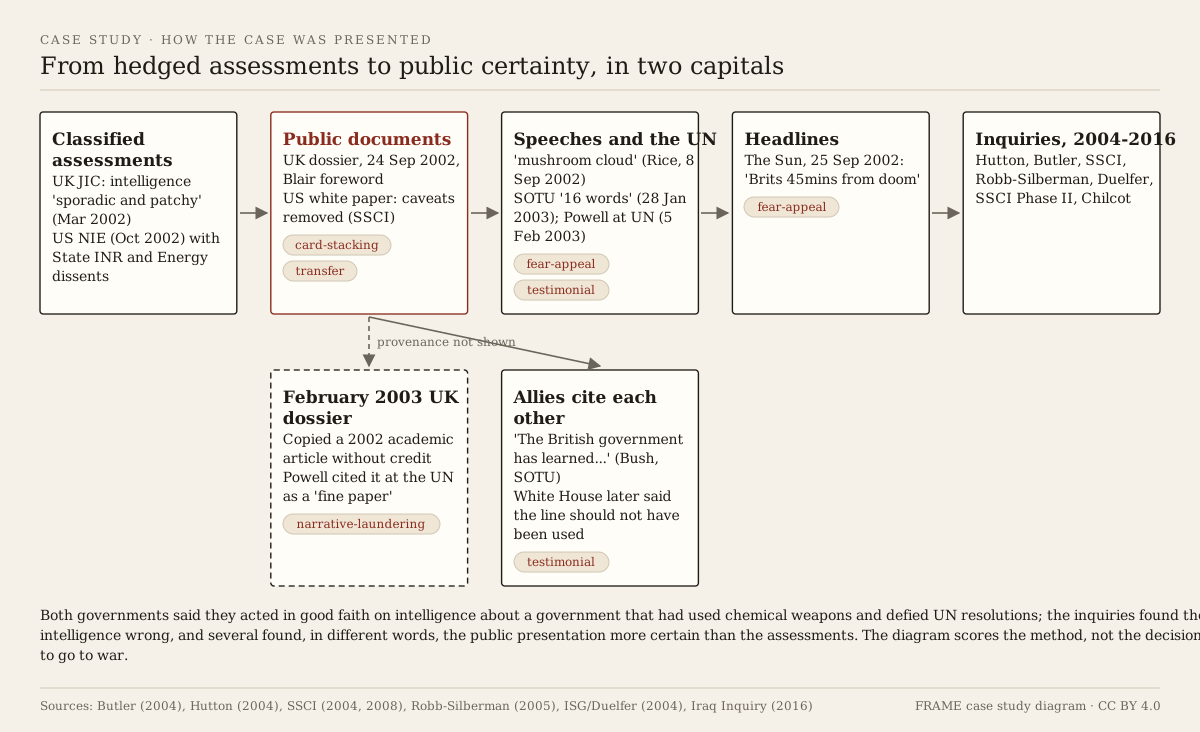
- March 2002. A Joint Intelligence Committee (JIC) assessment describes intelligence on Iraq's weapons of mass destruction and ballistic missile programmes as "sporadic and patchy" (quoted in the Butler Review, 2004).
- 24 September 2002. Downing Street publishes Iraq's Weapons of Mass Destruction: The Assessment of the British Government. Tony Blair's foreword says Iraq poses a "current and serious threat to the UK national interest" and that Saddam Hussein has continued to produce chemical and biological weapons. The text says some weapons could be deployed within 45 minutes of an order. The underlying report reached the Secret Intelligence Service on 29 August 2002 from a single source, and referred to battlefield munitions, which the dossier did not say. In the Commons that day Blair calls the intelligence picture "extensive, detailed and authoritative".
- Alastair Campbell's role. Blair's Director of Communications and Strategy worked with John Scarlett, the JIC chairman, on the dossier's presentation and sent him drafting suggestions (Hutton Inquiry evidence). The dossier went out as a government document rather than a JIC assessment, with Blair's foreword on top.
- 24-25 September 2002. The London Evening Standard runs "45 MINUTES FROM ATTACK"; The Sun runs "Brits 45mins from doom", saying British servicemen and tourists in Cyprus could be "annihilated" by Iraqi germ-warfare missiles.
- 3 February 2003. Campbell's office issues Iraq: Its Infrastructure of Concealment, Deception and Intimidation to journalists. On 6 February Channel 4 News, drawing on Cambridge researcher Glen Rangwala, reports that large parts were copied, typographical errors included, from Ibrahim al-Marashi's September 2002 article "Iraq's Security and Intelligence Network: A Guide and Analysis" (Middle East Review of International Affairs, drawn from his postgraduate research) and from Jane's Intelligence Review, uncredited, with some wording hardened ("monitoring foreign embassies" became "spying on foreign embassies"). Downing Street says "we should have made the attribution clearer". It becomes known as the "dodgy dossier".
- 29 May 2003. BBC reporter Andrew Gilligan says on Today that the government "probably knew that the 45-minute figure was wrong even before it decided to put it in". His source, Ministry of Defence scientist Dr David Kelly, is named and dies in July 2003.
- 7 July 2003. The Commons Foreign Affairs Committee calls the February dossier "counter-productive" and says its sources should have been credited.
United States
- August 2002. Chief of Staff Andrew Card forms the White House Iraq Group (WHIG), a weekly Situation Room meeting to set communications strategy on Iraq; regulars include Karl Rove, Karen Hughes, Mary Matalin, I. Lewis "Scooter" Libby, Condoleezza Rice and Stephen Hadley (Washington Post, 2008). On 7 September Card tells the New York Times: "From a marketing point of view, you don't introduce new products in August."
- 8 September 2002. National Security Adviser Rice tells CNN that aluminium tubes bought by Iraq "are really only suited for nuclear weapons programs" and that "we don't want the smoking gun to be a mushroom cloud". Department of Energy experts had assessed the tubes as more consistent with conventional rockets. On 7 October in Cincinnati, President Bush says: "we cannot wait for the final proof -- the smoking gun -- that could come in the form of a mushroom cloud."
- October 2002. The National Intelligence Estimate (NIE) Iraq's Continuing Programs for Weapons of Mass Destruction judges that Iraq is reconstituting its nuclear programme, with a dissent from the State Department's Bureau of Intelligence and Research (INR) on the tubes. A public CIA "white paper" released the same month leaves out the dissents and the "we judge" and "we assess" wording.
- 28 January 2003. In the State of the Union, Bush says: "The British government has learned that Saddam Hussein recently sought significant quantities of uranium from Africa," and "From three Iraqi defectors we know that Iraq, in the late 1990s, had several mobile biological weapons labs."
- 5 February 2003. Secretary of State Colin Powell presents to the UN Security Council, with CIA Director George Tenet seated behind him: "every statement I make today is backed up by sources, solid sources." He holds up a small vial to illustrate a quantity of anthrax, shows drawings of mobile biological labs, and commends "the fine paper that the United Kingdom distributed yesterday which describes in exquisite detail Iraqi deception activities" (the February dossier). The mobile-lab claim rested mainly on one Iraqi source handled by Germany's BND, codenamed Curveball.
- 17 March 2003. Bush: "Intelligence gathered by this and other governments leaves no doubt that the Iraq regime continues to possess and conceal some of the most lethal weapons ever devised." The invasion begins on 20 March.
- July 2003. The White House says the uranium sentence should not have been in the speech. Tenet (11 July): "These 16 words should never have been included in the text written for the President." Deputy National Security Adviser Hadley (22 July) says he "failed in that responsibility".
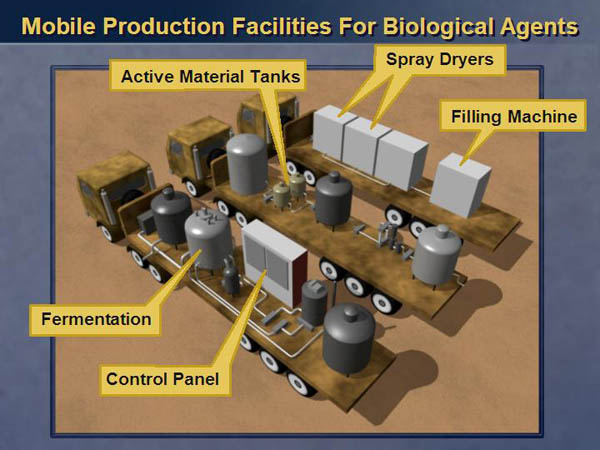
Mobile Production Facilities for Biological Agents (UN Security Council slide), U.S. Department of State, 5 February 2003. Public domain.
What the inquiries found
- Hutton Inquiry (28 January 2004, UK). Found Gilligan's allegation that the government probably knew the 45-minute claim was wrong to be unfounded, and strongly criticised the BBC. It added that "the possibility cannot be completely ruled out" that the Prime Minister's wish for a dossier "as strong as possible" may have "subconsciously influenced" Scarlett and the JIC "to make the wording of the dossier somewhat stronger than it would have been if it had been contained in a normal JIC assessment".
- Senate Select Committee on Intelligence (July 2004, US). Conclusion 1: "Most of the major key judgments" in the October 2002 NIE "either overstated, or were not supported by, the underlying intelligence reporting." Conclusion 85: the removal of caveats from the white paper "misrepresented their judgments to the public".
- Butler Review (14 July 2004, UK). The dossier "went to (although not beyond) the outer limits of the intelligence available"; the 45-minute report should not have been included "without stating what it was believed to refer to", and its repetition "led to suspicions that it had been included because of its eye-catching character". Butler also wrote: "we have found no evidence of deliberate distortion or of culpable negligence."
- Iraq Survey Group / Duelfer report (30 September 2004). Iraq had destroyed its chemical and biological stockpiles and ended its nuclear programme after 1991; no stockpiles remained in 2003. It also reported that Saddam Hussein intended to rebuild weapons capability once sanctions ended.
- Robb-Silberman Commission (31 March 2005, US). The intelligence community "was dead wrong in almost all of its pre-war judgments about Iraq's weapons of mass destruction", and the mobile-lab judgement leaned on Curveball. The commission was not charged with examining how policymakers used the intelligence.
- SSCI Phase II (5 June 2008, US, adopted 10-5). Found many statements on weapons programmes substantiated by the intelligence, but that pre-NIE statements on chemical weapons production "did not reflect the intelligence community's uncertainties", and that statements suggesting an Iraq-al-Qaida partnership "were not substantiated by the intelligence". Chairman Jay Rockefeller: the administration "made significant claims that were not supported by the intelligence." A minority dissented.
- Iraq Inquiry / Chilcot report (6 July 2016, UK). "The judgements about the severity of the threat posed by Iraq's weapons of mass destruction – WMD – were presented with a certainty that was not justified." The assessed intelligence "had not established beyond doubt" that Iraq had continued to produce chemical and biological weapons. It found "no evidence that intelligence was improperly included in the dossier or that No.10 improperly influenced the text", but that the public use of JIC material "did not make clear enough the limitations or the subtleties of assessment".
- Curveball, February 2011. Rafid Ahmed Alwan al-Janabi told the Guardian he had invented the mobile-lab account to help bring down Saddam Hussein.
How it works
- Card stacking: the classified texts carried the hedges ("sporadic and patchy", "we judge", the INR and Energy dissents, the battlefield scope of the 45-minute report); the public texts kept the conclusions and dropped the hedges. The Senate committee found the white paper's edits "misrepresented" the analysts' judgements; Butler and Chilcot found the UK dossier did not make the limits clear.
- Fear appeal: two short, vivid images carried the threat to mass audiences: a "mushroom cloud" and "45 minutes". Each was a worst case, stated without its uncertainty and tied to one remedy: act now. The Sun's headline moved the 45-minute line from battlefield munitions to British lives in Cyprus.
- Testimonial: authority vouched for claims in place of the underlying data. Powell's personal standing and the words "solid sources", with the CIA director seated behind him; a President citing "the British government has learned"; a Secretary of State praising the UK's "fine paper". Each government's claim was offered as corroboration of the other's.
- Transfer: the September dossier carried the prestige of the JIC and "The Assessment of the British Government" over a text worked on with Downing Street's communications staff and fronted by a political foreword. Hutton's "subconsciously influenced" finding and Chilcot's finding on the limits of JIC material in public presentation both concern this mix of assessment and advocacy.
- Narrative laundering: the February 2003 dossier presented an uncredited academic article and press material as a government intelligence product. Downing Street accepted it should have made the attribution clearer; once Powell cited it at the UN, the copied material reached the Security Council as allied intelligence.
Then and now
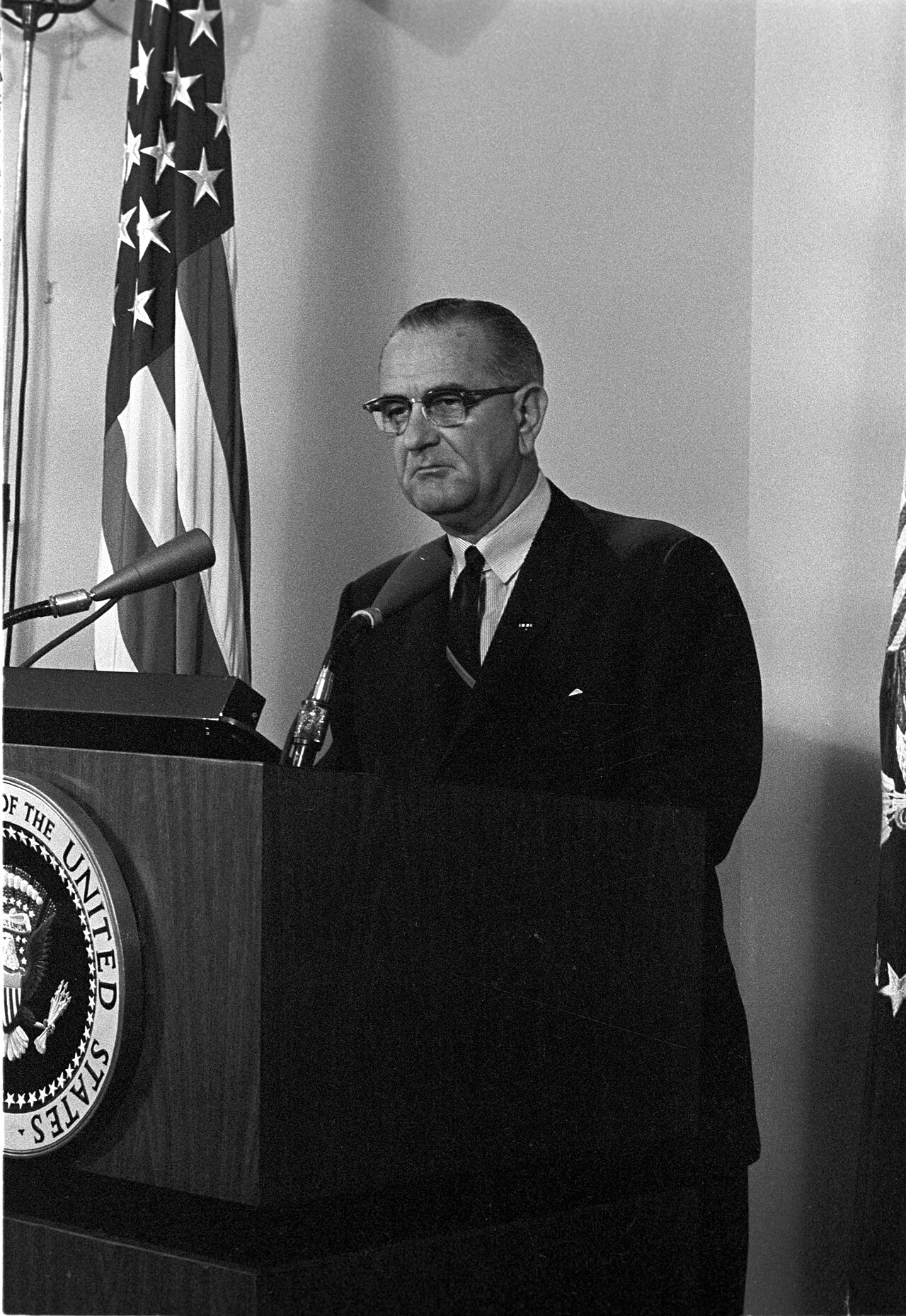
President Johnson's Gulf of Tonkin 'Midnight Address', White House Photo Office, LBJ Library (NARA), 4 August 1964. Public domain.
On 4 August 1964 President Lyndon Johnson, a Democrat, told Americans on television that North Vietnamese boats had attacked U.S. destroyers a second time; Congress passed the Gulf of Tonkin Resolution three days later. The NSA's own historian later concluded that the second attack did not happen and that intercepts had been presented in a way that kept decision-makers from "the complete and objective narrative". The method matches 2002-03 in one respect: selected intelligence, stated as settled, supported a decision on war. The differences are plain too. In 1964 the disputed event was a single naval incident; in 2002-03 it was a multi-year weapons assessment, made in two countries, that was later reviewed by at least seven official inquiries. The Johnson administration's case unravelled through a declassified internal history; the Bush and Blair cases unravelled through a survey on the ground and public inquiries.
Positions on the record
- The governments' stated case. Iraq had used chemical weapons against Iran and against Iraqi Kurds in the 1980s ("He has gassed many Iranians, and 40 Iraqi villages," Bush to the UN, 12 September 2002). It had admitted only in 1995 to a crash nuclear-weapons programme before the 1991 war, had not accounted for prohibited stocks, and had defied UN resolutions; Resolution 1441 (8 November 2002, unanimous) found Iraq in "material breach". After 11 September 2001, both governments said, the risk of waiting for proof was too great. Both said they acted in good faith on the intelligence they had. Tenet said "the President had every reason to believe that the text presented to him was sound." Blair, on 6 July 2016: "The report should lay to rest allegations of bad faith, lies or deceit," and "I will take full responsibility for any mistakes without exception or excuse." Powell later called his UN speech a "blot" on his record (ABC News, September 2005).
- Critics' position. Many opponents of the war argued that both governments selected and hardened intelligence to sell a decision already taken. Major General Michael Laurie, who worked on the September dossier, wrote to the Iraq Inquiry in 2011 that its purpose was "precisely to make a case for war"; Campbell told the inquiry it was "not the case for war".
- This archive's reading. Documented: the gap between the classified assessments and the public texts, measured by the Senate committee (2004, 2008), Butler (2004) and Chilcot (2016); the uncredited copying in the February dossier; the withdrawal of the uranium sentence; the absence of stockpiles (Duelfer). The inquiries differ on intent, and this page keeps their words. Butler found "no evidence of deliberate distortion"; Hutton found no improper insertion; Chilcot found no improper influence on the dossier's text but certainty "that was not justified". In the U.S., Robb-Silberman placed the failure in the intelligence community and did not examine policymakers' use of it, while the SSCI Phase II majority found some public statements, notably on an Iraq-al-Qaida partnership, "not substantiated by the intelligence". Not shown in any of these official findings: that Bush, Blair, Powell or Campbell knew the weapons claims were false when they made them. This page makes no finding on whether the war was right.
Same-method test
The finding would be the same with the flags and parties swapped. The Johnson administration (Democratic, 1964) is scored the same way in this archive. A government in any country that publishes an unclassified summary without the analysts' caveats, puts a single-source report on its cover in vivid terms, and has an ally cite that document as independent proof would be tagged Card stacking, Fear appeal and Testimonial here, whatever the policy it supported and whether or not the underlying claim later proved true. Note too that the method does not depend on the claim being false: a true claim presented without its caveats would score the same way.
How to spot it
- Put the public text beside the classified or technical one where it is released, and look for dropped hedges: "we judge", "one source", "limited", dissents.
- Ask what a vivid number (45 minutes) or image (a mushroom cloud) refers to, how many sources support it, and who is said to hold it.
- When a government cites an ally's findings, ask whether it has checked them itself. "Our partners have learned" is a vouch, not evidence.
- Check the provenance of a dossier's content: who wrote it, who cleared it, what it copies.
- Read what each inquiry actually concluded. "Overstated", "not substantiated", and "deliberately deceived" are three different findings.
Images
| Image | Source | Licence |
|---|---|---|
| Mechanism diagram (above) | Drawn for FRAME from the sourced facts on this page (make_diagrams.py) |
CC BY 4.0, FRAME |
| Powell UN slide, mobile labs (2003) | FRAME gallery | Public domain (U.S. government work) |
| Johnson's Gulf of Tonkin address (1964) | FRAME gallery | Public domain (U.S. government work) |
Image gaps
- Cover and 45-minute page of the September 2002 dossier, and the February 2003 dossier. UK Crown copyright material that may be reusable under the Open Government Licence, but no copy with a verified licence was found on Wikimedia Commons, and the National Archives web archive could not be reached from the environment used to build this page. This gap can be filled.
- The Sun's "Brits 45mins from doom" front page (25 September 2002). Not included: copyrighted newspaper page.
- Official photographs of Rice, Bush's State of the Union (28 January 2003) or Powell at the UN. U.S. government works, so public domain; not added because of Wikimedia rate limits during the build. This gap can be filled.
- Pages of the Senate committee reports and the Chilcot report. Public domain (U.S.) and Open Government Licence (UK) respectively, but the hosting sites could not be reached from the environment used to build this page. This gap can be filled.
Sources
- Hansard, House of Commons, 14 July 2004: Intelligence on Weapons of Mass Destruction (Butler Review statement and debate)
- Review of Intelligence on Weapons of Mass Destruction (Butler Review), HC 898, 14 July 2004
- Report of the Inquiry into the Circumstances Surrounding the Death of Dr David Kelly (Hutton), 28 January 2004, chapter 12
- Hansard, House of Commons, 28 January 2004: Lord Hutton's Report
- House of Commons Foreign Affairs Committee, The Decision to go to War in Iraq, HC 813, 7 July 2003
- The Report of the Iraq Inquiry (Chilcot), Executive Summary, 6 July 2016 (Wikimedia Commons copy, OGL v3)
- The Conversation, July 2016: Chilcot scolds Britain's intelligence community for its role in the Iraq War
- Hansard, House of Commons, 6 July 2016: Report of the Iraq Inquiry
- Tony Blair Institute: transcript of Tony Blair's press conference, 6 July 2016
- Senate Select Committee on Intelligence, Report on the U.S. Intelligence Community's Prewar Intelligence Assessments on Iraq, S. Rept. 108-301, July 2004 (text)
- SSCI 2004 report, chapter X: the White Paper
- SSCI press release, 5 June 2008: Final Phase II reports on prewar Iraq intelligence
- SSCI, Report on Whether Public Statements Regarding Iraq by U.S. Government Officials Were Substantiated by Intelligence, June 2008 (GPO)
- Commission on the Intelligence Capabilities of the United States Regarding Weapons of Mass Destruction (Robb-Silberman), Report to the President, 31 March 2005
- Comprehensive Report of the Special Advisor to the DCI on Iraq's WMD (Duelfer), key findings, 30 September 2004
- White House, President Bush's remarks to the UN General Assembly, 12 September 2002
- White House, President Bush's Cincinnati address, 7 October 2002
- White House, State of the Union, 28 January 2003
- White House, President Bush's address to the nation, 17 March 2003
- White House press briefing with Dan Bartlett and Stephen Hadley, 22 July 2003
- Statement by DCI George J. Tenet on Iraqi uranium allegations, 11 July 2003
- CNN Late Edition transcript, 8 September 2002 (Condoleezza Rice)
- Colin Powell's address to the UN Security Council, 5 February 2003 (Wikisource)
- Washington Post, 9 June 2008: Records could shed light on Iraq Group
- CNN, 12 September 2002: Marketing Iraq: why now? (quotes Card's remark to the New York Times of 7 September 2002)
- Ibrahim al-Marashi, "Iraq's Security and Intelligence Network: A Guide and Analysis", MERIA, September 2002
- Al Jazeera, 8 June 2003: 'Dodgy dossier' haunts Blair (Downing Street's attribution statement)
- Channel 4 News: Downing St apologises for dodgy dossier
- Press Gazette: Andrew Gilligan's 29 May 2003 broadcast
- David Morrison, "45 minutes from doom" (reproduces the Sun and Evening Standard headlines)
- Washington Post, 25 June 2006: Warnings on WMD "fabricator" were ignored, ex-CIA aide says
- NPR, 15 February 2011: "Curveball" admits for first time that he lied about Iraq's WMD (reporting the Guardian interview)
- Dawn / ABC News, September 2005: Powell terms Iraq speech a blot on his record