Content note. This page quotes a 1915 deportation order, a U.S. ambassador's cables, 1915 newspaper headlines about killings and torture, and later official statements that reject the word genocide. It shows a 1918 fundraising poster of a destitute child. All are quoted and shown as evidence.
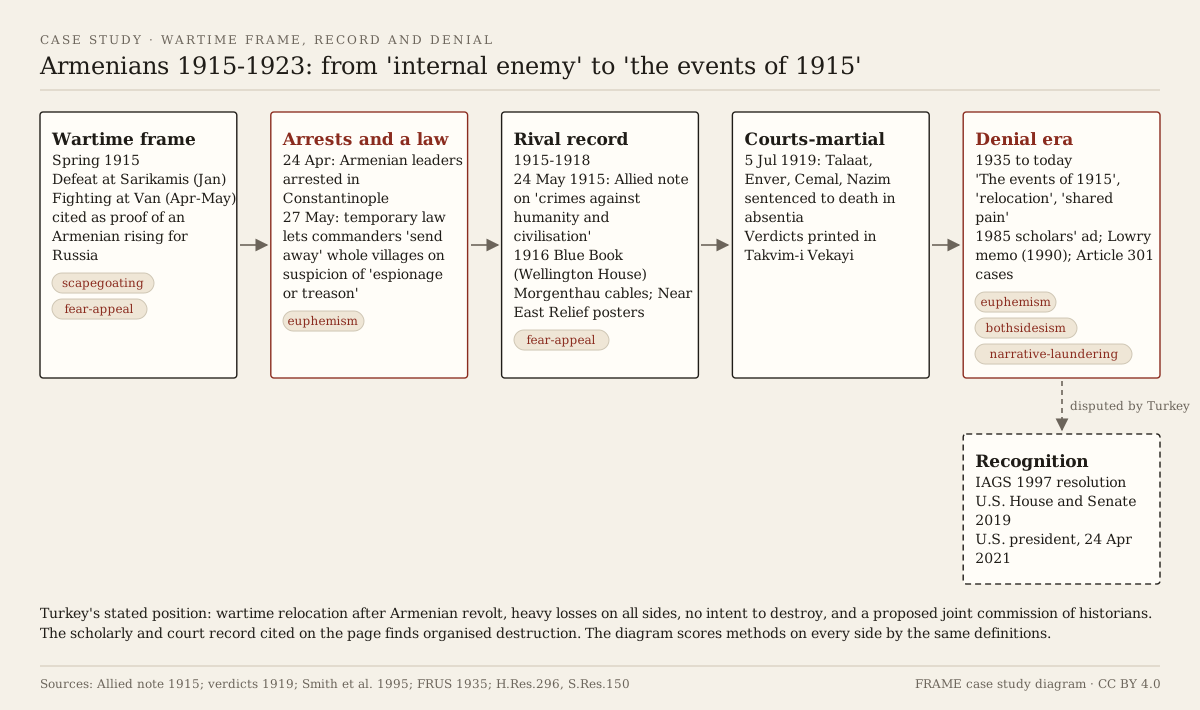
In one line: in 1915 the Ottoman government described its Armenian subjects as a wartime internal enemy and their removal as "dispatch and settlement"; enemy governments and American relief groups published the killings for their own wartime and fundraising purposes; and from the 1930s Turkish governments and bodies they funded worked to keep the word "genocide" out of films, scholarship and foreign legislatures.
What happened
The wartime frame, 1914-1915
- November 1914 to January 1915. The Ottoman Empire enters the war on Germany's side; in January 1915 Enver's army is defeated by Russia at Sarıkamış. Armenian volunteer units from the Russian Empire fight for Russia. Historians including Ronald Suny and Taner Akçam describe CUP leaders then treating Ottoman Armenians as a whole as allied to the enemy.
- 20 April to mid-May 1915, Van. Armenians in Van hold out against Governor Cevdet Bey's forces until Russian troops and Armenian volunteers arrive. Ottoman and later official Turkish accounts present Van as a revolt in support of the invader; most historians of the genocide treat it as self-defence against local killings, used by the government to justify measures against all Armenians.
- 24 April 1915, Constantinople. On an order from Talaat's interior ministry, police arrest Armenian community leaders, writers, deputies and clergy, usually put at 235 to 270 in the first wave. Most are sent toward Ankara and many are later killed. The order presents the Armenian committees as a threat to national security. Armenians mark 24 April as the day of remembrance.
- 27 May 1915, the temporary law. The cabinet adopts a temporary law, published on 1 June, letting army, corps and division commanders deport civilians. Its Ottoman name uses sevk ve iskân, "dispatch and settlement"; official Turkish usage today is "relocation" (tehcir). As printed in U.S. newspapers in October 1915, the order read: "The commanders of the army, of independent army corps and of divisions may, in case of military necessity and in case they suspect espionage or treason, send away either singly or in mass the inhabitants of villages or towns and install them in other places."
- 1915-1916, the deportations. Armenians are marched toward the Syrian desert; men are often separated and killed, and many deportees die in camps around Deir ez-Zor. The 1919 Ottoman indictment charged the CUP with using the "Special Organisation" (Teşkilât-ı Mahsusa) for the killings. Estimates of Armenian deaths vary: the International Association of Genocide Scholars (IAGS) gives more than a million; the 2019 U.S. resolutions and the 2021 U.S. presidential statement use 1.5 million.
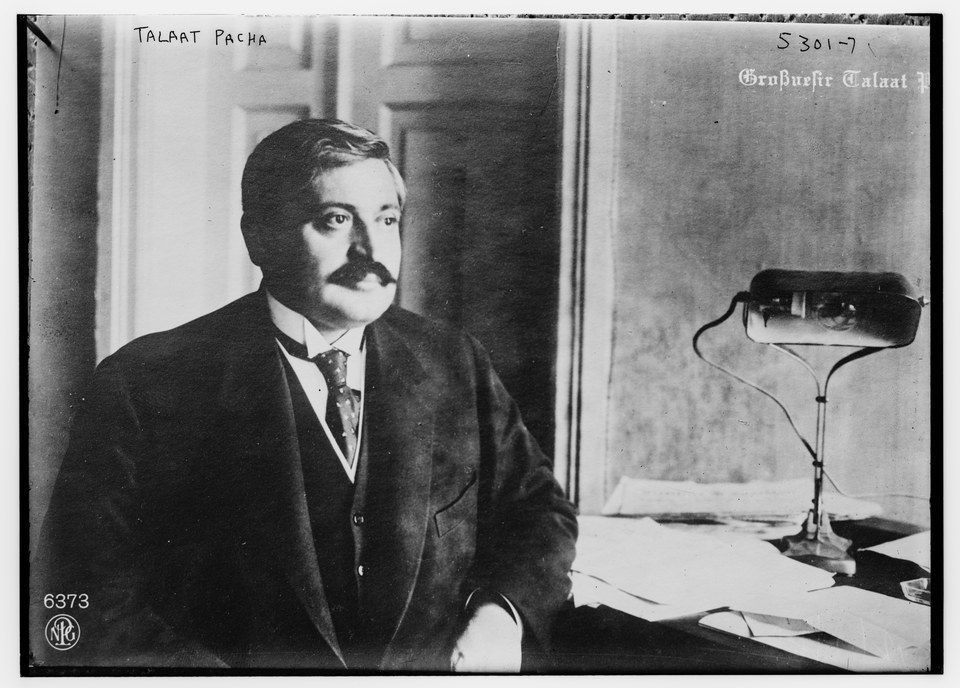
Talaat Pasha, Ottoman interior minister in 1915 and grand vizier from 1917 (the German caption reads "Großvezir Talaat"). Photograph published by Neue Photographische Gesellschaft, c. 1917-1920, via the Bain News Service. Library of Congress, public domain in the U.S. Shown because his ministry issued the 24 April arrest order. The 1919 court-martial sentenced him to death in absentia.
The rival record, 1915-1918
- 24 May 1915, the Allied declaration. Britain, France and Russia, then at war with the Ottoman Empire, announce: "In view of these new crimes of Turkey against humanity and civilization, the Allied Governments announce publicly to the Sublime Porte that they will hold personally responsible for these crimes all members of the Ottoman Government, as well as those of their agents who are implicated in such massacres." It is the first use of "crimes against humanity" in diplomacy, issued by belligerents.
- 16 July 1915, the U.S. ambassador. Henry Morgenthau, ambassador of a then-neutral United States, cables Washington: "Deportation of and excesses against peaceful Armenians is increasing and from harrowing reports of eye witnesses it appears that a campaign of race extermination is in progress under a pretext of reprisal against rebellion."
- October 1915, U.S. front pages. A committee formed by Charles R. Crane, Cleveland H. Dodge and others releases consular and missionary reports with names withheld; the Daily Kennebec Journal of 4 October leads with "FEARFUL ATROCITIES CHARGED AGAINST TURKS ON ARMENIANS" and prints the deportation order.
- 1916, the Blue Book. The British government publishes The Treatment of Armenians in the Ottoman Empire, 1915-16 (Miscellaneous No. 31), 149 documents compiled by Arnold Toynbee at Wellington House, the War Propaganda Bureau, with a preface by Viscount Bryce. Wellington House worked mainly on U.S. opinion. The Blue Book was wartime propaganda by a belligerent, and it is also a documentary record that historians still use: many documents came from U.S. consuls and missionaries, and the names withheld in 1916 (listed in a confidential key) are restored in Ara Sarafian's 2000 edition. The Ottoman government answered with its own 1916 white book on the "revolutionary" aims of the Armenian committees.
- 1918, Morgenthau's book. Ambassador Morgenthau's Story, ghostwritten by Burton J. Hendrick and published by Doubleday, Page while the U.S. was at war with Germany, says the deportation orders were "merely giving the death warrant to a whole race". In 1990 Heath Lowry called the book a record of "crude half-truths and outright falsehoods". The 1915 cables quoted above are contemporaneous and do not depend on the book.
- 1918, "Lest We Perish". The American Committee for Relief in the Near East, incorporated by Congress in 1919 as Near East Relief, runs a $30,000,000 campaign. Ethel Franklin Betts's poster shows a girl with open hands above the words "LEST WE PERISH". The Library of Congress records it under the Committee on Public Information's Division on Pictorial Publicity, the U.S. government's wartime poster office. Near East Relief administered about $116 million to $117 million from 1915 to 1930, much of it under the slogan "the starving Armenians".
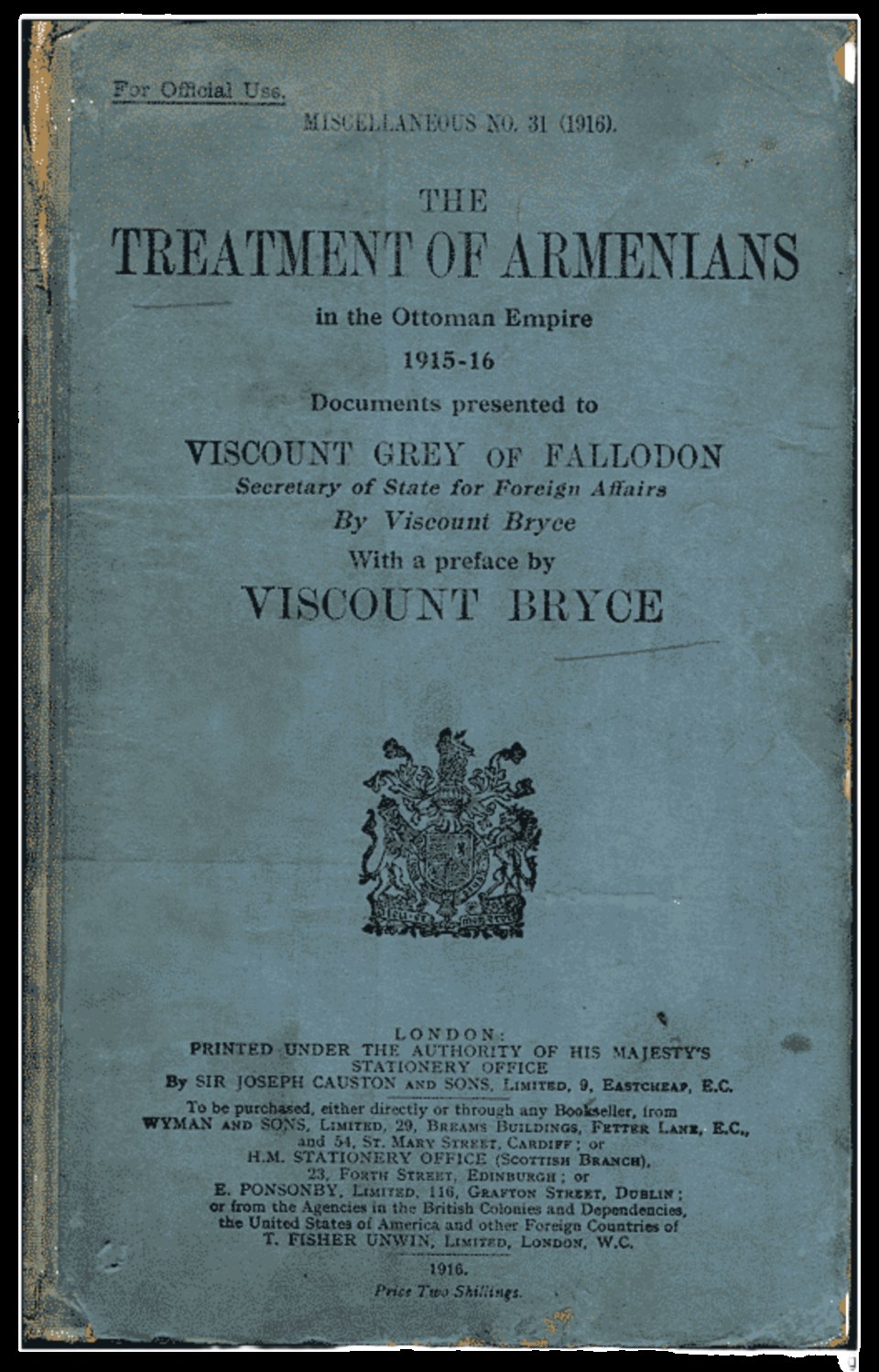
Cover of The Treatment of Armenians in the Ottoman Empire, 1915-16, Miscellaneous No. 31 (1916), H.M. Stationery Office, public domain, via Wikimedia Commons. Shown because it is both a British wartime propaganda product and a documentary source.
Trials, 1919-1921
- 8-10 April 1919. An Ottoman court-martial in occupied Istanbul convicts Mehmed Kemal, former district governor of Boğazlıyan, of ordering the robbery and murder of Armenians. He is hanged in Beyazıt Square on 10 April 1919.
- 5 July 1919. In the main case against CUP leaders and wartime ministers (28 April to 5 July 1919), the court sentences Talaat, Enver, Cemal and Nazım to death in absentia. They had fled in November 1918. The verdict is printed in the official gazette, Takvim-i Vekayi.
- 1920-1923. The Treaty of Sèvres (1920) would have required Turkey to hand over those responsible; it is never ratified and is replaced by the Treaty of Lausanne (1923). Talaat is killed in Berlin in March 1921 by Soghomon Tehlirian, whom a German jury acquits.
The denial era, 1935 to today
- 1935, The Forty Days of Musa Dagh. MGM plans a film of Franz Werfel's novel. Turkish Ambassador Münir Ertegün protests to the State Department, which passes his note to Will Hays, whose office replies that the script "will not go into production without the approval of the Turkish Ambassador". MGM's representative later tells the ambassador that filming "could not but be harmful from every standpoint". MGM drops the film.
- 1981-1985. Reagan's Proclamation 4838 (1981) refers to "the genocide of the Armenians". In 1982 the Institute of Turkish Studies (ITS) is founded in Washington with a $3 million Turkish government grant, with Heath Lowry as executive director. On 19 May 1985 the Assembly of Turkish American Associations places an advertisement in the New York Times and Washington Post in which 69 academics tell the House that House Joint Resolution 192 is "misleading and/or inaccurate" and describe the period as "serious inter communal warfare (perpetrated by Muslim and Christian irregular forces), complicated by disease, famine, suffering and massacres".
- October 1990, the Lowry memo. Turkish Ambassador Nüzhet Kandemir writes to psychiatrist Robert Jay Lifton objecting to references to the Armenian genocide in his book The Nazi Doctors. The envelope also contains Lowry's memo advising the ambassador how to answer Lifton, and a draft of the letter. The letter refers to "the so-called Armenian Genocide" and "a tragic civil war perpetrated by misguided Armenian nationalists". In 1995 Roger Smith, Eric Markusen and Lifton publish the documents in Holocaust and Genocide Studies, describing "an arrangement by which the government of Turkey has channeled funds into a supposedly objective research institute in the United States, which in turn paid the salary of a historian who served that government in its campaign to discredit scholarship on the Armenian genocide".
- 1997 and 2005. The IAGS resolves unanimously in 1997 that the 1915 massacres were genocide under the UN Convention, and in June 2005 sends an open letter to Prime Minister Erdoğan.
- 2005-2011, Article 301 and the courts. Novelist Orhan Pamuk is charged under Article 301 of the penal code ("denigrating Turkishness") after telling Das Magazin: "Thirty thousand Kurds have been killed here, and a million Armenians. And almost nobody dares to mention that." The charges are dropped in January 2006. Journalist Hrant Dink, editor of Agos, receives a six-month suspended sentence under the same article and is shot dead outside his office on 19 January 2007. The European Court of Human Rights (ECtHR) finds violations of his rights to life and free expression (Dink v. Turkey, 2010) and rules that Article 301 itself breaches free expression (Altuğ Taner Akçam v. Turkey, 2011).
- 2005-2009, the commission proposal. On 10 April 2005 Erdoğan writes to Armenia's President Robert Kocharyan proposing a joint commission of historians. The 2009 Zurich Protocols between the two states include a historical sub-commission; neither parliament ratifies them.
- 2007 and 2019, the U.S. Congress. In October 2007 the House Foreign Affairs Committee approves H.Res.106 by 27 to 21; Turkey recalls its ambassador for consultations, the Bush administration opposes the measure, and it never reaches the floor. On 29 October 2019 the House adopts H.Res.296 by 405 to 11. Senators Graham, Perdue and Cramer each block S.Res.150 by objection, Graham saying the White House asked him to; it passes by unanimous consent on 12 December 2019.
- 23 April 2014. Prime Minister Erdoğan offers condolences to the grandchildren of Armenians who died, calls the First World War "our shared pain", refers to "events which had inhumane consequences – such as relocation", and renews the joint-commission offer.
- 15 October 2015, Perinçek v. Switzerland. The ECtHR Grand Chamber finds, ten votes to seven, that Switzerland's conviction of a Turkish politician for denying the genocide breached his free expression, and says it had no authority to rule on whether the events were genocide.
- 24 April 2021. President Biden's statement: "The American people honor all those Armenians who perished in the genocide that began 106 years ago today", adding "We do this not to cast blame but to ensure that what happened is never repeated." Turkey's foreign ministry replies that it rejects the statement "in the strongest terms" and that it "does not have a scholarly and legal basis, nor is it supported by any evidence".
How it works
- Scapegoating: a military defeat at Sarıkamış and a Russian advance at Van are placed on the Armenian population as a whole. The 1915 order lets commanders remove whole "villages or towns" when they "suspect espionage or treason": suspicion attaches to a community, not to a charged person.
- Fear appeal: used on two sides. The wartime frame presents an enemy inside the lines during an invasion, with one remedy, removal. The 1918 Near East Relief poster presents a child's imminent death with one remedy, the $30,000,000 campaign. The famine and deaths behind the poster were real and documented; as with Remember Belgium in this archive, the tag is for the construction (one image, one remedy), not for doubt about the facts.
- Euphemism / doublespeak: "dispatch and settlement", "relocation", "the events of 1915" and "inhumane consequences – such as relocation". The operational words (deported, killed, died on the marches) are absent from the official phrase.
- Bothsidesism: the 1985 advertisement's "inter communal warfare (perpetrated by Muslim and Christian irregular forces)", the 1990 letter's "tragic civil war", and the later "shared pain" and joint-commission frames present the question as open and the losses as symmetrical. Large Muslim losses in the war are not in dispute. The asymmetry is in the evidence on intent, set out under Positions on the record.
- Narrative laundering: according to Smith, Markusen and Lifton, a state-funded institute's director drafted the ambassador's letter, and state funding stood behind scholarship presented to U.S. readers and legislators as independent. The finding rests on the documents they published, not on the opinions of the scholars involved.
The Blue Book, the Allied declaration and Morgenthau's cables are white propaganda in Jowett and O'Donnell's sense: openly sourced to governments at war or to a diplomat. They carry no technique tag here because the cited evidence does not show a technique applied to their content, though the Blue Book's selection and timing were made by a belligerent to move U.S. opinion, as noted above; their documents have been tested against other sources. The ghostwritten 1918 book is weighed separately from the cables.
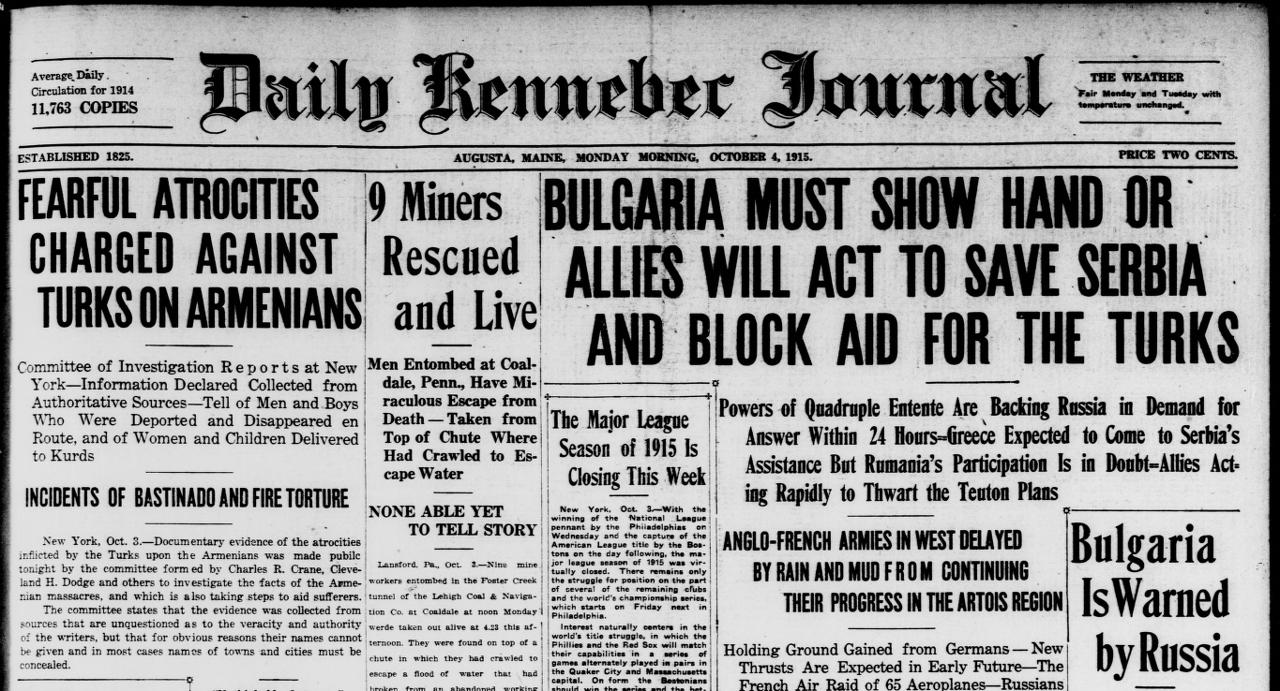
Daily Kennebec Journal (Augusta, Maine), 4 October 1915, top of page 1: "FEARFUL ATROCITIES CHARGED AGAINST TURKS ON ARMENIANS". The article quotes the Ottoman deportation order. Library of Congress, Chronicling America, public domain; cropped by FRAME. Shown as an example of how the Crane-Dodge committee's release reached U.S. readers.
Then and now
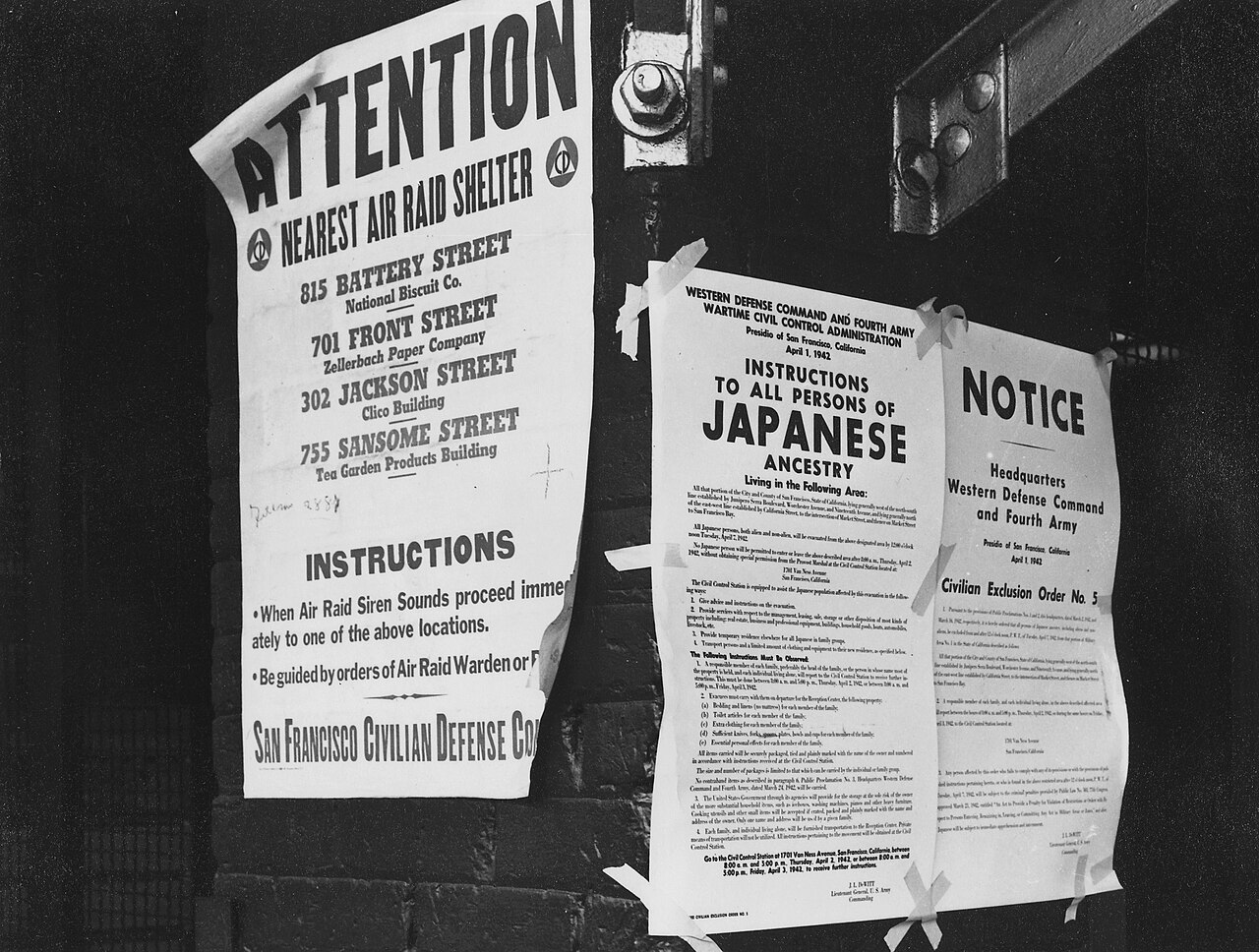
'Instructions to All Persons of Japanese Ancestry' (exclusion order posted in San Francisco), U.S. Army Western Defense Command, 1942, photographed by Dorothea Lange for the War Relocation Authority. Public domain.
The U.S. order of April 1942 removed "all persons of Japanese ancestry" from the West Coast under the words "evacuation" and "relocation", the same family of terms as sevk ve iskân. The outcomes differ greatly: about 120,000 people were held in U.S. camps, there was no mass killing, and Congress apologised in 1988; the Ottoman deportations ended in mass death. What the two share is the method: a wartime security word where the act, forced removal of a group defined by descent, would be.
The later denial campaign has parallels in other case studies: Germany's decades of avoiding the word for the Herero and Nama killings until 2021 (see the Herero and Nama case study, herero-nama-genocide) and the Soviet and later Russian framing of the 1932-33 famine (Collectivisation, the 1932-33 famine and its denial: the kulak label, the silence and the foreign press).
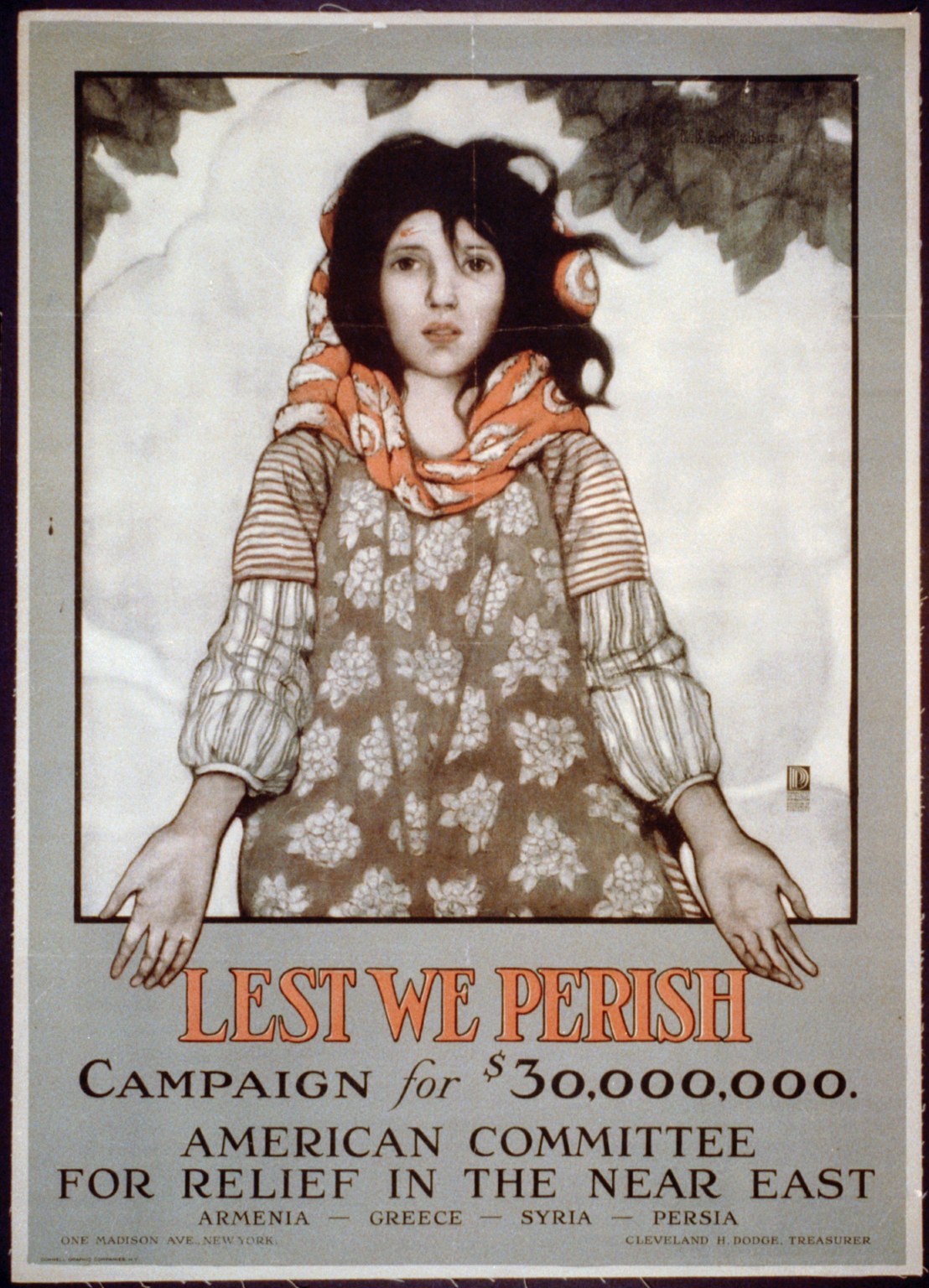
"Lest We Perish", Ethel Franklin Betts for the American Committee for Relief in the Near East, c. 1918. Library of Congress (LC-USZC4-1343), public domain in the U.S. Shown because it is scored by the same fear-appeal definition as the Ottoman wartime frame.
Positions on the record
- The Ottoman government, 1915-1916. The deportations were a wartime security measure against Armenian committees that had risen in support of Russia; its 1916 white book set out that case.
- The Republic of Turkey today, in its own terms. Some Armenians sided with the invading Russian armies and revolted; the relocation was a wartime measure; many Armenians died of disease, famine and attacks during it; very large numbers of Muslims also died; the events do not meet the legal definition of genocide, which requires proven intent and a competent court ruling. Turkey proposes a joint commission of Turkish, Armenian and international historians working in open archives, and offers condolences for the deaths (2014). It calls recognition statements, such as the 2021 U.S. one, political and without scholarly or legal basis.
- Courts. The Ottoman state's own courts-martial convicted CUP leaders and officials in 1919 of organising the massacres. No international court has ruled on whether 1915 was genocide; the Genocide Convention dates from 1948, and in Perinçek the ECtHR said it had no authority to decide the question.
- Scholars. The IAGS (1997, 2005) and most historians of the period, including Turkish historians such as Taner Akçam, conclude that the deportations and killings were an organised destruction of the Ottoman Armenians and meet the definition of genocide. Their evidence includes Ottoman documents, the 1919 court records, and reports from neutral U.S. diplomats and from diplomats of the Ottoman Empire's ally Germany.
- Other states. Uruguay's parliament recognised the genocide in 1965. The European Parliament did so in 1987 and again in 2015, France by law in 2001 (Law 2001-70) and the German Bundestag by resolution on 2 June 2016. Turkey recalled its ambassadors from Paris in 2001 and from Berlin in 2016.
- U.S. government. Reagan's 1981 proclamation, the House and Senate resolutions of 2019 and the president's statement of 2021 use the word genocide; other administrations avoided it, citing relations with Turkey.
- The difference in evidence. Both sides agree that large numbers of Armenians died and that the deportation law existed. The dispute is over intent. On that point the record includes the Ottoman state's own postwar verdicts and contemporaneous reporting from neutral and allied diplomats; the official Turkish position rests on the wartime security justification, on Muslim losses, which are real, and on the absence of a court ruling under the 1948 Convention; the first two do not answer the question of whether the Armenian deaths were organised.
- Not shown. An exact death toll. A single surviving signed extermination order: the "Talaat telegrams" published by Aram Andonian in 1920 are of disputed authenticity, and the scholarly finding does not rest on them.
Same-method test
A democracy that removed a wartime minority under the words "evacuation" or "relocation" is scored the same way for Euphemism / doublespeak, as the U.S. 1942 orders are in this archive. A British bureau compiling atrocity documents to move neutral opinion is described as propaganda and as a record, as a German or Ottoman bureau would be. If a U.S.-funded institute's director ghostwrote an ambassador's rebuttal to a scholar, and an advertisement told a foreign parliament that a U.S. atrocity was "inter communal warfare", the page would tag Narrative laundering and Bothsidesism in the same words.
How to spot it
- When a whole community is described as the cause of a military setback, ask which named people did which acts, and whether the measure is aimed at them or at everyone who shares their descent.
- When a document says "relocation", "dispatch" or "the events", look for the verb that describes what happened to the people moved.
- "Losses on all sides" can be true and still not answer the question asked. Check whether the claim addresses intent and organisation, or only totals.
- "Leave it to historians" is worth checking against what historians' own bodies have concluded, and against any declared funding of the historians named, as in the Institute of Turkish Studies case above.
- Humanitarian appeals and a belligerent's atrocity reports can be accurate and still be built to move an audience. Read the underlying documents, not only the poster or the preface.
Images
| Image | Source | Licence |
|---|---|---|
| Mechanism diagram (above) | Drawn for FRAME from the sources below (make_diagrams_atrocity.py) |
CC BY 4.0, FRAME |
| Talaat Pasha, c. 1917 | Library of Congress, Bain Collection, LC-DIG-ggbain-31323 | Public domain in the U.S. (published before 1931) |
| Daily Kennebec Journal, 4 October 1915 | Library of Congress, Chronicling America | Public domain (cropped by FRAME) |
| "Lest We Perish", c. 1918 | Library of Congress, LC-USZC4-1343 | Public domain in the U.S. (published 1918) |
| Blue Book cover, 1916 | Wikimedia Commons, H.M. Stationery Office | Public domain (Crown copyright expired) |
| Exclusion order, 1942 | FRAME gallery | Public domain (U.S. government work) |

Image gaps
- Deportation photographs (for example Armin T. Wegner's). Not included: U.S. copyright status of individual prints is unclear. Could be filled with a verified public-domain print.
- The Takvim-i Vekayi pages carrying the 1919 verdicts. Likely public domain as Ottoman government publications, but no verified copy was reachable from the build environment. Could be filled.
- Plates from Ambassador Morgenthau's Story (1918). Public domain in the U.S. and on Wikimedia Commons; rate limits prevented licence checks. Could be filled.
- The 1985 advertisement and the Lowry memo. Not included: the advertisement is a 1985 newspaper page, and the memo is reproduced in a copyrighted 1995 journal article.
- The FRUS 1935 Musa Dagh documents. Public domain U.S. government text, but history.state.gov was unreachable. Could be filled.
Sources
- Légifrance: Loi n° 2001-70 du 29 janvier 2001 relative à la reconnaissance du génocide arménien de 1915
- Deutscher Bundestag, Drucksache 18/8613: Erinnerung und Gedenken an den Völkermord an den Armeniern und anderen christlichen Minderheiten in den Jahren 1915 und 1916 (2 June 2016)
- European Parliament resolution of 15 April 2015 on the centenary of the Armenian Genocide (P8_TA(2015)0094)
- Daily Kennebec Journal, 4 October 1915, p. 1 (Chronicling America)
- Allied declaration of 24 May 1915 (text and context) and Genocide Studies International: From War Crimes to Crimes against Humanity and Genocide
- Morgenthau telegram to the Secretary of State, 16 July 1915
- Henry Morgenthau, Ambassador Morgenthau's Story (1918), Project Gutenberg
- Bryce and Toynbee, The Treatment of Armenians in the Ottoman Empire, 1915-16, uncensored edition, Gomidas Institute
- Verdict (Kararname) of the Ottoman military tribunal, 5 July 1919
- The Ottoman State Special Military Tribunal for the Genocide of the Armenians, in The Hidden Histories of War Crimes Trials (Oxford)
- FRUS 1935, vol. I: Representations by the Turkish Embassy against filming The Forty Days of Musa Dagh
- Library of Congress: "Lest we perish" poster record
- Library of Congress: Talaat Pacha, Bain Collection
- Reagan, Proclamation 4838, 22 April 1981
- H.Res.296 (116th Congress), text and S.Res.150 (116th Congress), text
- Statement by President Joe Biden on Armenian Remembrance Day, 24 April 2021
- Turkish Ministry of Foreign Affairs, Press Release No. 160, 24 April 2021
- Turkish Ministry of Foreign Affairs: Erdoğan's message on the events of 1915, 23 April 2014
- Republic of Türkiye Directorate of Communications: The Relocation and official declarations
- Perinçek v. Switzerland [GC], ECtHR, 15 October 2015 (HUDOC summary)
- Dink v. Turkey, ECtHR, 14 September 2010 (press release)
- Altuğ Taner Akçam v. Turkey, ECtHR, 25 October 2011
- Roger W. Smith, Eric Markusen and Robert Jay Lifton, "Professional Ethics and the Denial of Armenian Genocide", Holocaust and Genocide Studies 9:1 (1995)
- Text of the 19 May 1985 academics' advertisement, as reproduced by a Turkish community site and H.J.Res.192 (99th Congress)
- IAGS open letter to Prime Minister Erdoğan, June 2005 and IAGS resolutions
- Inside Higher Ed, 22 December 2015: Turkey ends funding for the Institute of Turkish Studies
- RFE/RL, January 2006: Turkey drops case against Pamuk
- Committee to Protect Journalists: Hrant Dink
- CNN, 11 October 2007: Turkey recalls ambassador over genocide resolution
- Axios, 24 November 2019: White House asked Graham to block the resolution and Sen. Ted Cruz, 12 December 2019: resolution passes the Senate
- Near East Relief Committee records, Burke Library, Columbia University and Near East Foundation: our history
- 1914-1918-online: Van resistance as rebellion
- Taner Akçam, The Young Turks' Crime against Humanity (Princeton, 2012)
- Ronald Grigor Suny, "They Can Live in the Desert but Nowhere Else" (Princeton, 2015)
- Michelle Tusan, "James Bryce's Bluebook as Evidence"
- Heath W. Lowry, The Story Behind Ambassador Morgenthau's Story (Isis Press, 1990), WorldCat