Content note. This page quotes Soviet class-enemy labels ("kulak", "bloodsuckers", "enemies of the people") as they were used, and shows a 1935 newspaper page with photographs of starving and dead people. The labels are quoted as evidence of the method.
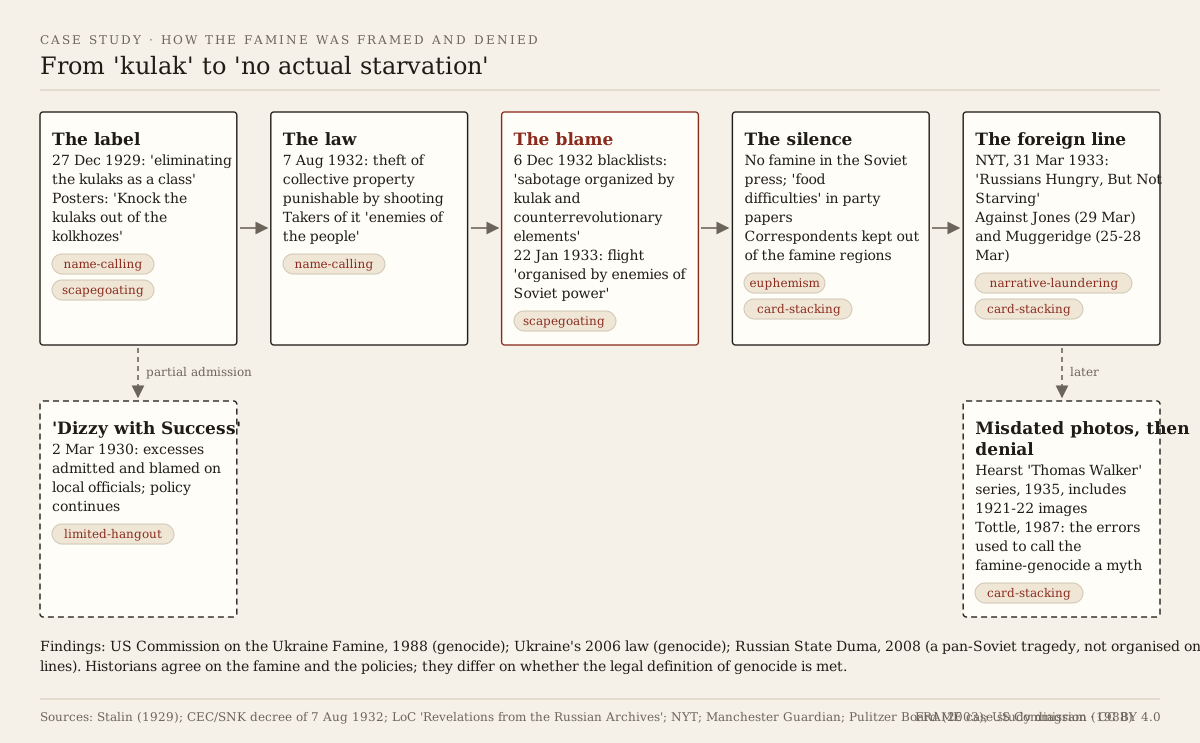
In one line: the Soviet leadership named the "kulak" as a class enemy, wrote that label into law and into orders blaming failed grain collection and peasant flight on "enemies of Soviet power", kept the word famine out of its own press, and saw its line carried abroad by a leading foreign correspondent; later, some anti-Soviet campaigns printed misdated famine photographs, and writers disputing the genocide finding used those errors to call the famine-genocide a myth.
What happened
- Background, 11 August 1918. Lenin's telegram to Penza communists orders them to hang "at least 100 notorious kulaks, the rich, and the bloodsuckers" and to "publish their names". The label kulak (literally "fist"), for a better-off peasant, was a term of abuse before it was a policy category (Library of Congress translation).
- 27 December 1929. At a conference of Marxist agrarian specialists, Stalin announces that the party has "passed from the policy of restricting the exploiting proclivities of the kulaks to the policy of eliminating the kulaks as a class". A Politburo resolution of 30 January 1930 sorts kulak households into three categories for arrest, deportation or resettlement. Lynne Viola puts the number deported in 1930-31 at about 1.8 million people.
- 1930 posters. State publishers print mass posters for wholesale collectivisation. The State Publishing House poster shown below, Vyshibem kulakov iz kolkhozov ("We will knock the kulaks out of the kolkhozes", Moscow-Leningrad, 1930), shows a young activist in red facing a snarling bearded man with clenched fists while other villagers look on.
- 2 March 1930. Stalin's Pravda article "Dizzy with Success" admits "distortions" in collectivisation, blames local officials carried away by success, and permits peasants to leave collective farms. Collectivisation resumes in the autumn.
- 26 March 1932. A Politburo commission, rejecting the forced collectivisation of peasants' own livestock, writes that "only enemies of collective farms could allow" it (Library of Congress translation).
- 7 August 1932. A decree of the Central Executive Committee and Council of People's Commissars declares collective and cooperative property "sacred and inviolable", directs that people who encroach on it be treated as "enemies of the people", and sets the penalty as shooting with confiscation of all property, or not less than ten years' deprivation of liberty under extenuating circumstances. It becomes known as the "law of spikelets" (or "five ears of grain"), after prosecutions for gleaning.
- Autumn 1932. Procurement quotas are enforced in Ukraine and the Kuban. On 6 December 1932 the Ukrainian Council of People's Commissars and Party Central Committee (Chubar and Kosior) put named villages on a "black list" for "malicious sabotage, organized by kulak and counterrevolutionary elements". Measures: no deliveries of goods, removal of goods from state stores, a ban on trade, recall of credit, and purges (Library of Congress translation).
- 22 January 1933. A directive signed by Stalin and Molotov orders the Ukrainian SSR and the North Caucasus to stop peasants leaving "for bread". It states that the mass departure was organised by enemies of Soviet power, Socialist Revolutionaries and Polish agents to agitate "through the peasants" against collective farms. Peasants who got out are to be arrested and sent back.
- Silence at home. Soviet newspapers do not report a famine. Internal party documents refer to "food difficulties" (prodovolstvennye zatrudneniia). In 1933 foreign correspondents are barred from travelling to the famine regions. The 1937 census, which showed the population shortfall, was annulled and its organisers arrested.
- Scale. Demographers of Ukraine's Ptoukha Institute and their colleagues estimate about 3.9 million excess deaths in Ukraine in 1932-34. In Kazakhstan, where collectivisation was combined with the forced settlement of nomads, Sarah Cameron estimates about 1.5 million deaths in 1930-33, some 38 percent of all Kazakhs. Kazakhs call it the Asharshylyk ("great hunger").
- 25, 27 and 28 March 1933. The Manchester Guardian prints Malcolm Muggeridge's unsigned three-part series "The Soviet and the Peasantry", on famine in the North Caucasus and Ukraine. He sent it in the British diplomatic bag to avoid the censor.
- 29 March 1933. Gareth Jones, back from an unescorted walk through villages near Kharkiv, issues a press release in Berlin. It is reported in the Berliner Tageblatt and in the London Evening Standard ("Famine Rules Russia", 31 March). His summary of what he heard: "There is no bread. We are dying."
- 31 March 1933. Walter Duranty, New York Times Moscow correspondent and 1932 Pulitzer winner, files "Russians Hungry, But Not Starving". He calls Jones's account "a big scare story" and writes: "There is no actual starvation or deaths from starvation, but there is widespread mortality from diseases due to malnutrition." In the same piece: "you can't make an omelette without breaking eggs." Eugene Lyons, then United Press correspondent in Moscow, later wrote (Assignment in Utopia, 1937) that the Moscow correspondents joined in discrediting Jones.
- September 1933. A British Foreign Office dispatch records Duranty telling a British diplomat that as many as ten million people may have died from lack of food in the past year (cited by S. J. Taylor, Stalin's Apologist, 1990). His published reporting did not carry that figure.
- 1933-34, Germany. Studies of German reporting find that German diplomats limited the spread of famine news inside Germany while anti-Bolshevik groups used the famine in campaigns against communism. Under the 1941-44 occupation of Ukraine, Nazi propaganda blamed the Soviet government and "the Jews" for the famine.
- February-March 1935, Hearst press. The New York Evening Journal, Chicago American and other Hearst papers run a series by "Thomas Walker" with photographs presented as the famine of 1934. On 13 March 1935 Louis Fischer, in The Nation ("Hearst's Russian 'Famine'"), writes that he found no famine in Ukraine in 1934 and calls the series invention. Later research found that "Walker" was Robert Green, an escaped Colorado convict, and that some of his photographs came from the 1921-22 Volga famine. The 1932-33 famine was real; the series placed it in the wrong year and used images from another famine.
- 1984-1987. The Canadian documentary Harvest of Despair (1984) used archival famine photographs; its researcher Marco Carynnyk said photos from the 1930s and from 1921-22 had been mixed in the edit. In 1987 Progress Books (Toronto) published Douglas Tottle's Fraud, Famine and Fascism: The Ukrainian Genocide Myth from Hitler to Harvard, which used the Walker photographs and the film's misdated images to argue that the famine-genocide was a Nazi and Hearst invention. In December 1987 Ukrainian party leader Volodymyr Shcherbytsky publicly acknowledged the famine.
- 1985-1988. Congress establishes the U.S. Commission on the Ukraine Famine (executive director James Mace). Its report, adopted 19 April 1988 and submitted 22 April 1988, concludes that "Joseph Stalin and those around him committed genocide against Ukrainians in 1932-1933."
- 1990. In a signed New York Times editorial, Karl E. Meyer calls Duranty's famine coverage "some of the worst reporting to appear in this newspaper".
- 2003. The Times commissions Columbia historian Mark von Hagen to review Duranty's 1931 prize-winning articles. He finds "a serious lack of balance" and "uncritical acceptance of the Soviet self-justification", and recommends that the prize be withdrawn. On 21 November 2003 the Pulitzer Board declines to revoke it: the 1931 work "falls seriously short" by today's standards, but there was "not clear and convincing evidence of deliberate deception, the relevant standard in this case".
- 2006-2022. Ukraine's law of 28 November 2006 defines the Holodomor as genocide of the Ukrainian people. In January 2010 the Kyiv Court of Appeal finds Stalin, Molotov, Kaganovich, Postyshev, Kosior, Chubar and Khataievich guilty of genocide and closes the case because they are dead. On 2 April 2008 Russia's State Duma adopts a statement calling the famine a tragedy of many Soviet peoples and saying there is no historical evidence that it was organised on ethnic grounds. The German Bundestag (30 November 2022) and the European Parliament (December 2022) recognise the Holodomor as genocide.
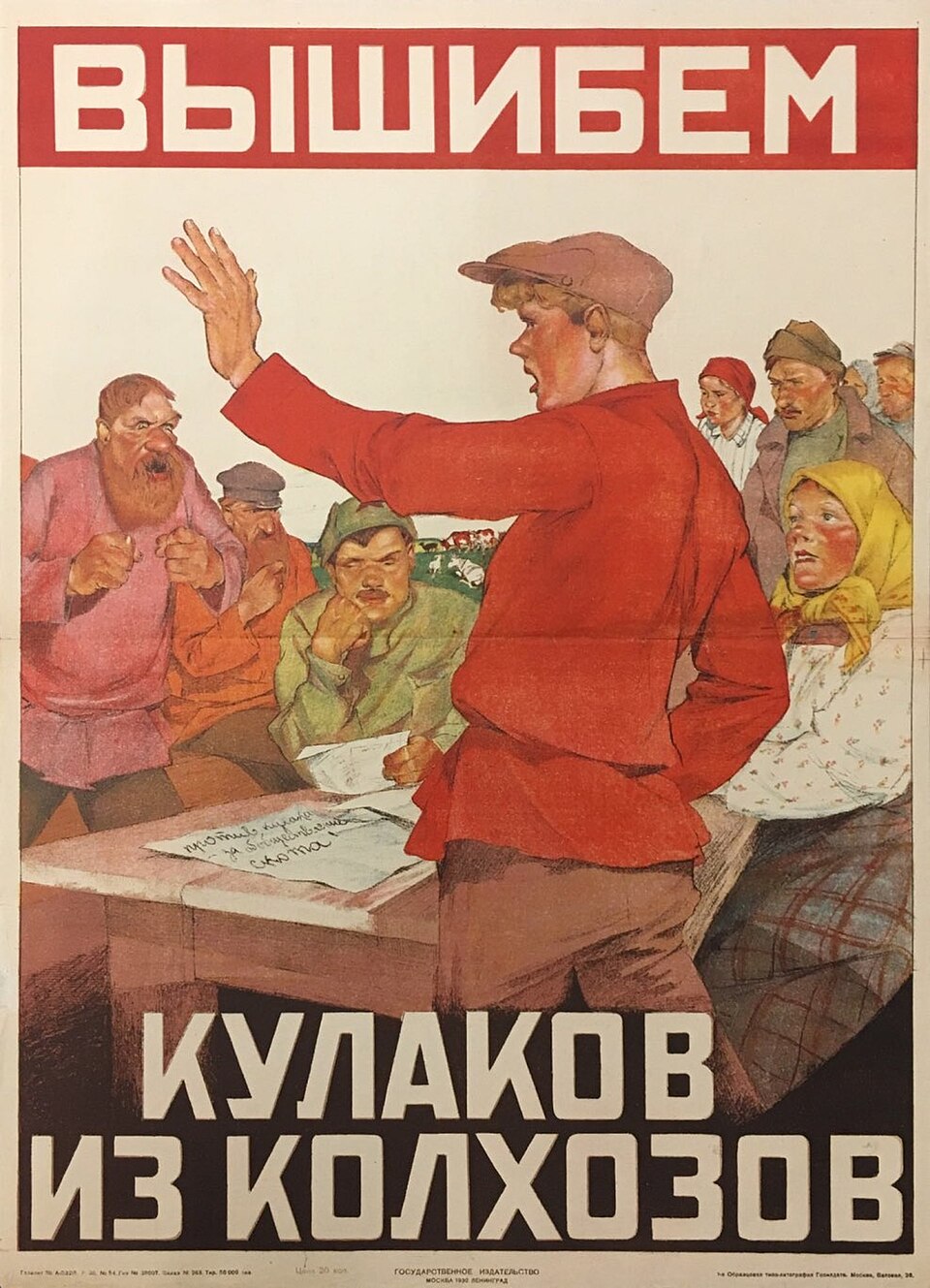
"Вышибем кулаков из колхозов" ("We will knock the kulaks out of the kolkhozes"), State Publishing House (Gosizdat), Moscow-Leningrad, 1930. Artist unknown (State Historical Museum, Moscow). Public domain in Russia and the United States (Wikimedia Commons, PD-Russia-1996). Shown because it is the dekulakisation label in poster form.
How it works
- Name-calling: "kulak" was a flexible label. It was attached to households by quota and category, and to peasants who resisted collectivisation whatever their wealth. The 7 August 1932 decree made anyone who took collective grain an "enemy of the people" before any court weighed the case.
- Scapegoating: failed procurement was blamed on "sabotage, organized by kulak and counterrevolutionary elements" (6 December 1932), forced livestock seizures on "enemies of collective farms" (March 1932), and the flight of starving peasants on "enemies of Soviet power", Socialist Revolutionaries and "Polish agents" (22 January 1933). In each document the quota, the policy and its authors are absent as causes.
- Euphemism / doublespeak: "elimination of the kulaks as a class" stood for arrest, deportation and dispossession. Inside the party, famine was "food difficulties". In print it did not appear at all.
- Card stacking: the Soviet press reported plan fulfilment and not deaths; correspondents were kept out of the famine regions; the 1937 census that showed the losses was annulled. Abroad, Duranty's public reports of "no actual starvation" did not include the death toll he gave the British privately. The same technique appears on the other side: the 1935 Hearst series paired a real famine with misdated photographs, and Tottle's 1987 book selected those misdated images and left out the archival record to argue that the famine-genocide was an invention.
- Limited hangout: "Dizzy with Success" (2 March 1930) admitted "distortions", blamed local officials for them, and let peasants leave the farms for a season. The policy itself was not withdrawn and collectivisation resumed that autumn.
- Narrative laundering: in Duranty's dispatches the Soviet leadership's account of events reached American readers under the byline of an independent newspaper. The Times's own reviewer called it "uncritical acceptance of the Soviet self-justification". The record does not show that Duranty was paid or directed by Soviet authorities; the Pulitzer Board found no clear and convincing evidence of deliberate deception. The tag describes the route the message took.
Then and now
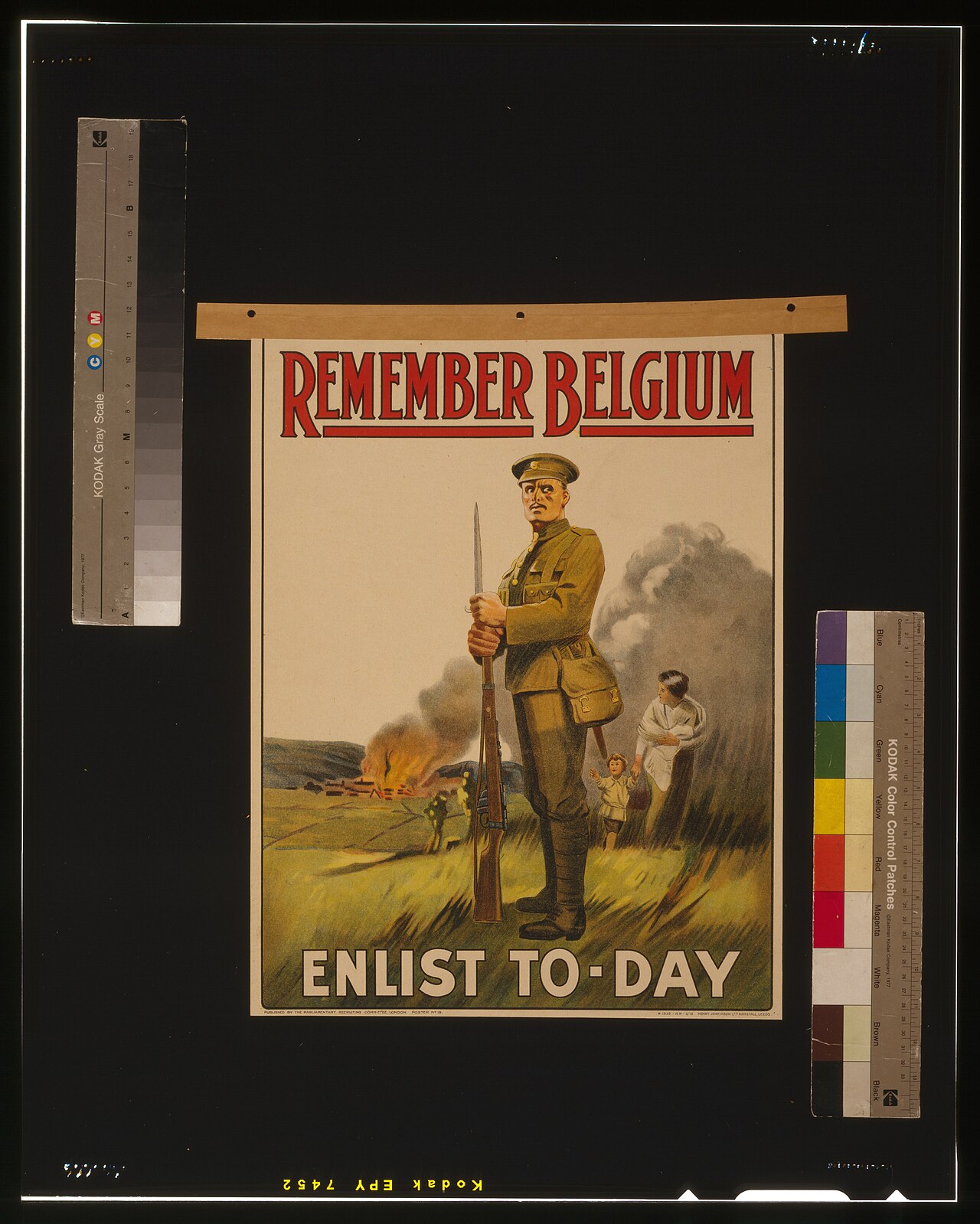
Remember Belgium — Enlist To-Day, Parliamentary Recruiting Committee (United Kingdom), 1915. Public domain.
The 1915 British poster built a recruiting message on a real, documented atrocity, and the gallery scores its method, not the event. The 1935 Hearst series is the same kind of case: the famine was real, and the series still used misdated images and a false byline. The evidence standard applies to both, and to the 1987 book that used the Hearst errors to call the famine-genocide an invention.
The official vocabulary of dekulakisation also has a parallel in the U.S. exclusion orders of 1942 ('Instructions to All Persons of Japanese Ancestry' (exclusion order posted in San Francisco)), where forced removal was "evacuation". The scale and the outcome are different: the famine of 1932-33 killed millions, and the U.S. removal did not involve mass death. The comparison is only of how official language named the act.
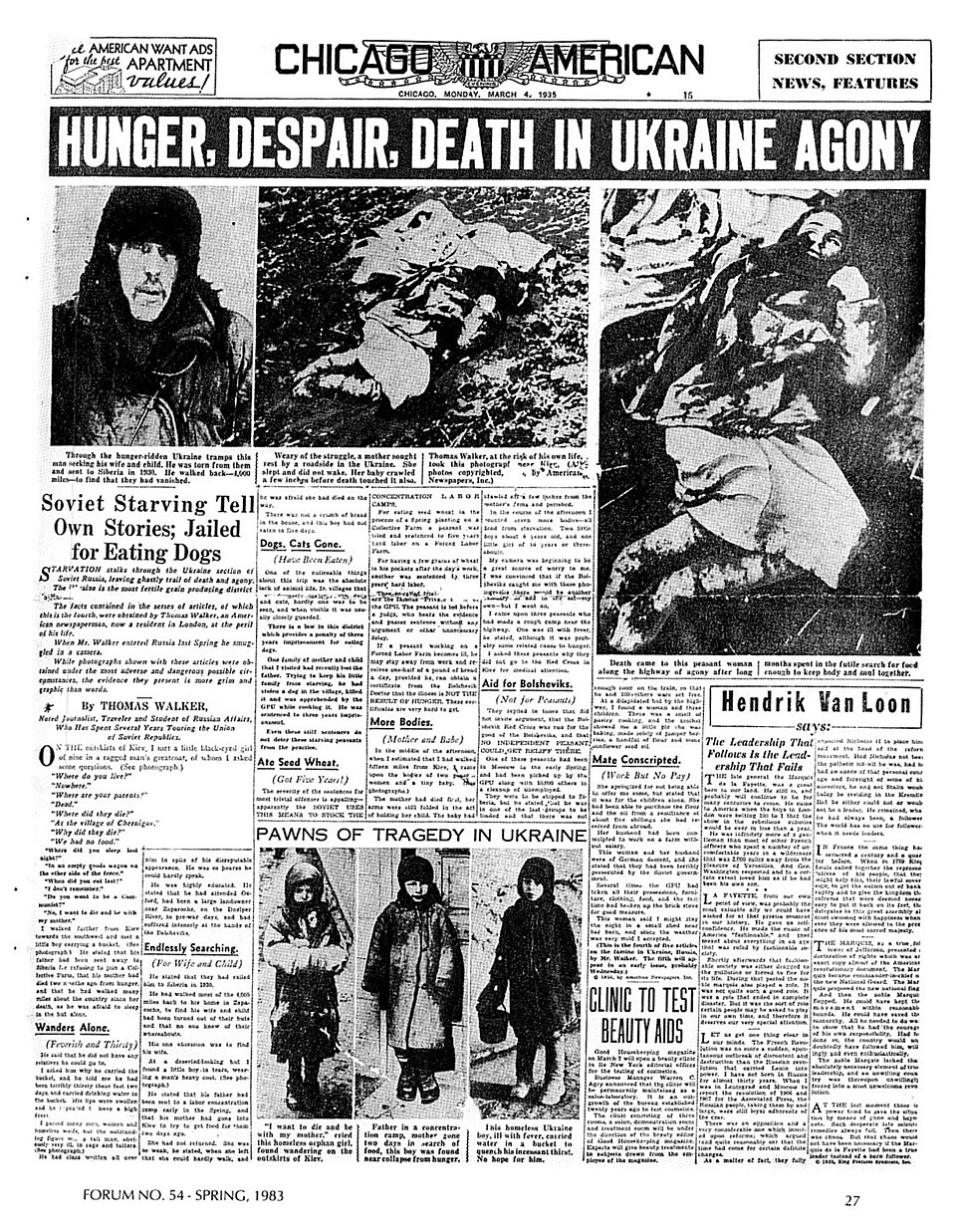
Chicago American (Hearst), second section, 4 March 1935: "Hunger, Despair, Death in Ukraine Agony", part of the "Thomas Walker" series. Scan of a 1983 reprint in Forum (no. 54). Public domain in the United States (published 1935, copyright not renewed; Wikimedia Commons, PD-US-not renewed). Shown because it is the campaign whose photographs and dates were later disputed. This page does not identify which photographs on it are misdated.
Positions on the record
- The Soviet state, 1932-1987: there was no famine. Official texts spoke of kulak sabotage, enemies and "food difficulties". Shcherbytsky's December 1987 statement was the first public acknowledgement by a Soviet Ukrainian leader.
- Ukraine: the Holodomor was a genocide of the Ukrainian people (law of 28 November 2006; Kyiv Court of Appeal, January 2010).
- Russia: the State Duma's statement of 2 April 2008 recognises the famine and its victims across the USSR, including Ukraine, Kazakhstan and Russia, and rejects the claim that it was organised on ethnic grounds.
- Kazakhstan: the Asharshylyk is marked on 31 May, the day of remembrance for victims of political repression and famine. The state has not adopted a genocide finding.
- The U.S. Commission (1988) found genocide. The German Bundestag, the European Parliament and other parliaments later recognised the Holodomor as genocide.
- Historians: that the famine happened, that it killed millions, and that the measures above (the 7 August law, the blacklists, the 22 January directive, grain requisitioning during famine) were ordered from the centre is documented in Soviet archives and is not disputed by any of the scholars named here. They differ on intent and on the legal definition. Robert Conquest (The Harvest of Sorrow, 1986), Andrea Graziosi and Anne Applebaum (Red Famine, 2017) argue that from late 1932 the policy was aimed at Ukraine and Ukrainians, and Graziosi and Conquest call it genocide. Applebaum argues that it fits Raphael Lemkin's original conception of genocide while noting that the narrower 1948 Convention wording makes the legal case harder. R. W. Davies and Stephen Wheatcroft (The Years of Hunger, 2004) argue that the famine resulted from policies pursued despite their cost and was not an intentional plan to starve Ukrainians.
- Foreign reporting: the New York Times (1990 editorial; von Hagen review, 2003) has criticised Duranty's coverage. The Pulitzer Board (2003) kept the 1932 prize on the standard of deliberate deception.
- Not shown: that Duranty was paid or directed by Soviet authorities; which of the Walker photographs came from which famine (this page makes no photo-by-photo attribution); a complete figure for deaths from the 7 August law.
Same-method test
In Bengal in 1943, under British rule, the provincial government did not declare a famine under the Bengal Famine Code, and wartime controls limited reporting until The Statesman of Calcutta, under its editor Ian Stephens, printed photographs of the dead in August 1943. The Famine Inquiry Commission later estimated about 1.5 million deaths. A government that keeps the word famine out of its announcements and holds back news of the dying would be tagged Euphemism / doublespeak and Card stacking here, whether it is Moscow in 1933 or a colonial government in 1943. The differences are stated plainly: the Bengal famine came in wartime, and British wartime measures such as the 1942 "denial policy", which removed boats and rice stocks from coastal districts, are part of its record; the sources cited here show no order like the 22 January 1933 directive that sealed starving regions and blamed the flight on enemy agents. The comparison is of the information methods only.
How to spot it
- When a whole social category is named as the cause of a shortage ("kulaks", "saboteurs", "foreign agents"), ask what the quota, the price or the policy was, and whether the document names any of them.
- A law that names the offender as an "enemy" in its text has already delivered the verdict. Look for the offence and the evidence.
- Missing words matter. If official sources speak only of "difficulties" while travel to a region is closed to reporters, the silence is part of the record.
- A famous byline is not a source. Ask where a correspondent went, whom he spoke to, and whether his private and public accounts agree.
- Check photo dates and places, including on pages whose cause you share. A misdated photo does not disprove an event; it only disproves the caption. Treat any argument that moves from "this photo is fake" to "this event did not happen" as a claim that needs its own evidence.
Images
| Image | Source | Licence |
|---|---|---|
| Mechanism diagram (above) | Drawn for FRAME from the sources below (make_diagrams_atrocity.py) |
CC BY 4.0, FRAME |
| "Vyshibem kulakov iz kolkhozov" poster (1930) | Wikimedia Commons, Gosizdat; artist unknown (State Historical Museum) | Public domain (PD-Russia-1996: public domain in Russia on 1 January 1996, so not restored in the U.S.) |
| Chicago American, 4 March 1935 | Wikimedia Commons, via the 1983 Forum reprint | Public domain in the U.S. (copyright not renewed) |
| U.S. Commission on the Ukraine Famine, report to Congress (1988), cover | Wikimedia Commons, U.S. Government Printing Office | Public domain (U.S. government work) |
| Remember Belgium (1915) | FRAME gallery (Library of Congress) | Public domain |


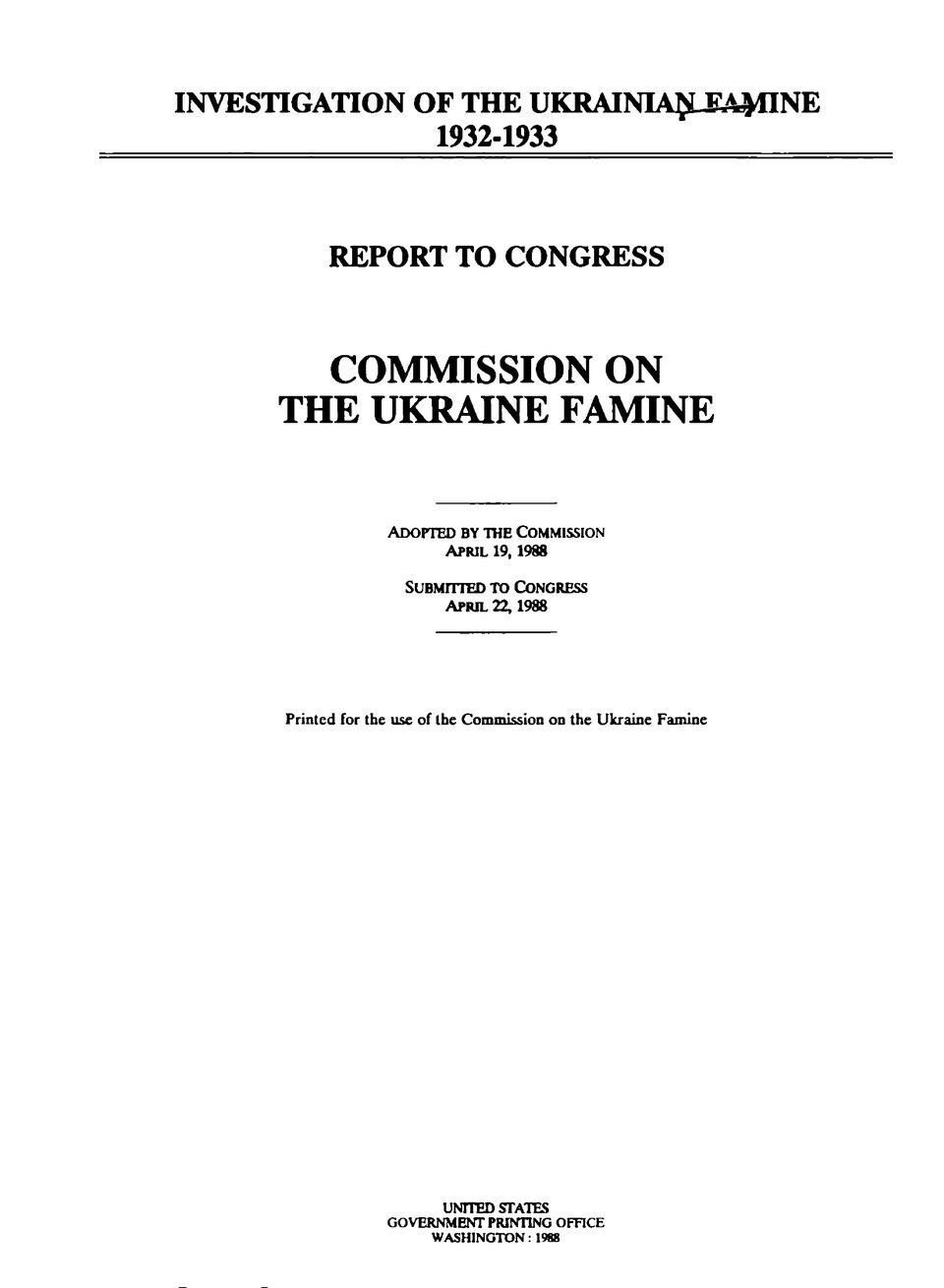
Cover of Investigation of the Ukrainian Famine, 1932-1933: Report to Congress, Commission on the Ukraine Famine, adopted 19 April 1988. U.S. Government Printing Office; public domain (U.S. government work). Shown as the first official finding outside the USSR on the famine and its denial.
Image gaps
- Alexander Wienerberger's 1933 Kharkiv photographs. On Commons as "PD-Austria" and "PD-1996", but their U.S. status depends on whether Austrian law treats them as simple photographs (short term) or as photographic works (70 years after his death in 1955). Not included because the U.S. status is unclear. Could be filled if a rights holder or archive (Diözesanarchiv Wien) confirms an open licence.
- Gareth Jones's report in the Berliner Tageblatt, 31 March 1933. On Commons as public domain, but Jones died in 1935, so the work was still in copyright in Germany in 1996 and its U.S. term was restored (to the end of 2028). Not included. Could be filled in 2029.
- Duranty's "Russians Hungry, But Not Starving" (NYT, 31 March 1933) and Muggeridge's Manchester Guardian pages. Published 1933; the Times page's U.S. renewal status was not verified, and Muggeridge (d. 1990) is still in copyright in the UK. No openly licensed copies were found. Not fillable now.
- Other 1929-32 Soviet collectivisation posters (for example "Долой кулака из колхоза", LSE Library). Commons tags them only "PD-Russia", which does not settle U.S. status; one Viktor Deni poster is tagged CC BY-SA 4.0 by an uploader who is not the rights holder. Rejected.
- The Holodomor memorial in Washington, D.C. (2015). Openly licensed photos exist, but the memorial is a recent sculpture and the U.S. has no freedom of panorama for artworks. Not included.
- Photographs of the Kazakh famine. None with a clear U.S. licence status was found. Could be filled from an archive with an open licence.
Sources
- Janam Mukherjee, Hungry Bengal: War, Famine and the End of Empire (Oxford University Press, 2015), on the 1942 denial policy.
- Library of Congress, Revelations from the Russian Archives: resolution of the Ukrainian SNK and CP(b)U on blacklisting villages, 6 December 1932 (translation)
- Library of Congress, Revelations from the Russian Archives: Lenin's telegram to Penza, 11 August 1918 (translation)
- Library of Congress, Revelations from the Russian Archives: Politburo commission on forced collectivisation of livestock, 26 March 1932 (translation)
- J. V. Stalin, "Concerning Questions of Agrarian Policy in the U.S.S.R.", speech of 27 December 1929 (Works, vol. 12)
- J. V. Stalin, "Dizzy with Success", Pravda, 2 March 1930 (Works, vol. 12)
- Decree of the Central Executive Committee and Council of People's Commissars of the USSR, "On the protection of the property of state enterprises, collective farms and cooperatives and the strengthening of public (socialist) property", 7 August 1932.
- Directive of the Council of People's Commissars and the Central Committee (Stalin, Molotov), "On preventing the mass departure of starving peasants", 22 January 1933; published in Tragediia sovetskoi derevni, vol. 3 (Moscow, 2001).
- U.S. Commission on the Ukraine Famine, Investigation of the Ukrainian Famine, 1932-1933: Report to Congress (GPO, 1988)
- Law of Ukraine "On the Holodomor of 1932-33 in Ukraine", 28 November 2006
- Pulitzer Prize Board, "Statement on Walter Duranty", 21 November 2003
- Mark von Hagen's 2003 assessment for the New York Times, as reprinted by Common Dreams, 24 October 2003
- Malcolm Muggeridge, "The Soviet and the Peasantry. I", Manchester Guardian, 25 March 1933 (transcription)
- Malcolm Muggeridge, "The Soviet and the Peasantry. II: Hunger in the Ukraine", Manchester Guardian, 27 March 1933 (transcription)
- Gareth Jones, "Hungersnot in Russland?", Berliner Tageblatt, 31 March 1933 (transcription)
- Louis Fischer, "Hearst's Russian 'Famine'", The Nation, 13 March 1935 (transcription)
- The Thomas Walker affair (garethjones.org)
- Douglas Tottle, Fraud, Famine and Fascism (Progress Books, Toronto, 1987), scanned copy
- Walter Duranty, "Russians Hungry, But Not Starving", New York Times, 31 March 1933.
- Eugene Lyons, Assignment in Utopia (Harcourt, Brace, 1937).
- S. J. Taylor, Stalin's Apologist: Walter Duranty, The New York Times's Man in Moscow (Oxford University Press, 1990).
- Robert Fulford, "Duranty was Stalin's spin doctor", National Post, 25 November 2003 (quotes the 1990 Karl E. Meyer editorial)
- NPR, "'The New York Times' can't shake the cloud over a 90-year-old Pulitzer Prize", 8 May 2022
- Harvard Ukrainian Studies, "'No German Must Starve': The Germans and the Soviet Famines of 1931-1933"
- "'Trial of Strength against the Restive Peasantry': What the Germans Knew about the Great Famine in the USSR", Ukraina Moderna 30-31
- "Reception of the Holodomor of 1932-1933 in the practice of the Nazi occupation regime in Ukraine", East European Historical Bulletin
- Euronews, "Germany's parliament recognises Ukraine's 1930s famine as 'genocide'", 30 November 2022
- Emerging Europe, "Mr Jones: The Welsh journalist who told the world about Ukraine's famine"
- Robert Conquest, The Harvest of Sorrow: Soviet Collectivization and the Terror-Famine (Oxford University Press, 1986).
- Anne Applebaum, Red Famine: Stalin's War on Ukraine (Doubleday, 2017).
- Andrea Graziosi, "The Soviet 1931-1933 Famines and the Ukrainian Holodomor: Is a New Interpretation Possible, and What Would Its Consequences Be?", Harvard Ukrainian Studies 27 (2004-2005).
- R. W. Davies and Stephen G. Wheatcroft, The Years of Hunger: Soviet Agriculture, 1931-1933 (Palgrave Macmillan, 2004).
- Lynne Viola, The Unknown Gulag: The Lost World of Stalin's Special Settlements (Oxford University Press, 2007).
- Sarah Cameron, The Hungry Steppe: Famine, Violence, and the Making of Soviet Kazakhstan (Cornell University Press, 2018).
- Omelian Rudnytskyi, Nataliia Levchuk, Oleh Wolowyna, Pavlo Shevchuk and Alla Kovbasiuk, "Demography of a man-made human catastrophe: The case of massive famine in Ukraine 1932-1933", Canadian Studies in Population 42 (2015).
- Famine Inquiry Commission (India), Report on Bengal (1945).