Content note: this page shows a still from the 1915 film in which white actors in blackface play Black characters as threats, a 1925 photograph of a Klan march, and quotes the film's advertising and its author's stated aims. The film's racism is shown as it was, not softened.
In one line: D. W. Griffith's 1915 film, adapted from Thomas Dixon's novel The Clansman, drew Reconstruction as a story of Black menace and Klan rescue; the NAACP and Black Bostonians fought it in the streets, the press and the legislature and won cuts and some local bans but not its withdrawal, and the Klan relaunched in Georgia the same year the film opened there; the famous White House endorsement quote is unproven.
Content note: Advertising poster for a 1915 film that portrays Black Americans as threats and the Klan as heroes; shown as a record of how it was sold. This object is shown as it was published. Why 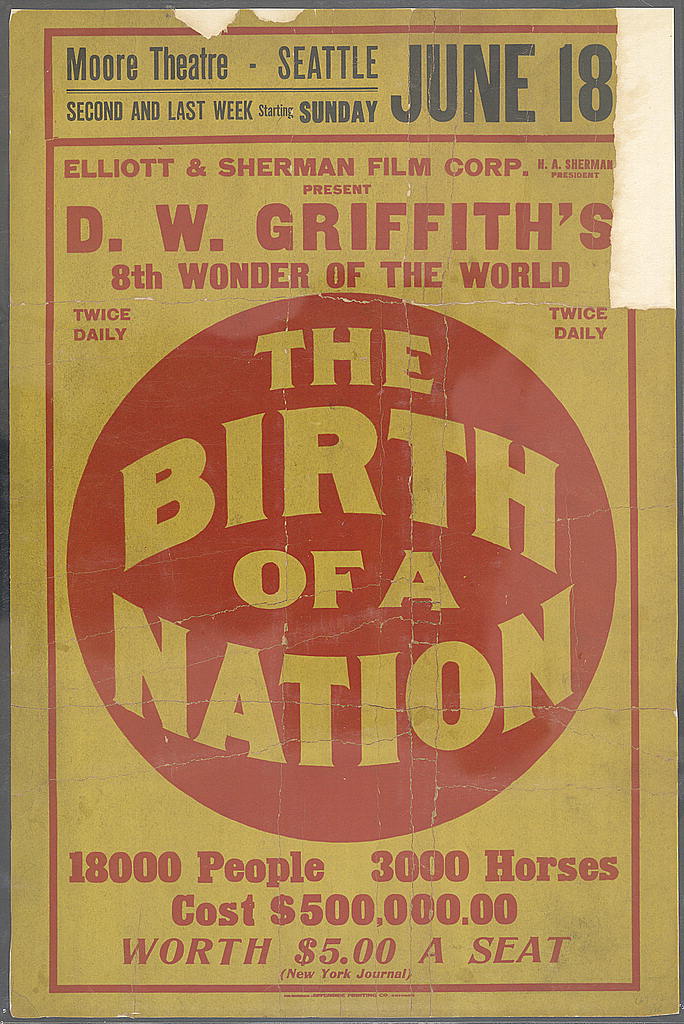
Poster, Elliot & Sherman Film Corp., Moore Theatre, Seattle, 1915 (Riverside Printing Co., Milwaukee). "18000 People, 3000 Horses, Cost $500,000.00, Worth $5.00 a Seat" are the advertiser's own figures; this archive has not audited them. Library of Congress. Public domain (no known restrictions).
What happened
- 1905. Thomas Dixon Jr. publishes the novel The Clansman and stages it as a play. It is the second of his Reconstruction trilogy (1902-1907). Slate's account of the NAACP campaign quotes Dixon saying the play's purpose was to create "a feeling of abhorrence" toward Black men in white audiences; Dixon is also reported as wishing all Black Americans removed from the United States. He sold the film rights to Griffith in 1913.
- 8 February 1915. The film opens in Los Angeles as The Clansman (Time; MTSU). It runs just over three hours (History.com). It uses white actors in blackface for its main Black characters and presents the Klan's rise as a rescue.
- Late January to February 1915. The Los Angeles branch of the NAACP sees the film in advance, judges it historically inaccurate and aimed at excusing lynching, and asks authorities for a ban (Slate). It fails locally and appeals to the national office in New York.
Show all 13Show fewer
- 18 February 1915. The film is shown at the White House at Dixon's invitation, attended by President Woodrow Wilson, an old college acquaintance of Dixon's (Stokes, 2007; the Jim Crow Museum also gives 18 February; Salve Regina's summary of Stokes gives the 19th). Time calls it the first film shown inside the White House.
- February 1915. The Supreme Court's decision in Mutual Film Corp. v. Industrial Commission of Ohio holds that films are not protected by free speech like the press, leaving states and cities free to censor them. The ruling stood until 1952 (Slate).
- 3 March 1915. It opens at the Liberty Theatre in New York under its new title, The Birth of a Nation, with daily picketing (Jim Crow Museum). In March the National Board of Censorship, which had approved it, reconsiders under NAACP pressure and passes it again after cuts to scenes of interracial violence (Slate). Jane Addams, an NAACP board member, calls the film a "pernicious caricature" of Black people in a New York Post interview.
- April to May 1915, Boston. Mayor James Curley says he can censor the film only if it is indecent or immoral; Griffith agrees to cut sexually suggestive scenes and it opens on 17 April at the Tremont Theatre. William Monroe Trotter and ten others are arrested after being refused tickets. About 2,000 Black Bostonians gather at the State House on 19 April, and Governor David Walsh sponsors a bill to tighten censorship. Trotter organises a rally on Boston Common after an NAACP meeting on 2 May. The new board then rules the film "not at all objectionable"; it runs for 360 performances over six and a half months (Mass Moments).
- Spring 1915. Griffith issues an annotated guide defending the film with the scholarship of William Dunning. By the end of April, under pressure, Wilson's office denies that he approved the film. Ebert's review quotes the letter from Wilson's secretary Joseph Tumulty to the Boston NAACP: the president was "entirely unaware of the nature of the play before it was presented" and had at no time expressed his approval.
- 6 December 1915. The film opens in Atlanta. Eleven days earlier, on 25 November, William J. Simmons and a small group had burned a cross on Stone Mountain to relaunch the Ku Klux Klan (History.com; the New Georgia Encyclopedia, cited on the The second Ku Klux Klan: selling membership as '100% Americanism' page, has Simmons choosing the date for the publicity a film opening would bring). On premiere night, robed men paraded on Peachtree Street with rifle salutes outside the theatre.
- 1916. Griffith publishes a pamphlet, The Rise and Fall of Free Speech in America, against censorship, and releases Intolerance. By early 1916 only Ohio and Kansas had imposed statewide bans, according to Slate; the NAACP counted about 10,000 members at the end of 1915 and about 80,000 by the end of the decade.
- 1917. Courts in Illinois (Chicago) and California reject attempts to stop the film (MTSU); Slate reports that during the war several states banned it, reportedly to avoid conflict between Black and white soldiers.
- 1918 and 1920. Black-led answers appear: The Birth of a Race (1918, produced under Emmett J. Scott, struggled through years of delays) and Oscar Micheaux's Within Our Gates (1920), often read as a reply to Griffith, though scholars caution that Micheaux's film had other prompts too.
- 1920s to 1947. The film is re-released for decades and the Klan uses it. In 1947 the NAACP is still picketing a New York screening (Library of Congress photograph, below).
Content note: Publicity still from the 1915 film showing a white actor in blackface as a Black character surrounded by Klansmen; shown as made, as a record of the film's racist portrayal. This object is shown as it was published. Why 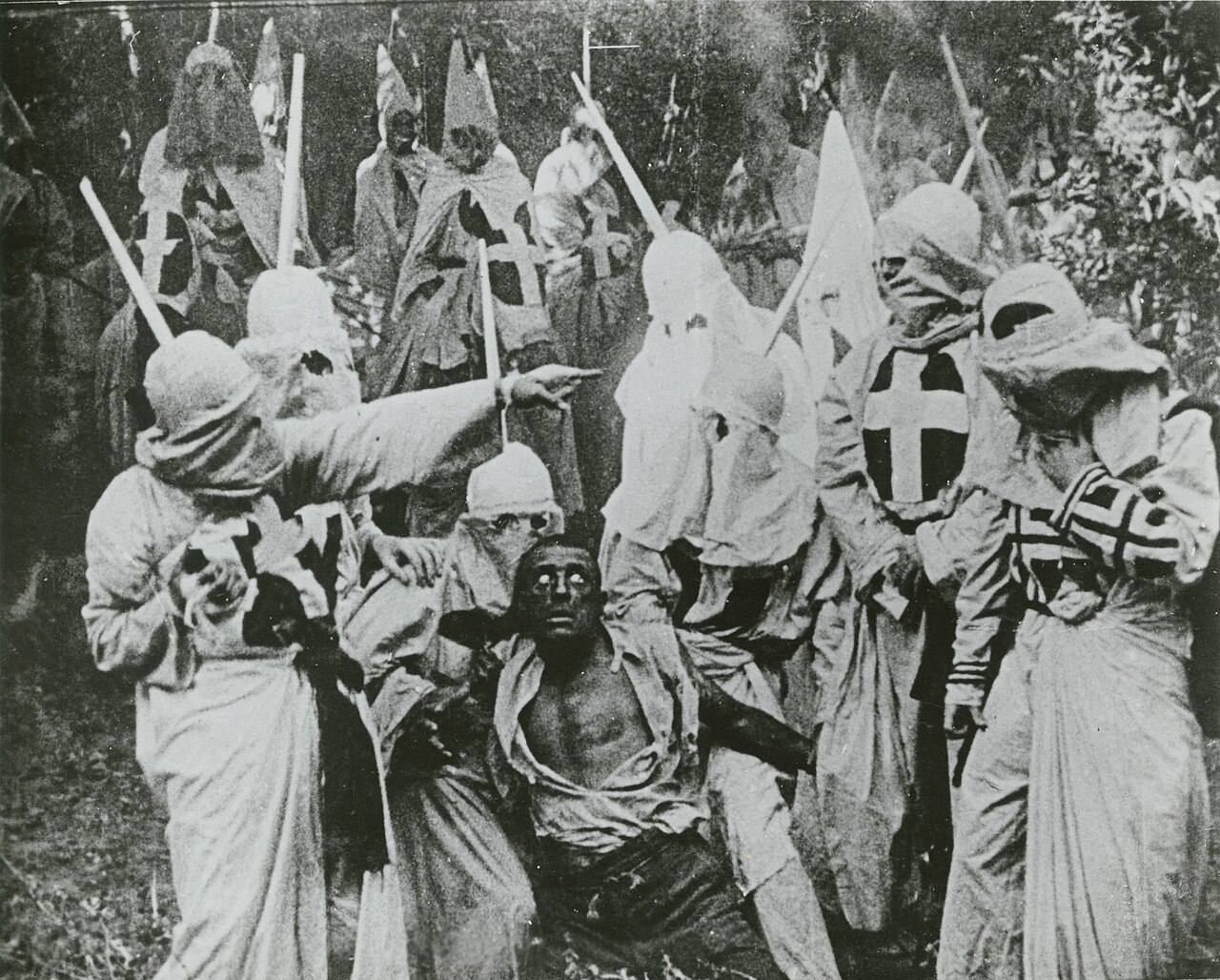
Explain moreShow less
Publicity still, The Birth of a Nation (1915): Klansmen surround the character Gus, played by the white actor Walter Long in blackface. Epoch Producing Corporation, via the New York Public Library Digital Collections and Wikimedia Commons. Public domain.
How it works
- Dehumanization: the film's Black characters are mostly played by white actors in blackface, drawn as predators, corrupt officials or fools; the plot turns on attacks by Black characters on white women. What the tag scores is the method: a group reduced to a menace and a type, with no inner life allowed. The film's own title cards, quoting Wilson's History of the American People, lend the portrait the weight of scholarship.
- Scapegoating: Reconstruction's hardships and the postwar North-South quarrel are assigned to Black voters and legislators and to Northern "radicals", and the Klan is the cure. Dixon said his aim was to produce abhorrence; the film delivers the same story at greater length and on a far larger audience.
- Fear appeal: the second half is built as a threat-and-rescue sequence, with cross-cut chases and a ride to the rescue. It is a cinematic technique first, but the fear it builds attaches to a population, not a villain.
Show all 6Show fewer
- Transfer: the film borrows the authority of history, scholarship and the presidency. The Wilson quotations in the intertitles, the White House screening, and the "history written with lightning" line (which is probably apocryphal and first appeared in print years after the screening) all lent it the standing of history and office, which the cited record does not support for the quote. Modern historians of Reconstruction, such as Eric Foner, reject the Dunning School account the film follows.
- Bandwagon: the film's marketing sold it by crowd size and price: the poster above, and the 'The Great American Play at Last!' The Birth of a Nation, Lyric Theatre advertisement (Allentown, 1916) advertisement with its "20 Million People Have Seen It Without Adverse Criticism", an advertiser's claim, set against the protests and bans of 1915-1916.
- Card stacking: Black Reconstruction officeholders appear only as corrupt or comic, the film carries no Black testimony about the period, and Klan killings are shown as justice, not as the crimes the NAACP said they were.
Content note: Illustration from Dixon's novel The Clansman, a racist Reconstruction narrative that the 1915 film adapted; shown as part of the record. This object is shown as it was published. Why 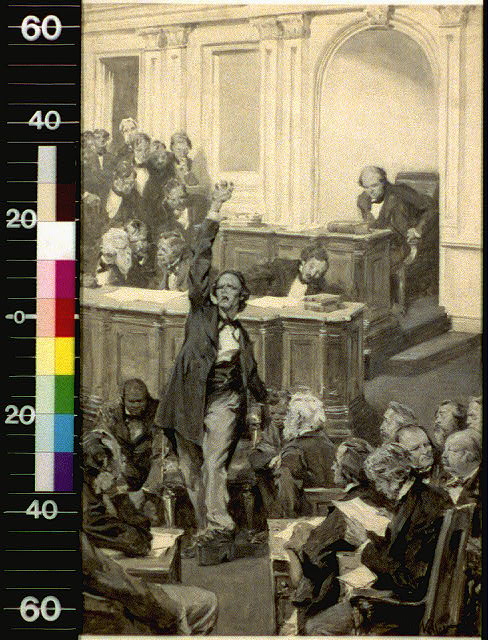
Explain moreShow less
"I hurl the everlasting curse of a nation", illustration in Thomas Dixon's The Clansman (New York: Doubleday, Page, 1914 edition), p. 172, Cabinet of American Illustration. Library of Congress. Public domain (no known restrictions).
Then and now
Content note: Ku Klux Klan members marching in robes.
Content note: Ku Klux Klan members marching in robes. This object is shown as it was published. Why 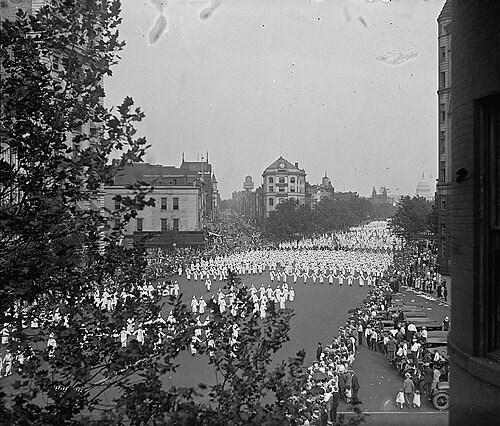
Klan march on Pennsylvania Avenue, Washington, D.C., 8 August 1925. National Photo Company Collection, Library of Congress. Public domain.
The film and the Klan fed each other. The film showed Klansmen in white robes and hoods as heroes and a burning cross; Simmons's relaunch burned a cross within the year, and historians describe the film as fixing that imagery in the public mind (History.com; MTSU). Simmons's Klan grew slowly until a publicity firm turned recruitment into a sales network in 1920, and by 1925 tens of thousands marched in Washington; see The second Ku Klux Klan: selling membership as '100% Americanism' for the mechanics, the figures and the disputes over membership counts. Whether the film caused the revival or the revival used a film that was already a hit is argued: Simmons timed his relaunch to the premiere, while the Klan's 1920s growth rested on recruiters, pastors and an economic and anti-immigrant mood that the film did not create. In the 1970s the journalist Dick Lehr watched David Duke show the film at a Klan recruiting meeting (Time).
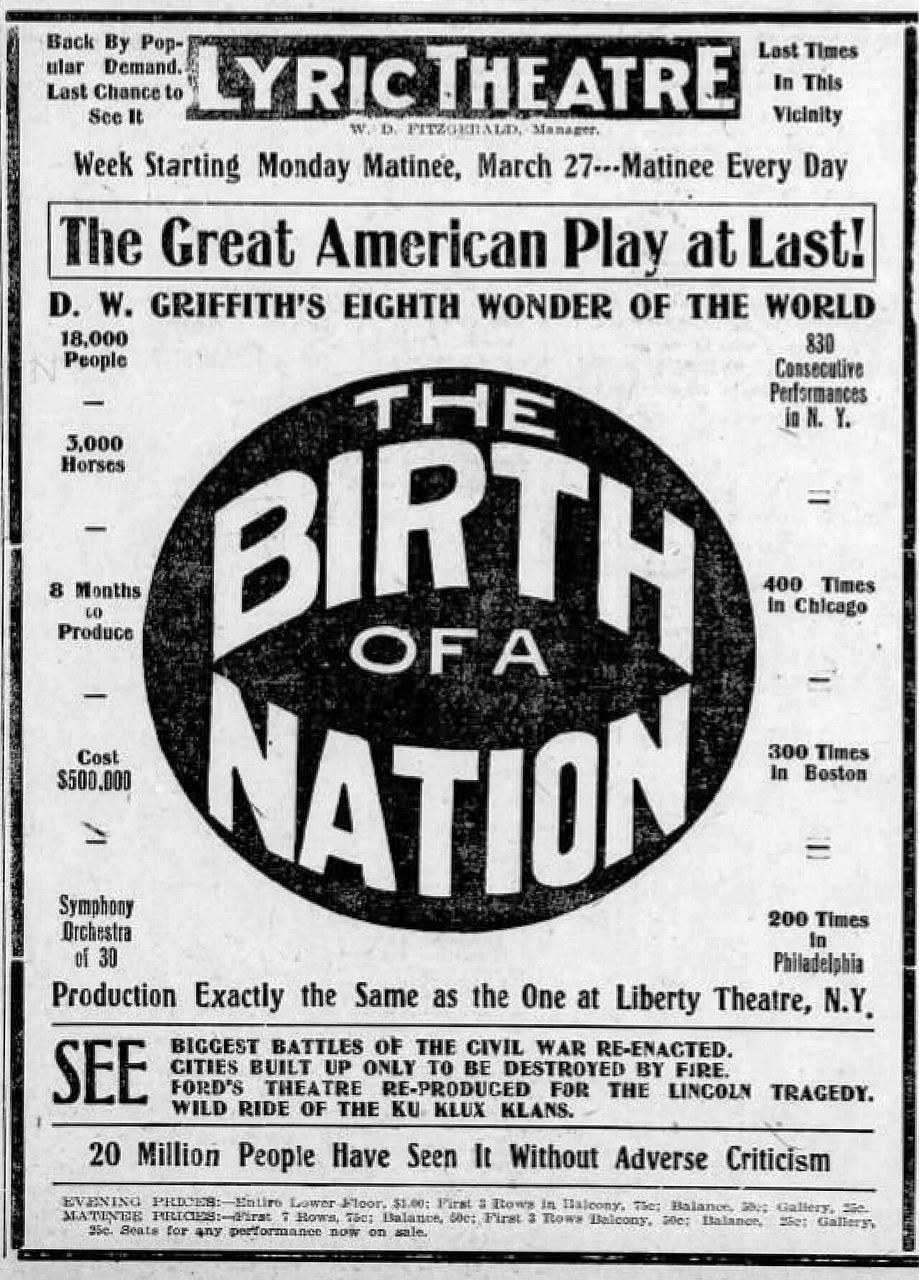
'The Great American Play at Last!' The Birth of a Nation, Lyric Theatre advertisement (Allentown, 1916), The Allentown Leader, 18 March 1916. Public domain.
The advertisement shows the commercial side: attendance counts used as the argument. It lists the "wild ride of the Ku Klux Klans" as a spectacle. For another feature film that portrayed a minority as a menace, see Film under Goebbels: Triumph des Willens (1935) and Der ewige Jude (1940). The differences are large: Griffith's film was a private production in a state that did not control cinemas; it met organised protest, press criticism and local bans. Der ewige Jude was a ministry commission, made while that state persecuted the people it showed. The shared method is the portrait of a group as a menace; the scale, state backing and consequences are not the same.
Positions on the record
6 items · Griffith and Dixon: Griffith called the film history and defended it as art and as free…
- Griffith and Dixon: Griffith called the film history and defended it as art and as free expression; his 1916 pamphlet argued against censorship. Later, according to Slate, Dixon opposed the Klan, which he called "a menace to American democracy".
- The NAACP and Trotter: the NAACP argued the film was historically false and a danger to public order and Black citizens; Trotter's Boston protest argued the same and pressed for state censorship law. The national leadership worried that protest advertised the film and weighed quiet censorship against public pickets (Slate).
- Wilson: the White House showing is documented. The "writing history with lightning" line has no contemporary source; Tumulty's letter denied any approval. The film quoted Wilson's History of the American People in its intertitles. Wilson's wider record on race, including segregating parts of the federal service, is covered in standard biographies.
- Censors and courts: Mutual Film denied films free-speech protection, so bans were lawful in principle; bans and cuts were uneven (Boston cut some scenes and passed the film; Ohio and Kansas banned it; courts in Illinois and California rejected attempts in 1917).
- Historians: Melvyn Stokes (2007) gives the fullest history of the film's making, protests and Klan link. Dick Lehr (2014) treats the Boston fight as the start of a modern civil-rights protest. Paul McEwan (BFI) says the North's response "half-heartedly condemned racism" (History.com).
- This archive's reading: documented are the film's content, the White House screening, the Boston and New York protests, the cuts, the state bans, Simmons's timing and the Atlanta premiere parade. Not shown: that Wilson said "history with lightning", that the film single-handedly created the Second Klan, and the advertisers' attendance and cost figures.
Same-method test
A film that drew white Southerners, or any other group, as predators played by actors in make-up, assigned a nation's troubles to…
A film that drew white Southerners, or any other group, as predators played by actors in make-up, assigned a nation's troubles to them and offered a mob as the cure would be scored the same: Dehumanization, Scapegoating and Fear appeal. The Black-led answer films, The Birth of a Race and Within Our Gates, are advocacy and are judged on method by the same definitions, not on who made them.
How to spot it
- Ask who is cast, who plays whom, and who is allowed a point of view in any film about a past conflict.
- Treat an "it's history" frame as a claim: check who the film's historians were and whether the scholarship still stands.
- Count the ways a famous endorsement is reported: a quotation first printed years later is a claim, not a record.
- A box-office figure in an advertisement is an advertiser's claim.
- Notice when protest is itself covered as a publicity engine, as the NAACP leaders feared in 1915.
Sources and further reading
Images
4 items · NAACP picket outside the Republic Theatre, New York, 1947. Library of Congress (NAACP…
| Image | Source | Licence |
|---|---|---|
| Poster, Moore Theatre Seattle, Elliot & Sherman Film Corp., 1915 | Library of Congress | Public domain (no known restrictions) |
| Publicity still, Klansmen and Gus, 1915 | Wikimedia Commons, from the NYPL Digital Collections | Public domain (Commons PD; 1915 publication) |
| "I hurl the everlasting curse of a nation", The Clansman illustration, 1914 | Library of Congress | Public domain (no known restrictions) |
| Klan march, Washington, 1925 | Wikimedia Commons (National Photo Company, LOC npcc.14034), reused from The second Ku Klux Klan: selling membership as '100% Americanism' | Public domain |
| Lyric Theatre advertisement, Allentown, 1916 | FRAME gallery, 'The Great American Play at Last!' The Birth of a Nation, Lyric Theatre advertisement (Allentown, 1916) | Public domain |


Image gaps
- NAACP picket outside the Republic Theatre, New York, 1947. Library of Congress (NAACP records, sign reading "Birth of a Nation revives KKK"). The record says "publication may be restricted", so it is held and not hosted.
- 1930s sound re-release posters. The Library of Congress "first time in sound" poster is dated "193-" and is not clearly pre-1931; the 1936 one is "rights not evaluated". Held.
- Boston protest photographs and 1915 Boston newspapers. Not found in openly licensed scans. Fillable from the Boston Public Library or Chronicling America.
- Atlanta premiere advertisement with the Klan notice (December 1915). Described by History.com; no scan was found. Fillable.
Sources
12 items · Melvyn Stokes, D. W. Griffith's The Birth of a Nation: A History of "The Most…
- Melvyn Stokes, D. W. Griffith's The Birth of a Nation: A History of "The Most Controversial Motion Picture of All Time" (Oxford University Press, 2007).
- Dick Lehr, The Birth of a Nation: How a Legendary Filmmaker and a Crusading Editor Reignited America's Civil War (PublicAffairs, 2014).
- Slate, "The Birth of a Nation: How the fight to censor D.W. Griffith's film shaped American history" (2015).
- Mass Moments, "The Birth of a Nation Sparks Protest".
- Jim Crow Museum, Ferris State University, "The Birth of a Nation and Black Protest" (2012).
- History.com, "How The Birth of a Nation Revived the Ku Klux Klan".
- Time, "'Writing History With Lightning': The Birth of a Nation at 100" (2015).
- Roger Ebert, review of The Birth of a Nation, quoting the Tumulty letter.
- Free Speech Center, MTSU, "The Birth of a Nation".
- Wikisource, The Birth of a Nation intertitles, for the quotations from Wilson's History of the American People.
- Mutual Film Corp. v. Industrial Commission of Ohio, 236 U.S. 230 (1915).
- Eric Foner, Reconstruction: America's Unfinished Revolution, 1863-1877 (Harper & Row, 1988).