Content note. This page quotes and describes antisemitic film content as it was made and shown: narration comparing Jews to rats, footage filmed in occupied Poland, and animal slaughter used to depict Jews as cruel. The words quoted are the films' words, kept as evidence. They are not this archive's description of anyone.
In one line: Nazi Germany's propaganda ministry built a film system (a compulsory trade chamber, state-owned studios, one national newsreel, youth screenings) that carried Triumph des Willens, a rally film shot by a crew of 172 with the rally's cooperation that its director later called "pure history", and Der ewige Jude, a compilation presented as a documentary that cut footage filmed in occupied Poland against shots of rats, which many cinema-goers avoided.
What happened
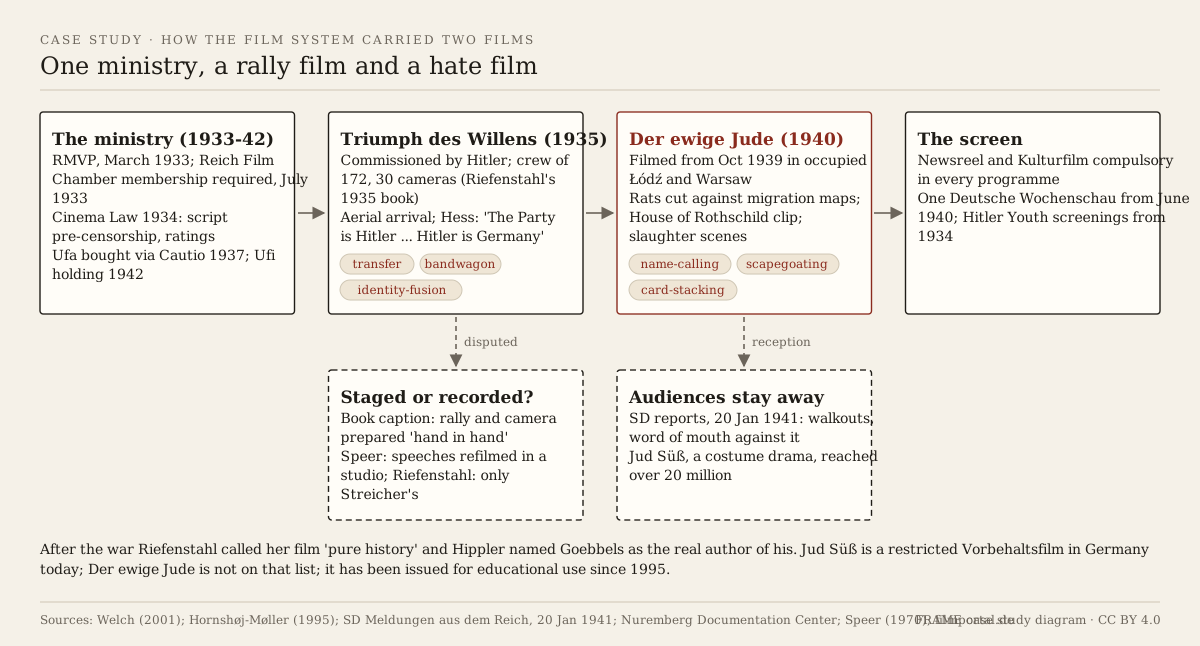
The machinery
- 13 March 1933. The Reich Ministry of Public Enlightenment and Propaganda (RMVP) is created, with Joseph Goebbels as minister (Welch, 2001).
- 14 July 1933. A law sets up a Reich Film Chamber (Reichsfilmkammer), part of the Reich Chamber of Culture from 22 September 1933. Membership becomes a condition of working in film, which shuts out Jews and political opponents (Bundesarchiv; Welch).
- 16 February 1934. The Reich Cinema Law (Reichslichtspielgesetz) brings pre-censorship of scripts through a Reich film dramaturge, and a system of ratings (Prädikate) that carried tax relief (Welch).
- 1937 to 1942. The trust company Cautio Treuhand, run by Max Winkler for the state, buys 72.6 per cent of Ufa in 1937, then Tobis, Terra and Bavaria. On 10 January 1942 the firms are merged into one holding company, Ufa-Film GmbH (Ufi). filmportal.de calls this a covert nationalisation (filmportal.de; Kiel film lexicon).
- Programmes. Every cinema programme had to include a newsreel and a short documentary ("Kulturfilm") (Welch; Trumpener, 2009). From June 1940 a single Die Deutsche Wochenschau is the only newsreel shown in Germany, until March 1945 (Vande Winkel, 2004).
- Hitler Youth screenings. From 1934 the Hitler Youth runs Jugendfilmstunden, usually on Sunday mornings: 217,354 attendees in 1934/35, about 3.5 million in 1939/40 (Kiel film lexicon).
Triumph des Willens (1935)
- April 1934. Hitler assigns Leni Riefenstahl, an actor and director, to film the party rally due in Nuremberg that September (Nuremberg Documentation Center). Ufa distributes the film. Its opening titles say it was made "im Auftrag des Führers" (on the Führer's commission).
- September 1934, Nuremberg. The crew list in Riefenstahl's 1935 companion book gives 172 people, including 36 camera operators and assistants working 30 cameras in 16 teams; more than 60 hours of footage were shot (Riefenstahl, 1935; Nuremberg Documentation Center). Her team was allowed to build camera towers, bridges and tracks at the rally sites, where Albert Speer designed the settings.
- The opening. Hitler's aircraft descends through the clouds over Nuremberg, its shadow passing over marching columns, to an orchestral arrangement of the Horst-Wessel-Lied. The arrival is edited from footage shot at different times to look like one continuous event.
- The close. After Hitler's closing speech, Rudolf Hess says: "Die Partei ist Hitler! Hitler aber ist Deutschland, wie Deutschland Hitler ist!" ("The Party is Hitler! But Hitler is Germany, just as Germany is Hitler!").
- Studio work. In his memoir (1969; English 1970), Speer wrote that large parts of the congress speeches were refilmed in a Berlin studio because the original footage was unusable. Riefenstahl replied in a letter that only Julius Streicher's speech was refilmed, because the cameraman had run out of film. Both accounts agree some reshooting took place.
- 28 March 1935. Premiere at the Ufa-Palast am Zoo in Berlin, with Hitler present. In 1935 the film receives the National Film Prize; it receives a top award at the 1937 Paris World Exhibition. Sources differ on whether it won a prize at Venice.
- Staged for the camera? A photograph on page 31 of Riefenstahl's 1935 book Hinter den Kulissen des Reichsparteitag-Films shows her and Hitler over plans, captioned to say the rally preparations were made "hand in hand" with those for the camera work. Riefenstahl later said the book was ghostwritten and she had not seen it before publication. A longer quotation Susan Sontag attributed to the book in 1975 ("planned not only as a spectacular mass meeting, but as a spectacular propaganda film") was reported by David B. Hinton not to appear in it; its wording follows Siegfried Kracauer (1947) (Hinton and Sontag, 1975).
Der ewige Jude (1940)
- October 1939 onward. On Goebbels's orders, Hippler sends film crews to occupied Polish cities, chiefly Łódź and Warsaw, weeks after the German invasion and before the ghettos there were sealed (Łódź in spring 1940, Warsaw in November 1940). A Łódź synagogue was filmed on 10 October 1939. Hornshøj-Møller's source analysis describes scenes arranged by the crews. After touring Łódź, Goebbels wrote of its Jews in his diary entry for 2 November 1939: "Das sind keine Menschen mehr, das sind Tiere" ("These are no longer human beings, they are animals") (Goebbels diaries, ed. Fröhlich, Part I, vol. 7). He followed "the Jew film" closely through the winter (Hornshøj-Møller, 1995).
- The makers. Fritz Hippler, head of the ministry's film department, directs; Eberhard Taubert writes the text; Harry Giese narrates. Apart from the Polish footage and maps, the film is built from stills and clips from other films (USHMM; Hornshøj-Møller).
- The rat montage. Maps of Jewish migration are cut against footage of rats pouring out of sewers. The narration says: "Wo Ratten auch auftauchen, tragen sie Vernichtung ins Land, zerstören sie menschliche Güter und Nahrungsmittel" (wherever rats appear, they bring destruction to the land and destroy human goods and food). It then says rats represent among animals "das Element der heimtückischen, unterirdischen Zerstörung", no different from "die Juden unter den Menschen" (the element of insidious, underground destruction; the Jews among humans) (GHDI; DHM LeMO).
- The borrowed clips. Scenes from the Hollywood feature The House of Rothschild (Twentieth Century Pictures, 1934), with George Arliss as Mayer Rothschild, are shown as a record of Jewish financial behaviour. They were used without permission.
- The slaughter sequence. Footage of cattle and sheep killed under kosher (shechita) slaughter is shown at length as proof of cruelty. The film then shows Hitler's Reichstag speech of 30 January 1939, predicting "die Vernichtung der jüdischen Rasse in Europa" ("the annihilation of the Jewish race in Europe") if war came.
- 28 November 1940. Premiere in Berlin with the subtitle "Dokumentarfilm über das Weltjudentum" (documentary on world Jewry), rated a Lehrfilm (educational film). Two cuts circulate: the full version, and a shorter one without the slaughter scenes for women and young people (filmportal.de; encyclopedia.com).
- Reception. The Security Service (SD) report of 20 January 1941 says that in cities including Munich, Frankfurt, Dortmund and Innsbruck often only the "politically more active" part of the population went, the typical cinema audience partly avoided it, and word of mouth ran against it. Some viewers walked out in disgust, and some fainted at the slaughter scenes. One recorded remark: they had seen Jud Süß and had "enough of the Jewish filth" (SD report, in Die Quellen sprechen). Historians count it a commercial failure (Welch; Hornshøj-Møller).
- The comparison. Jud Süß, Veit Harlan's costume drama released in September 1940, carried a similar message through stars and a plot. It is credited with about 20 million viewers by 1943, and on 30 September 1940 Himmler ordered that the entire SS and police see it during the winter (DHM LeMO; Welch). Harlan was tried in Hamburg in 1949 and again in 1950 on a charge of aiding crimes against humanity over the film, and acquitted both times (Wollheim Memorial).
Afterwards
- Hippler was interned after the war, and a German denazification court convicted him (USHMM, "Assessing Guilt"). In his memoir Die Verstrickung (1981) and in interviews up to his death in 2002, he said Goebbels was the film's real author and that he had shot only some footage.
- Riefenstahl was classed a Mitläuferin (fellow traveller) by a Freiburg denazification tribunal in December 1949; a Berlin tribunal found her not incriminated in 1952 (zeitklicks; Evangelische Zeitung). In a 1965 Cahiers du Cinéma interview she said of the film: "Everything is genuine. And there is no tendentious commentary for the simple reason that there is no commentary at all. It is history, pure history." She died in 2003.
- Status today. Jud Süß is one of the Murnau Foundation's Vorbehaltsfilme, shown in Germany only with an introduction and discussion. Der ewige Jude is not in the foundation's holdings, so it is not a Vorbehaltsfilm; the IWF in Göttingen issued it for educational use in 1995 with Hornshøj-Møller's analysis. The rights to Triumph des Willens went to the Federal Republic in 1966 and are managed by the federally owned Transit Film, which has blocked a German home-video release. On 1 February 2018 the Federal Review Board for Media Harmful to Minors (BPjM) declined to list a US Blu-ray, calling the film a historical document of artistic merit that posed no harm to minors (BPjM decision 6219; German Wikipedia).
How it works
- Transfer: Triumph des Willens borrows prestige from symbols. The descent from the clouds, the medieval city, church spires, the war memorial walk and the Horst-Wessel-Lied attach the weight of religion, history and the war dead to the party leader. Der ewige Jude borrows the form of a scientific documentary, with maps, statistics and an "educational film" rating, for material chosen to reach a fixed conclusion.
- Bandwagon: Triumph des Willens has no commentary; its case is the size of the crowd. Tens of thousands of marchers, Labour Service men and cheering onlookers are offered as proof that the nation already agrees.
- Identity fusion: Hess's closing line equates party, leader and nation, so disagreeing with the leader reads as leaving Germany. The Labour Service sequence, in which men call out their home regions and answer as one, performs the same merger.
- Scapegoating: Der ewige Jude assigns economic crisis, cultural change, crime and war to one bounded group, "world Jewry".
- Name-calling: the rat montage and the title's "eternal Jew" do the labelling before any claim is examined. The narration's comparison of rats with "die Juden unter den Menschen" is the argument; no evidence is offered for it.
- Card stacking: poor Jewish districts filmed weeks into a military occupation are presented as how Jews choose to live; a fiction film's scenes are presented as evidence; slaughter footage is extended to stand for a religion. The conditions of filming are left out.
Considered and not tagged: Accusation in a mirror: the film charges Jews with plunder while Germany was occupying Poland, but the record here does not show the tight match between charge and the speaker's own playbook that the definition requires. Glittering generalities: Triumph des Willens leans on images more than virtue words.
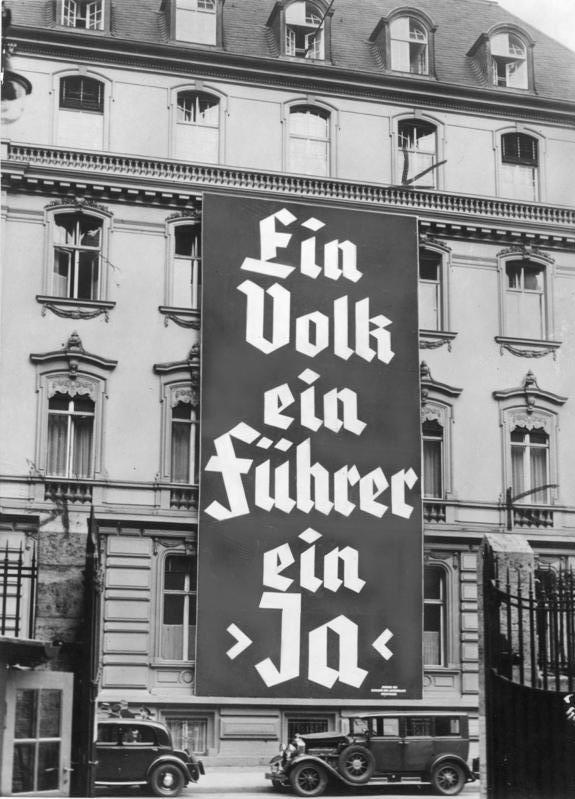
Ein Volk, ein Führer, ein Ja (One People, One Leader, One Yes), NSDAP, 1933. Bundesarchiv, Bild 183-K0930-502, CC BY-SA 3.0 DE. The same equation of people, leader and vote that Hess states at the end of the rally film a year later.
Then and now
The Birth of a Nation (United States, 1915), directed by D. W. Griffith from Thomas Dixon's novel The Clansman, is an earlier feature film that presents Black Americans as a threat. Its main Black characters were played by white actors in blackface and shown as sexual predators and corrupt officials; the Ku Klux Klan rides in as the rescuers. It was shown at the White House on 18 February 1915 (Stokes, 2007). The line attributed to President Wilson, that it was "like writing history with lightning", is widely considered apocryphal: it first appeared in print years after the screening (Benbow, 2010). The NAACP campaigned against it from 1915, and some city and state censors cut or refused it. When William J. Simmons refounded the Klan near Atlanta in November 1915, the film was about to open there, and Klan advertisements ran beside its promotion (Gordon, 2017; Stokes, 2007).
The differences are large. The Birth of a Nation was a private production in a country whose government did not own the studios, license film workers or require audiences to watch; it met organised protest and was restricted in places. Der ewige Jude was commissioned by a ministry that controlled every stage from filming to exhibition, was made while that state persecuted the people it depicted, and used a head of state's prediction of their "annihilation". The shared method is the portrayal of a group as a menace; the scale, state backing and what followed are not equivalent.
Positions on the record
- The makers' stated purpose. Riefenstahl maintained until her death that Triumph des Willens was reportage and art, not propaganda. Hippler said Goebbels was the author of Der ewige Jude, which described itself as a documentary.
- Critics. Kracauer (1947) argued that the rally was organised to be filmed; Sontag (1975) that Riefenstahl's films expressed a fascist aesthetic. Welch and Hornshøj-Møller document Der ewige Jude as a ministry project and its manipulation of footage.
- What is disputed or not shown: how far the 1934 rally was planned around the camera (the "hand in hand" caption is documented; the longer Sontag quotation is not in the book); how much of the congress was refilmed; how large Der ewige Jude's audience was (no reliable total was found); and any direct measure of either film's effect on viewers' later actions.
Same-method test
The finding would be the same with the flag swapped. A democratic government's rally film made hand in hand with the organisers and released as a neutral record would be tagged for transfer and bandwagon here. Any state that intercut footage of a minority filmed under its own military occupation with shots of rats, and rated the result an educational film, would be tagged for name-calling, scapegoating and card-stacking in the same words.
How to spot it
- Ask who controlled the camera and the subject. Footage of people filmed under occupation shows the conditions of filming, not their nature.
- Check where each clip comes from. A scene from a fiction film offered as evidence is a borrowed clip, whatever the narration says.
- Watch for animal imagery cut against a human group. The edit makes the comparison so the narration does not have to argue it.
- In a film without commentary, the editing is the commentary: note what is repeated and omitted.
- Look at the system, not only the film: who licensed the makers, who owned the studio, and whether the audience could choose not to watch.
Images
| Image | Source | Licence |
|---|---|---|
| Mechanism diagram (above) | Drawn for FRAME from the page's sourced facts (make_diagrams.py) |
CC BY 4.0, FRAME |
| Ein Volk, ein Führer, ein Ja (1933) | FRAME gallery; Bundesarchiv, Bild 183-K0930-502, via Wikimedia Commons | CC BY-SA 3.0 DE |
| SA and SS formations in the Luitpold Arena at the 1934 Nuremberg rally | Wikimedia Commons | CC BY-SA 3.0 DE (Bundesarchiv) |
| Joseph Goebbels with Leni Riefenstahl, November 1937 | Wikimedia Commons | CC BY-SA 3.0 DE (Bundesarchiv) |


Stills
Content note: Nazi symbols at the 1934 Nuremberg rally. This object is shown as it was published. Why 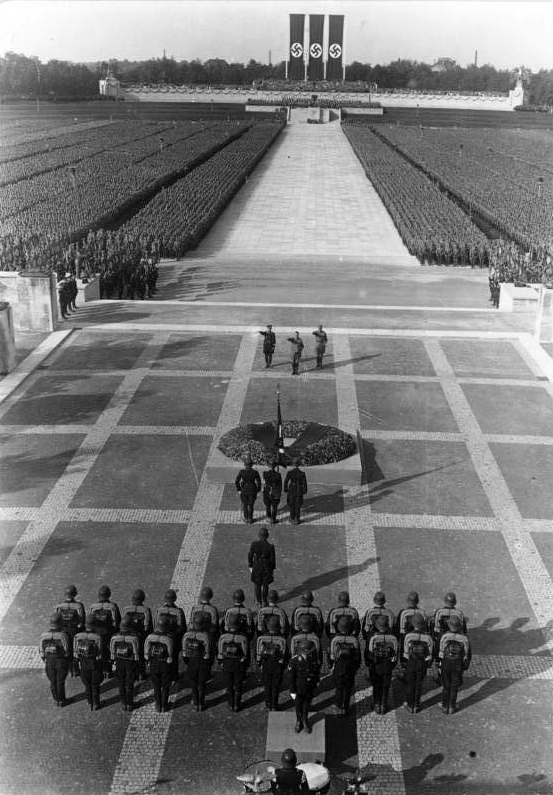
The 1934 party rally in Nuremberg's Luitpold Arena, the rally Triumph des Willens was made from: the memorial ceremony during the SA and SS roll-call. Photo by Georg Pahl, September 1934. Bundesarchiv, Bild 102-04062A, CC BY-SA 3.0 DE. Shows Nazi symbols, as they were.
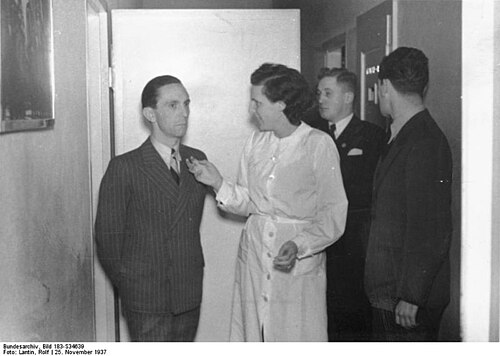
Propaganda minister Joseph Goebbels visits Leni Riefenstahl during preparations for her Olympia film, 25 November 1937. Photo by Rolf Lantin. Bundesarchiv, Bild 183-S34639, CC BY-SA 3.0 DE.
Image gaps
- Frames from Triumph des Willens (the aerial opening, the Luitpold Arena walk). The film is still in copyright in Germany, with rights held by Transit Film. The Bundesarchiv's openly licensed photographs on Wikimedia Commons (CC BY-SA 3.0 DE) may include 1934 rally scenes that could stand in for the setting. Fillable with a rally photograph, not a film frame.
- Frames from Der ewige Jude (the rat montage, the Łódź street scenes). Rights status in Germany is unclear and the film is restricted to educational use; the images are also of real people filmed under occupation. Not filled here.
- The Nuremberg rally grounds today (Zeppelin Field tribune). Openly licensed photographs are on Wikimedia Commons. Fillable.
- A still from The Birth of a Nation (1915). The film is in the public domain in the United States, and stills are on Wikimedia Commons. Fillable.
Sources
- David Welch, Propaganda and the German Cinema, 1933-1945 (Oxford: Clarendon Press, 1983; revised edition, London: I. B. Tauris, 2001).
- Stig Hornshøj-Møller, "Der ewige Jude": Quellenkritische Analyse eines antisemitischen Propagandafilms (Göttingen: Institut für den Wissenschaftlichen Film, 1995), companion to film edition G 171. IWM catalogue record.
- Yizhak Ahren, Stig Hornshøj-Møller and Christoph B. Melchers, Der ewige Jude: wie Goebbels hetzte (Aachen: Alano, 1990). WorldCat.
- USHMM Holocaust Encyclopedia: Der ewige Jude.
- German History in Documents and Images (GHI): The Eternal Jew (1940), with translated narration.
- Deutsches Historisches Museum, LeMO: Film "Der ewige Jude" and Film "Jud Süß".
- filmportal.de: Der ewige Jude. Dokumentarfilm über das Weltjudentum and Triumph des Willens.
- Encyclopedia.com: Der ewige Jude.
- SD, Meldungen aus dem Reich, 20 January 1941, on reactions to "Der ewige Jude" (primary source; Die Quellen sprechen, from the edition Die Verfolgung und Ermordung der europäischen Juden).
- Die Tagebücher von Joseph Goebbels, ed. Elke Fröhlich, Part I, vol. 7, July 1939 to March 1940 (Munich: K. G. Saur, 1998), entry for 2 November 1939.
- Fritz Hippler, Die Verstrickung: Einstellungen und Rückblenden (Düsseldorf, 1981; 2nd ed. 1982).
- Documentation Center Nazi Party Rally Grounds, Nuremberg: Leni Riefenstahl's "Triumph of the Will" and German version.
- University of St Andrews research portal: "28 March 1935: Hitler attends the premiere of Leni Riefenstahl's Triumph des Willens at the Ufa-Palast am Zoo in Berlin".
- Leni Riefenstahl, Hinter den Kulissen des Reichsparteitag-Films (Munich: Eher, 1935). Internet Archive copy.
- Albert Speer, Inside the Third Reich (New York: Macmillan, 1970).
- Siegfried Kracauer, From Caligari to Hitler: A Psychological History of the German Film (Princeton University Press, 1947).
- Susan Sontag, "Fascinating Fascism", New York Review of Books, 6 February 1975, and David B. Hinton and Susan Sontag, "An Exchange on Leni Riefenstahl", 18 September 1975.
- Michel Delahaye, interview with Leni Riefenstahl, Cahiers du Cinéma (1965); English version in Cahiers du Cinéma in English (1966). Discussed in Francine Prose, "Leni Riefenstahl", The Yale Review.
- filmportal.de: "Die verdeckte Verstaatlichung" (state purchase of the studios).
- Bundesarchiv: "Eine 'kleine' Geschichte des Films".
- Lexikon der Filmbegriffe, University of Kiel: Cautio-Treuhandgesellschaft and Jugendfilmstunden.
- Roel Vande Winkel, "Nazi newsreels in Europe, 1939-1945", Historical Journal of Film, Radio and Television 24:1 (2004).
- Katie Trumpener, "Drowning out the Newsreel: Nazi Cinema", London Review of Books 31:5 (2009).
- zeitklicks: Leni Riefenstahl and "Triumph des Willens"; Evangelische Zeitung: Zur Person Leni Riefenstahl.
- BPjM decision 6219 of 1 February 2018 (non-listing of Triumph of the Will, Synapse Blu-ray), via FragDenStaat.
- USHMM Holocaust Encyclopedia: Assessing Guilt (postwar trials of propagandists, including Hippler).
- Norbert Wollheim Memorial: Norbert Wollheim's Testimony in the Trial of Veit Harlan.
- German Wikipedia: Triumph des Willens (legal status and rights; used alongside the sources above, not alone).
- taz: "Nicht nur in Ausschnitten" (on screening Triumph des Willens in Germany).
- Melvyn Stokes, D. W. Griffith's The Birth of a Nation: A History of "The Most Controversial Motion Picture of All Time" (Oxford University Press, 2007).
- Mark E. Benbow, "Birth of a Quotation: Woodrow Wilson and 'Like Writing History with Lightning'", Journal of the Gilded Age and Progressive Era 9:4 (2010).
- Linda Gordon, The Second Coming of the KKK (New York: Liveright, 2017).