Also called Othering, Enemy image, Animalization, Subhuman rhetoric
Portray a group as vermin, disease, beasts or objects so harm against them stops feeling like harm against people.
How to spot Dehumanization: the tell
Animal, insect, contagion or filth imagery applied to a whole people, class or faith.
What Dehumanization is not
Harsh criticism of named individuals' acts without stripping the group of human standing.
History and effect of Dehumanization propaganda
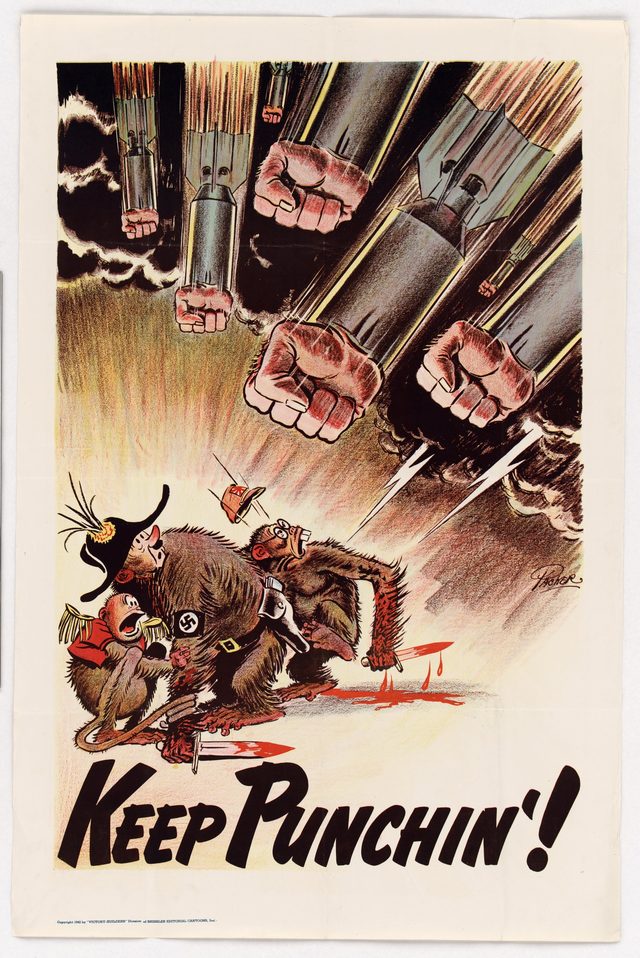
Calling an enemy an animal is older than print, but the poster, the film and the radio made it a mass technique in the twentieth century. The two world wars produced a stock of enemy images from every belligerent: the ape in a helmet, the rat, the louse, the serpent. Their emotional work is disgust and fear, which move a viewer toward removal rather than argument. A person can be reasoned with, punished or pitied. A pest is exterminated.
Explain moreShow less
"Othering" is the milder neighbour of this technique. To other a group is to mark it as outside "us" (strange customs, a foreign loyalty) while still treating its members as people. Dehumanization goes further and denies the group human standing. The two shade into each other, and a campaign often starts with one and ends with the other. What the psychology research says about the process, and the debate over whether it causes cruelty or only excuses it, is summarised in Dehumanization; this page does not repeat it.
Lineage: Wartime enemy-image posters; Smith (2011); Haslam (2006)
How Dehumanization propaganda works
- Pick a category image. The group is drawn as one creature, not as individuals: an ape, a rat, a louse, a serpent, a germ.
- Attach a threat. The creature carries disease, destroys food or attacks women and children, so the audience feels danger from the whole category.
- Offer the remedy. The remedy is a verb used for pests: destroy, wipe out, stamp out, exterminate, trap.
- Repeat it until the label stands in for the group's name.
Why Dehumanization propaganda works
Disgust is fast and hard to argue with. An image of vermin skips the questions that a claim about a group's actions would invite (who did it, when, with what evidence) and answers "what should be done" before anyone asks. Because the category is one creature, a single bad act by one member is read onto all. It also lowers the cost of cruelty for the speaker's own side: a viewer who accepts the image no longer needs a reason to refuse, or to feel regret.

Dehumanization propaganda examples across eras and sides
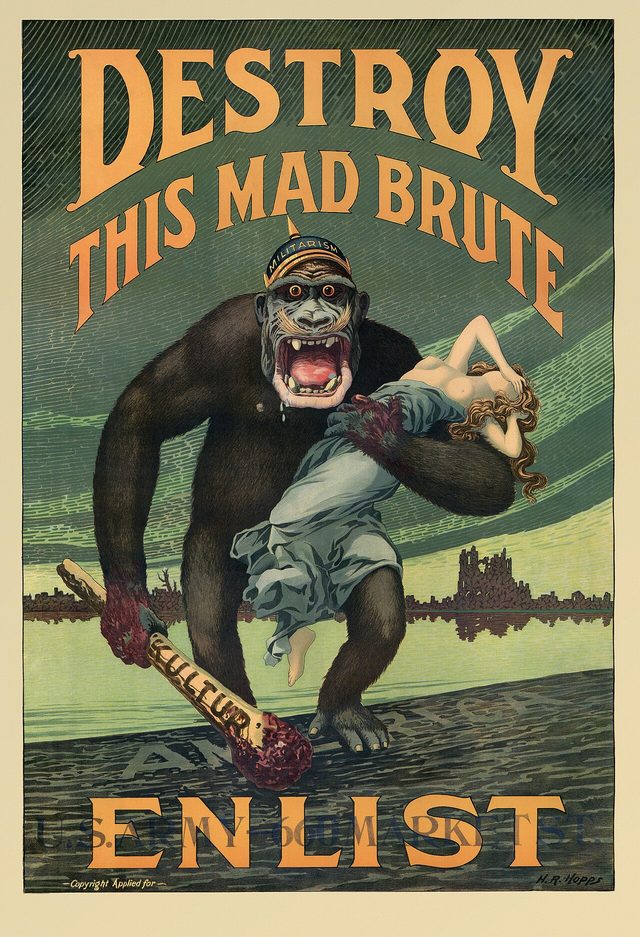
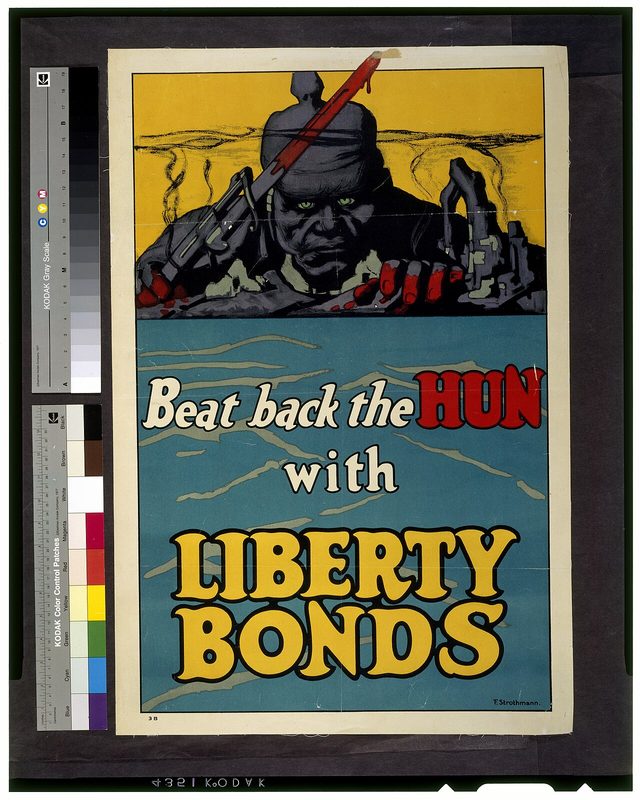
- United States and Australia, 1917 to 1918. In 1917 the U.S. Army issued a recruiting poster, Destroy This Mad Brute (artist Harry R. Hopps), showing an ape in a helmet marked "Militarism" carrying a woman onto American shores. In 1918 the Commonwealth Government of Australia used Norman Lindsay's ? (The German Ogre), an ape-like figure gripping the globe in bloody hands, and a U.S. Treasury Liberty Loan poster, Beat Back the Hun, drew a German soldier as a bloody ape. The target was an enemy state and army, drawn as a beast in all three.
- Nazi Germany, 1940 to 1942. The film Der ewige Jude premiered in Berlin on 28 November 1940. A sequence in it cuts footage of rats against maps of Jewish migration, with narration that rats "bring destruction to the land" (see Film under Goebbels: Triumph des Willens (1935) and Der ewige Jude (1940)). In 1942 the SS Main Office (SS-Hauptamt) issued the brochure Der Untermensch ("The Subhuman"), a photo-led booklet about the peoples of the East, Jews among them. The Holocaust Encyclopedia of the U.S. Holocaust Memorial Museum describes the film's rat sequence as comparing Jews to rats that carry contagion and devour resources. These campaigns came before and during the state's mass murder of Jews and others. Scale and intent are not comparable with any other case on this page.
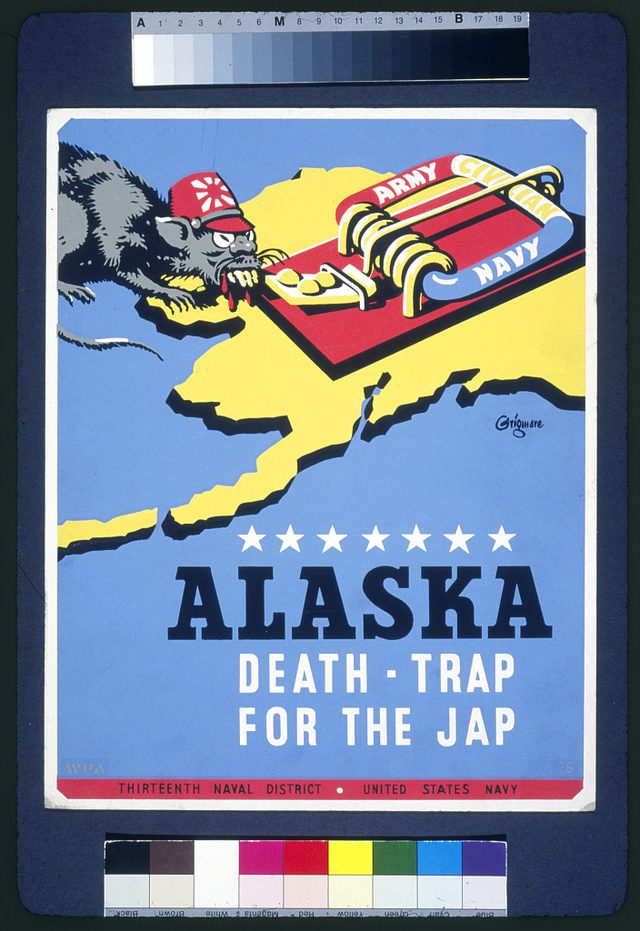
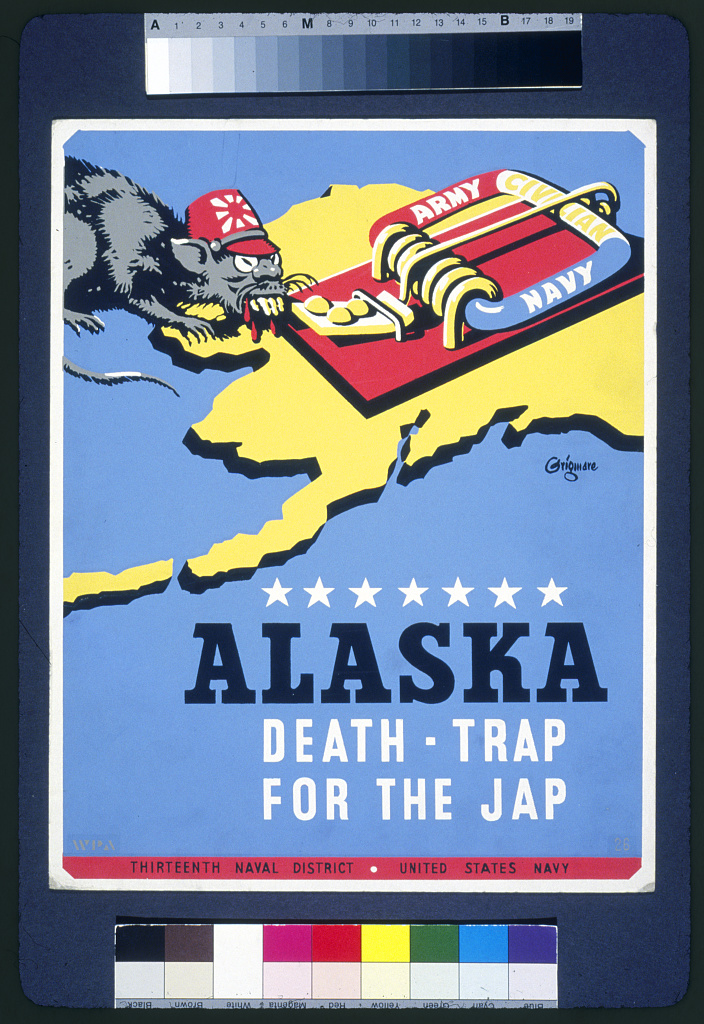
- United States, 1941 to 1945. U.S. war art drew Japanese as rats, apes and "Japs". A 1942 Navy poster by a WPA artist, Alaska, Death-Trap for the Jap, shows a rat in a rising-sun cap approaching a mousetrap; a Douglas Aircraft factory poster of the same year turned a bucktoothed rat into "Jap Trap". The historian John Dower's War Without Mercy (1986) documents this imagery in both American and Japanese propaganda; reviewer Ian Buruma, in the New York Review of Books (14 August 1986), notes cartoons of Japanese as "savage little yellow monkeys", Japanese portrayal of Westerners as "arrogant white demons", and Admiral William Halsey's "Kill Japs, kill Japs, kill more Japs." The same period saw the exclusion and detention of people of Japanese ancestry on the U.S. West Coast, covered in 'Instructions to All Persons of Japanese Ancestry' (exclusion order posted in San Francisco).
Show all 9Show fewer
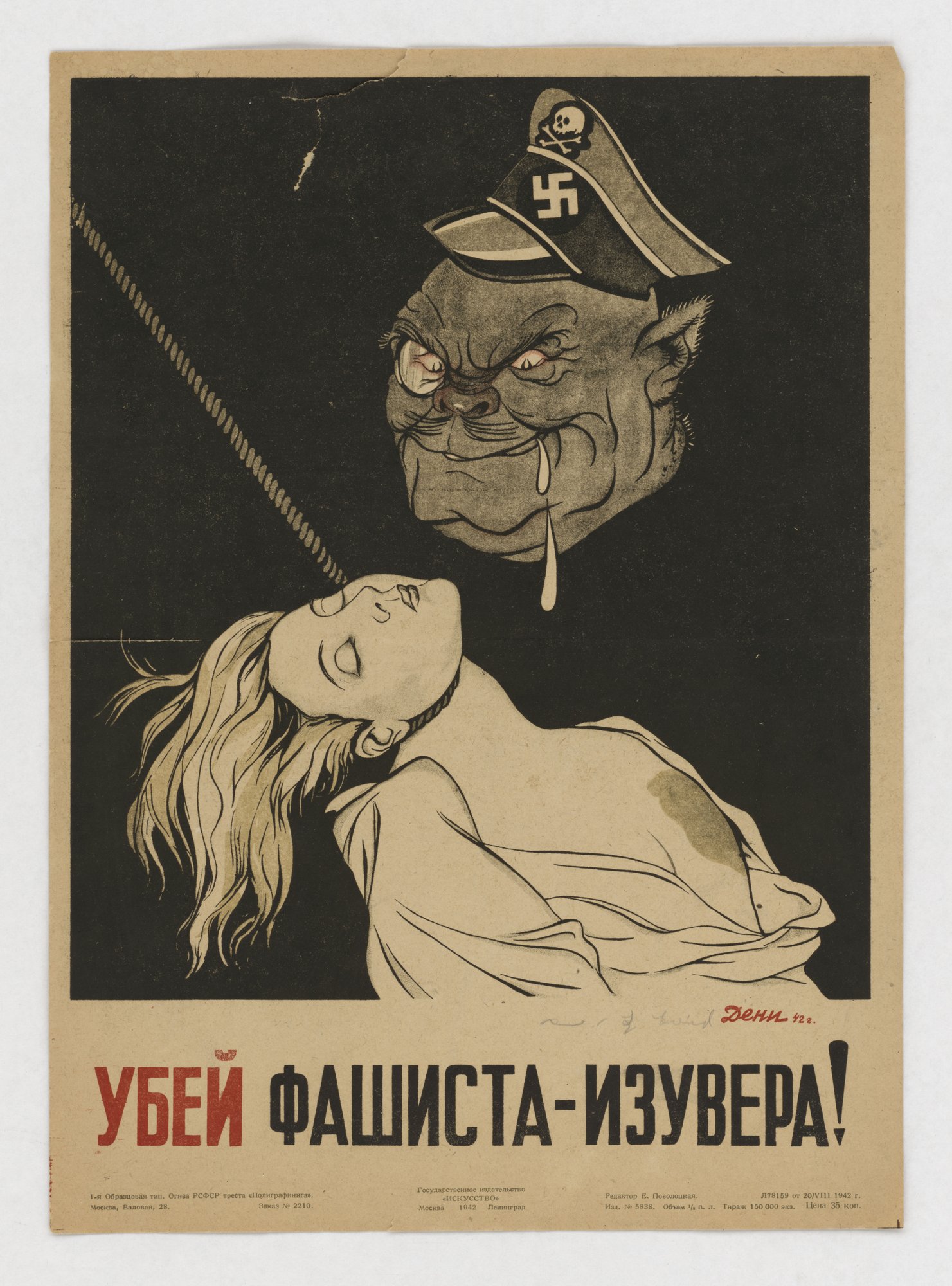
- Soviet Union, 1942 to 1945. Viktor Deni's 1942 poster Kill the Fascist Brute! drew a German officer as a drooling monster over a murdered woman. In the same period the writer Ilya Ehrenburg published articles in the army press, among them "Kill" (summer 1942), which, in the English rendering by the historian Arnold Suppan, says "The Germans are not humans" and urges readers to keep killing Germans. In April 1945 Pravda ran Georgy Aleksandrov's article "Comrade Ehrenburg Simplifies", rebuking this line; Ehrenburg replied that he meant armed aggressors who had entered Soviet soil. The technique was applied by the invaded country to the invader, and Soviet officials themselves objected to the generalisation by the end of the war.
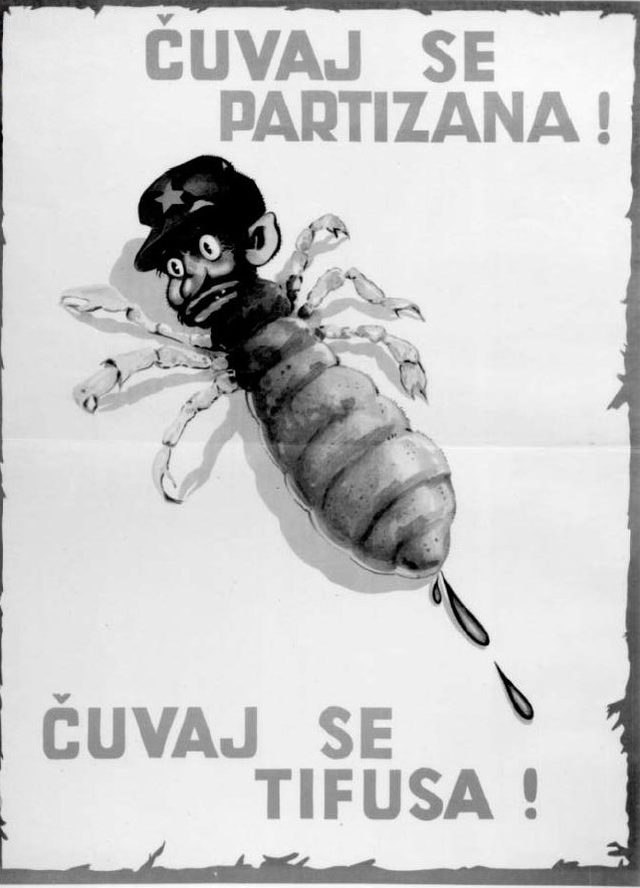
- Independent State of Croatia, 1941 to 1942. The state propaganda office issued a 1941 poster pairing "the Partisan" with typhus, drawn as a louse with a human face, and a 1942 exhibition poster, Židovi, showing a warrior fighting a serpent marked with Stars of David. The first labels a political and armed opponent, the second a religious community, as pests.
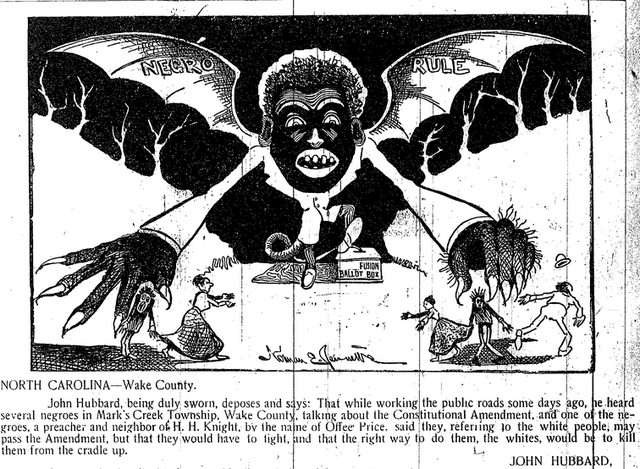
- United States, 1900. The Raleigh News & Observer, part of the white-supremacy campaign in North Carolina, printed a cartoon on 4 July 1900 of a bat-winged Black figure labelled "Negro Rule" rising from a ballot box and clawing at fleeing white people. Two years earlier the same campaign had ended in the Wilmington coup of November 1898, in which armed white men killed Black residents (1898 Wilmington Race Riot Commission, 2006).
- Rwanda, 1990 to 1994. Hutu Power media used inyenzi, "cockroaches", for Tutsi. The newspaper Kangura ran an article in March 1993 titled "A cockroach cannot give birth to a butterfly" (Des Forges, Human Rights Watch, 1999). In his speech at Kabaya on 22 November 1992, MRND official Léon Mugesera called Tutsi inyenzi in an excerpt later broadcast on national radio. In the 2000 judgment against the radio presenter Georges Ruggiu, the International Criminal Tribunal for Rwanda found that by 1994 the term "Inyenzi" had the de facto meaning of "persons to be killed" and had become synonymous with "Tutsi". The full case is in Kangura, Radio Rwanda and RTLM: Hutu Power propaganda before and during the genocide against the Tutsi, 1990-1994.
- United States, 2023. At a Veterans Day rally in Claremont, New Hampshire, on 11 November 2023, Donald Trump said "the radical left thugs that live like vermin within the confines of our country" and, in the ABC News headline's words, said he would "root out" his opponents. Historians and the Biden campaign compared the language to that of fascist leaders; Trump's spokesman Steven Cheung rejected the comparison. It is cited here for the word, not scored.
- Israel, 2023. On 9 October 2023, two days after the Hamas attack of 7 October, Israel's Defense Minister Yoav Gallant announced a "complete siege" of Gaza and said, "We are fighting human animals and we act accordingly." He said it in announcing a siege order, after the attack. News reports tie the remark to Hamas; critics read it as covering Gaza's population. The sentence is quoted, not scored.
Content note: Dehumanizing caricature of Germans as an ape, implied sexual violence and partial nudity. This object is shown as it was published. Why 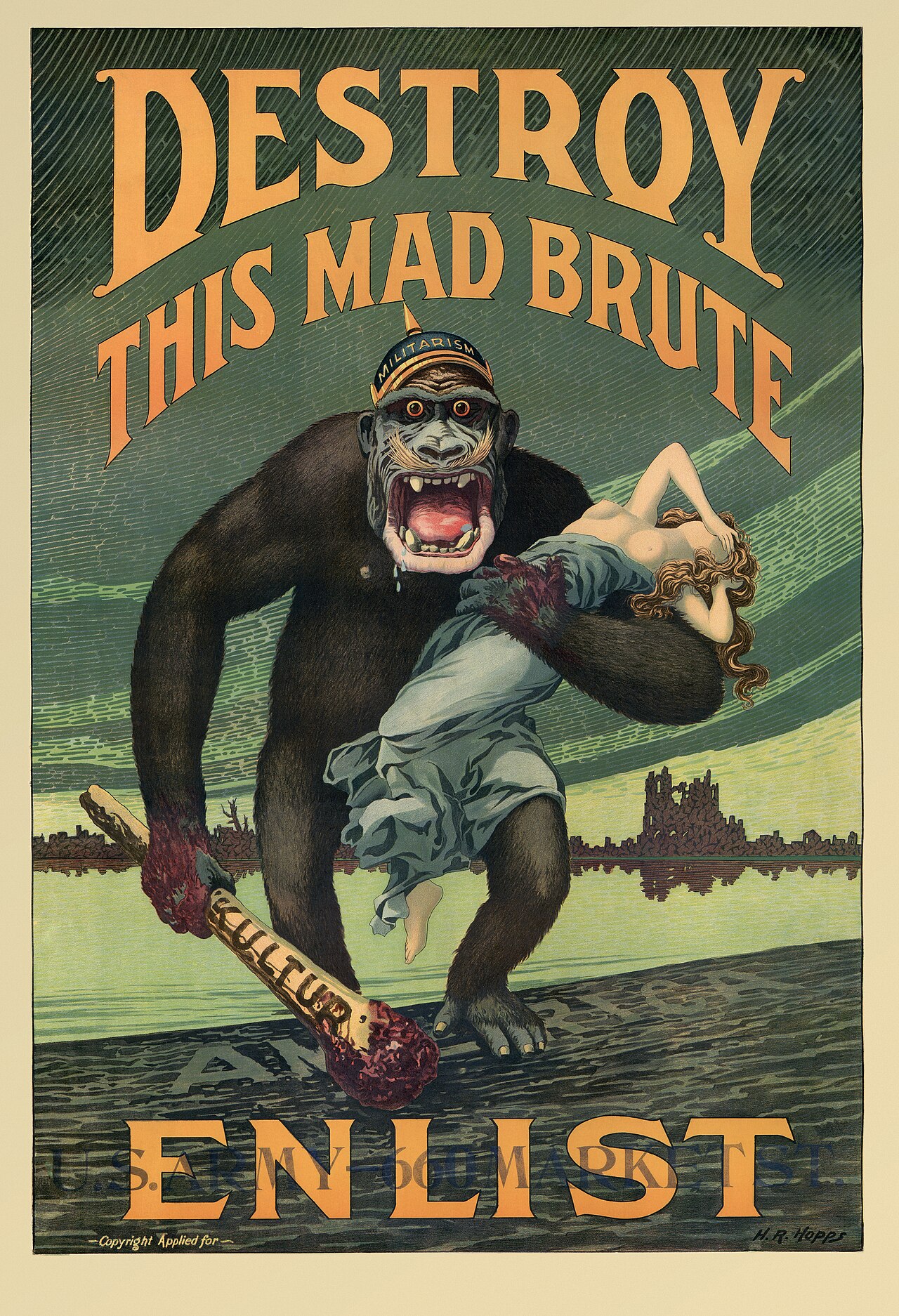
Content note: Dehumanising caricature of Germans as a blood-covered ape-like ogre. This object is shown as it was published. Why 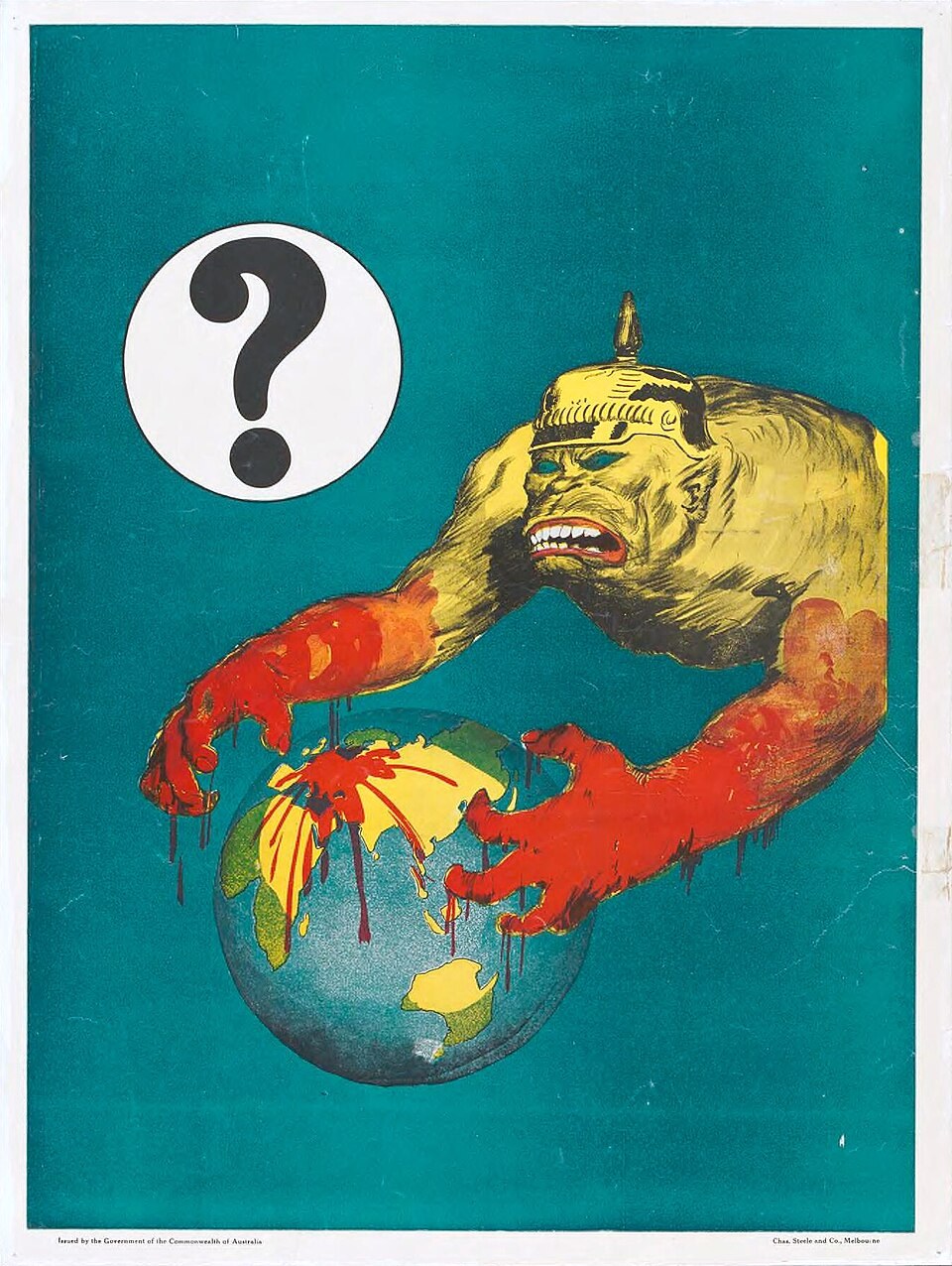


Explain moreShow less
Destroy This Mad Brute — Enlist: "Destroy This Mad Brute — Enlist", U.S. Army recruiting poster by Harry R. Hopps, 1917. Library of Congress (LC-USZC4-4696), via Wikimedia Commons. Public domain.
? (The German Ogre), Norman Lindsay recruiting poster: "? (The German Ogre)", Commonwealth Government of Australia recruiting campaign, artist Norman Lindsay, 1918. Australian War Memorial (ARTV00078). Public domain.
Der Untermensch (SS Main Office brochure, cover): cover of the SS Main Office brochure "Der Untermensch" ("The Subhuman"), 1942. Via the Holocaust Research Project and Wikimedia Commons. Public domain per the Commons page (PD Germany).
Alaska - Death-Trap for the Jap: "Alaska, Death-Trap for the Jap", WPA Art Project poster for the Thirteenth Naval District, U.S. Navy, 1942. Library of Congress, Prints and Photographs Division (cph.3b48885). Public domain (U.S. government work).
Židovi: izložba o razvoju židovstva (Jews: Exhibition on the Development of Jewry), Zagreb: "Židovi" exhibition poster, State Propaganda Office of the Independent State of Croatia, Zagreb, 1942. Wikimedia Commons. Public domain in Croatia (PD-Croatia).
Убей фашиста-изувера! [Kill the fascist brute!]: "Kill the fascist brute!", artist Viktor Deni, State Publishing House "Art", Moscow-Leningrad, 1942. U.S. National Archives (NAID 44266074). Public domain in the U.S.
How to spot Dehumanization propaganda
- Check the noun. Is the group named as a creature or condition (rats, apes, lice, plague, cockroaches, "animals")?
- Check the scope. Does the label cover everyone in the category, or only people who did something specific?
- Check the verb. Pest verbs such as exterminate, wipe out, root out or trap signal that the label is doing the work.
Show all 5Show fewer
- Check who is shown. Individuals with names, faces and acts point away from dehumanization; a single creature standing for a million people points toward it.
- Ask for the opposite. Swap the group for your own. If the same sentence would feel like an attack on you, the framing is doing more than describing conduct.
Where Dehumanization propaganda ends: edge cases and legitimate persuasion
5 items · Real pests. A 1917 or 1944 public-health poster about rats or lice is about animals. The…
- Real pests. A 1917 or 1944 public-health poster about rats or lice is about animals. The archive holds many, and they are not tagged here.
- Naming conduct. "Murderers", "war criminals" or "terrorists" for people shown to have done those acts is name-calling at most, unless the label is stretched to a whole people.
- Metaphor aimed at a leader. A cartoon of a named ruler as a worm or a wolf targets one person's acts. It becomes dehumanization when it spreads to the nation.
- Scholarly or historical use. Quoting these images to explain them, as this archive does, is not the technique.
- Anger is not proof. A group can have committed atrocities and still be dehumanized in the telling; the label then adds nothing the evidence needs.
Sources and further reading
Sources
11 items · Dower, John W. War Without Mercy: Race and Power in the Pacific War . Pantheon, 1986.…
- Dower, John W. War Without Mercy: Race and Power in the Pacific War. Pantheon, 1986. Reviewed by Ian Buruma, "Us and Others", The New York Review of Books, 14 August 1986. https://www.nybooks.com/articles/1986/08/14/us-and-others/
- Des Forges, Alison. Leave None to Tell the Story: Genocide in Rwanda, "Propaganda and Practice". Human Rights Watch, 1999. https://www.hrw.org/reports/1999/rwanda/Geno1-3-10.htm
- International Criminal Tribunal for Rwanda. Prosecutor v. Georges Ruggiu, ICTR-97-32-I, Judgement and Sentence, 1 June 2000, para. 44(iii). https://unictr.irmct.org/files/case-documents/ictr-97-32/trial-judgements/en/000601.pdf
- U.S. Holocaust Memorial Museum. "Der ewige Jude (The Eternal Jew)". Holocaust Encyclopedia. https://encyclopedia.ushmm.org/content/en/article/der-ewige-jude
- Wikipedia. "Ilya Ehrenburg" (quoting Arnold Suppan's translation of "Kill" and the April 1945 Pravda exchange). https://en.wikipedia.org/wiki/Ilya_Ehrenburg
- ABC News. "Trump compares political opponents to 'vermin' who he will 'root out,' alarming historians". November 2023. https://abcnews.com/Politics/trump-compares-political-opponents-vermin-root-alarming-historians/story?id=104847748
- Al Jazeera. "Israeli defence minister orders 'complete siege' on Gaza". 9 October 2023. https://www.aljazeera.com/video/newsfeed/2023/10/9/israeli-defence-minister-orders-complete-siege-on-gaza ; HuffPost, "Israeli Defense Minister Announces Siege On Gaza To Fight 'Human Animals'", October 2023. https://www.huffpost.com/entry/israel-defense-minister-human-animals-gaza-palestine_n_6524220ae4b09f4b8d412e0a
- 1898 Wilmington Race Riot Commission, final report, 2006, North Carolina Department of Natural and Cultural Resources. https://digital.ncdcr.gov/Documents/Detail/1898-wilmington-race-riot-report/2257408
- Haslam, Nick. "Dehumanization: An Integrative Review". Personality and Social Psychology Review 10(3), 2006.
- Smith, David Livingstone. Less Than Human: Why We Demean, Enslave, and Exterminate Others. St. Martin's Press, 2011.
- Object details for the posters, brochure and film frames come from the archive entries listed below.
Sourcing note: the Ehrenburg wording is taken from Wikipedia's quotation of Suppan, not from the Russian original, and the date of the "Kill" article is given there only as summer 1942. The Gallant wording is from news reports of his remarks on 9 October 2023.
Gaps. No sourced contemporary case from China or from the Global South is on this page yet. The Rwandan case is documented through Kangura and a speech; the page does not quote RTLM broadcasts, which Des Forges's text does not quote word for word.
The science
Research on the psychology this technique relies on, from the Learn library:
Research on the psychology this technique relies on, from the Learn library:
- Dehumanization — Dehumanization
- Disgust — Disgust
- Out-group homogeneity — Out-group homogeneity
- In-group favoritism — In-group favoritism