Content note: this page describes killings by police and killings of police officers, and quotes a protest sign that likens police to the Ku Klux Klan and a campaign ad that calls protesters a "mob".
In one line: a 2013 hashtag became a national movement over police killings of Black Americans, a counter-movement formed in 2014 around the deaths of police officers, both mostly argued in the open, and a Russian operation ran fake pages on both sides at once.
What happened
- July 2013. After George Zimmerman is acquitted in the killing of Trayvon Martin, organizers Alicia Garza, Patrisse Cullors and Opal Tometi start #BlackLivesMatter. Pew counts the hashtag nearly 30 million times on Twitter between July 2013 and 1 May 2018.
- August 2014. Ferguson officer Darren Wilson shoots and kills Michael Brown, 18. Protesters adopt the chant and gesture "Hands up, don't shoot", based on witness accounts that Brown was surrendering. On 1 December 2014 four members of the Congressional Black Caucus make the gesture on the House floor.
- December 2014. NYPD officers Rafael Ramos and Wenjian Liu are shot dead in their patrol car in Brooklyn. Three NYPD officers, Joseph Imperatrice, Christopher Brinkley and Carlos Delgado, found Blue Lives Matter, stating its aim as supporting officers and their families. A black-and-white U.S. flag with one blue stripe, designed in 2014 by college student Andrew Jacob, spreads in the same months. "All Lives Matter" appears on social media in 2014 as a reply slogan.
- 4 March 2015. The Justice Department issues two reports. One finds that the Ferguson Police Department engaged in a pattern or practice of conduct violating the First, Fourth and Fourteenth Amendments, shaped by a focus on revenue and by racial bias. The other declines to charge Wilson. It finds that accounts of Brown with his hands up in surrender were "inconsistent with the physical and forensic evidence", and that the evidence did not show Wilson's use of force was "objectively unreasonable". Washington Post opinion writer Jonathan Capehart writes that "Hands up, don't shoot" "was built on a lie", and in the same column points to the police-department report to explain why Ferguson erupted.
- 2015. The African American Policy Forum publishes Say Her Name: Resisting Police Brutality Against Black Women (Kimberlé Crenshaw and Andrea Ritchie), arguing that women harmed by police were missing from the movement's stories and from coverage.
- May 2016. Louisiana's Democratic governor, John Bel Edwards, signs the first "Blue Lives Matter" law, adding police, firefighters and EMS workers to the state hate-crime statute after a 91-0 House vote. In early 2017, 32 similar bills are filed in 14 states; Kentucky, Mississippi and Texas enact versions.
- 2015 to 2017, unattributed. Russia's Internet Research Agency (IRA) runs pages on both sides. Its "Blacktivist" Facebook page draws 11.2 million engagements. Its "Back the Badge" ad, "Community of people who support our brave Police Officers", runs on 19 October 2016 and is shown more than 1.3 million times. Its Instagram accounts include "@pray4police" (127,853 followers) and "@cop_block_us" (109,648).
- June 2020. After the murder of George Floyd by a Minneapolis officer, "Defund the police" spreads nationally. The BLM Global Network Foundation (BLMGNF) pairs #DefundPolice with #InvestInCommunities. Mariame Kaba's New York Times essay is titled "Yes, We Mean Literally Abolish the Police"; sociologist Rashawn Ray writes at Brookings that it means reallocating funds. On 7 June nine of 13 Minneapolis council members pledge to "begin the process of ending the Minneapolis Police Department".
- July 2020. The Trump campaign runs the TV ad "You won't be safe in Joe Biden's America" and a digital ad using a clip of Biden. Biden says he does not support defunding the police.
- 2020 to 2025, money. BLMGNF reports raising just over $90 million in 2020 and granting $21.7 million. In April 2022 New York magazine reports a roughly $6 million California property bought with donations in October 2020. The foundation says it was for a fellowship and would appear on its tax filing; Cullors, who left as executive director in May 2021, says it was used as a safe place after threats. A 2022 lawsuit by BLM Grassroots accusing foundation leader Shalomyah Bowers of taking $10 million is denied by him and dismissed in 2023. In October 2025 the AP reports a Justice Department fraud investigation; no charge is reported. On the police-support side, a 2025 Philadelphia Inquirer investigation into the city's Fraternal Order of Police Lodge 5, drawing on tax records, audits and internal documents, finds the union and its Survivors' Fund spent $660,000 combined on events, funerals, flowers and gifts in the year to September 2023, and a 2026 follow-up finds the lodge billed the city for expenses it says go beyond funeral costs; the union disputes the characterization.
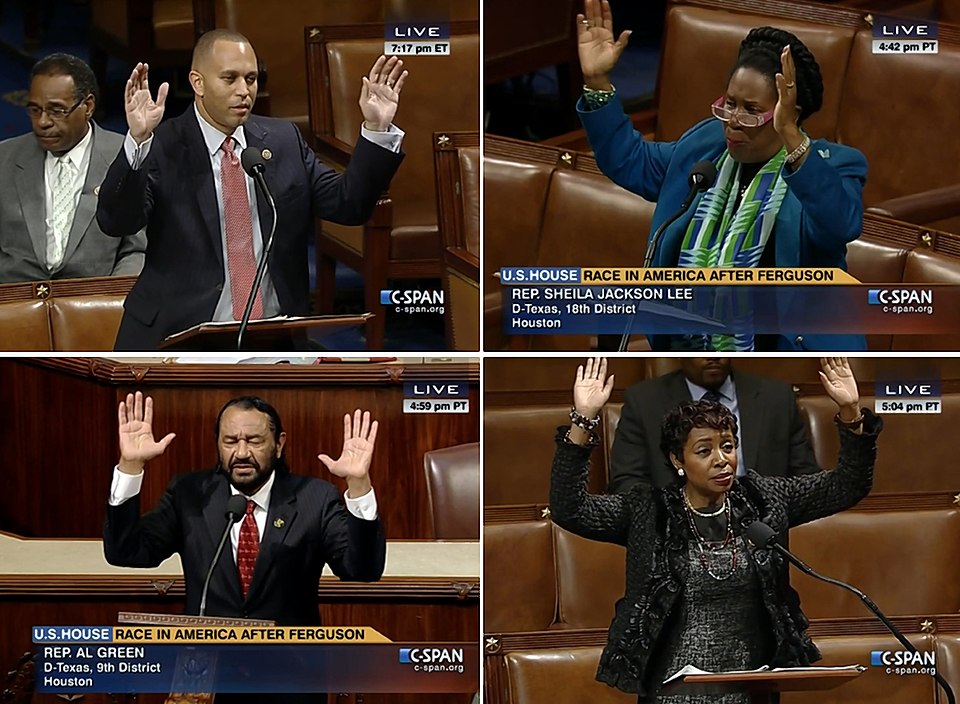
Reps. Jeffries, Jackson Lee, Green and Clarke make the "Hands up, don't shoot" gesture on the House floor, December 2014. House video, public domain.
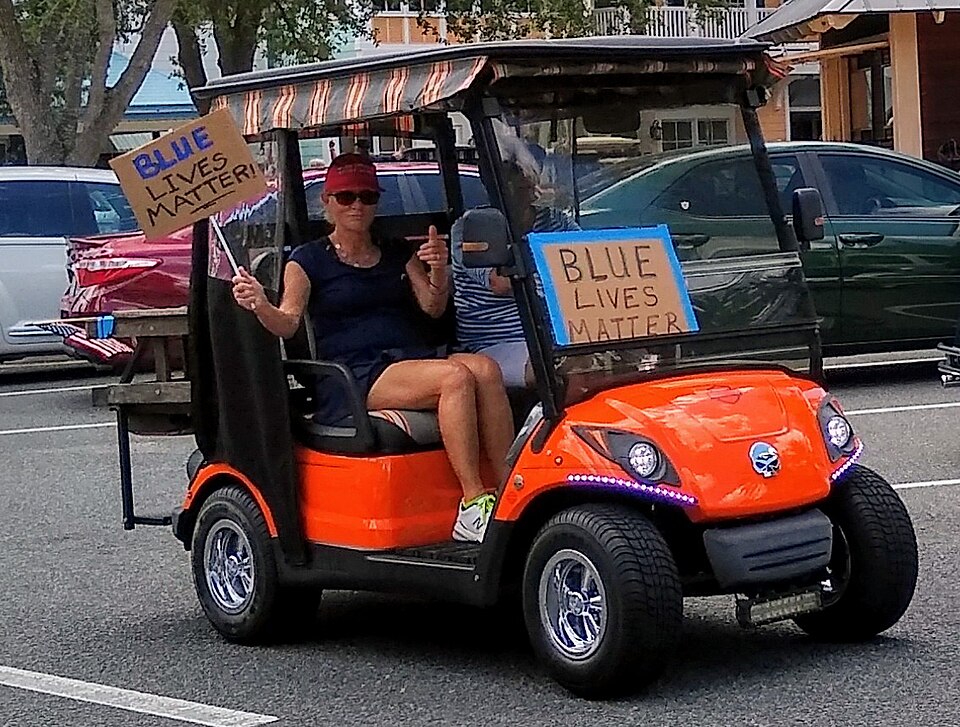
A "Blue Lives Matter" rally in The Villages, Florida, June 2020. Photo by Whoisjohngalt, CC BY-SA 4.0.
How it works
- Name-calling, both sides. At a December 2015 Black Lives Matter demonstration outside the Minneapolis police union's offices, a handmade sign reads "Blue by day, white by night. KKKops." (photo). Days earlier, that union's president, Lt. Bob Kroll, called Black Lives Matter a "terrorist organization" at a press conference (CBS News). The 2020 Trump ad's narrator says "The radical left-wing mob's agenda: Take over U.S. cities, defund the police". In each, the label does the work before any evidence. The clearest examples this page found differ in kind: a protester's sign, a police union president's press-conference remark, and a paid presidential-campaign ad; no comparable statement from a Black Lives Matter organization or a Democratic campaign naming police was found, so the comparison is left uneven rather than filled with a weaker match.
- Fear appeal: the same ad shows an unanswered 911 line and asks "Who will answer the phone when you call 9-1-1?", with one remedy offered. BLMGNF's 2023 "Defund the Police" ad, reviewed for this page, does not use the same staged-harm structure: it calls for "real systemic change that protects all communities, not just a wealthy, powerful few" and does not depict an unanswered emergency, so it is not tagged fear-appeal here.
- Card stacking: a Trump campaign digital ad from the same period shows Biden saying "Yes. Absolutely" under the on-screen words "Defund the police?". The AP's fact check reports that he was answering a question about redirecting some police funding, and that the ad cut his next remark: "that's not the same as getting rid of or defunding all the police".
- Astroturfing and Narrative laundering, the IRA only: foreign staff built pages that looked like Black activists, police supporters and conservatives. The Senate Intelligence Committee says the operation was "simultaneously taking and attacking all sides of the arguments". No finding shows that either movement was created or run by the IRA.
- Outrage bait, the IRA only: a study the Senate committee quotes says the pages first appealed to "supporting veterans and police, or pride in race and heritage" and then "posted content that intended to elicit outrage from these groups."
- Considered, not tagged: Motte and bailey. "Defund the police" was used for different things by different speakers: abolition (Kaba), reallocation (Ray). In Minneapolis, council members later called the pledge meant "in spirit", "up for interpretation" and said it had "created confusion". That record shows a retreat, but not the same speakers then reclaiming the bold claim, so the full pattern is not shown.
- Sleeper effect: "Hands up, don't shoot" as a claim about the Brown shooting specifically. It was drawn from early witness accounts, which the March 2015 Justice Department report found the evidence did not support. Protesters were still chanting it in the 2020 George Floyd protests (CNN), six years after the finding and five years after Capehart's column reported it. The record does not show that the people who first used it in 2014 knew it was unsupported; the tag is on the claim's later life, not its origin.
- Plain open persuasion, both sides. The hashtag, marches, the Say Her Name report, the House-floor gesture, Blue Lives Matter's support for officers' families, the flag, "All Lives Matter", "Back the Blue", and bills passed by recorded votes were all attributed and public. That is ordinary advocacy, not a technique in the taxonomy.
.jpg)
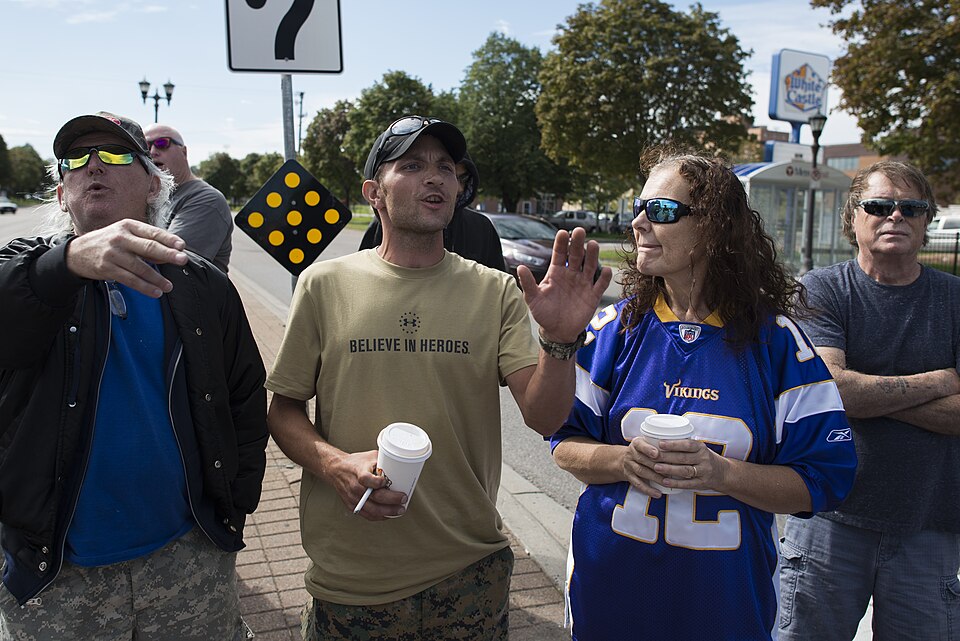
Counter-protesters at a Black Lives Matter protest, St. Paul, September 2015. Photo by Fibonacci Blue, CC BY 2.0.
Then and now
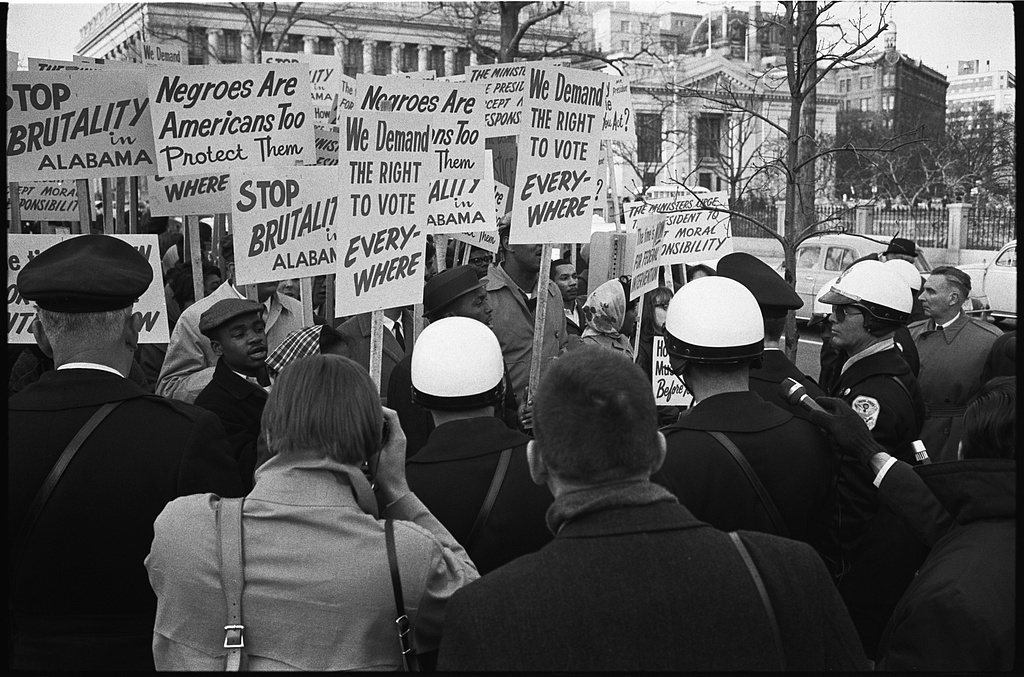
Demonstrators outside the White House, 12 March 1965, with signs reading "Stop brutality in Alabama" and "We demand the right to vote everywhere". Warren K. Leffler, U.S. News & World Report. Library of Congress: no known restrictions on publication.
Open protest over police conduct is old. In 1965 marchers carried signed placards about Selma to the White House, as named people in public. The Senate committee also records the older foreign method: in 1984 KGB officers mailed forged Ku Klux Klan letters to Olympic committees of African and Asian countries. The committee calls the IRA's race-focused work the latest form of that long-standing focus, now with ads bought and targeted by audience. The difference between them is attribution: the marchers of 1965 and 2014 and the officers who founded Blue Lives Matter signed their messages; the IRA did not.
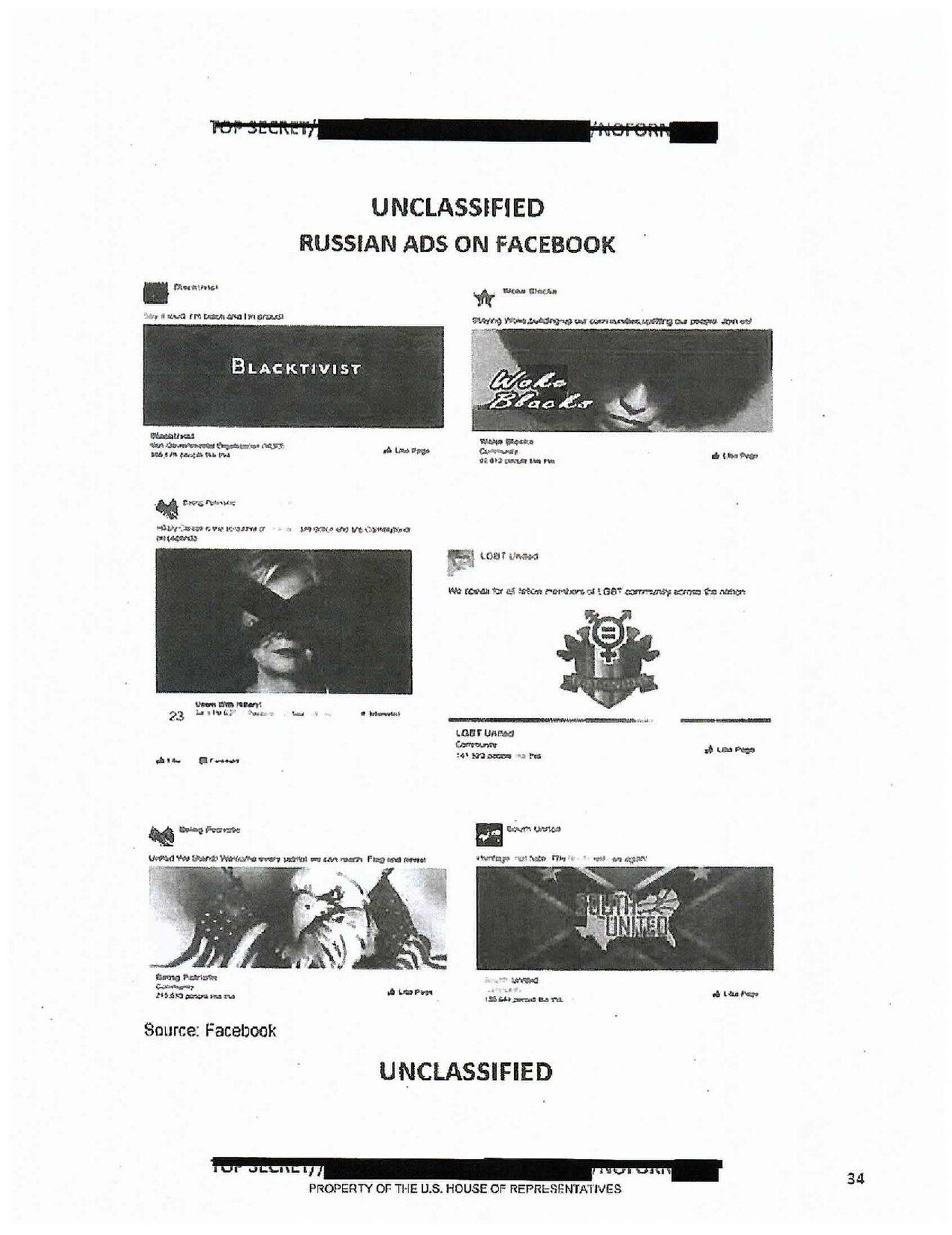
'Russian Ads on Facebook' (House Intelligence Committee exhibit), Internet Research Agency, 2016. Public domain.
Positions on the record
- Black Lives Matter's stated position: BLMGNF argues that police do not keep Black communities safe, and that money should move from police and prisons to housing, health and education.
- Blue Lives Matter's stated position: officers are often unfairly labelled as racists and blamed as a group for the acts of individual officers; the group states its aim as helping and supporting officers and their families; supporters of the laws argue that attacks on police should count as hate crimes.
- This archive's reading: documented are the Justice Department's Ferguson findings on police practices, its finding that the evidence did not support the hands-up account, the IRA pages and ads, the clipped ad, the Minneapolis pledge and vote, and the foundation's filings and disputes. Not shown: that either movement was foreign-run, and any criminal finding about the foundation's money. This page takes no position on policing.
Same-method test
If a police union's page used a sign likening protesters to a hate group, or a movement group or a Democratic campaign clipped an opponent's answer to imply he backed a policy he rejects, this page would tag them the same way. If the IRA pages had posed only as police supporters, or only as activists, the astroturf finding would be the same.
How to spot it
- Check a slogan that states a fact ("hands up", "they want to abolish the police") against the primary record: the report, the full clip, the pledge text.
- Ask who runs a page that speaks for a community. The IRA's pages had names like "Blacktivist" and "Back the Badge"; platform disclosures later showed who ran them.
- One slogan can carry several meanings. Ask the speaker which one they mean before scoring it.
Images
| Image | Source | Licence |
|---|---|---|
| House-floor gesture (2014) | Wikimedia Commons, House video via C-SPAN | Public domain (House chamber video) |
| Blue Lives Matter rally, The Villages (2020) | Wikimedia Commons, Whoisjohngalt | CC BY-SA 4.0 |
| Counter-protesters, St. Paul (2015) | Wikimedia Commons, Fibonacci Blue | CC BY 2.0 |
| White House demonstrators (1965) | Library of Congress, Warren K. Leffler | No known restrictions on publication |
| IRA Facebook pages exhibit (2018) | FRAME gallery | Public domain (U.S. government work) |


.jpg)
Image gaps
- The "Back the Badge" and "Blacktivist" ads as individual images. Released by the House committee and public domain, but its site could not be reached from the environment used to build this page. This gap can be filled.
- The thin blue line flag. A CC0 photo exists on Commons, but the design is sold by a living designer's company, so under this archive's rules it is cited, not hosted.
- The 2020 Trump ad and BLMGNF's defund ad. Copyrighted campaign material; linked in Sources.
- The "KKKops" sign. Openly licensed (CC BY-SA 2.0) and linked above; not hosted so that neither side's name-calling example is shown larger than the other's, since the ad cannot be hosted.
Sources
- CBS News, December 2015: MPD union leader "Black Lives Matter is a terrorist organization"
- CNN, 30 May 2020: Tennessee protesters chant "hands up don't shoot"
- Black Lives Matter, 2023: "It's Still Defund the Police"
- Philadelphia Inquirer, 12 August 2025: five takeaways from the FOP finances investigation
-
Philadelphia Inquirer, 11 June 2026: FOP bills taxpayers for questionable funeral expenses
- Pew Research Center, 2018: #BlackLivesMatter and other hashtags
- DOJ: Investigation of the Ferguson Police Department (2015)
- DOJ: Report on the shooting of Michael Brown (2015)
- NPR, 17 March 2015: Capehart on "Hands up, don't shoot"
- BLMGNF, 2023: "Defund the Police" ad announcement
- Say Her Name (AAPF, 2015)
- EBSCO Research Starters: Blue Lives Matter and All Lives Matter
- The Marshall Project, 2020: the thin blue line flag
- NPR, 26 May 2016: Louisiana hate-crime law; HuffPost, 2017: 32 bills in 14 states; Mason, Blue Lives Matter and Hate Crime Law (2022)
- Senate Intelligence Committee, Volume 2: Russia's Use of Social Media (2019)
- The Daily Beast: "Back the Badge" ad; House Intelligence Committee Democrats: IRA ads
- Arif, Stewart and Starbird, Acting the Part (CSCW 2018)
- Journalist's Resource: "Defund the police" (Kaba, Ray)
- MPR News, 28 October 2020: after the pledge; CBS Minnesota on the NYT report; Ballotpedia: Question 2 (2021)
- UCSB American Presidency Project: Trump campaign, "You Won't Be Safe in Joe Biden's America"; AP fact check via Seattle Times; CNN fact check
- CNN, 2021: BLMGNF's 2020 finances; Snopes, 2022: the property; NBC News, 2022: the Grassroots lawsuit; PBS/AP, 2025: DOJ investigation
- Gallery: 'Russian Ads on Facebook' (House Intelligence Committee exhibit), 'Miners for Trump' rally poster (Internet Research Agency).