Content note: this page quotes segregationist language of the 1950s and 1960s, including a racial slur spoken by a Birmingham official in 1963, and describes bombings, killings and police dogs used on children.
In one line: from 1954 the civil rights movement campaigned publicly with boycotts, marches, signs and lawsuits, while the Citizens' Councils and allied officials answered with labels ("outside agitators", "Communism"), a manifesto and economic pressure; in Mississippi the Councils also received state money, and a state agency's investigators worked with them.
What happened
- July 1954, Indianola, Mississippi. The first Citizens' Council forms after Brown v. Board of Education. Minutes circulated to a selected mailing list quote attorney Arthur J. Clark Jr.: "the solution to this problem may become easier if various agitators and the like could be removed from the communities in which they operate. We propose to accomplish this through the careful application of economic pressures." A statewide body is set up in October with Robert B. Patterson as executive secretary (Evening Star, 21 November 1954).
- 1954. NAACP state president Dr. Emmett J. Stringer tells the same reporter that a branch president lost his credit and "had to give up", and that "I can't get credit anywhere in Mississippi" (Evening Star).
- December 1955 to December 1956, Montgomery. After Rosa Parks's arrest on 1 December, Black riders boycott the city buses. The Montgomery Improvement Association, with Martin Luther King Jr. as president, runs a volunteer car pool, and Parks tours the country in 1956 speaking for the boycott. A federal court rules bus segregation unconstitutional and the Supreme Court affirms (Library of Congress).
- 12 March 1956. Nineteen senators and 77 representatives issue the "Declaration of Constitutional Principles", known as the Southern Manifesto (Evening Star; the Library of Congress counts 101 signers in all). It pledges "all lawful means" to reverse Brown.
- 1955 to 1961, Mississippi. The legislature creates the State Sovereignty Commission, a state agency that, in the Library of Congress's summary, "investigated activists across the state, using a network of informants, economic reprisals, and threats." By January 1961 it has voted the Citizens' Councils $5,000 a month from its $350,000 appropriation (Lexington Advertiser, 12 January 1961). A federal suit challenges the grants, naming the Citizens' Council Forum among the defendants (Holmes County Herald, 12 January 1961).
- 1957 to 1959, Little Rock. Governor Orval Faubus uses the National Guard to keep nine Black students out of Central High until President Eisenhower sends federal troops (Library of Congress). In August 1959 a Capitol rally against integration carries signs reading "Race mixing is Communism".
- January 1962. The Commission's director and an investigator swear an affidavit that editor Hazel Brannon Smith attended a meeting with integration leaders, and, per a UPI report, "the councils mailed throughout the state copies" (Lexington Advertiser, 11 and 18 January 1962).
- May 1963, Birmingham. SCLC, whose executive director Wyatt Tee Walker helped organise it, brings school children into mass marches. Police Commissioner Eugene "Bull" Connor's police and firemen use dogs and fire hoses; more than 1,400 are arrested in four days, including more than 500 children under 16 held (Evening Star, 4 and 6 May 1963). Connor, calling for the dogs, told an officer: "I want them to see the dogs work. Look at those Niggers run." Televised footage "shocked the nation" (Library of Congress). On the night of 11 May a Klan bombing of the A.G. Gaston Motel and the home of A. D. King, Martin Luther King's brother, is followed by a riot in which Black residents burn businesses and fight police. On 15 September a Klan bombing of the Sixteenth Street Baptist Church kills four girls, Addie Mae Collins, Carole Robertson, Cynthia Wesley and Carol Denise McNair; in the hours after, police kill 16-year-old Johnny Robinson and a white youth kills 13-year-old Virgil Ware.
- 28 August 1963. The March on Washington for Jobs and Freedom draws more than 250,000 people (National Archives).
- February to April 1968, Memphis. More than 1,100 Black sanitation workers strike after two co-workers are crushed in a truck; marchers carry "I Am a Man" placards. On 28 March students at the rear of a march use their signs to break windows and looting follows; a Memphis police officer shoots and kills 16-year-old Larry Payne, whom witnesses describe as emerging from a basement with his hands up (Justice Department). King is assassinated on 4 April (National Archives).
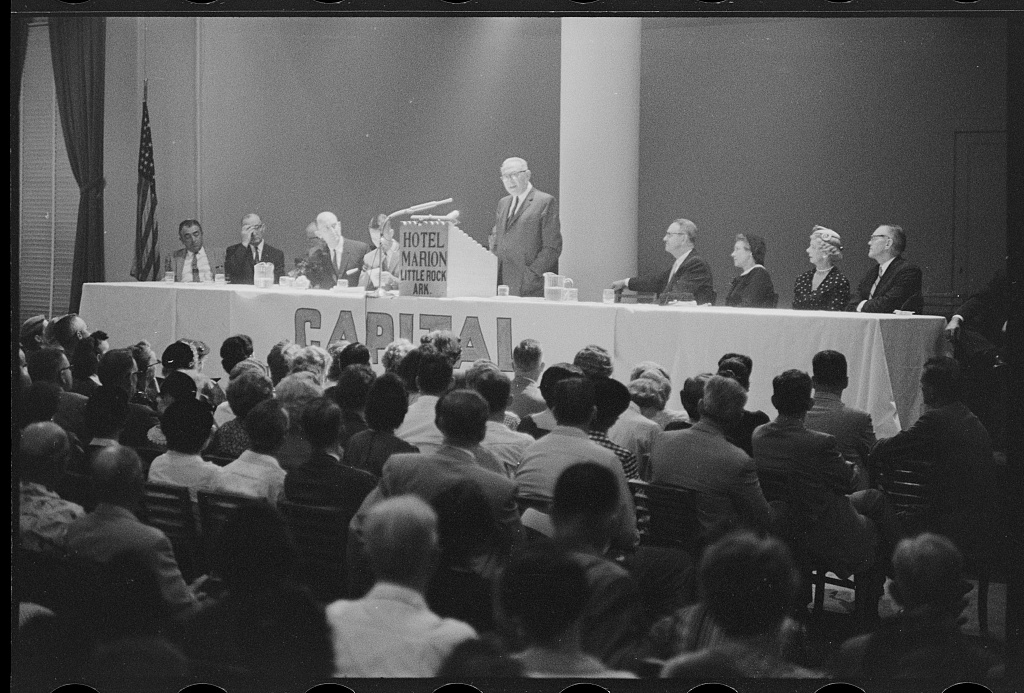
A meeting of the Capital Citizens Council, Hotel Marion, Little Rock, September 1958. Photo by Thomas J. O'Halloran, U.S. News & World Report. Public domain.
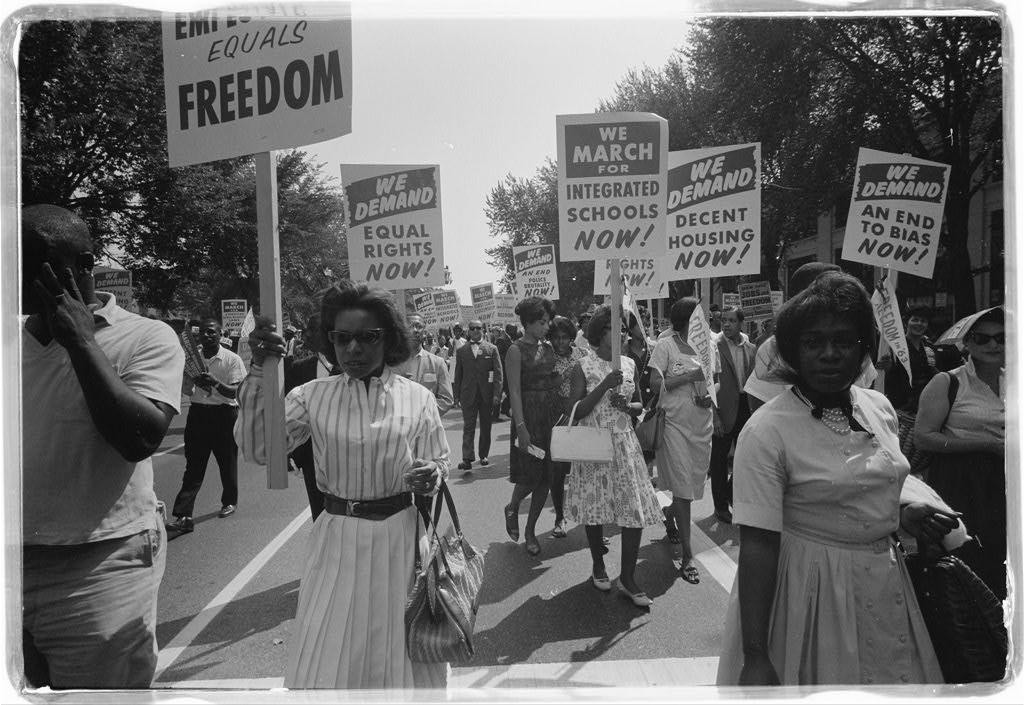
Placards at the March on Washington, 28 August 1963. Photo by Warren K. Leffler, U.S. News & World Report. Public domain.
How it works
- Name-calling, segregationist side. The Manifesto says "outside agitators are threatening immediate and revolutionary changes" and speaks of a condition "inflamed by outside meddlers". Connor criticised "agitators coming in here to stir up trouble" (Evening Star, 4 May 1963). In Birmingham more than half of those held were school children, whom the city's school superintendent threatened with expulsion, and the Library of Congress names Fred Shuttlesworth as the city's own leading civil rights figure. The same test applies to the Councils' critics: Hazel Brannon Smith's paper called the Sovereignty Commission the "private gestapo for the Citizens Council", a label the same page's sources support: Smith's own newspaper reported the Commission's grants to the Councils.
- Scapegoating and Semantic hijacking, segregationist side. Patterson told the Evening Star: "Communists are trying to make us integrate, weaken us and destroy us." The 1959 Little Rock signs read "Race mixing is Communism". A court ruling and the demands of local Black citizens are put down to a single hostile out-group, and a high-stigma Cold War word is stretched to cover school integration. The Holmes County Herald called the suit against the grants "left-wing labor socialistic action".
- Euphemism / doublespeak, Council side. "Careful application of economic pressures" and "removed from the communities" stand in for denying named people credit, jobs and customers, which Stringer and the Library of Congress's oral histories describe.
- Fear appeal, Council side. An Indianola mailing warned: "Unless we organize, the Negro leaders will continue to exert pressure until violence breaks out and then, regardless of how you feel, you will be drawn into the conflict for the issue will be black against white." One remedy is offered: join.
- Bandwagon, Council side. A 1956 anniversary report claimed "half a million members in the South alone, a number that is increasing every week" (Augusta Courier). The figure is the Councils' own and is not verified here. The March on Washington's crowd, by contrast, was counted by others; showing a real turnout is excluded by the definition.
- Identity fusion, Council and Commission side. The Smith affidavit treated an editor's reported presence at a meeting as the story itself, and the Herald described a legal challenge to the grants as an attack on "men of unquestionable character" and on "state sovereignty".
- Transfer, both sides. Flags at the 1959 Little Rock rally, and the "Save our Constitution" signs photographed there, lend national symbols to a protest against integration. The March on Washington was held at the Lincoln Memorial in the centennial year of the Emancipation Proclamation, and King closed with "let freedom ring". In both cases the symbol sat beside an explicit constitutional argument.
- Open persuasion and deliberate staging, movement side. The boycotts, car pools, speaking tours, voter drives, lawsuits and strikes are signed, attributed advocacy, not techniques in the taxonomy. The movement also planned its public image closely. Organisers chose a Wednesday in August, while Congress sat; workers at march headquarters stacked "thousands of signs" to be carried (UPI caption, Library of Congress), with slogans such as "We march for integrated schools now" and "We demand equal rights now"; and other march leaders insisted that John Lewis revise his speech, so that "we cannot support, wholeheartedly the [Kennedy] civil rights bill" became "We support it with great reservations" (Library of Congress). Memphis flyers told marchers to use "soul-force which is peaceful, loving, courageous, yet militant" (National Archives). Printed signs carried by real marchers are message discipline, not Astroturfing; the same holds for the hand-lettered signs at Little Rock. The Birmingham plan to fill the jails with children was an open, disputed choice: Attorney General Robert Kennedy said "an injured, maimed or dead child is a price that none of us can afford to pay", and Governor George Wallace called for an inquiry into teachers "contributing to the delinquency of juveniles", and the Rev. Albert Foley of the Alabama advisory committee to the U.S. Civil Rights Commission called the marches "poorly timed and misdirected" (Evening Star, 4 May 1963).
- Economic pressure, both sides, in different forms. The movement used boycotts of buses and, in Memphis, of downtown stores: public, collective refusals to buy. The Councils' documented method was pressure on named individuals' credit and jobs, and in Mississippi it drew on state funds and state investigators. Neither is a taxonomy technique by itself; the difference is the target and the state's role.
Then and now
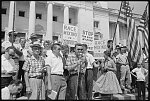
Crowd at the Arkansas State Capitol protesting school integration, with signs reading "Race mixing is Communism," Little Rock, Arkansas, segregationist protesters, Little Rock, 1959. Photo by John T. Bledsoe, U.S. News & World Report. Public domain.
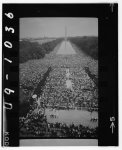
Civil rights March on Washington, D.C., March on Washington for Jobs and Freedom, 1963. Photo by Warren K. Leffler, U.S. News & World Report. Public domain.
Both photographs show crowds using national symbols. They differ in what stood behind them: the Little Rock rally opposed school integration and was addressed by Governor Faubus, who had used the National Guard in 1957; the March had no state power and was lobbying Congress for a bill.
A different method recurs across these pages without being the same case: calling protest foreign-directed. The 1950s Mississippi case paired the label with a state agency paying a private group to investigate and pressure activists. Two other pages score a similar label: a 2026 U.S. Justice Department FARA reminder that named no case (The Justice Department's FARA release and public demonstrations), and an Iranian state-media portal for reporting "traitors abroad" (Alaj: the portal Iranian state media promoted for reporting 'traitors abroad'). Each is scored on its own record; none is evidence about the others.
Positions on the record
- The Councils and their allies: the Councils were, in state legislator Wilma Sledge's 1954 statement, "reliable White male citizens who believe that segregation is not discrimination", and "They do not and will not advocate violence in any form." Patterson: "As long as there is no integration, there will be no trouble." The Manifesto signers called Brown "a clear abuse of judicial power" and pledged "all lawful means".
- The movement: its official 1963 title named its aims, "Jobs and Freedom"; its signs named concrete demands; its leaders called for nonviolence and trained marchers in it (King: "our aim must never be to defeat or humiliate the white man"); and it pressed Congress for what became the Civil Rights Act of 1964.
- This archive's reading: documented are the Councils' own statements of economic pressure, the Sovereignty Commission's grants to the Councils and its investigators' affidavit, police use of dogs and hoses on child marchers, and the bombing of the Sixteenth Street Baptist Church by Klan members. Also documented: rocks thrown at police in Birmingham, the Klan's 11 May bombings that set off Birmingham's riot, and the window-breaking and looting in Memphis on 28 March 1968 before Payne's killing. Not shown in the cited record: that communists directed the movement, or that the Councils as organisations ordered the bombings. The segregationist side had the backing of state and city governments; the movement did not, until federal courts, troops and Congress acted.
Same-method test
If a civil rights group had taken $5,000 a month from a state agency whose investigators swore affidavits against the group's critics, this page would score it the same way. If the movement had called its opponents "outside agitators" or communists without evidence, that would be name-calling too; the one comparable label in this record, "private gestapo", comes from a critic of the Councils and is scored here. The March's printed signs and monument setting get the same reading as the flags at Little Rock.
How to spot it
- When a campaign blames "outsiders", check who was actually arrested, marching or suing, and where they lived.
- Ask who pays a "citizens'" group. In Mississippi the answer was partly the state, and local papers reported it.
- Separate a sign that names a demand ("Integrated schools now") from a sign that names an enemy ("Race mixing is Communism").
- Translate gentle words for pressure ("careful application of economic pressures") into the concrete act: lost credit, lost job.
Images
| Image | Source | Licence |
|---|---|---|
| Little Rock rally, 20 August 1959 (John T. Bledsoe) | Library of Congress | Public domain (U.S. News & World Report collection; LoC: no known restrictions on publication) |
| March on Washington from the Lincoln Memorial, 28 August 1963 (Warren K. Leffler) | Library of Congress | Public domain (U.S. News & World Report collection; LoC: no known restrictions on publication) |
| Capital Citizens Council meeting, September 1958 (Thomas J. O'Halloran) | Library of Congress | Public domain (U.S. News & World Report collection; LoC: no known restrictions on publication) | | Placards at the March on Washington, 28 August 1963 (Warren K. Leffler) | Library of Congress | Public domain (U.S. News & World Report collection; LoC: no known restrictions on publication) |
Image gaps
- The Citizens' Council newspaper, Council leaflets and the Citizens' Council Forum. Segregationist printed material from after 1930 may still be under copyright, and no copy with a verified rights status was found. Not hosted.
- "I Am a Man", Memphis, 28 March 1968. Ernest C. Withers's photograph is at the Library of Congress, marked "Publication may be restricted". Linked only.
- Governor George Wallace holding a photograph of "known agitators" at a Citizens' Council meeting, 1963. UPI photograph, Library of Congress, "Publication may be restricted". Linked only.
- Workers stacking March on Washington signs, 26 August 1963. UPI photograph, Library of Congress, "Publication may be restricted". Linked only.
- Birmingham fire hoses and dogs, May 1963. No photograph with verified open rights was found; wire and Magnum images are copyrighted.
Sources
- U.S. Department of Justice, Civil Rights Division: Larry Payne, Notice to Close File
- National Park Service, African American Civil Rights Network: A. D. King Home (11 May 1963 bombing and the riot that followed)
- Martin Luther King Jr., Stride Toward Freedom: The Montgomery Story (1958), quoted by the Stanford King Institute
- Library of Congress, The Civil Rights Act of 1964: A Long Struggle for Freedom, "Civil Rights Era (1950–1963)"
- Library of Congress, NAACP: A Century in the Fight for Freedom, "The Civil Rights Era"
- Library of Congress, Civil Rights History Project, "Voting Rights" (Sovereignty Commission; Robert G. Clark Jr.)
- Library of Congress, Wyatt Tee Walker oral history, 2014 and Freeman A. Hrabowski oral history, 2011
- Evening Star (Washington), 21 November 1954: Mississippi's Citizens' Councils (Clark minutes, Patterson, Sledge, Stringer)
- Evening Star, 12 March 1956: text of the "Declaration of Constitutional Principles"
- Augusta Courier, 23 July 1956: Citizens' Council second-anniversary report
- Lexington Advertiser, 12 January 1961: "Tax Donations To Citizens' Councils Hit"
- Holmes County Herald, 12 January 1961: editorial defending the Sovereignty Commission's grants
- Lexington Advertiser, 27 April 1961: "Through Hazel Eyes"
- Lexington Advertiser, 11 January 1962: the Sovereignty Commission affidavit and 18 January 1962 reprint from The Mississippian
- Evening Star, 4 May 1963: Birmingham, Connor, Wallace and Robert Kennedy's statement (AP)
- Evening Star, 6 May 1963: arrests and children held (AP)
- National Archives, Official Program for the March on Washington (1963)
- National Archives, "Court Documents Related to Martin Luther King, Jr., and Memphis Sanitation Workers"
- Library of Congress photograph records: Little Rock, "Save our Constitution Follow-Faubus" signs, 1959; "We demand" signs at the March, 1963; Memphis, "I am a man", 1968
- Library of Congress, UPI photograph of March headquarters signs, 26 August 1963 (catalog record)