Content note. This page shows a 1904 photograph of a Congolese man seated beside the severed hand and foot of his five-year-old daughter, and describes killings and mutilations. It also shows a 1906 cartoon of a Congolese rubber collector crushed by a snake with Leopold II's head, and a 1907 pamphlet cover that caricatures two reform campaigners. They are shown as the campaigns published them.
In one line: Leopold II sold his Congo state to the powers as a civilising, anti-slavery mission; when evidence of forced-labour violence reached Europe, a secret Press Bureau paid journalists and ran front bodies, while the Congo Reform Association answered with atrocity photographs, lantern lectures and famous authors, each side building its media for the audiences it needed.
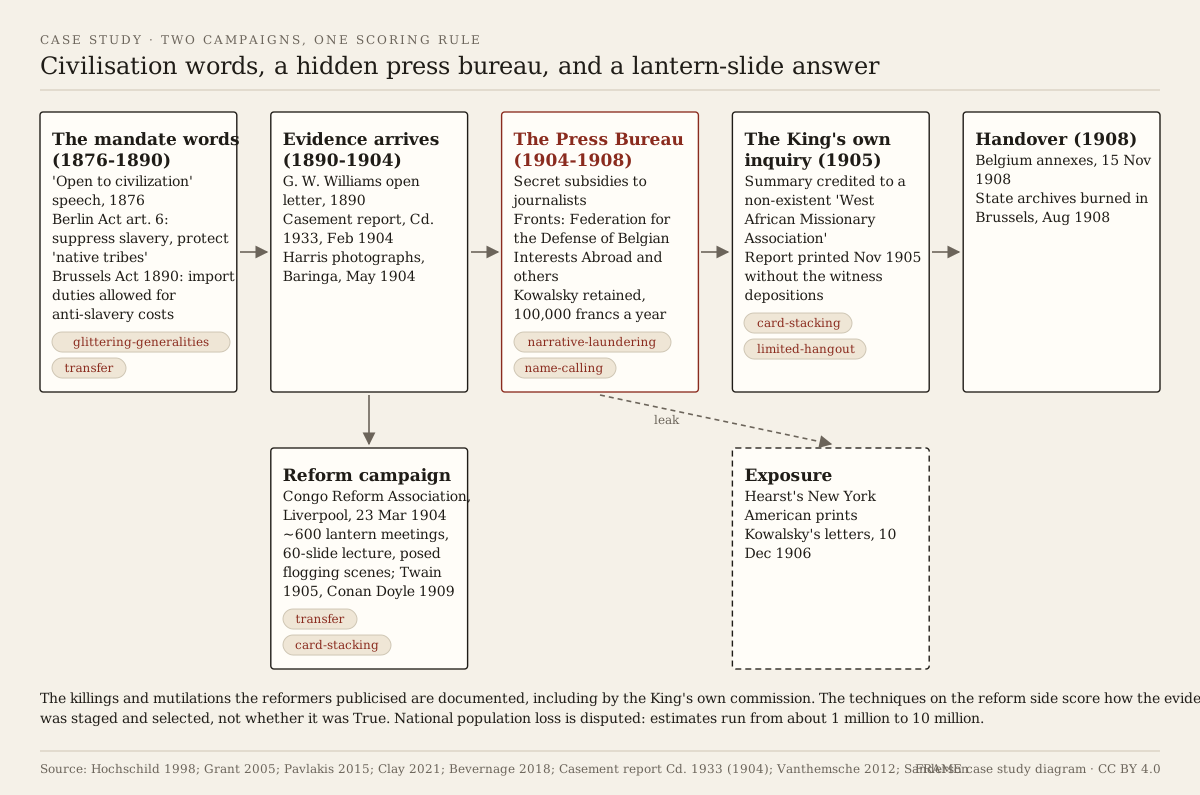
What happened
- 1876. At the Brussels Geographic Conference Leopold calls opening Central Africa to "civilization" "a crusade worthy of this century of progress" (English translations vary).
- 26 February 1885. The Berlin General Act binds powers in the Congo basin to "watch over the preservation of the native tribes" and "help in suppressing slavery" (Article 6). The Congo Free State is Leopold's personal possession, not a Belgian colony.
- 1889-90. The Brussels Anti-Slavery Conference. Leopold links a separate declaration allowing import duties in the Congo basin, departing from Berlin's free-trade terms, to the anti-slavery act, so that neither can be ratified without the other.
- 1890. The African-American writer George Washington Williams publishes an open letter to Leopold describing abuses. This is the first widely read public criticism.
- 1890s-1904. Rubber quotas are enforced by the Force Publique and by company sentries (ABIR, Anversoise). Missionaries report killings, hostage-taking and severed hands.
- 12 February 1904. Roger Casement's consular report goes to Parliament (Cd. 1933, Africa No. 1). Among other findings, it records that Lukolela had "fully 5,000" people in 1887 and fewer than 600 in 1903. Casement lists sleeping sickness, hunger and labour exactions as causes. Names of witnesses and officials were removed before publication.
- 23 March 1904. E. D. Morel founds the Congo Reform Association (CRA) in Liverpool. Liverpool trader John Holt is a major donor; William Cadbury is later its largest single donor.
- 14-15 May 1904. At Baringa, Alice Seeley Harris photographs Nsala of Wala with the hand and foot of his daughter Boali, whom ABIR sentries had killed along with his wife and a son. Morel prints the photograph in King Leopold's Rule in Africa (1904).
- 1904. Leopold sets up a secret Press Bureau. It subsidises journalists and newspapers and works through fronts including the Bureau of Comparative Legislation (Brussels), the Committee for the Protection of Interests in Africa (Germany) and the Federation for the Defense of Belgian Interests Abroad. In December the King retains the San Francisco lawyer Henry I. Kowalsky as his U.S. lobbyist for 100,000 francs a year.
- October 1904-November 1905. Leopold's Commission of Inquiry (Janssens, Nisco, de Schumacher) takes evidence in the Congo from 5 October 1904 to 21 February 1905. Chief Lontulu of Bolima lays 110 twigs on the table, one for each person he says was killed for rubber. The report confirms most major charges. Before it appears, a brief summary credited to a "West African Missionary Association", a body that did not exist, is released to the press. The report is printed in the Bulletin officiel in November 1905 without the witnesses' depositions. Those depositions remained closed to researchers until the 1980s.
- 1905-07. Mark Twain's King Leopold's Soliloquy (Boston: P. R. Warren, 1905) is published, with proceeds going to the reform cause. John and Alice Harris report about 200 lantern meetings in 49 U.S. cities, and some 600 meetings between them in all, using a 60-slide lecture. An anonymous Brussels pamphlet, An Answer to Mark Twain (1907), replies.
- 10 December 1906. Hearst's New York American begins printing Kowalsky's correspondence with the King, including payments meant to derail Senate Congo resolutions.
- August-15 November 1908. The Congo state archives are burned in Brussels over eight days, according to the King's aide Gustave Stinglhamber. Belgium annexes the territory on 15 November. Conan Doyle's The Crime of the Congo (October 1909) argues that the reforms are not enough.
Deaths. No census exists before the 1920s, so there is no body count. Hochschild (1998), drawing on Jan Vansina's estimate that the population fell by about half, gives about 10 million deaths for roughly 1880-1920. The demographer Jean-Paul Sanderson, working back from later census data, finds a much smaller fall (about 10.5 million in 1885 to about 10 million in 1910) and puts the loss at roughly 1 to 5 million. Serious estimates therefore run from about 1 million to 10 million. Killings and mutilations in the rubber districts are documented; it is the national totals that are disputed.
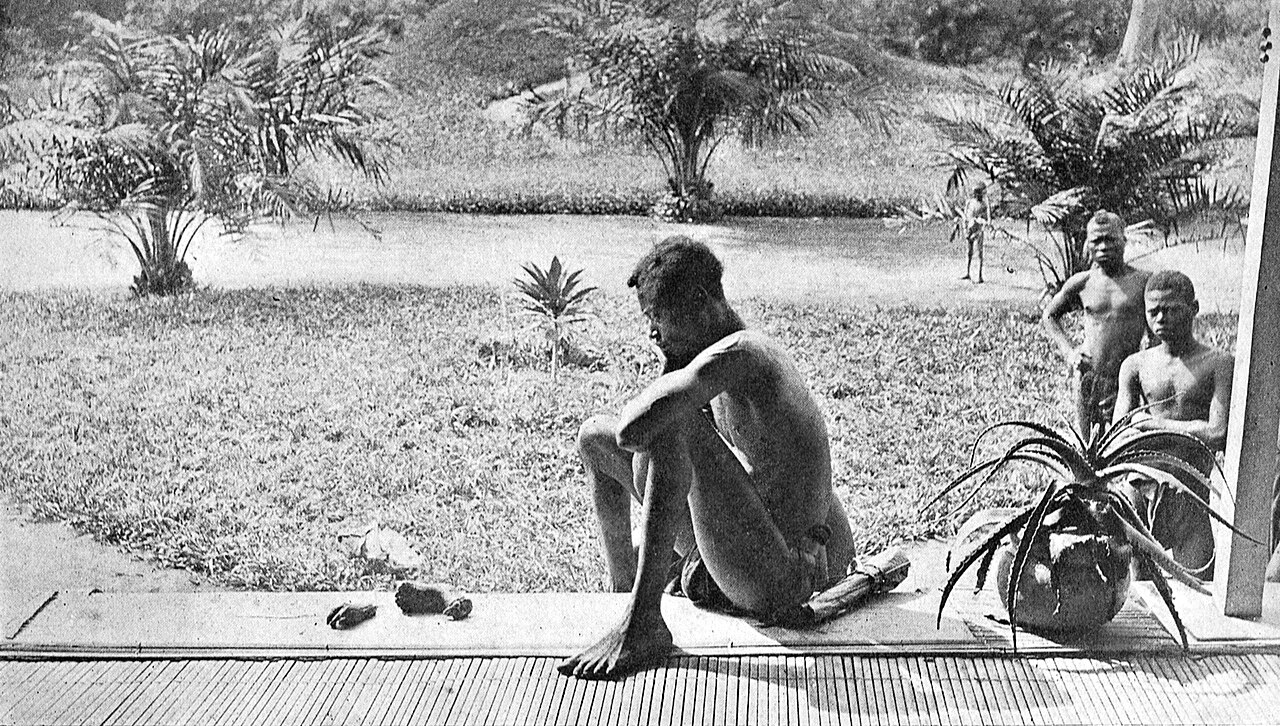
Nsala of Wala, with his daughter's hand and foot (1904), photograph by Alice Seeley Harris, May 1904, as printed by E. D. Morel. The photograph was taken as evidence, and it also became the most-used slide of the reform campaign. Public domain.
How it works
- Glittering generalities: "civilisation", "crusade" and "suppression of the slave trade" stood where a measurable commitment should have been. At Brussels in 1890 the anti-slavery goal was used to justify import duties that fed the Free State's treasury.
- Narrative laundering: the Press Bureau paid journalists and routed the King's case through neutral-sounding bodies (the Bureau of Comparative Legislation, the Federation for the Defense of Belgian Interests Abroad) and anonymous pamphlets such as The Truth about the Civilisation in Congoland ("by a Belgian", London, 1903). Readers saw national or legal opinion and could not see who was paying.
- Card stacking: the "West African Missionary Association" summary gave the press a benign reading of a report that said otherwise. On the reform side, Morel's CRA, heavily funded by Cadbury, played down criticism of Cadbury's purchases of São Tomé cocoa produced by forced labour recruited partly from Congo. Some of the reformers' flogging photographs were posed reenactments.
- Limited hangout: the commission's conclusions were published and a reform commission followed, but the depositions naming victims, places and officers were not. The state published the summary and withheld the evidence underneath it.
- Name-calling: the cover of An Answer to Mark Twain draws Morel and Twain with tongues spelling "SLANDER" and "LIES". It quotes the CRA secretary on the "partition" of the Free State "among the Powers" to present reform as a cover for a British land grab.
- Transfer: both sides borrowed standing. Leopold used anti-slavery law and, in America, the endorsement of Catholic clergy such as Cardinal Gibbons, which Gibbons later withdrew. The reformers ran their lantern lectures like missionary meetings, with hymns, chicottes and shackles on display, and with flogging and chain-gang images that echoed the Passion and the anti-slavery prints of earlier abolition campaigns (Grant 2001; Peffer 2008).
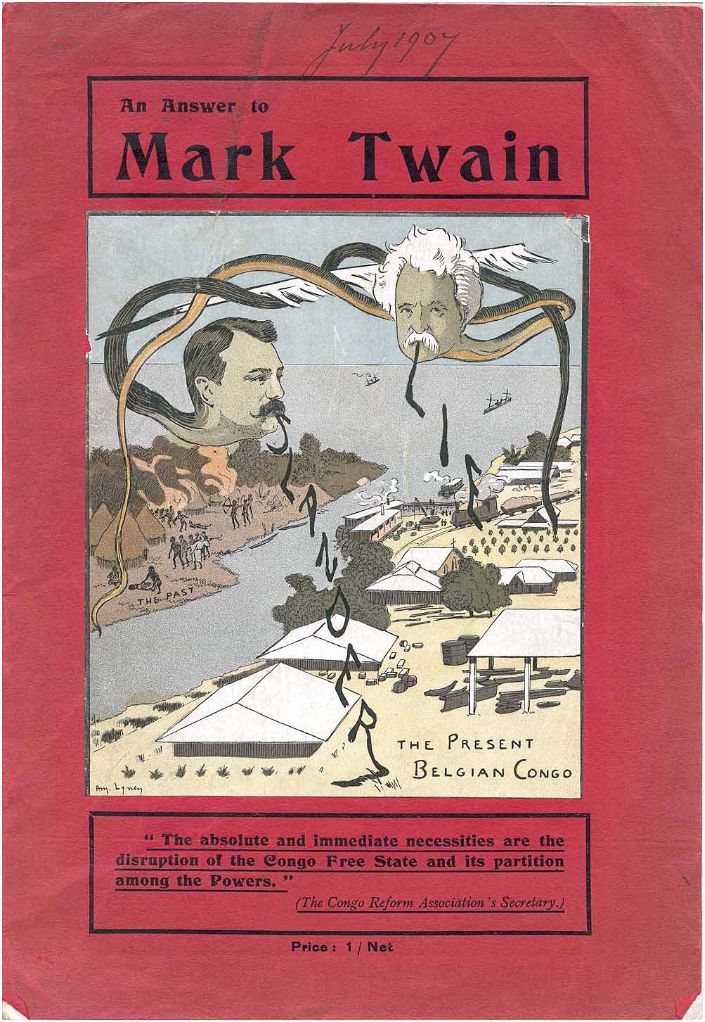
An Answer to Mark Twain (Brussels pamphlet cover, 1907), anonymous, Brussels, 1907. E. D. Morel (left) and Twain speak "SLANDER" and "LIES"; "The Past" (a burning village) is set against "The Present Belgian Congo" (orderly buildings and a railway). Public domain.
Then and now
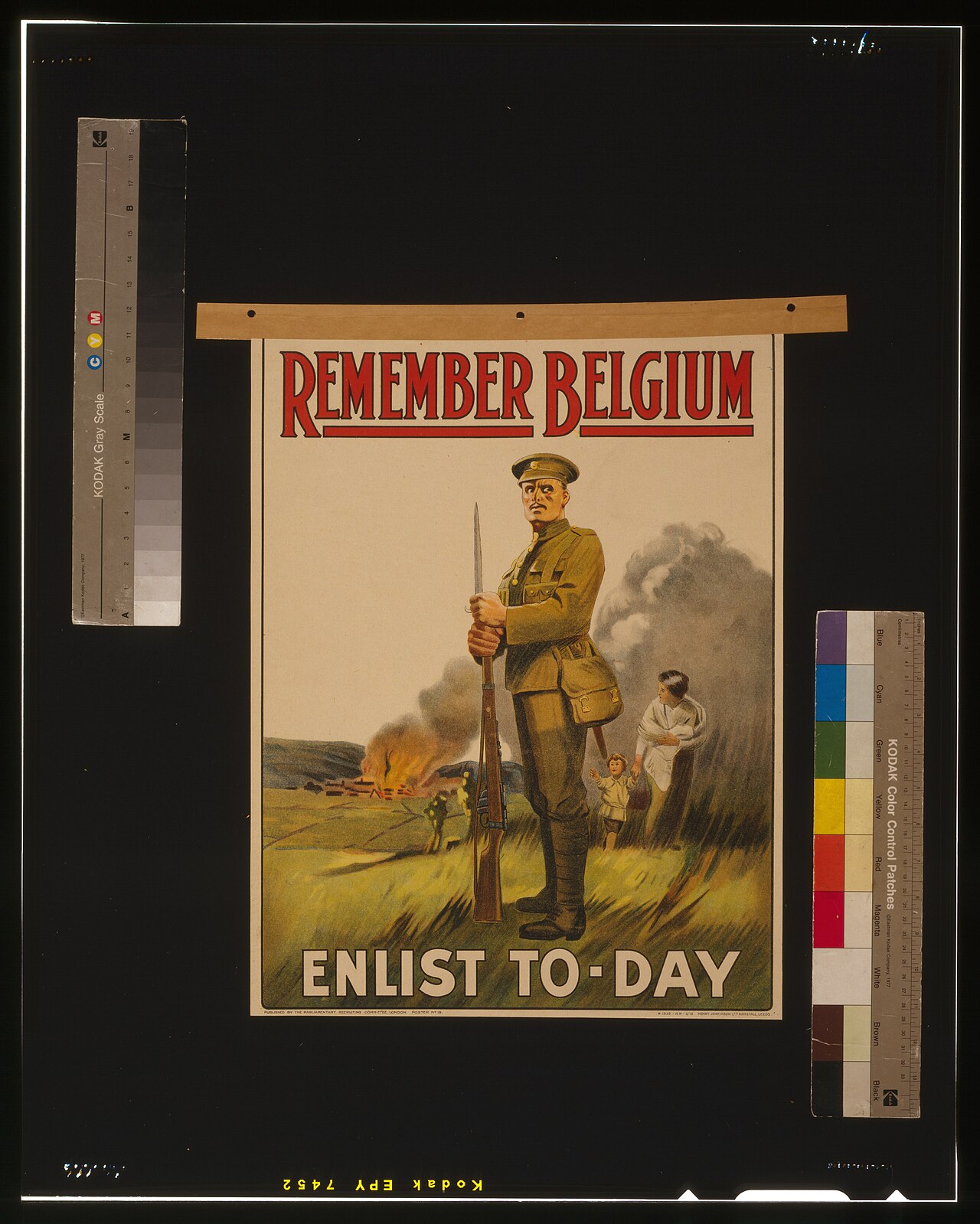
Remember Belgium — Enlist To-Day, Parliamentary Recruiting Committee, 1915. Public domain.
Ten years after the Congo campaign, British recruiting posters turned Belgium into the victim. Stories of German soldiers cutting off Belgian children's hands, an image the Congo campaign had made familiar, spread widely in 1914. Horne and Kramer found no evidence to support them, while documenting that German troops killed about 6,500 civilians in Belgium and northern France in 1914. The mechanism is the same: real violence, a single image built to carry it, and an audience that sees the image before the evidence. The differences are also large. In the Congo, the core atrocity claims were confirmed by the accused state's own commission. In 1914, a real massacre was wrapped in added stories, and the campaign served a government at war rather than a voluntary league. The German reply, Sind wir die Barbaren? (Are We the Barbarians?), mirrors An Answer to Mark Twain: a rebuttal that answers the atrocity charge with a counter-comparison.
Positions on the record
- Leopold and his defenders: the Free State ended the Arab-Swahili slave trade, built railways and stations, and punished individual abuses through its courts. They said the critics were Protestant missionaries, Liverpool merchants who wanted the rubber trade, and British imperialists who wanted partition.
- The reformers: the violence came from the system of rubber quotas and concession companies, not from rogue agents, and the only remedy was to end the King's personal rule and restore free trade and land rights.
- What is documented: the Casement report; the commission's confirmation of the main charges; the Press Bureau and its fronts (Marchal's archival work, summarised by Hochschild); Kowalsky's retainer and letters; Holt's and Cadbury's funding of the CRA; Alfred Jones, Congo consul in Liverpool and owner of Elder Dempster, organising pro-Leopold publishing.
- What is not shown: a verified national death toll; the full list of newspapers and journalists the Press Bureau paid; whether lecture audiences were always told which flogging images were posed. Commercial interest among the CRA's funders is documented. It does not make the atrocity evidence false, and the reformers' cause does not make their staging neutral.
Same-method test
Swap the flags. A British colonial office that secretly paid continental journalists, credited a critical inquiry's summary to an invented missionary society, and destroyed its records before a handover would score the same. Britain's own handover-era record removals, the Kenya "migrated archives" disclosed in 2011, are the nearest real counterpart. A Belgian reform league that toured posed atrocity photographs of British colonies to chapel audiences while going quiet about its donor's supply chain would score the same on the reform side.
How to spot it
- Ask who pays the "federation", the "bureau" or the pamphlet signed "a Belgian". Check whether the body existed before the controversy.
- Read the report, not the summary. Ask where the witness testimony is.
- For atrocity images, separate the photograph (Nsala, 1904: a documented event) from the staging around it (music, sequence, reenactment).
- When motive is used to answer evidence ("they want our trade"), test the evidence on its own terms.
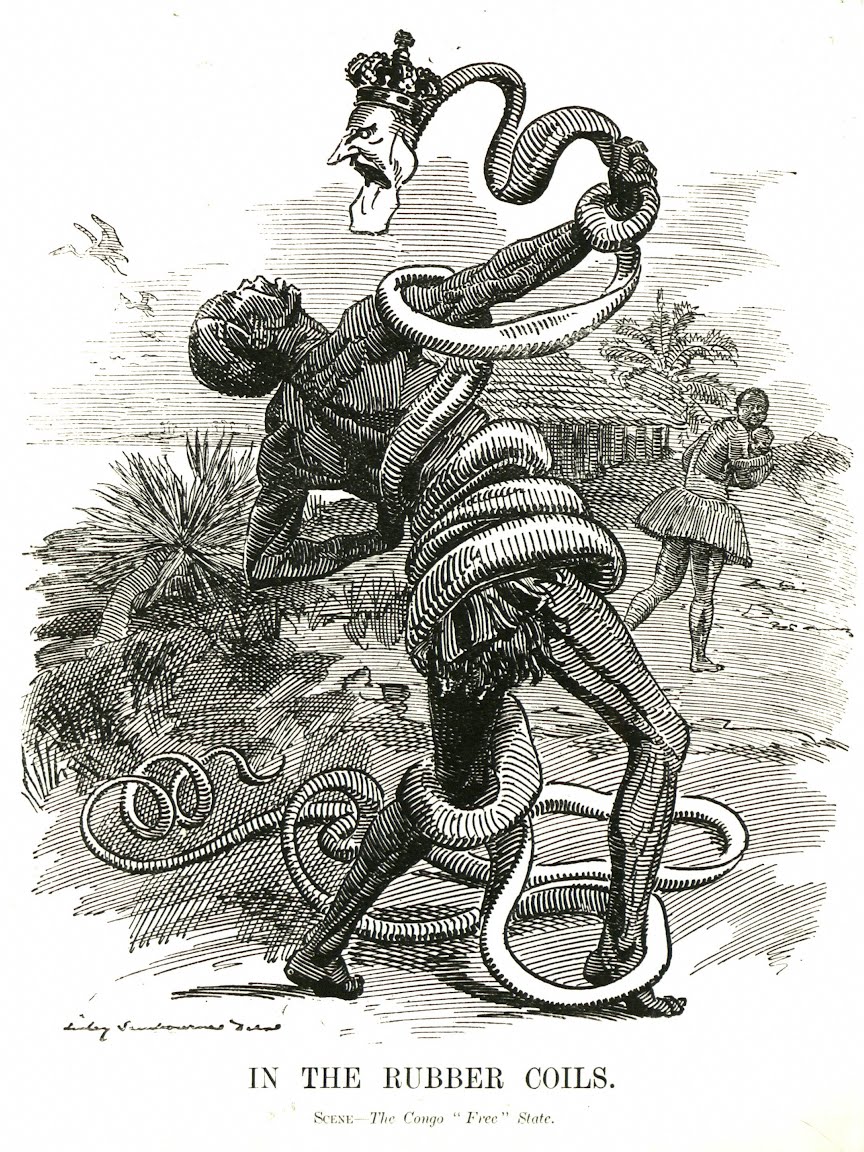
"In the Rubber Coils" (Punch, 1906), Linley Sambourne, Punch, 28 November 1906. An independent British weekly, not the CRA, turns Leopold into a crowned snake. Public domain.
Images
| Image | Source | Licence |
|---|---|---|
| Mechanism diagram (above) | Drawn for FRAME from the page's sourced facts (make_diagrams.py) |
CC BY 4.0, FRAME |
| Nsala of Wala, with his daughter's hand and foot (1904) (Alice Seeley Harris, 1904) | FRAME gallery | Public domain (published 1904-05; PD in the U.S.) |
| An Answer to Mark Twain (Brussels pamphlet cover, 1907) cover (1907) | FRAME gallery | Public domain (anonymous, 1907) |
| "In the Rubber Coils" (Punch, 1906), Punch (1906) | FRAME gallery | Public domain (Sambourne d. 1910) |
| Remember Belgium (1915) | FRAME gallery | Public domain |
Image gaps
- A Press Bureau document or subsidised article. No scan was found on Commons. Belgian archive items (Archives africaines) could fill it. Fillable with archive access.
- Twain's Soliloquy cover and inside illustrations (1905, PD-US) are on Commons (for example
King Leopold's Soliloquy (1905) - illustration - page 6.jpg), but the download was rate-limited. Fillable. - A lantern slide or programme from a CRA meeting. The Harris slides are held by Anti-Slavery International and licensed through Panos. Printed copies of the 1906 lecture text are public domain and could be scanned. Partly fillable.
Sources
- Adam Hochschild, King Leopold's Ghost (Boston: Houghton Mifflin, 1998): chapters on Casement and Morel, the Press Bureau ("Journalists Won't Give You Receipts"), Kowalsky, the commission and the "West African Missionary Association", the archive burning ("The Great Forgetting") and the population estimate.
- Kevin Grant, A Civilised Savagery: Britain and the New Slaveries in Africa, 1884-1926 (New York: Routledge, 2005); and "Christian Critics of Empire: Missionaries, Lantern Lectures, and the Congo Reform Campaign in Britain", Journal of Imperial and Commonwealth History 29:2 (2001), 27-58.
- Dean Pavlakis, British Humanitarianism and the Congo Reform Movement, 1896-1913 (Farnham: Ashgate/Routledge, 2015).
- Dean Clay, "'David vs Goliath': The Congo Free State Propaganda War, 1890-1909", International History Review 43:3 (2021).
- Berber Bevernage, "The making of the Congo question: truth-telling, denial and 'colonial science' in King Leopold's commission of inquiry", Rethinking History 22:2 (2018), 203-238.
- Guy Vanthemsche, Belgium and the Congo, 1885-1980 (Cambridge University Press, 2012).
- Jules Marchal, E. D. Morel contre Léopold II (Paris: L'Harmattan, 1996) and L'État libre du Congo: paradis perdu (1996).
- Jean-Paul Sanderson, Démographie coloniale congolaise (Presses universitaires de Louvain, 2018), and his UCLouvain work Le Congo belge entre mythe et réalité.
- Roger Casement, Correspondence and Report from His Majesty's Consul at Boma, Cd. 1933, Africa No. 1 (1904); text at Internet Archive.
- General Act of the Berlin Conference, 26 February 1885, Article 6.
- E. D. Morel, King Leopold's Rule in Africa (London: Heinemann, 1904).
- Mark Twain, King Leopold's Soliloquy (Boston: P. R. Warren, 1905).
- Arthur Conan Doyle, The Crime of the Congo (London: Hutchinson, 1909).
- Brief of Henry I. Kowalsky ... in reply to the memorial presented to the President (Library of Congress).
- The Truth about the Civilisation in Congoland, "by a Belgian" (London, 1903), HathiTrust record.
- The Congo: a report of the Commission of Enquiry (English translation, 1906).
- John H. Harris and E. D. Morel, The Congo Atrocities: A lecture to accompany a series of 60 photographic slides, Antislavery Usable Past.
- John Peffer, "Snap of the Whip/Crossroads of Shame: Flogging, Photography, and the Representation of Atrocity in the Congo Reform Campaign", Visual Anthropology Review (2008).
- "The contested legacy of Edmund Dene Morel", The Conversation (2024), on Cadbury funding and São Tomé.
- John Horne and Alan Kramer, German Atrocities, 1914: A History of Denial (New Haven: Yale University Press, 2001).