In one line: From the barracks attacks of 26 July 1953 to Fidel Castro's entry into Havana on 8 January 1959, the 26th of July Movement and Fulgencio Batista's government ran the same devices on each other: a selected pile of facts, a national name pasted onto the pile, a label that ended the argument, and a witness or a crowd asked to stand in for a count.
What happened
- 26 July 1953. A group led by Fidel Castro attacks the Moncada barracks in Santiago de Cuba. The same morning, a second group attacks the Carlos Manuel de Céspedes barracks in Bayamo. Both attacks fail. Survivors are tried. Published casualty totals do not match: the English Wikipedia's summary of the Moncada attack gives one set of killed and executed, and notes a different count Castro later gave. This page does not adopt a body count.
- 21 September 1953. At the main hearings in Santiago, Castro conducts his own defence. The English Wikipedia's account of that day says that, asked who was responsible, he answered that the intellectual author of the revolution was José Martí, "the apostle of our independence." The court then separates his case from the other defendants.
- 16 October 1953. Castro is brought before a different court for sentencing and speaks in his own defence. He is sentenced to 15 years. The pamphlet later titled History Will Absolve Me (La historia me absolverá) is not a stenographic transcript. In a 2013 interview published on the Cuban site Fidel soldado de las ideas, Castro says he could not record his words or take notes of them, so he had to reconstruct them in prison. The English Wikipedia adds that witnesses, among them Judge Nieto and Lieutenant Camps, said the speech in court was much shorter than the pamphlet, and that historian Antonio Rafael de la Cova argues the published text overruns the time of the hearing. The famous closing line belongs to that reconstruction.
- May 1955. An amnesty frees the Moncada prisoners. The New York Times of 15 May 1955, datelined Havana the day before, reports that the Isle of Pines gates will open on Monday for enemies of the regime covered by a recent amnesty law, among them Fidel Castro and thirty followers. Cuban commemorations date the release 15 May. This page says May 1955 and does not pick the day. By the time Herbert L. Matthews writes in February 1957, the group is calling itself the 26th of July Movement, after the date of the failed attacks.
- 25 November and 2 December 1956. Eighty-two members of the movement leave Tuxpan, Mexico, on the yacht Granma and run aground on the southwestern coast of Oriente, near Las Coloradas, on 2 December. The landing is late for a rising in Santiago timed to meet it. This page uses 82 because that is the figure in the English Wikipedia's account of the landing and on the Cuban comptroller's account of the same voyage. It does not treat either page as a muster roll.
- 5 December 1956. At Alegría de Pío, the army ambushes the column. How many survived is not a settled number, and the word "survived" is not one question. Granma, the Communist Party paper, says only three men were unable to escape the ambush itself, Humberto Lamothe, Oscar Rodríguez and Israel Cabrera, and that the rest scattered. That is a cut of the gunfight, not a census of who was alive a week later. The English Wikipedia's article on the fight says estimates of survivors run as low as twelve, while most of the sources it surveys put the figure around 20 to 22. This page does not pick a remainder.
- December 1956 to February 1957. Batista's government and Havana dispatches report Castro dead. Anthony DePalma writes that front pages, including the New York Times, carried a wire report that the landing force and its leader had been wiped out, and that the government went on reporting him dead for several weeks. The Guardian of 4 December 1956, a sarcastic commentary rather than a transcript, says an unconfirmed Havana dispatch had Castro and his brother dead, and that the Presidential Palace then put out a communiqué denying its own reports that he was a corpse. Both the report and the quick denial are part of the record. Neither is a finding that he had died.
- 17 February 1957, published 24–26 February. Matthews of the New York Times interviews Castro in the Sierra Maestra. The State Department's editorial note on the interview, FRUS, 1955–1957, vol. VI, doc. 290, dates the meeting 17 February and the articles 24, 25 and 26 February. Matthews's first article calls itself "the first sure news that Fidel Castro is still alive and still in Cuba," and says it will "break the tightest censorship in the history of the Cuban Republic." He quotes Castro: "Above all, we are fighting for a democratic Cuba and an end to the dictatorship," and "I have followers all over the island. All the best elements, especially all the youth, are with us." He also prints Castro's claim that the men have something more than fifty rifles with telescopic sights. Matthews adds that the programme is "vague and couched in generalities, but it amounts to a new deal for Cuba, radical, democratic and therefore anti-Communist," and he writes that hundreds of highly respected citizens are helping and that thousands are "heart and soul" with Castro. Castro signs and dates the notes. DePalma records the signature as Sierra Maestra, 17 February 1957. When the first article appears, Batista's government, in DePalma's account, calls it "a chapter in a fantastic novel."
- 28 February 1957. In despatch 531, Ambassador Arthur Gardner writes that many of Matthews's statements are accurate and that Batista faces the most determined opposition yet. He also writes that Matthews has presented a one-sided picture, emphasised the negative, and exaggerated the size and importance of the Castro movement, and that the government has the situation "fairly well under control." The opposition, he adds, is several groups with different aims, not one movement. That is Gardner's despatch, as summarised in the FRUS note. It is not a troop count.
- The circle story. On a 1959 visit to the United States, Castro boasts at the Overseas Press Club that the same men walked in circles during the Matthews interview so the force would look larger. DePalma records the boast in Newsweek (26 November 2016) and records that Matthews always denied he had been tricked. Jonathan Alter's review of DePalma's The Man Who Invented Fidel (New York Times, 23 April 2006) says DePalma shows the story was almost certainly untrue, one of Castro's jokes, and that Matthews's larger estimates came from reporting in Havana. The boast and the denial are documented. The march is not. This page does not treat the trick as fact.
- 1956–1957, the censorship. What is documented is repeated suspension of constitutional guarantees, not a subsidy total and not a single permanent press law. The New York Times of 2 August 1957 (R. Hart Phillips) reports that guarantees were suspended nationwide that day for 45 days, with censorship of press and radio, including foreign correspondents, and of publications entering Cuba. The same article calls it the fourth such suspension since the 2 December landing: four provinces at the landing, all six provinces from 15 January 1957, again from 2 March, restoration on 15 April, and the new decree on 1 August. A palace statement on that decree says: "National interest makes it necessary to suspend guarantees owing to present circumstances." The palace communiqué quotes a government senator on "a situation created by criminal, terroristic and politically ambitious elements." This page does not invent a peso figure for subsidised papers. It does not use Hugh Thomas's totals or a 1959 Revolución bribe list. Those would be that author's claim, or that paper's claim, and they were not verified here.
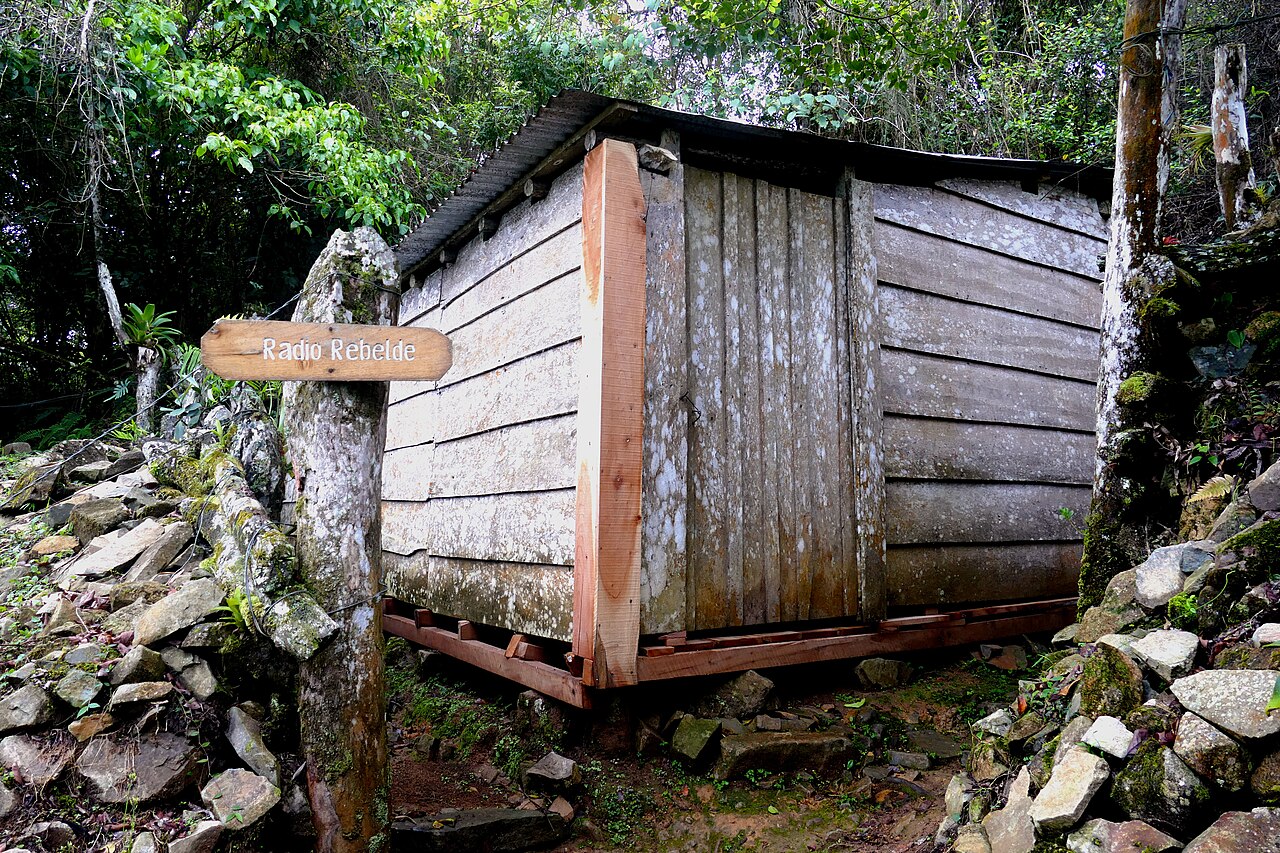
- 24 February 1958. Radio Rebelde goes on the air from Altos de Conrado, in the Sierra Maestra. The station's own history page says Ernesto Guevara founded it that day, with Captain Luis Orlando Rodríguez as director, and that the first transmission lasted about 20 minutes. The same page says the station did not open that day with the habitual line "Aquí, Radio Rebelde," that the first sound was the Himno Invasor, and then, further down, prints an identification ("Aquí Radio Rebelde, la voz de la Sierra Maestra…") and calls that "the first identification." A Cuban comptroller's history says the transmission opened with the Himno Invasor and then the identification. The station's own accounts differ. This page says so. The same history page states, as a principle of the work, that the station held to "la más estricta verdad," the strictest truth, and that this was the basis of its credibility. That is the station's claim. It is not a finding that the broadcasts were accurate.
- The early hours of 1 January 1959. Batista leaves Cuba for the Dominican Republic. Why he left is two stories, and they are not the same story. On arrival he says, as the New York Times of 10 January reports it, that he resigned to spare further bloodshed. The Times of 2 January (Peter Kihss) reports him saying, through Rafael Herrera of El Caribe, that the rebels had achieved superiority in arms and that he gave up the presidency because he wished peace and harmony. The statement issued on 9–10 January through former foreign minister Gonzalo Güell says the armed-forces chiefs told him, early on 1 January at Camp Columbia, that they could not keep order or control of their commands, appealed to his patriotism and his love of the people, and warned that prolonging the fight would cost lives every hour; he resigned, the statement says, from "the sane desire of preventing more bloodshed," and unwillingly. Castro's version, in a later recollection and in the 1 January Radio Rebelde texts as compiled by the Toronto Forum on Cuba, is that he learned of the flight from Radio Progreso, that a junta had been installed to steal the victory, and that the flight was a way for Batista and "los principales asesinos" to escape. The compilation's announcer line is "el tirano ha huido… ante el empuje incontenible del Ejército Rebelde." That compilation is a later gathering of texts, not a tape this page has heard. His account and Batista's statement are both on the record. Neither is adopted here as the cause.
- 8 January 1959. Castro enters Havana. The New York Times of 9 January 1959 (R. Hart Phillips, dateline Havana, 8 January) reports that he rolled into the city that afternoon at the head of his rebels, and that Batista had fled to the Dominican Republic on New Year's Day. This page stops there. The literacy campaign, the Committees for the Defense of the Revolution, OSPAAAL, the schools, and the crisis years after 1959 are other pages. Radio after 1959 is The Cuba-United States radio war: Radio Swan's cover story and Havana's 'gusanos'.
How it works
The same definitions are applied to both sides. A device does not become something else because the speaker is in the mountains or in the palace.
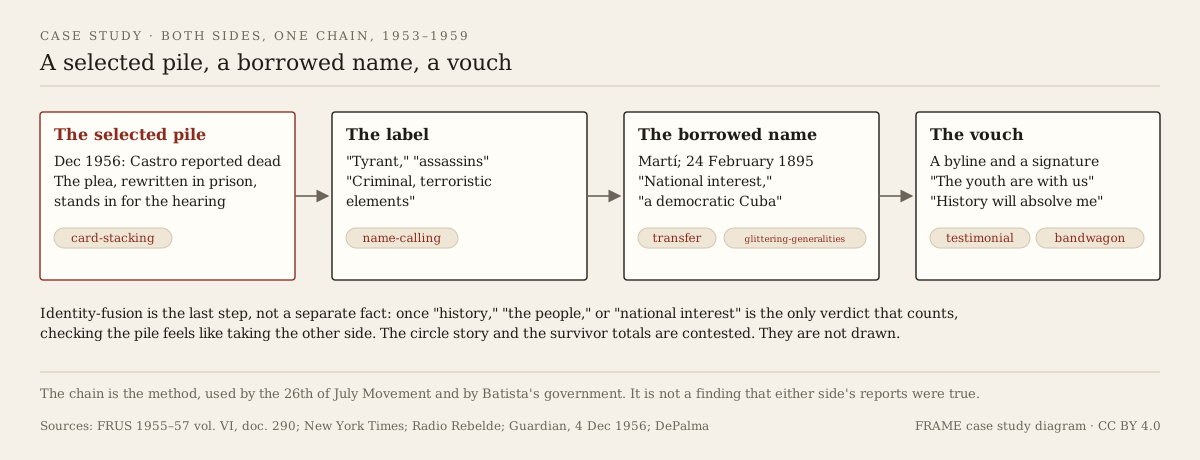
- Card stacking: A death report that omits the uncertainty, a palace denial that does not catch up with the headline, and a "fairly well under control" that omits the opposition Gardner himself calls the most determined yet, are three ways of stacking one pile. Matthews's "hundreds" and "thousands," set against Gardner's charge that the size was exaggerated, are another pile, and Matthews's own phrase "vague and couched in generalities" is a card he did print. The pamphlet is a third: a reader who takes History Will Absolve Me as the hearing of 16 October is reading a text Castro says he rebuilt later, which witnesses say was longer than the speech. The survivor numbers are a fourth pile. Twelve, about twenty, and Granma's three-unable-to-escape-then-scattered are not the same cut of the same days. This page leaves the disagreement visible on purpose.
- Testimonial: Matthews's byline, the signed and dated notes, and the photograph the Times ran after Havana called the story a fantasy, were asked to end the question "is he alive?" They answer that question. They do not answer how many men were in the mountains, or what "democratic" would mean in office. The reconstructed speech is the speaker vouching for himself, and then handing the vouch to "history." Batista's airport interview and the Güell statement are the same device from the other side: a named man, and then the chiefs, asked to close the question of why the government fell.
- Transfer: Martí's name, on the Wikipedia account of the September hearing, is pasted onto the defendants. Radio Rebelde's first day is set on 24 February, the anniversary of the 1895 war, and both of the station's accounts put the Himno Invasor on that opening, whether or not they agree about the identification line. On the government side, the suspension decrees wear "the Republic" and "national interest" while removing the guarantees in the Constitution those words point at.
- Glittering generalities: "A democratic Cuba," "an end to the dictatorship," "liberty, democracy, social justice," "a new deal," "peace," "harmony," "national interest," and "love for the people" are virtue words. Matthews says the programme is vague. Batista's "peace and harmony" does not say who still holds which town. Where either man does offer a checkable claim, arms superiority, more than fifty telescopic rifles, a signed date, that sentence is a claim, and it stays labelled as his.
- Name-calling: The 1 January compilation calls Batista "el tirano" and the men who left "los principales asesinos," before a hearing. The palace communiqué of 1 August 1957, as the Times prints it, puts "criminal, terroristic and politically ambitious elements" on the people whose demonstrations and rebellion are the reason given for suspending rights. The label is there so the audience can skip the file.
- Identity fusion: "History will absolve me" tells the listener that a finding against the speaker does not count, because the nation's story is already on his side. Checking the case is separated from the only verdict that matters. The station's later claim that strict truth was the basis of its credibility does the same job if it is believed: doubting a bulletin is doubting the revolution. The palace line that "national interest" requires the suspension does it from the government side. Reporting the other pile is made to feel like taking the other side.
- Bandwagon: "All the best elements, especially all the youth, are with us" treats a following as proof. So does Matthews's "all over the island," which Gardner then calls exaggerated. The compilation's "empuje incontenible," and the station's later claim of a "Cadena de la Libertad" of 32 guerrilla stations and a high rating, treat momentum and a chain of transmitters as if they settled the reports. A crowd on 8 January shows that a crowd was there. It does not audit the war bulletins.
Then and now
Radio Rebelde in 1958 told listeners it was the voice of the Sierra, and its own history page later says strict truth was why people should believe it. What that station, and the stations aimed at Cuba, became after 1959, including a covert station with a commercial cover and the label "gusanos," is The Cuba-United States radio war: Radio Swan's cover story and Havana's 'gusanos'. This page does not retell that one.
The comparison that stays inside the method is attribution. Matthews's articles named the reporter, the paper, and the date on the notes. A reader could reject the "new deal" sentence without having to guess who was speaking. The death reports of December 1956 named a result, Castro is dead, and left the uncertainty for a communiqué and, two months later, a byline to catch up with. After 1959 the argument moves to stations whose sponsor is the thing in dispute. That argument is the other page.
Positions on the record
- The 26th of July Movement, and later Cuban state accounts: The attacks of 26 July open the fight. The reconstructed pamphlet is the programme. Radio Rebelde's credibility is its "estricta verdad." Batista flees because the rebel push is already irresistible, and the junta is a device to let him and the "asesinos" escape. Those are their accounts.
- Batista, in the statements of 1–10 January 1959: He resigns to stop the bloodshed, after the chiefs tell him they cannot hold the commands. He also says the rebels have reached superiority in arms. His government had called Matthews's February articles a fantasy, and his offices had put out, and then denied, the report that Castro was dead.
- Matthews: Castro is alive, the censorship is the tightest in the republic's history, the programme is democratic and anti-communist, and the youth are with him. He denies the circle trick.
- Gardner, 28 February 1957: The picture is one-sided, the size is exaggerated, the situation is "fairly well under control," and the opposition is not one movement. He also says the opposition is the most determined Batista has faced.
- DePalma: The death story was a false government story that newspapers ran. The circle march is Castro's later boast. Alter's review of DePalma's book reports DePalma's conclusion that the boast was almost certainly untrue.
- What is documented: The two barracks attacks on 26 July 1953. A sentencing appearance on 16 October 1953. Castro's own statement that the pamphlet is a reconstruction. An amnesty in May 1955. The Granma landing on 2 December 1956 with the figure 82 in the accounts opened here. Alegría de Pío on 5 December 1956. Death reports, a palace denial, and the Matthews articles of 24–26 February from an interview dated 17 February. Gardner's despatch. Radio Rebelde on 24 February 1958, Guevara, Altos de Conrado, Luis Orlando Rodríguez, and a disagreement in the station's own pages about the opening line. Batista's departure in the early hours of 1 January 1959. Castro's entry into Havana on 8 January 1959. Repeated 45-day suspensions of guarantees, with prior censorship, as the Times listed them through 1 August 1957.
- What is not shown here: A single survivor total. A finding that the same men walked in circles. A stenographic text of 16 October 1953. A subsidy total, a Hugh Thomas figure, or the 1959 Revolución bribe list. Any claim about literacy, neighbourhood committees, schools, or the years after 8 January 1959. The channels on this page are white in this archive's sense: the palace, the movement, the paper, and the station sign their own names. The first minute of Radio Rebelde is the exception that is not settled, because the station's pages do not agree whether it identified itself. This page does not score that minute as a hidden source, and it does not score it as an open one.
Same-method test
A government of any country that reports a rebel leader dead, then restores the report only under a foreign byline, and that suspends constitutional guarantees in repeated blocks while prior-censoring the press, would be scored as Batista's side is scored here. An insurgency of any name that replaces the hearing with a pamphlet written later, that sets its station's anniversary on a national war, that calls its own signal the strict truth, and whose leader later boasts of marching the same men in circles, would be scored as the 26th of July side is scored here. The boast is scored as a boast. It is not scored as a fact.
How to spot it
- When both sides say the other is lying, list the pile that is missing: the denial, the ambassador's "under control," the date on the notes, the other survivor figure.
- A signed interview proves the meeting. It does not prove the troop count, the rifles, or the word "democratic."
- A national hero's name, an independence anniversary, or "national interest" on a censorship decree is transfer. It is not evidence.
- "History will absolve me" and "the strictest truth" ask you to treat a doubt as disloyalty. That is the device, whichever flag is on it.
- If the remainder comes in a set, twelve, about twenty, and three-unable-to-escape-then-scattered, the page that prints only one number has already stacked the cards.
Images
| Image | Source | Licence |
|---|---|---|
| Mechanism diagram (above) | Drawn for FRAME from the sources below | CC BY 4.0, FRAME |
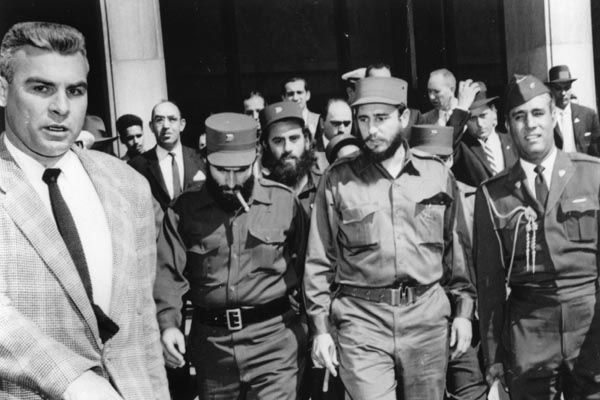
| Fidel Castro in Washington, April 1959 | U.S. Department of State, via Wikimedia Commons | Public domain (U.S. government work) |
| Hut marked Radio Rebelde, Sierra Maestra | Wikimedia Commons; also on The Cuba-United States radio war: Radio Swan's cover story and Havana's 'gusanos' | CC BY 2.5, Maxence |
Image gaps
No photograph is used. The images that would illustrate this page do not have a licence this page has verified as US public domain or an open Creative Commons grant.
- Matthews and Castro in the Sierra, February 1957, and the signed notes. New York Times photographs and notes. Not a verified public-domain file.
- The Moncada barracks after 26 July 1953, and the Bayamo barracks. The files on Wikimedia are not used. Cuban government photographs of the attack were not opened under a verified US public-domain or CC licence.
- The yacht Granma, the landing, and Alegría de Pío. No verified open licence was established for a photograph of the voyage or the ambush.
- A copy of the 1954 pamphlet La historia me absolverá. No openly licensed scan was verified.
- Batista's departure, 1 January 1959, and Castro's entry into Havana, 8 January 1959. News photographs of both days remain under copyright or under an unverified licence. They are not used.
- A photograph of the 24 February 1958 broadcast itself. The hut above is a later picture of the place, not the first transmission.
Sources
- Foreign Relations of the United States, 1955–1957, vol. VI, doc. 290, editorial note on the Matthews interview of 17 February 1957 and on Ambassador Gardner's despatch 531 of 28 February 1957.
- Herbert L. Matthews, "Cuban Rebel Is Visited in Hideout," New York Times, 24 February 1957, excerpts in a Routledge teaching PDF of that article. The series ran 24, 25 and 26 February, as the FRUS note states.
- R. Hart Phillips, "Batista Suspends Civil Guarantees," New York Times, 2 August 1957, as transcribed at LatinAmericanStudies.org.
- "Cuba Freeing Prisoners," New York Times, 15 May 1955.
- R. Hart Phillips, "Havana Welcomes Castro at End of Triumphal Trip," New York Times, 9 January 1959.
- "Batista and Regime Flee Cuba; Castro Superior in Arms, Batista Declares in Exile," New York Times, 2 January 1959 (Peter Kihss).
- "Batista Asserts Army Ousted Him," New York Times, 10 January 1959.
- "The battle for Cuba", Guardian, 4 December 1956. A sarcastic commentary. Used for the death report and the palace denial, not as a transcript.
- Anthony DePalma, "How Fake News Created the Myth of Fidel Castro as Latin Robin Hood", Newsweek, 26 November 2016.
- Jonathan Alter, "Taking Sides," review of Anthony DePalma, The Man Who Invented Fidel, New York Times, 23 April 2006.
- Fidel Castro, interview on the writing of La historia me absolverá, "Cómo se escribió y salió de la prisión", Fidel soldado de las ideas (from Boletín Revolución, 2013). His later account that the pamphlet is a reconstruction.
- History Will Absolve Me, English Wikipedia, for the 21 September Martí answer and for the witness claims that the spoken defence was shorter than the pamphlet.
- Attack on the Moncada Barracks and Battle of Alegría de Pío, English Wikipedia. The Moncada article flags its own reliance on primary sources. Casualty lines are cited only as that disagreement.
- "Desembarco del Granma", Contraloría General de la República, for the figure 82 and for a fight at Alegría de Pío three days after 2 December.
- "The road to victory begins", Granma, 2 December 2015, for the claim that three men were unable to escape the ambush and that the rest scattered. A party-paper account of the gunfight, not a census.
- "Nuestra Historia", Radio Rebelde, and "¡Aquí Radio Rebelde!", Contraloría General de la República. Read against each other on the first broadcast.
- Acela Caner Román, "El primer día de 1959", Toronto Forum on Cuba, a later compilation of the 1 January Radio Rebelde texts and of Castro's recollection. Labelled as that compilation.