In one line: After 1959 Cuba built a ladder from a mass children's organization into the Union of Young Communists and the Communist Party, closed private schools, and gave one ministry the textbook; the official account calls that communist formation and a right to school, the critical account calls it indoctrination, and this page scores both with the same tags.
What happened
- 4 April 1961. The Asociación de Jóvenes Rebeldes creates the Unión de Pioneros Rebeldes. Official histories date a separate Cuban pioneer league to 1931 and treat 1961 as a new start, not a revival of that league. The national literacy campaign of the same year is a different operation (¡Venceremos!: Cuba's 1961 literacy campaign, the primer, and the year-end declaration) and is not retold here.
- 6 June 1961. The Council of Ministers issues the Ley de Nacionalización general y gratuita de la enseñanza, published in the Gaceta Oficial of 7 June. A preamble clause says the revolutionary state must not delegate the function of teaching. Article 1 declares that function public and its provision free. Article 2 nationalizes private schools then in operation and their assets. The preamble says it is "evidente y notorio" that in many private schools, "especialmente los operados por órdenes religiosas católicas," directors and teachers had been carrying on "una activa labor de propaganda contrarrevolucionaria." Article 5 leaves the Ministry to decide whether a center is too small, or too special, to be included. This page has no list of centers left in private hands.
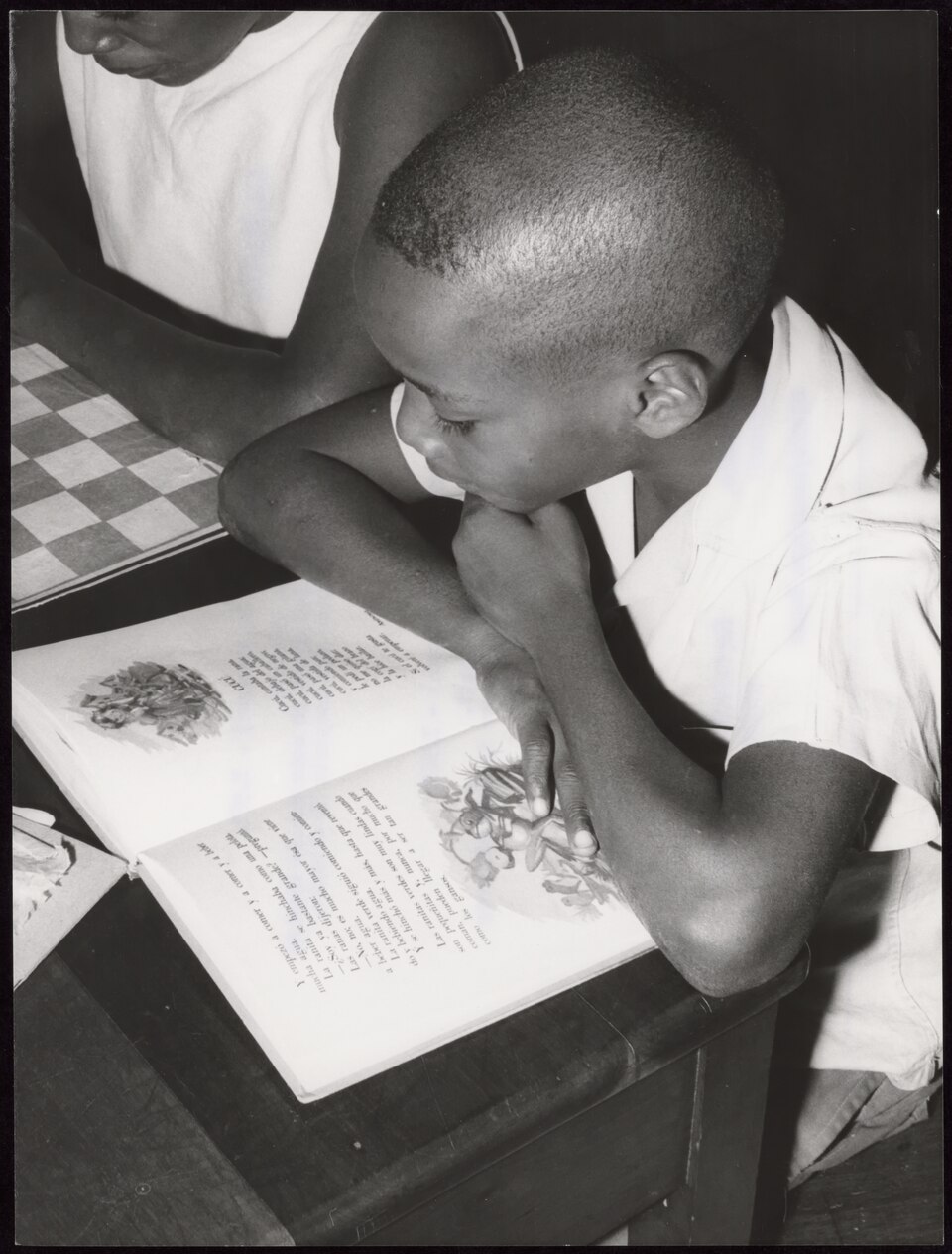
A boy reading an illustrated book at the Centro Especial Jorge Dimitrof, an evening literacy centre in Marianao, near Havana, 1967. Photograph by Dominique Roger, UNESCO Archives, via Wikimedia Commons; CC BY-SA 3.0 IGO. The caption of the original is about the adult centre; the photograph does not show a school, a pioneer group or a textbook of the ministry.
- 30 March to 4 April 1962. The first congress of the Asociación de Jóvenes Rebeldes, 596 delegates, closes at the Latin American Stadium. Fidel Castro proposes the name Unión de Jóvenes Comunistas; the delegates adopt it, with statutes, as the youth organization of the Partido Unido de la Revolución Socialista (the Communist Party of Cuba is constituted in 1965). A Cuban government account of the speech quotes him calling the act a crystallization of what the Revolution wants. The same congress turns the Unión de Pioneros Rebeldes into the Unión de Pioneros de Cuba. Its motto is then "¡Siempre listos!" The historians' association UNHIC dates the membership band at founding to ages 14 to 27, and records the 1960 plenary slogan of the predecessor as "Estudio, trabajo y fusil." The UJC's own site today calls it the Party's youth organization and the main "cantera" (quarry) for entry into the Party. Membership is described as selective, not as the mass body the pioneers became.
- Until 1966, then after. The Ministry of Education says the pioneer union was selective until 1966. In 1966 it is given a mass character: the official pioneer history says that from then every primary-school child may belong. That is an eligibility rule in the sources used here, not a statute this page has found that makes membership a legal duty.
- 21 October 1965. Fidel Castro announces a youth newspaper at the Pedro Marrero stadium; the meeting chooses the name Juventud Rebelde. The first issue circulates the next day. It is the UJC's paper. The state news agency gives the first printing as 65,000 copies, soon down to 45,000.
- 18 October 1967. At the memorial for Ernesto Che Guevara in the Plaza de la Revolución, Fidel Castro says that if one wants to express what one wishes one's children to be, one must say "¡Queremos que sean como el Che!" Granma writes that the crowd answered "Seremos como el Che," and that the line became part of the pioneers' salute to the flag. The Ministry dates the organization's own change of motto to 1968, from "Pioneros siempre listos" to "Pioneros por el comunismo, ¡Seremos como el Che!"
- 1976. The socialist constitution, approved by referendum and published that February, names the UJC in Article 6 as the organization of advanced youth, under the Party, preparing its members as future militants and educating the new generations "en los ideales del comunismo." Article 7 still says "Unión de Pioneros de Cuba," the name about to be replaced. Article 38 bases educational policy on "la concepción científica del mundo, establecida y desarrollada por el marxismo-leninismo," states that schools are state schools, and calls for "la formación comunista de las nuevas generaciones," combining general education with work and with political, social and military preparation. Article 39 says education of children and youth "en el espíritu comunista" is the duty of all society. Article 54 says it is "ilegal y punible" to set religious faith against the Revolution, against education, or against constitutional duties.
- April 1977. The UJC's Third Congress turns the Unión de Pioneros de Cuba into the Organización de Pioneros José Martí and extends it through ninth grade. The Ministry's description of the emblem is a triangle whose three flames stand for the Party (largest), the UJC, and the OPJM (smallest). An official pioneer history distinguishes Moncadistas (grades 1 to 3, blue neckerchief) from José Martí pioneers (grades 4 to 6, red neckerchief; grades 7 to 9, a badge). The neckerchief is an attribute of membership and is worn with the school clothes.
- Countryside schools, beside the organizations. From the mid-1960s, secondary students were sent to agricultural work for part of the year ("escuela al campo"). The New York Times, reporting Cuban education officials in 1978, dates a Camagüey experiment to 1966, with classes suspended for an annual period the article gives as six weeks, and dates the decision to build boarding "escuelas en el campo" to a 1971 national education congress. UNESCO published the Ministry's own account in 1974 (Figueroa, Prieto and Gutiérrez). The ERIC abstract of that book describes boarders whose agricultural work formed part of a production plan, and counts 50 such schools then existing and 83 planned. Cubanet in 2015 quotes that book for a three-hour field day, Monday to Friday, and for the claim that 500 students on 500 hectares of citrus would cover a school's costs. Those two sentences are that quotation, not a figure recalculated here. The Times in 1978 reports about 480 countryside schools built since 1971. The two counts are four years apart and are not collapsed into one number here.
- The textbook after the law. School books carry the copyright of the Ministry of Education and of Editorial Pueblo y Educación. Current editions say they were reviewed by the permanent national commission for plans, programs and textbooks at the Instituto Central de Ciencias Pedagógicas. The primary timetable published by the Ministry lists Historia de Cuba and Educación Cívica as subjects; secondary and pre-university books in the same house include Historia de Cuba and Educación Moral y Ciudadana. Diario de Cuba (27 January 2020) reports that a first-grade reader teaches the letters C and Ch with the sentences "Che fought in Cuba" and "Camilo lives," and quotes Georgina Arias, a Ministry primary-education specialist, telling a 2010 panel that the books had not had a general revision in about twenty years. This page has not made its own count of political readings, and it does not adopt the article's "more than 40 percent."
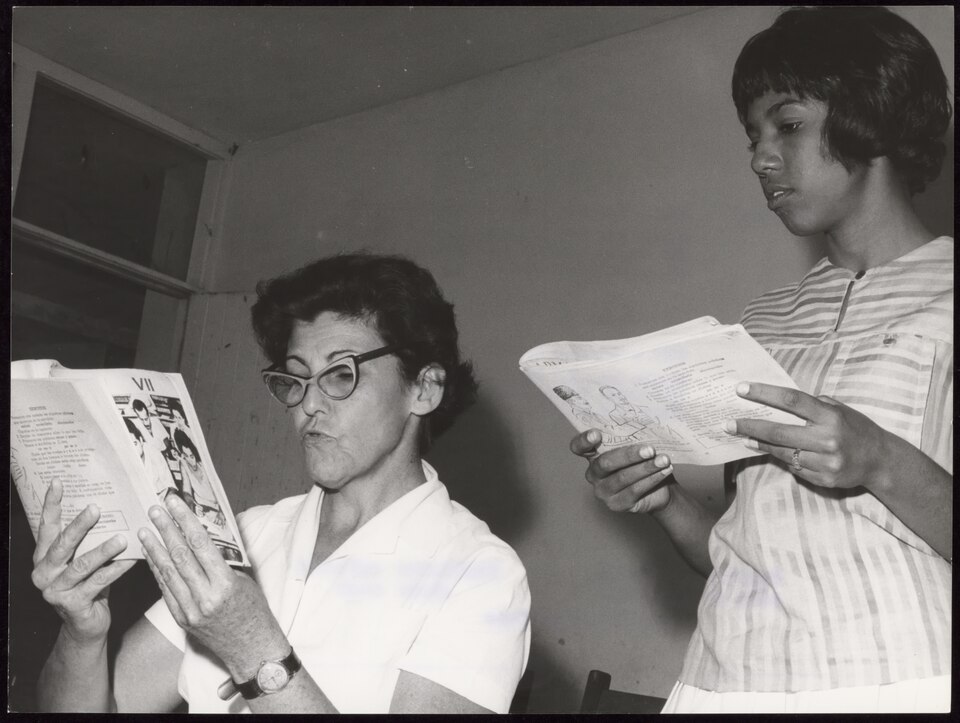
Two women reading from exercise books ("ejercicios") in a classroom at the same centre, Marianao, near Havana, 1967. Photograph by Dominique Roger, UNESCO Archives, via Wikimedia Commons; CC BY-SA 3.0 IGO. UNESCO's description gives no publisher or edition for the books.
- 24 February 2019, in force 10 April. A new constitution keeps the Party, in Article 5, as the "fuerza política dirigente superior," "único, martiano, fidelista, marxista y leninista." Article 6 still recognizes the UJC and assigns it a role in educating youth in revolutionary principles. Article 15 calls the state secular and separates religious institutions from it; it does not repeat the 1976 penalty for setting faith against education. Article 32 still says teaching is a function of the state, and that it is secular, and it ties education to the nation's history and to ethical, moral, civic and patriotic values. It does not repeat Article 38's sentences on Marxism-Leninism and "formación comunista." Who writes the textbook does not change with that wording.
How it works
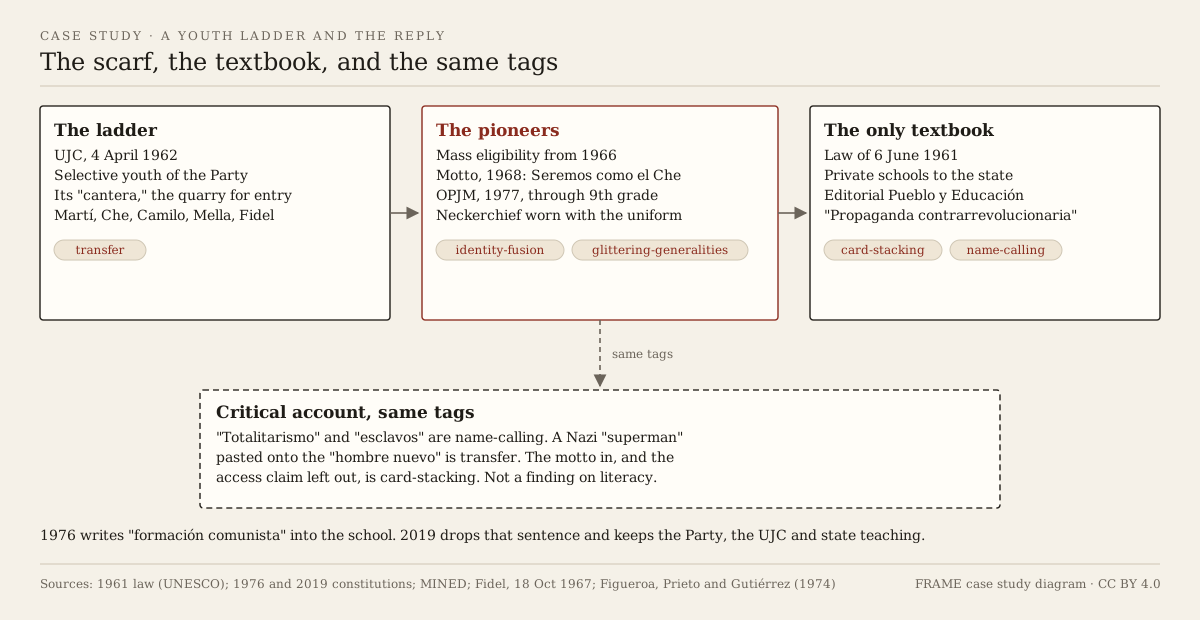
The same five tags are used on the official account and on the critical account. A tag is not applied to a side that the sources used here do not show using it.
- Transfer: The official ladder pastes Martí, Maceo, Mella, Camilo Cienfuegos, Che and Fidel onto one youth organization, and the emblem's three flames paste the Party, the UJC and the pioneers onto a single badge a child wears. The critical transfer is the move relayed by the Observatorio Cubano de Derechos Humanos on 1 March 2018, from the writer Roberto Álvarez Quiñones, that pastes the Nazi "superman" onto Guevara's "hombre nuevo." The documented program cites Marx, Martí and Che, and a study-work school. It does not, in the texts used here, cite a racial doctrine. The stigma is doing the work of the comparison.
- Identity fusion: "¡Queremos que sean como el Che!" defines the child by a guerrilla's example, and the 1968 motto makes "pioneros por el comunismo" the line said with the flag. The 1976 constitution makes education "en el espíritu comunista" a duty of the whole society, so objecting to the line and objecting to school are written as the same act. Article 54 then makes it an offense to set religious faith against that education. A parent's refusal of the motto, including the refusal quoted by Diario de Cuba in 2026 ("Yo no quiero que mi hija sea como el Che"), is an objection to the fusion. The objection itself is not the device.
- Glittering generalities: Official virtue words in these sources are "formación integral," "hombre nuevo," "valores," "concepción científica del mundo," and "vínculo del estudio con el trabajo." Swap any of them for a count (hours in the field, schools closed, sentences in the reader) and the sentence has to become specific. On the critical side, "totalitarismo" does the same job as a description of the children ("Niños en Cuba, educados para el totalitarismo," Diario de Cuba, 7 June 2022). The word does not say which lesson, which hour, or which school. A parent's wish that her child be free, quoted in the same outlet in 2026, is a refusal of the motto. It is not scored here as a campaign slogan.
- Card stacking: The official pile is one publisher, one review commission, and a law that ended the private and religious schools where a different book could be chosen. The preamble exhibits Catholic orders as the case and does not stop to separate a school's catechism hour from political opposition. The critical pile, in the countryside-school polemics and in the textbook polemics used here, leads with the motto, the field hours and the slogans, and does not put beside them the law's claim about who could attend private schools, or the enrollment the state treats as the result. Each pile can be read in only one direction because the other pile is off the table. This page does not supply the missing denominator.
- Name-calling: The 1961 preamble attaches "propaganda contrarrevolucionaria" to directors and teachers of private, especially Catholic, schools as a class, before any particular school is named in the articles. Critical texts attach "esclavos" (the Cubanet headline of a 2015 interview with a former ESBEC director) and "totalitarismo" to the school as a whole. The labels arrive before a reader can see the statute, the timetable, or a named lesson. Naming a documented office, or quoting a documented motto, is not this device. "Contrarrevolucionario," "esclavo" and "totalitario," used so that the noun replaces the evidence, are.
Then and now
The 2019 constitution is the official "now." Article 32 no longer says that educational policy rests on Marxism-Leninism or that the school must give "formación comunista." Article 5 still defines the only party as Marxist-Leninist and as the leading force, Article 6 still gives the UJC a constitutional job in revolutionary education, and teaching is still "función del Estado." A deleted sentence is not a second publisher.
The ladder is the same shape as the Soviet pioneers-to-Komsomol-to-Party path and the Chinese pioneers-to-Youth-League path, both scored on their own pages (The All-Union Pioneer Organization: scouting rebuilt as a communist pipeline, 1922-1991, The Komsomol: youth pipeline, mass mobilization and internal discipline, 1918-1991, A corner of the flag on a six-year-old: the Young Pioneers of China, Red scarf to Party card: a century of the Communist Youth League of China). The difference that matters for Transfer is the name on the lowest rung. The Soviet organization carried Lenin's name, the founder of the party that ran it. The Cuban organization carries José Martí, who was killed in 1895, was not a Marxist, and is also the name the state uses for the nation. Scale differs as well: one island's school system, not a union of republics, and this page does not document a purge of the pioneers' own leadership of the kind the Komsomol page records.
A public-school civics requirement in a country that still allows private schools and more than one textbook publisher is not this case. Argentina's substitution of "Evita me ama" for "mamá me ama," scored on Perón cumple, Evita dignifica: Argentina's state media machine, and the decree that erased it, is closer in the classroom sentence and different in the sequel: a later government there criminalized the leader's name. Cuba's 2019 text changed an education clause. It did not withdraw Martí or Che from the school.
Positions on the record
- Official institutions. The Ministry, the UJC and the Party press describe the pioneers as formation in communism, patriotism and the habit of work, the UJC as a selective vanguard and the Party's reserve, and the 1961 law as the end of a private school that served "las clases acomodadas" and preached against the Revolution. Free, state, universal schooling is the result they put first. Granma presents the 1967 shout in the Plaza as the children's own commitment.
- Critics. Diario de Cuba treats the 1961 law as a founding act of a closed system, and treats primary readers as ideological manuals, citing named sentences and a Ministry specialist's admission that the books went unrevised. Cubanet (2015) quotes former students and a former director of countryside schools who describe the boarding school as agricultural labor and as a place where protest was not available, not as the civic lesson the Ministry's UNESCO book describes. A 2026 Diario de Cuba article quotes a mother who objects to her child reciting the Che motto. A 1 March 2018 Observatorio Cubano column relays Álvarez Quiñones's equation of the "hombre nuevo" with a fascist superman. That equation is recorded here as the critic's move, not as this page's finding.
- What is documented. The dates of the UPR, the UJC, Juventud Rebelde, the 1961 law and its preamble, the 1966 shift from selective to mass eligibility, the 1967 speech and the 1968 motto, the 1976 articles cited above, the 1977 renaming and the extension through ninth grade, the state textbook house and its review commission, the existence and ERIC abstract of the 1974 UNESCO book, and the 2019 articles that drop one formula and keep the Party, the UJC and state teaching.
- What is not shown. A statute that makes the neckerchief a legal obligation, as distinct from an attribute that is socially universal; a roll of UJC membership this page is willing to repeat; a single legal date on which the boarding countryside schools ended; whether the seasonal mobilization was six weeks, as the Times reports for the 1966 Camagüey experiment, or the 45 days later critics use; whether Article 5 of the 1961 law was used; how evenly the three-hour day was actually worked; any count of political pages in a reader that this page did itself. Allegations of widespread sexual violence, and a dollar total for Soviet subsidy, in the 2018 Observatorio column, are not adopted here; this page did not verify them. This page takes no position on literacy rates, examination results, or whether study-plus-work is a sound pedagogy.
Same-method test
A government of any party that nationalized every private and religious school, put a party-youth motto on the schoolchild, and left one ministry as the textbook's author would be scored with these tags. A critic who answered with "slaves," or by pasting a Nazi category onto a study-work school, would be scored with the same name-calling and transfer. The test asks what was said and what was left out. It does not ask which side a reader prefers.
How to spot it
- Ask who may publish the book, and who may not. One house and one commission is a different fact from a state standard that more than one publisher can meet.
- Notice when the uniform and a political membership are the same garment. Eligibility ("any child may belong") and a scarf everyone wears are not the same rule; check which one the school actually runs.
- Swap the virtue word for a count. "Formación integral," "hombre nuevo" and "totalitarianism," used as a complete description of the school, all fail the swap in the same way. Hours, schools closed, and a named sentence in a named reader do not.
- Watch which noun arrives before the evidence. "Contrarrevolucionario," "esclavo" and "totalitario" are the same device when they replace the statute or the timetable.
Images
| Image | Source | Licence |
|---|---|---|
| Mechanism diagram (above) | Drawn for FRAME from the sources below | CC BY 4.0, FRAME |
| Boy reading, Marianao (1967) | Wikimedia Commons (UNESCO Archives, Dominique Roger) | CC BY-SA 3.0 IGO |
| Two women with exercise books, Marianao (1967) | Wikimedia Commons (UNESCO Archives, Dominique Roger) | CC BY-SA 3.0 IGO |
Image gaps
The two photographs hosted are third-party UNESCO images from a 1967 adult literacy centre. They show reading in a Cuban classroom; they do not show pioneers, the UJC or a ministry textbook. Pioneer investitures, countryside-school dormitories and textbook pages are widely reproduced by Cuban state media and by independent outlets. This page did not save a local file whose licence had been checked, and it does not use an unverified photograph in place of one.
Sources
- Ley de Nacionalización general y gratuita de la enseñanza, 6 June 1961, text hosted by UNESCO (Gaceta Oficial, 7 June 1961).
- Constitución de la República de Cuba (1976), Articles 6, 7, 38, 39 and 54, Wikisource.
- Cuba 2019 constitution, Articles 5, 6, 15 and 32, Constitute Project; Spanish wording of Articles 15 and 32 also in the Gaceta Oficial text.
- Organización de Pioneros José Martí, EcuRed, and the Ministry of Education pioneer page (motto, 1966, 1977, emblem).
- Historia de la organización, Zunzún, archived 2010 (grades, neckerchiefs, congresses).
- "Los niños, adolescentes y jóvenes cubanos son el futuro de la Revolución", Partido Comunista de Cuba (1961, 1966, 1967 speech, 1968 motto, 1977).
- Fidel Castro, 18 October 1967, fidelcastro.cu.
- "We will be like Che", Granma, 14 June 2023.
- "La Historia el 4 de abril", Cuban foreign-ministry missions (UJC founding speech as quoted there); Unión de Jóvenes Comunistas, statutes description, ujc.cu.
- 65 aniversario de la AJR, Unión Nacional de Historiadores de Cuba (age band at founding; 1960 slogan "Estudio, trabajo y fusil").
- "La Historia el 21 de octubre", Agencia Cubana de Noticias (Juventud Rebelde).
- Max Figueroa, Abel Prieto and Raúl Gutiérrez, La Escuela secundaria básica en el campo: una innovación educativa en Cuba (UNESCO / International Bureau of Education, 1974). ERIC abstract ED102073. The three-hour day and the 500-hectare sentence are quoted from this book in "Éramos esclavos, ¿quién iba a protestar?", Cubanet, 1 October 2015.
- "Cuban Students Learn on the Farm", New York Times, 30 April 1978.
- "Primary School Textbooks in Cuba: Ideological Manuals", Diario de Cuba, 27 January 2020.
- "La otra cara de la enseñanza en Cuba: La 'nacionalización'", Diario de Cuba, 7 June 2022.
- "Made in Cuba: escuelas para el «hombre nuevo»", Observatorio Cubano de Derechos Humanos, 1 March 2018 (relays Roberto Álvarez Quiñones).
- "Este será un curso de zombis", Diario de Cuba, 2 September 2026 (a mother on the Che motto).
- Ministry textbooks and the primary timetable, CubaEduca and MINED, Adaptaciones curriculares 2020-2021 (publisher, review commission, subjects).