In one line: Founded in October 1949 on the explicit model of the Soviet Union's Young Pioneers, the Chinese Young Pioneers enrolled, and still enrols, nearly every child aged six to fourteen; ties on each one a red scarf its own teaching materials describe as a corner of the national flag dyed with revolutionary martyrs' blood; was suspended for the Cultural Revolution's most radical years and replaced, for the same young age band, by the Little Red Guards; was restored in October 1978; and today runs a stated pipeline from the scarf, through the Communist Youth League, toward eventual Communist Party membership.
What happened
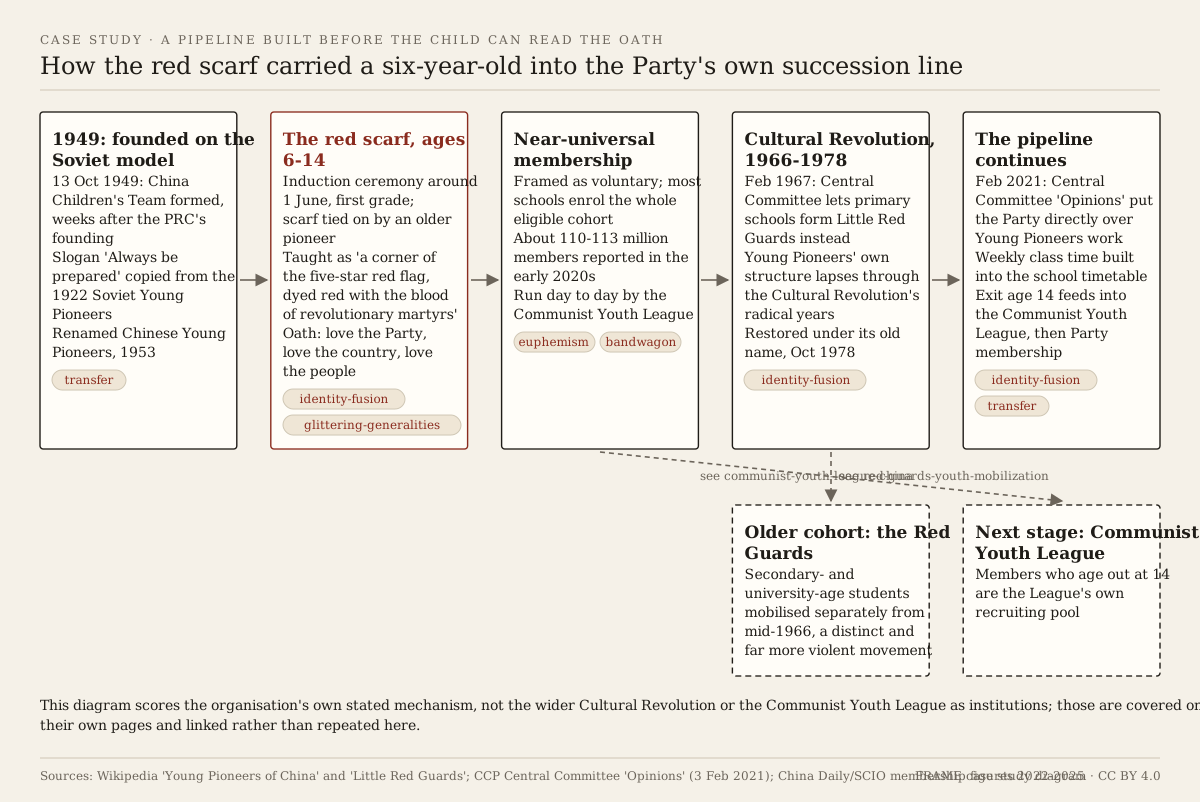
- 13 October 1949. Weeks after the People's Republic's founding, the Central Committee of the New Democratic Youth League (the Communist Youth League's predecessor name) announces the China Children's Team (Zhongguo Shaonian Ertongdui), merging earlier children's groups into a single national children's organisation for the new state. The organisation is explicitly modelled on the Soviet Union's Young Pioneers, founded in Moscow on 19 May 1922, down to borrowing its call-and-response motto: the Soviet Pioneers' "Always be prepared!" ("Vsegda gotov!") had already been adopted, in Chinese, by the Party's own 1931 Jiangxi Soviet-era children's group, the Young Children's Corps (see Divide the land, label the enemy: propaganda and discipline in the Jiangxi Soviet (1927-1934)), and it carries over unchanged into the new national organisation's constitution.
- 21 August 1953. The Communist Youth League's Central Committee issues an "Explanation" renaming the organisation the Chinese Young Pioneers (Zhongguo Shaonian Xianfengdui), the name it still carries. "Pioneer" (xianfeng, literally "vanguard") is the same word used for the Party's own self-description as the vanguard of the working class.
- The red scarf. Every member wears a red triangular neckerchief, hong lingjin, tied on at an induction ceremony usually held around International Children's Day (1 June) in a child's first year of primary school, most often by an older Young Pioneer or a teacher. The organisation's own teaching material gives children a fixed formula for what the scarf means: it is "a corner of the five-star red flag, dyed red with the blood of revolutionary martyrs" (wuxing hongqi de yijiao, shi yong geming xianlie de xianxue ranhong de), and children are taught to wear it with reverence rather than treat it as an ordinary item of clothing.
- The oath and the salute. New members recite a pledge under the organisation's own flag: "I love the Communist Party of China, I love my country, I love the people; I will study diligently and train hard, always ready to contribute to the cause of communism." The Young Pioneers' salute, described as its highest form of etiquette, raises the five fingers of the right hand together above the head, taught as meaning that the interests of the people stand above all else.
- Near-universal, formally voluntary membership. Any child aged six to fourteen may apply and, on approval, become a member; in practice, most primary schools simply enrol the entire eligible class, and researchers describe the organisation as reaching nearly all Chinese children in that age band. State media reported roughly 115 million members as of 2022 and about 113 million as of the end of 2024, a slight fall that state reporting attributes mainly to China's declining birth rate rather than to declining enrolment rates. An internal stripe system, one to three cloth stripes plus gold stars for members who hold posts up to the provincial level, gives even young children an early, visible rank inside the organisation's own hierarchy.
- 4 February 1967: suspension. As the Cultural Revolution's mass politics reaches secondary and university students through the Red Guards (a separate, older-cohort movement covered on its own page, The Red Guards: how Mao turned millions of students into a political weapon, 1966-68), the Party Central Committee issues a notice letting primary schools organise a new children's group, the Little Red Guards, in place of the Young Pioneers. The Young Pioneers' own national structure lapses for the most radical years that follow.
- October 1978: restoration. At the Communist Youth League's Tenth National Congress, held 16-26 October 1978 as the Cultural Revolution decade closes, the Party Central Committee's decision to restore the Young Pioneers under its old name is announced, and the organisation resumes its national structure, uniform and rituals essentially as they had existed before 1966.
- 3 February 2021: tightened Party control. The Party Central Committee issues "Opinions on Comprehensively Strengthening the Work of the Young Pioneers in the New Era," restating a working structure "led by the Party, supported by the government, with the Communist Youth League taking the lead," and building a weekly class period of Young Pioneers activity, framed around Xi Jinping Thought, into the primary and lower-secondary timetable. A national technical standard for the Young Pioneers flag itself took effect 1 June 2024, part of the same drive to standardise the organisation's symbols nationwide.
- The pipeline. A member who ages out at fourteen is, by the Communist Youth League's own stated design, its natural recruiting pool; League membership in turn is the Party's own primary channel for selecting future cadres and, eventually, Party members (see Red scarf to Party card: a century of the Communist Youth League of China).
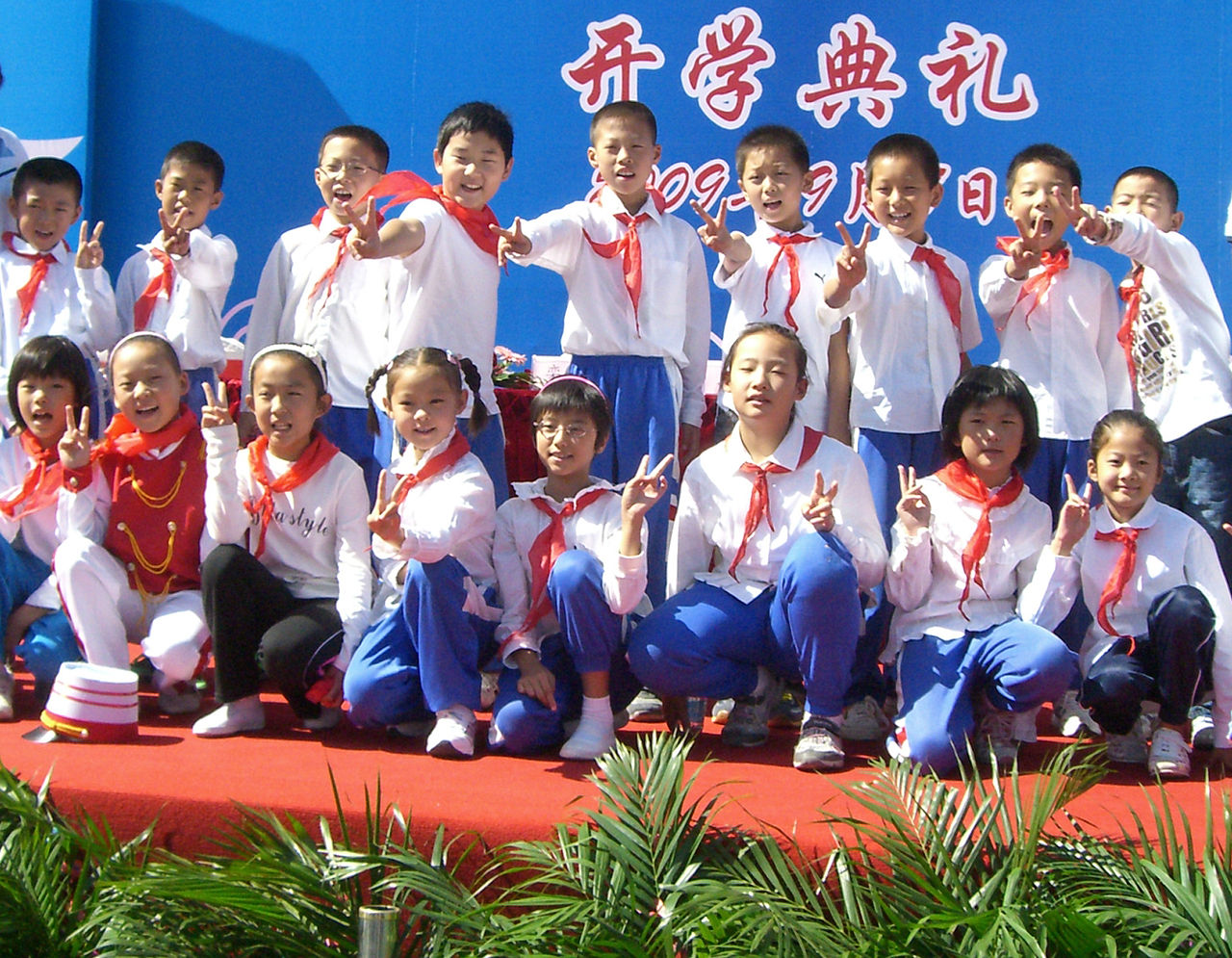
Children wearing the red scarf at a school opening ceremony (the banner reads 开学典礼, "school opening ceremony"), Beijing area, 1 September 2009. Photograph by Yoshi Canopus, own work, CC BY-SA 3.0 (also GFDL), via Wikimedia Commons.
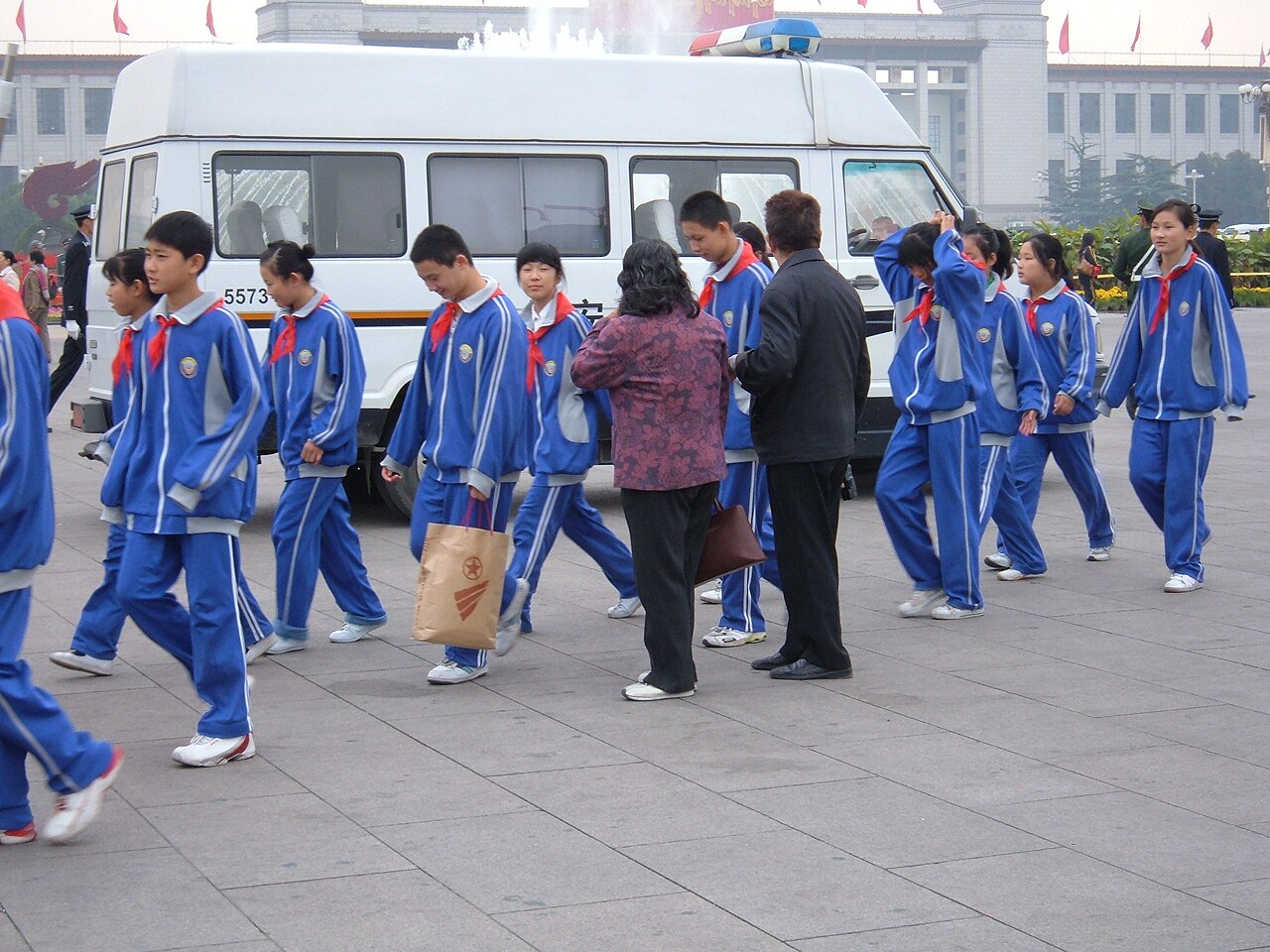
Schoolchildren wearing the red scarf walk across Tiananmen Square, Beijing, 23 October 2007. Photograph by BrokenSphere, own work, CC BY-SA 3.0 (also GFDL), via Wikimedia Commons.
How it works
- Identity fusion: the scarf-tying ceremony and the oath ask a six- or seven-year-old, years before they can reason about party programmes, to fuse "I am a Young Pioneer" with "I love the Communist Party of China" in a single sentence recited aloud in front of classmates. The 2021 directive's weekly class period turns that one-time ceremony into a standing, repeated occasion rather than a memory.
- Glittering generalities: "a corner of the five-star red flag, dyed red with the blood of revolutionary martyrs" and "the cause of communism" are virtue-laden formulas a child is taught to recite; neither tells the child what, specifically, they are agreeing to, and the formula's emotional charge (a flag, a martyr's blood) is set well ahead of any content a young child could evaluate.
- Transfer: the organisation borrows its name, its founding motto, its neckerchief and much of its ceremonial structure directly from the Soviet Union's Young Pioneers, itself founded in 1922; the borrowing is not incidental but stated, the same move the Chinese Soviet Republic made in 1931 when it borrowed Bolshevik symbols and a founding date (see Divide the land, label the enemy: propaganda and discipline in the Jiangxi Soviet (1927-1934)).
- Bandwagon: membership is described in official language as an individual application a child may or may not make, while in practice whole classes are enrolled together and a child without the scarf is the visible exception rather than the rule; near-universal enrolment does the persuasive work that an argument would otherwise have to do.
- Euphemism / doublespeak: "voluntary application" describes enrolment that functions, at the level of an ordinary school, as the default for an entire age cohort; "strengthening the work of the Young Pioneers" is the 2021 directive's own name for tightening direct Party control over an organisation nominally led by the Communist Youth League.
Then and now
The organisation is not a historical relic; it is larger, in absolute membership, than almost any other institution most of its members will ever belong to, and it continues to expand its formal claim on classroom time. The February 2021 Central Committee directive placed a weekly Young Pioneers activity period inside the standard primary and lower-secondary timetable and put the organisation more explicitly under direct Party, rather than only Communist Youth League, direction. Primary-school textbooks issued in the early 2020s depict Xi Jinping personally tying a red scarf onto a child's shoulders, alongside his own recollection of joining the Young Pioneers in 1960, a personalisation of the organisation's imagery that outside observers have linked to the wider building of a Xi-era personality cult in children's education (see, for the general pattern rather than this page's narrower subject, The Mao cult before the state: 'Mao Zedong Thought' and 'The East Is Red', 1943-1949 for the precedent of a leader's personal history built into a mass movement's own material). A national technical standard for the Young Pioneers flag took effect on 1 June 2024. State media reported the organisation's own membership at roughly 113 million children as of the end of 2024, essentially unchanged in scale from a decade earlier even as China's annual birth cohort has shrunk.
Positions on the record
- The organisation's and the Party's position. Official material presents the Young Pioneers as a voluntary children's mass organisation that builds character, discipline and patriotic feeling, led by the Communist Youth League under Party guidance, and open to any eligible child who applies. The 2021 Central Committee directive frames its tightened, more centralised oversight as "strengthening" rather than restructuring the organisation's basic character.
- What is documented. The 1949 founding date and its explicit Soviet model; the 1953 renaming; the exact wording of the scarf's official symbolic formula and of the pledge; the 1967 Central Committee notice authorising the Little Red Guards in the Young Pioneers' place; the October 1978 restoration announced at the Communist Youth League's Tenth Congress; the text and date of the February 2021 directive; state-reported membership figures for 2022 and 2024.
- What researchers argue. Scholars of Chinese political socialisation, including Marina Svensson (Project MUSE, "Chinese Youth and the Communist Party of China," 2023) and Jérôme Doyon (Rejuvenating Communism: Youth Organizations and Elite Renewal in Post-Mao China, University of Michigan Press, 2023), read the Young Pioneers-Communist Youth League-Party sequence as a designed elite-recruitment and political-socialisation pipeline rather than a voluntary civic club, and describe school-level enrolment as functionally compulsory despite the organisation's own "voluntary application" framing.
- Not ruled on here. Whether the specific values the Young Pioneers teaches, discipline, collective effort, national pride, are on balance harmful to a six-year-old or indistinguishable from what many countries' civics or scouting programmes teach at the same age. This page scores how identity is fused to a political institution at an age before a child can consent to that fusion in any meaningful sense, not whether the resulting values are themselves objectionable.
Same-method test
- The Soviet Union, the explicit model. The USSR's Young Pioneers (founded 19 May 1922, from 1924 renamed for Lenin) used the same red triangular neckerchief read as a piece of the Soviet flag, the same "Always be prepared!"/"Vsegda gotov!" call and response, a similar oath and salute, and, by the late Soviet period, near-total enrolment of the eligible age cohort feeding into the Komsomol and, for a much smaller fraction, the Communist Party. China's organisation copied this mechanism directly rather than arriving at it independently; the difference is mainly one of scale and continuity, the Soviet Pioneers ended with the USSR in 1991, while the Chinese organisation, after its own Cultural Revolution interruption, has now run for longer than its Soviet model did.
- Nazi Germany. The Deutsches Jungvolk (for boys aged 10-14, inside the Hitler Youth structure) and the parallel Jungmädelbund for girls fused a young child's identity to the Nazi movement through uniform, oath and ritual in much the same structural way, but the 1936 Reich Youth Law and its 1939 amendment made membership a matter of direct legal compulsion enforced against parents, rather than a near-universal social default inside a voluntary-in-name system, and the movement's oath bound a child to the person of Adolf Hitler rather than to an abstract party, country or "cause." That personalisation is the more significant difference from both the Chinese and Soviet Pioneer oaths, though Chinese classroom material's growing use of Xi Jinping's own image and biography, noted above under "Then and now," is a visible move in the same direction.
- Where they differ. Legal compulsion (Nazi Germany, from 1936) is a distinct mechanism from social near-universality inside a formally voluntary system (the Soviet Union and China); both produce something close to full enrolment, but only one does so by statute enforceable against a refusing family. The object each oath is fused to, an abstract party and cause in the Communist cases, a named leader in the Nazi case, is the clearest single difference between otherwise structurally similar youth organisations.
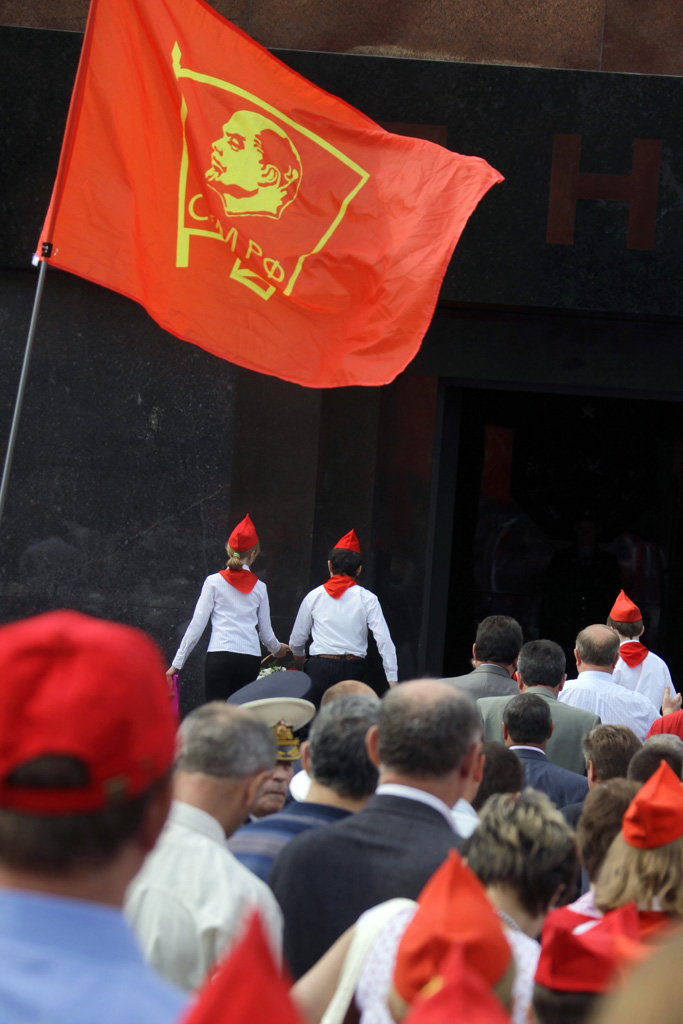
The model the Chinese organisation copied: a Young Pioneer neckerchief-tying induction ceremony beside Lenin's Mausoleum, Red Square, Moscow, 16 May 2010, staged by the Communist Party of the Russian Federation. The Soviet organisation itself was dissolved in 1991, so this is a later revival, not the state system of 1922-91. Photograph by Ruslan Krivobok, RIA Novosti archive image #665548, CC BY-SA 3.0, via Wikimedia Commons. Also shown on The All-Union Pioneer Organization: scouting rebuilt as a communist pipeline, 1922-1991.
How to spot it
- Ask how old a child is when asked to recite an oath, and whether the wording could be understood, let alone freely agreed to, at that age.
- Check whether "voluntary" enrolment is tracked or reported: a near-100 percent figure inside a system that calls itself voluntary is itself evidence about how the choice actually works at school level.
- Notice sacred-object language attached to an ordinary piece of clothing or insignia (a flag's corner, a martyr's blood, a founder's own gesture) and ask what institution's prestige that language is transferring onto the object.
- Trace whether early membership converts into a later, named organisational stage (a league, a party) and who is responsible for that conversion, rather than assuming childhood membership is a one-off, forgettable rite of passage.
- Watch for a movement's abstract symbols (a flag, a slogan, "the cause") being gradually replaced or accompanied by a living leader's own name, face and personal story in material aimed at small children.
Images
| Image | Source | Licence |
|---|---|---|
| Mechanism diagram (above) | Drawn for FRAME from the sources below (make_diagrams_youth_pioneers_china.py) |
CC BY 4.0, FRAME |
| Young Pioneers at a school opening ceremony, Beijing area, 1 September 2009 | Wikimedia Commons, photograph by Yoshi Canopus, own work | CC BY-SA 3.0 (also GFDL; multi-licensed by the photographer) |
| Young Pioneers in Tiananmen Square, Beijing, 23 October 2007 | Wikimedia Commons, photograph by BrokenSphere, own work | CC BY-SA 3.0 (also GFDL; multi-licensed by the photographer) |
| Young Pioneer induction ceremony, Red Square, Moscow, 16 May 2010 (reused from The All-Union Pioneer Organization: scouting rebuilt as a communist pipeline, 1922-1991) | Wikimedia Commons, photo by Ruslan Krivobok, RIA Novosti archive #665548 | CC BY-SA 3.0 |


Image gaps
- A dimensioned diagram of the small-size red scarf, issued by the Beijing Haidian District Young Pioneers Committee (2001). Identified on Wikimedia Commons at commons.wikimedia.org/wiki/File:Young_Pioneers_of_China_Red_Scarf(S).jpg.jpg>), tagged
PD-PRC-exempt(an official document exempted from copyright under Chinese law). Not hosted: whether a district Young Pioneers committee's specification counts as an official document of a state organ, and so is outside Chinese copyright and outside U.S. restoration, could not be confirmed, so it is cited rather than hosted. - A 1950s-60s photograph of the organisation in its early years, or of Mao Zedong with Young Pioneers. No file with a clear public-domain-in-the-United-States rationale was located: Commons holds PRC-era photographs of this kind tagged
PD-China, but, as this archive's Cultural Revolution page explains, a Chinese work still under copyright in China on 1 January 1996 had its U.S. copyright restored by the URAA regardless of its PD-China status, and most 1950s-60s Chinese press photography does not carry a documented rationale for having already been out of copyright in China before that date. Not hosted here for the same reason it is not hosted on Big-character posters: how the opening labels of China's Cultural Revolution did the work of charges (1966-68). - A photograph or scan of a Little Red Guards armband or 1967-78 material. No openly licensed image of this specific, brief replacement organisation was located; the fuller record of that period belongs on The Red Guards: how Mao turned millions of students into a political weapon, 1966-68 in any case.
- The February 2021 "Opinions" directive itself, or a 2020s classroom textbook page showing Xi Jinping tying a red scarf on a child. No openly licensed reproduction of either was located; both are described in text above with the outside reporting that documents them.
Sources
- Young Pioneers of China entry, in Wikipedia (English), consulted for the founding date, the 1953 renaming, the red scarf's official symbolic formula, the pledge text, the salute, and the Cultural Revolution suspension and 1978 restoration dates: en.wikipedia.org/wiki/Young_Pioneers_of_China.
- Little Red Guards entry, in Wikipedia (English), for the 4 February 1967 Central Committee notice and the Little Red Guards' operation from December 1967 to October 1978: en.wikipedia.org/wiki/Little_Red_Guards.
- Young Pioneers (Soviet Union) entry, in Wikipedia (English), for the 19 May 1922 Soviet founding date, the "Always be prepared!" motto and the organisation's structure, used in the same-method test: en.wikipedia.org/wiki/Young_Pioneers_(Soviet_Union).
- Globalsecurity.org, "Young Pioneers of China," for organisational structure, the stripe and rank system, and membership framing: globalsecurity.org/military/world/china/cyp.htm.
- Chinascope, "CCP Control Over the Chinese Communist Young Pioneers," for the February 2021 "Opinions on Comprehensively Strengthening the Work of the Young Pioneers in the New Era" and its content: chinascope.org/archives/37820.
- China Daily (Global edition), "Chinese Young Pioneers organization boasts 110M members," June 2022, and "China has nearly 115 million young pioneers as of 2022," June 2023, and "China has about 113 million young pioneers," May 2025, for membership figures: global.chinadaily.com.cn, global.chinadaily.com.cn.
- China Daily (Global edition), "National standard for Chinese Young Pioneers flag to be implemented June 1," May 2024: global.chinadaily.com.cn/a/202405/30/WS66586be1a31082fc043ca130.html.
- Marina Svensson, "Chinese Youth and the Communist Party of China: Cultivating a Loyal Generation through Ideological and Political Education," Project MUSE / journal article, 2023, for the academic reading of the Young Pioneers-Youth League-Party pipeline: muse.jhu.edu/article/898342.
- Jerome Doyon, Rejuvenating Communism: Youth Organizations and Elite Renewal in Post-Mao China (University of Michigan Press, 2023), for the Young Pioneers-Communist Youth League-Party elite-recruitment pipeline discussed in "Positions on the record" and linked from Red scarf to Party card: a century of the Communist Youth League of China.
- The Conversation / ABC News (Australia), "Little red children and 'Grandpa Xi': China's school textbooks reflect the rise of Xi Jinping's personality cult," 2021, for the textbook depiction of Xi Jinping tying a red scarf on a child and his own account of joining the Young Pioneers in 1960: theconversation.com/little-red-children-and-grandpa-xi-chinas-school-textbooks-reflect-the-rise-of-xi-jinpings-personality-cult-168482.
- Wikimedia Commons file pages cited individually in Images and Image gaps above, read 28 September 2026.