
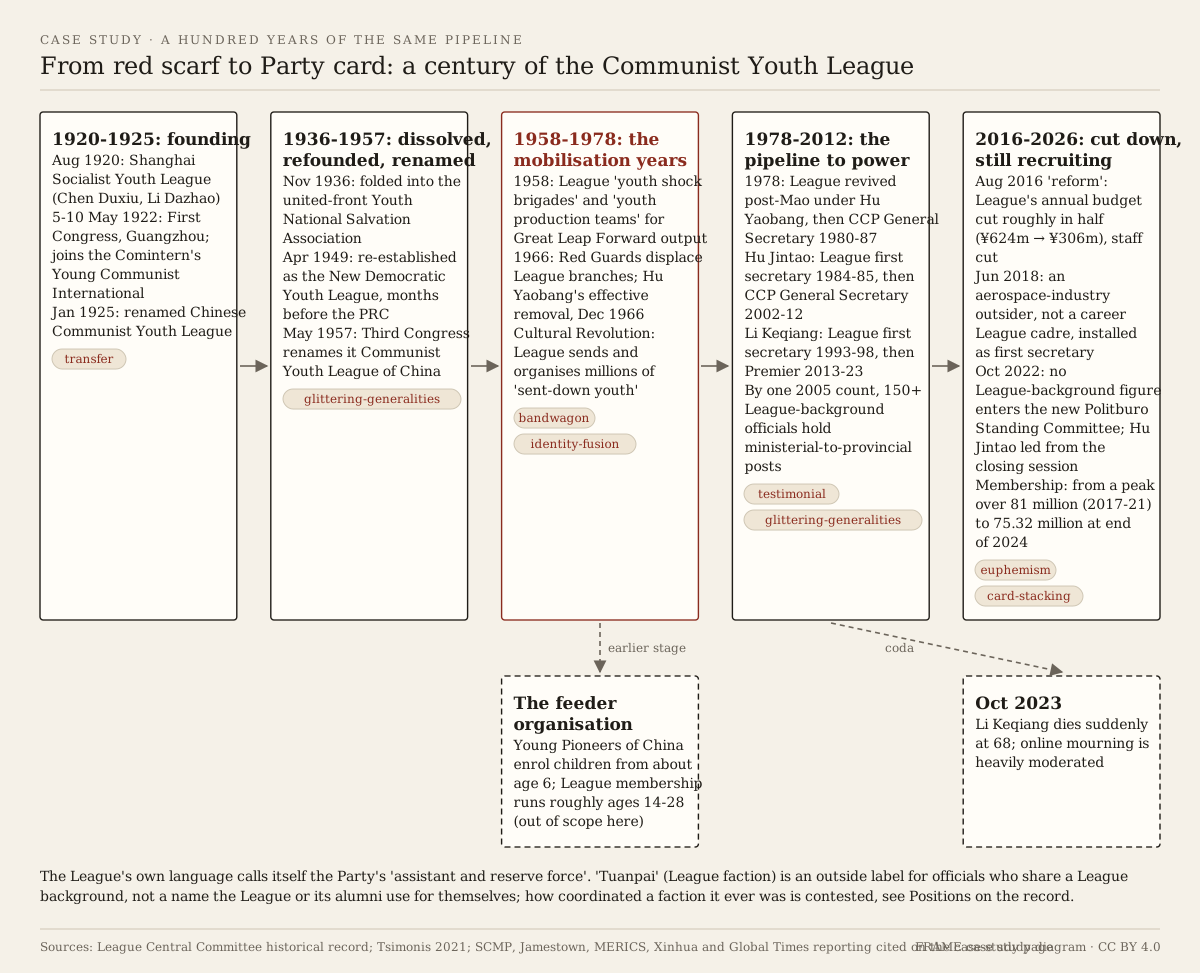
In one line: Founded in Guangzhou in May 1922, a year after the Chinese Communist Party itself and 27 years before the Party won power, the Communist Youth League built a standing pipeline that carried Chinese teenagers and young adults from the Young Pioneers into full Party membership, mobilised millions of them for Mao-era production drives and rural resettlement, and carried Hu Yaobang, Hu Jintao and Li Keqiang to the Party's top table before Xi Jinping halved its budget, installed an outsider to run it, and watched its alumni disappear from the 2022 Politburo Standing Committee — while the League itself, tens of millions of members strong, keeps recruiting.
What happened
- August 1920. Chen Duxiu and Li Dazhao, soon to found the Chinese Communist Party itself, organise a Socialist Youth League in Shanghai. Similar local groups form in other cities over the following months (Tsimonis 2021).
- 5-10 May 1922. The League's First National Congress meets in Guangzhou and proclaims the Socialist Youth League of China a national organisation, financed and directed in its early years by the Communist International. The Congress votes to join the Young Communist International, the Comintern's own youth wing, formally tying the new League to Moscow's Komsomol model from its first weeks.
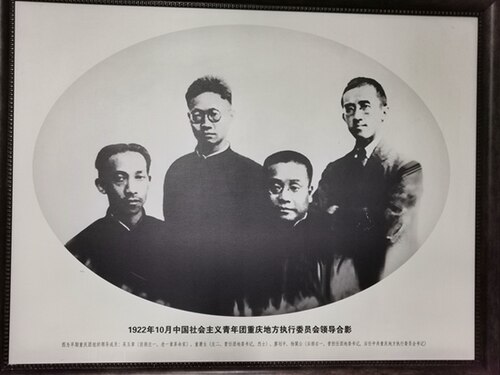
Photograph of a framed print showing four members of the Chinese Socialist Youth League's Chongqing local executive committee, October 1922; the Commons file description names Yang Angong and Wu Yuzhang among them. Author unknown; source given as the China Youth Daily online archive, via Wikimedia Commons. Public domain (published before 1931). - January 1925. The League is renamed the Chinese Communist Youth League (中国共产主义青年团), matching its name to the Party's own. - November 1936. As the CCP builds the Second United Front with the Guomindang against Japan, the League is reorganised into the broader, non-exclusively-Communist Youth National Salvation Association, submerging its separate Communist identity for the length of the war. - April 1949. Months before the People's Republic's October founding, the CCP re-establishes the organisation under Party leadership as the New Democratic Youth League (新民主主义青年团), headquartered in Beijing. - May 1957. The League's Third National Congress renames it the Communist Youth League of China (中国共产主义青年团), the name it still carries. - 1952-1966. Mao Zedong hand-picks Hu Yaobang to head the League; Hu becomes its first secretary in 1953 and runs it until the Cultural Revolution. Under his leadership the League sets up "youth shock brigades" (青年突击队) and "youth production teams" (青年生产队) to mobilise young people for Great Leap Forward output targets in industry and agriculture; the yield claims and famine those targets fed are covered on The Great Leap Forward's 'sputnik' harvests and the famine that followed, which this page does not re-describe. - December 1966. Tens of thousands of Red Guards confront Hu Yaobang at a League meeting; his effective authority over the organisation ends, and League branches are displaced by Red Guard organisations through the Cultural Revolution. From 1968 the League (alongside other state and Party bodies) is central to organising and sending millions of "sent-down youth" to the countryside, a movement covered in full on Down to the countryside: how China rebranded a mass relocation of youth as revolutionary 're-education' (1968-1980) and not re-described here. - From 1978. Rehabilitated after Mao's death, Hu Yaobang becomes the CCP's Organisation Department director in 1977 and its General Secretary from 1980 to 1987; the League itself is revived as a functioning national organisation in the same period (Tsimonis 2021). - December 1984-November 1985. Hu Jintao serves as the League's first secretary. He later becomes CCP General Secretary and PRC President, serving 2002-2012. - 1993-1998. Li Keqiang serves as the League's first secretary. He later becomes PRC Premier, serving 2013-2023. - By one 2005 count, more than 150 officials with a Communist Youth League background hold posts from vice-minister to provincial party secretary across China's government, informally dubbed the "Tuanpai" (Youth League faction) by outside analysts. - 2 August 2016. The CCP Central Committee approves a reform plan for the League. Its annual budget is cut roughly in half, from about 624 million yuan to about 306 million yuan, and its central and provincial staffing is trimmed, with the stated goal of redirecting the organisation toward "internet-based" youth work and grassroots activity. - 29 June 2018. He Junke, a former aerospace-industry official with no career background in League cadre work, is elected the League's first secretary — a break from the pattern in which the role had been filled by rising League insiders. - 22 October 2022. At the close of the CCP's 20th National Congress, former General Secretary Hu Jintao is visibly escorted from the closing session ahead of the final votes; state media give no explanation beyond his health. The Congress's new Politburo Standing Committee and Politburo include, for the first time in the post-Mao era, no figure with a clear League-background power base: Premier Li Keqiang and CPPCC chairman Wang Yang leave the Standing Committee, and Vice Premier Hu Chunhua leaves the Politburo entirely. - 27 October 2023. Li Keqiang, retired from the premiership seven months earlier, dies suddenly of a heart attack at 68. Online commemoration is heavily moderated by censors in the days that follow. - End of 2024. The League's own count puts its membership at 75.32 million, down from a reported peak above 81 million in 2017-2021 and roughly 6 percent of China's population at that peak; it remains one of the largest youth organisations in the world.

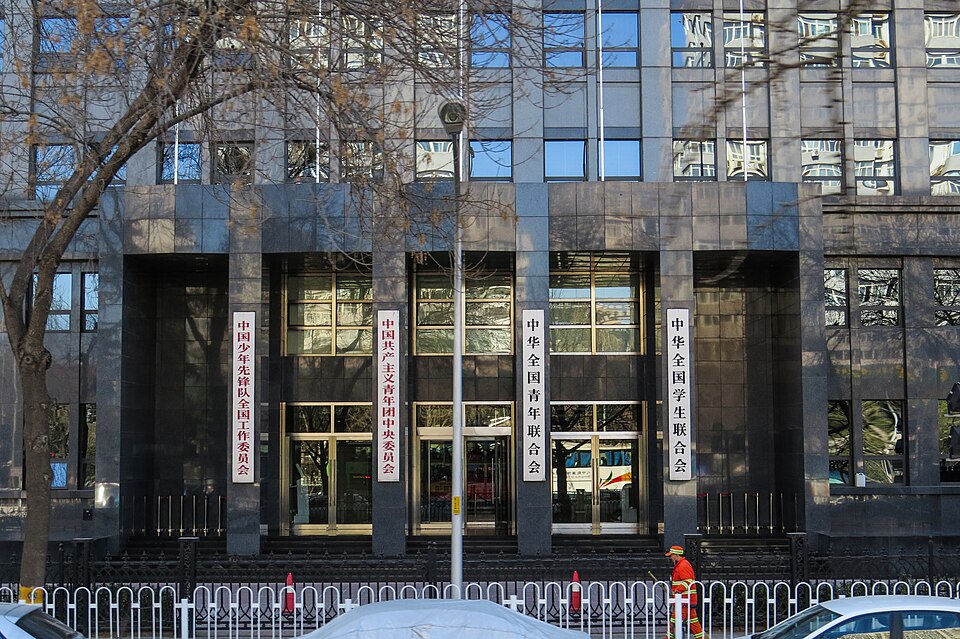
Entrance of the building at 10 Qianmen East Street, Beijing, with signboards for the Young Pioneers national working committee, the Communist Youth League of China Central Committee, the All-China Youth Federation and the All-China Students' Federation, 14 March 2017. Photograph by N509FZ, via Wikimedia Commons. CC BY-SA 4.0.
.jpg)
How it works
- Transfer: joining the Young Communist International within weeks of its own 1922 founding congress tied the new League to the prestige of the already-established Bolshevik youth movement, the Komsomol, before the Chinese Communist Party itself had won a single province.
- Glittering generalities: the League describes itself in Party documents and its own charter as the Party's "assistant and reserve force" (助手和后备军) and a "school for millions of young people to study Communism", virtue language that says nothing checkable about what membership actually requires or confers.
- Bandwagon: League membership is formally voluntary but reaches the large majority of Chinese secondary-school and university students; near-universal enrolment among a cohort makes joining the unmarked, default choice and not joining the visible exception.
- Identity fusion: the staged progression from the Young Pioneers' red scarf (see A corner of the flag on a six-year-old: the Young Pioneers of China) through the League badge to the Party emblem fuses a young person's growing personal and social identity to successive, escalating markers of loyalty to the Party, each formally optional and each the normal path.
- Testimonial: that Hu Yaobang, Hu Jintao and Li Keqiang all rose through League leadership to the Party's very top was cited, especially during the 1980s-2000s, as living proof that the League path led somewhere; the same biographies did the work of an implicit advertisement without anyone at the League having to make the claim explicitly.
- Card stacking: the League's own 2016-2018 accounts of its "reform" describe a modernising pivot to online youth engagement; outside reporting on the same budget cut, staffing reduction and choice of a non-League-cadre first secretary reads it, in the context of the same years' broader anti-corruption and factional consolidation under Xi Jinping, as a deliberate reduction of a rival internal power base. Both descriptions can be checked against the same public facts; the League's own account omits the second reading.
- Euphemism / doublespeak: "reform" (改革) is the League's and the Party's own word for a process that, on the numbers above, halved a national organisation's budget and changed how its leadership is chosen.
- Narrative laundering: the League Central Committee runs large, officially branded but youth-voiced social-media accounts (on Weibo, Bilibili and elsewhere) that carry patriotic and pro-Party content in youth-culture idiom rather than as visibly labelled state messaging, a role documented by China-media researchers tracking the League's post-2016 "internet + youth work" pivot.
Then and now
Then: a vanguard organisation used for mass labour. From the 1950s the League was Mao's and Hu Yaobang's instrument for turning Party slogans into youth labour on the ground: the "youth shock brigades" of the Great Leap Forward, and later the organisers of the sent-down youth movement, put League branches at the point where a Party campaign became a specific young person's assigned work or destination.
Now: an elite pipeline eclipsed, a mass organisation intact. For roughly three decades after 1978 the League was also something else: the most reliable career ladder into the CCP's own senior leadership, carrying Hu Yaobang, then Hu Jintao and Li Keqiang, and by 2005 more than 150 vice-minister-to-provincial-secretary-level officials, to the point that outside analysts gave the resulting informal network a name, the "Tuanpai." Xi Jinping's 2016 budget and staffing cuts, his installation of a non-League-cadre first secretary in 2018, and the 2022 Party Congress's Politburo and Standing Committee lineup, the first in the post-Mao era with no clear League-background figure at the top, mark that specific pipeline function as closed, at least for now; Hu Jintao's public removal from the 2022 closing session and Li Keqiang's 2023 death, each read by outside commentators as a marker of the same eclipse, bookend the period. What has not stopped is the League's other, older function: at 75.32 million members at the end of 2024, it remains one of the largest youth organisations on earth, still enrolling, still training cadres at lower levels, and still available, should a future leadership want it, as the same kind of instrument it was in 1958 and 1968.
Positions on the record
- The League's and the Party's position. The League describes itself as the Party's loyal "assistant and reserve force," a school for training politically reliable successors to the Party's cause. Xi Jinping's May 2022 speech marking the League's centenary called on it to stay "politically reliable" and to strengthen Party leadership over youth work, language consistent with, not contradicting, the same period's budget and leadership changes.
- Analysts' position. Scholars and journalists covering the 2016 reform and the 2022 Congress (Jamestown Foundation, MERICS, the South China Morning Post and others) read the budget cuts, the 2018 leadership change and the 2022 Standing Committee lineup together as a coordinated effort by Xi Jinping to dismantle a rival patronage network built on League service, not as ordinary institutional streamlining.
- What is documented. The founding dates and name changes above; the specific 1952-66 and 1984-85 and 1993-98 leadership tenures of Hu Yaobang, Hu Jintao and Li Keqiang; the August 2016 budget figures; He Junke's June 2018 election and non-League background; the October 2022 Standing Committee and Politburo lineup; Li Keqiang's October 2023 death; the League's own reported membership totals for each year cited.
- What is contested. Whether "Tuanpai" ever named a coordinated faction with a shared programme, rather than a label political scientists and journalists applied after the fact to officials who happened to share a career step, is argued both ways in the academic literature (see Kou 2018's Tsang and Cabestan volume chapter and Tsimonis 2021 for competing views); this page does not resolve that dispute. The precise cause of Hu Jintao's October 2022 removal from the closing session is not independently confirmed beyond the state media's own account (poor health); the cause of Li Keqiang's October 2023 death is not disputed by any documented evidence beyond the official finding of a heart attack, though online speculation to the contrary circulated before being censored.
- Not ruled on here. Whether the League's current, post-2016 form still functions as a meaningful path into Party leadership for a new generation of officials, a question that by 2026 has not been tested by a full leadership transition since the 2022 changes.
Same-method test
- The Soviet Union's Komsomol (All-Union Leninist Young Communist League), founded 29 October 1918. The League's model, explicitly joined in 1922 through the Young Communist International: the same age-graduated design (a children's organisation, the Young Pioneers, feeding a youth wing, feeding full party membership), the same use for mass labour mobilisation (Komsomol construction brigades on the first Five-Year Plan's projects and later the Virgin Lands and BAM campaigns), and the same later role as a career path into the ruling party's own leadership; Mikhail Gorbachev himself rose partly through Komsomol regional leadership. The difference is survival: the Komsomol dissolved with the Soviet Union in 1991, while the Chinese League, cut down but not abolished, marks its next centenary in 2122 unless the Party that runs it falls first.
- The Hitler Youth (Hitlerjugend), for its older cohort (ages 14-18, alongside the Jungvolk for ages 10-14). A genuine structural parallel, not a borrowed one: an age-graduated pipeline from a children's organisation into an older youth wing, used to build loyalty to a one-party state and to organise young people's labour and, during the war, service. The differences are sharper than the similarities. The Hitler Youth became legally compulsory for eligible German children and teenagers under the 1936 Hitler Youth Law, unlike the CYL's formally voluntary (if socially near-universal) membership; it was created independently rather than modelled on a foreign precedent; and Nazi Germany collapsed in 1945 before a generation of Hitler Youth alumni could rise, as League alumni did, into the regime's own top leadership. There is no Hitler Youth equivalent of a "Tuanpai."
- Where they differ from each other. The Komsomol comparison is a lineage: the Chinese League explicitly borrowed the Soviet model and joined its international body. The Hitler Youth comparison is a structural coincidence: two one-party states independently built similar age-graduated pipelines to the same organisational logic, without one copying the other.
How to spot it
- Ask whether a youth organisation's membership is formally voluntary and check how large a share of the eligible cohort actually joins; near-universal enrolment makes non-membership, not membership, the thing that needs explaining.
- Check whether a ruling party's senior leaders' own biographies are used, explicitly or by repetition, as evidence that a youth organisation's career path leads somewhere, and ask what share of alumni that path actually reaches.
- Read a "reform," "streamlining" or "modernisation" announcement about an internal party organisation against the same period's other personnel and power moves before taking the stated rationale as the whole story.
- Track a mass youth organisation across a full political cycle, not one leader's tenure: an instrument cut down under one leadership can be revived by the next, and a claim that a pipeline has "closed" should specify closed for whom, and since when.
- Distinguish an organisation's mobilisation function (turning a campaign into assigned labour) from its patronage function (turning membership into promotion); the same body can lose one while keeping the other, as this page's own "Then and now" shows.
Images
| Image | Source | Licence |
|---|---|---|
| Mechanism diagram (above) | Drawn for FRAME from the page's sourced facts (make_diagrams_youth_cyl_china.py) |
CC BY 4.0, FRAME |
| Chongqing local executive committee of the Socialist Youth League, October 1922 | Wikimedia Commons; author unknown, via China Youth Daily online archive | Public domain (published before 1931; also PD-China) |
| Communist Youth League Central Committee building, Beijing, 2017 | Wikimedia Commons; photograph by N509FZ | CC BY-SA 4.0 |
Image gaps
- Flag of the Communist Youth League of China (vector). Tagged
{{PD-ineligible}}on Commons (a simple geometric design below the threshold of originality), dated to the League's 4 May 1950 publication of the design. Identified and licence-checked but not embedded, since a flag adds little to a page already carrying a photograph of the League's headquarters: commons.wikimedia.org/wiki/File:Flag_of_the_Communist_Youth_League_of_China.svg. - Photographs of Hu Yaobang, Hu Jintao or Li Keqiang in League roles. A 1953 photograph of Hu Yaobang at the League's Second National Congress exists on Commons but is explicitly tagged
{{Not-PD-US-URAA}}(public domain in China but not confirmed public domain in the United States under the URAA), consistent with this archive's practice elsewhere of excluding URAA-restored Chinese-era photographs; it is not used here. No openly licensed photograph of Hu Jintao's or Li Keqiang's own League-era work was located; both men's post-League official photographs as national leaders are Xinhua or government copyright, not openly licensed. - A Great Leap Forward-era "youth shock brigade" poster or photograph, or a sent-down youth departure photograph. No openly licensed digitisation of either was located; both movements are covered on their own pages (The Great Leap Forward's 'sputnik' harvests and the famine that followed, Down to the countryside: how China rebranded a mass relocation of youth as revolutionary 're-education' (1968-1980)), which document their own image searches.

Sources
- Konstantinos Tsimonis, The Chinese Communist Youth League: Juniority and Responsiveness in a Party Youth Organization, Amsterdam University Press, 2021.
- Miles Yu and others, "Institutional Changes, Influences and Historical Junctures in the Communist Youth League of China," The China Quarterly, Cambridge University Press.
- "Brothers, Comrades or Competitors? The Communist Party and the Communist Youth League," Journal of Contemporary China / online library scholarship on the League-Party relationship.
- Cheng Li, "The Chinese Communist Youth League: Chairman Hu's Path to Power," China Leadership Monitor, no. 3, 2002, and subsequent China Leadership Monitor pieces on the "Tuanpai," Hoover Institution.
- Alice Miller, "The Successor Generation and Elite Politics in China," China Leadership Monitor.
- Willy Wo-Lap Lam and others, "The Eclipse of the Communist Youth League and the Rise of the Zhejiang Clique," Jamestown Foundation, China Brief.
- MERICS (Mercator Institute for China Studies), "China's Communist Youth League: Eternally young at a hundred," comment, 2022.
- South China Morning Post, "China's Communist Youth League gets new leader, aged 52," 29 June 2023, on He Junke's departure and A Dong's succession, and earlier SCMP reporting (2018) on He Junke's aerospace-industry background.
- South China Morning Post, "Is the promotion of this Chinese aerospace technocrat the start of a communist youthquake?," 2018.
- Global Voices / Hong Kong Free Press, "China Is Turning Its Once Powerful Communist Youth League Into an Online Campaign Machine," August 2016, on the 2 August 2016 reform plan and budget figures.
- Xinhua, "Communist Youth League elects new leadership," 29 June 2018.
- CNN, Washington Post and Reuters news coverage of Hu Jintao's removal from the 20th Party Congress closing session, 22 October 2022.
- Washington Post, CNN and Reuters coverage of Li Keqiang's death, 27 October 2023, and its aftermath.
- Global Times, "Communist Youth League of China has about 75.32 mln members," May 2025, for the end-2024 membership figure.
- Xi Jinping, speech marking the centenary of the Communist Youth League of China, 10 May 2022 (official record; English summary via Friends of Socialist China).
- Wikimedia Commons file pages linked in the Images table and Image gaps above, read 28 September 2026.