Content note: this page describes mass forced labor, a documented death toll, a famine year, and the later arrest and execution of the officials and camp administrators who built this propaganda campaign. Figures for deaths and prisoner numbers are contested between official Soviet statistics and historians' reconstructions; both are given, with their source, rather than resolved into one number.
In one line: the OGPU's camp administration, renamed the Gulag in November 1930, built the White Sea-Baltic Canal in 1931-33 with prisoner labor under the doctrine of perekovka ("re-forging") — the claim that hard labor reformed criminals and "class enemies" alike — then sent 120 Soviet writers led by Maxim Gorky to tour the finished canal and produce a 1934 book that named the camp's organizers by name and its death toll nowhere; three years later most of those organizers were shot as "enemies of the people," and Soviet censors pulled the book from circulation.
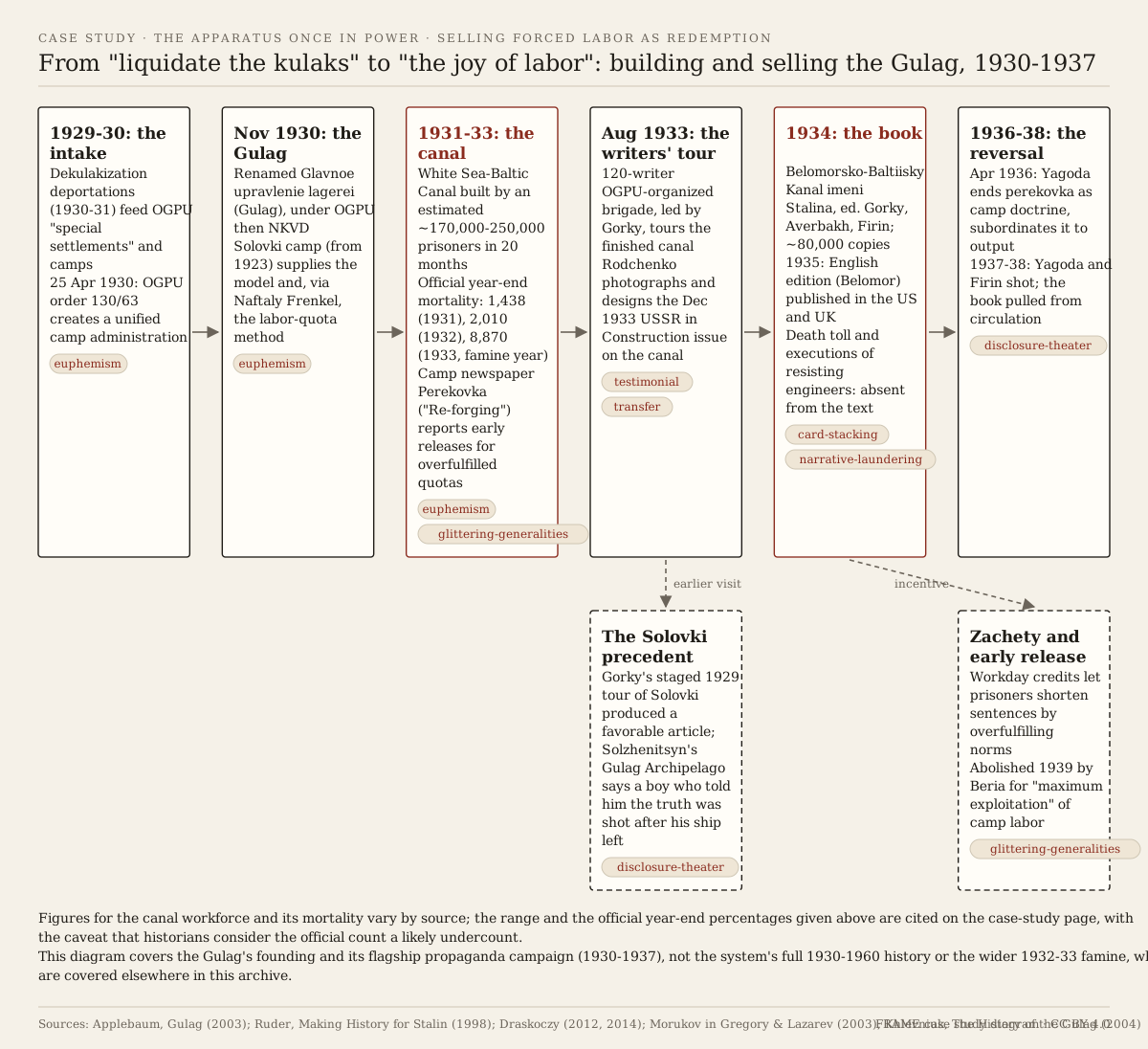
What happened
Building the camp system
- 7 April / 25 April 1930. A Council of People's Commissars (Sovnarkom) decree of 7 April 1930 orders the OGPU (the secret police) to organize "corrective labor camps" (ispravitel'no-trudovye lagerya) to hold prisoners sentenced to three years or more. An OGPU order of 25 April 1930 (No. 130/63) creates a Camp Administration (ULAG) to run them; in November 1930 it is renamed the Main Administration of Camps — Glavnoe upravlenie lagerei, abbreviated Gulag.
- The Solovki precedent. The Solovetsky camp of special designation (SLON), operating on the Solovetsky Islands in the White Sea from 1923, predates the Gulag's formal creation and is generally treated by historians as its prototype: a self-contained penal economy that already combined forced labor, a differentiated ration and quota system, and, from the mid-1920s, camp theater, a printed camp journal and prisoner "self-activity" circles. Naftaly Frenkel, sentenced in 1924 and sent to Solovki, is credited by historians with developing the ration-for-output system OGPU camps used more widely afterward.
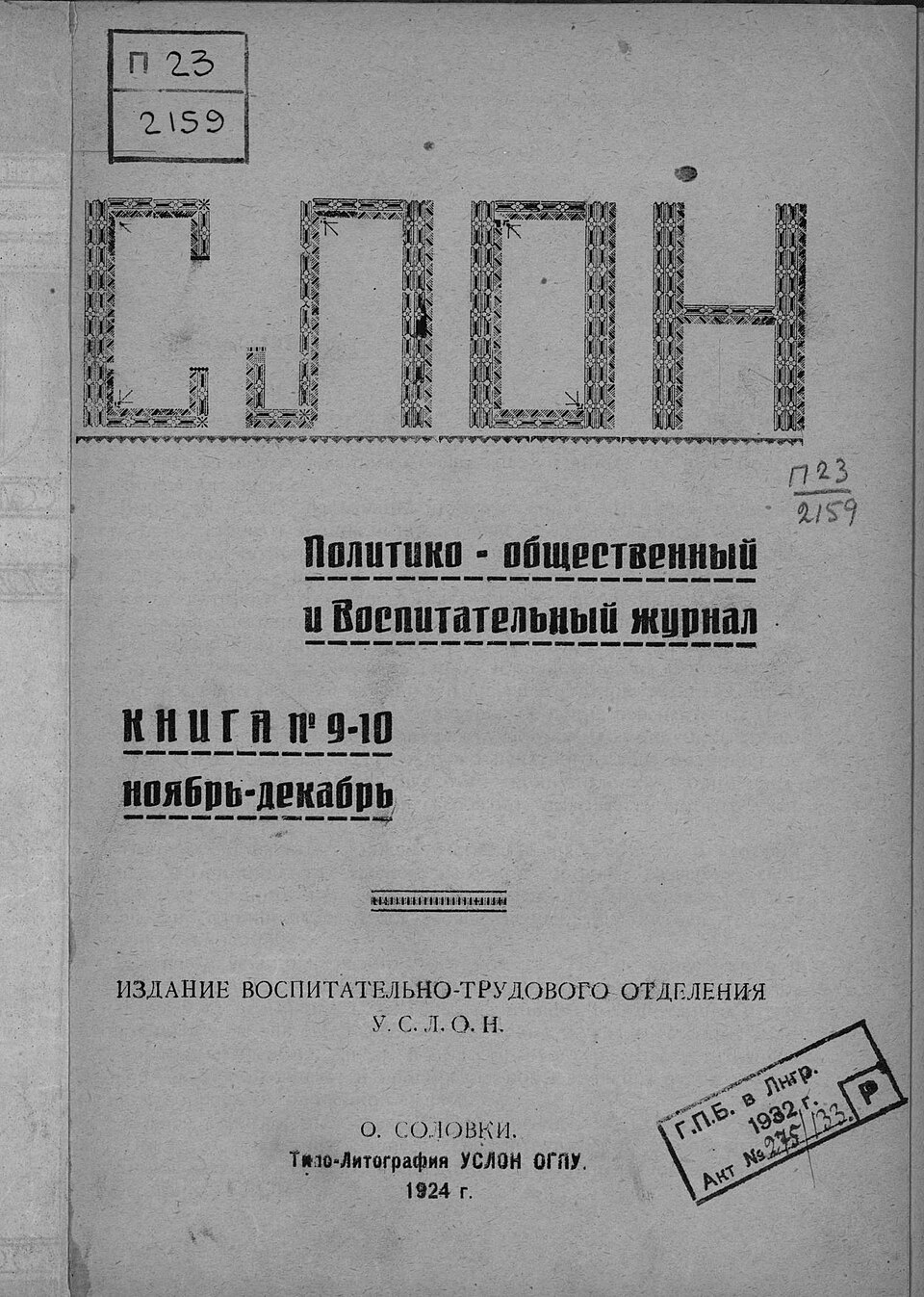
Cover of SLON, "a political-social and educational journal," book nos. 9-10, November-December 1924, published by the education-and-labour section of the Solovetsky camp administration (USLON OGPU) and printed at the camp press on the Solovetsky Islands. Public domain (published 1924), via Wikimedia Commons.
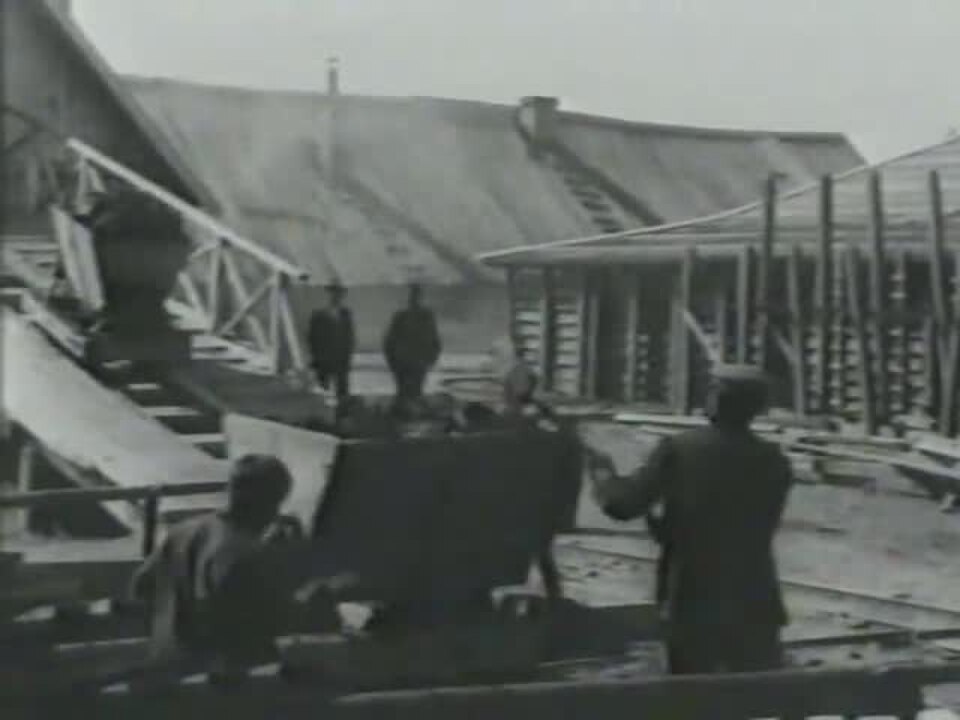
Frame from Solovki (Sovkino, 1928), a Soviet documentary filmed at the Solovetsky camp; the still is the poster frame of the Commons video file, and the file description does not identify the scene. Public domain (film first shown before 1943 in the USSR; published 1928), via Wikimedia Commons. - Growth. The recorded Gulag camp population rose from roughly 179,000 at the start of 1930 to about 510,000 by January 1934 (Getty, Rittersporn and Zemskov 1993, from NKVD archival returns), and continued to grow through the 1930s and into the postwar period; a large share of admissions in these early years followed directly from the dekulakization deportations of 1930-31 (covered on this archive's own page, "Liquidate the kulaks as a class": the propaganda campaign for collectivization (1929-1933), not repeated here) and from convictions under Article 58 of the criminal code ("counter-revolutionary crimes").
The White Sea-Baltic Canal and perekovka
- Perekovka ("re-forging"). From the camp system's earliest years, OGPU's cultural-educational departments (Kul'turno-vospitatel'nyi otdel, KVO) promoted the doctrine that hard, quota-driven labor did not merely punish prisoners but transformed them — turned thieves, "wreckers" and even political "class enemies" into loyal, productive Soviet citizens. The doctrine had a name, perekovka, and an institutional expression: camp theater troupes, prisoner poetry and prose competitions, "agitational brigades," and camp newspapers, the best known of which, at the White Sea-Baltic Canal, was called simply Perekovka ("Re-forging").
- 1931-33: construction. Ordered built in a single stroke, without the modern earth-moving equipment used on comparable Western projects, the 227-kilometer White Sea-Baltic Canal, linking the White Sea to Lake Onega and the Baltic, was constructed in about 20 months by a prisoner workforce historians estimate at roughly 100,000 to 200,000 at any one time (accounts differ; see Positions on the record), organized by the camp administration Belbaltlag.
- Workday credits (zachety). Prisoners who overfulfilled their work norms could earn credit toward early release, publicized in Perekovka as proof the doctrine worked; the camp newspaper's 1936 issues record specific early releases for high performers. The system stayed formally in place until 1939, when Lavrenty Beria, the NKVD's new chief, abolished workday credits system-wide, citing the need for "maximum exploitation" of camp labor rather than early release.
- The official death toll. Soviet administrative records, as reproduced by later researchers, give a mortality rate of 2.24% of the workforce in 1931 (1,438 people), 2.03% in 1932 (2,010 people), and 10.56% in 1933 (8,870 people) — a total of roughly 12,300 recorded deaths, the last year's jump coinciding with the 1932-33 famine's effect on camp food supplies. Historians, including Anne Applebaum, treat this official figure as a likely undercount and cite estimates as high as 25,000 deaths over the canal's construction; no single, agreed figure exists (see Positions on the record).
- August 1933: the tour. With the canal essentially finished, Stalin, Kliment Voroshilov and Sergei Kirov toured the site; the same month, the state publisher commissioned a book on the project, and OGPU organized a brigade of some 120 Soviet writers, who met in Moscow on 17 August 1933 before traveling to see the completed canal for themselves.
- December 1933: the photo-essay. The constructivist photographer and designer Alexander Rodchenko, on assignment for the state magazine SSSR na stroike ("USSR in Construction"), produced its entire December 1933 issue (no. 12) on the canal: a photomontage essay that presented the prisoner workforce as disciplined, purposeful and, per later art-historical analysis, deliberately blurred documentary specificity in favor of a unified visual argument for the project's success.
The 1934 book
- Editors and authorship. Belomorsko-Baltiysky Kanal imeni Stalina: Istoriya stroitelstva ("The Stalin White Sea-Baltic Canal: A History of Its Construction") was published in 1934 under the general editorship of Maxim Gorky, the literary critic and RAPP leader Leopold Averbakh, and Semyon Firin, the OGPU officer who headed Belbaltlag, the canal's own camp administration. Some 34 writers are credited as contributors, among them Aleksey Tolstoy, Valentin Kataev, Viktor Shklovsky and Mikhail Zoshchenko.
- Distribution. An initial edition of roughly 80,000 copies was printed in March 1934, reportedly including a run distributed to delegates of the Seventeenth Party Congress ("the Congress of Victors"), which met in Moscow in January-February 1934; a further run of about 30,000 followed in 1935.
- Content. The book presents the canal as proof that forced, quota-driven labor could reform criminals and "class enemies" into loyal builders of socialism: chapters narrate individual prisoners' journeys from thief or saboteur to shock-worker, name and praise the OGPU officials who ran the project, and frame the entire undertaking as a voluntary, enthusiastic collective effort. The camp's death toll — whichever figure is used — appears nowhere in the text.
- 1935: the English edition. The book was translated and published in 1935 as Belomor: An Account of the Construction of the New Canal Between the White Sea and the Baltic Sea in the United States (Harrison Smith and Robert Haas, New York) and in Britain under a comparable title, carrying the same account to English-language readers outside the USSR.
How it ended
- 2 April 1936. Yagoda, by then head of the NKVD, issues an order formally ending the cultural-educational departments' independent "re-forging" mission and subordinating their work to production targets — the doctrine's own administration downgrades it before the wider purge reaches the men who had built it.
- 1937-38: the purge. Yagoda is removed as NKVD chief in September 1936, arrested in 1937, tried in the March 1938 Moscow show trial and shot (covered in this archive's own The Moscow show trials: confession, spectacle and consent (1936-1938), not repeated here). Firin is arrested and shot in 1937; Averbakh, whose sister was married to Yagoda, is arrested and shot the same year.
- Withdrawal. With its editors and the officials it praised by name now "enemies of the people," and with Glavlit (Soviet censorship) barring the publication of such names, The History of the Construction of the Stalin White Sea-Baltic Canal was withdrawn from Soviet libraries; it remained effectively suppressed inside the USSR for decades.
How it works
- Euphemism / doublespeak: "perekovka" (re-forging) and the administrative language around it — "corrective labor camp," "special settlement" — name a system of forced, coerced, often fatal labor in terms of metalwork and moral transformation, replacing the concrete harm with a redemptive metaphor before any evaluation of conditions can occur.
- Glittering generalities: the camp newspaper's own title, Perekovka, and the language of "shock work" and "socialist competition" describe coerced quota labor in the vocabulary of voluntary civic virtue.
- Testimonial: Maxim Gorky's international standing as a humanist writer, and the roster of 34 well-known contributors alongside him, vouch for the project by association; a reader is invited to trust the canal because trusted writers wrote about it, not because the book supplies evidence a reader could check independently.
- Transfer: Gorky's literary prestige, and Rodchenko's avant-garde photographic reputation, are applied to an OGPU construction project and a camp administration, lending each the borrowed credibility of Soviet high culture.
- Card stacking: the 1934 book's chapters recount individual reform stories and organizational triumphs while omitting, completely, the death toll its own commissioning organization's records show — 12,300 recorded deaths at minimum, by the state's own count.
- Narrative laundering: rather than issue an OGPU report on the canal, the state routed the message through a "collectively written" literary history credited to named, celebrated authors, which is harder for a reader to recognize as a security-service production than a report from the OGPU itself would have been.
- Disclosure theater: the writers' brigade genuinely toured the finished, already-selected sections of the canal in August 1933 and could report what they saw — but what they saw had already been organized for the visit. Aleksandr Solzhenitsyn's The Gulag Archipelago describes an earlier instance of the same pattern: Gorky's own staged 1929 visit to Solovki, cleaned up in advance, after which — per Solzhenitsyn's account — a boy who had told Gorky privately what conditions were really like was shot once Gorky's ship had left. The published article Gorky wrote after that visit was favorable.
Colour. This campaign was overwhelmingly white: the book named its editors, publisher, and contributors, and SSSR na stroike's December 1933 issue credited Rodchenko by name. The disclosure was real but partial — a technically open production built on a curated, one-time site visit, which is what separates it from the fully covert operations elsewhere in this archive.
Then and now

Former "trainees" at the Xinjiang government's press conference in Beijing, 10 February 2021, from Xinjiang's 'vocational training centres': the government's messaging and its critics'. Still from a China News Service video, CC BY 3.0.
The closest match in this archive is Xinjiang's 'vocational training centres': the government's messaging and its critics'. From 2018 the Chinese government reframed mass detention facilities in Xinjiang as "vocational education and training centres" holding "trainees" who received free schooling and job skills — a euphemism doing exactly the work perekovka did nearly ninety years earlier: naming coerced confinement and labor as voluntary self-improvement. Both campaigns paired the reframing with testimony: the Belomorkanal book's individual "reformed criminal" chapters have a direct descendant in the February 2021 Xinjiang press conference where former detainees, filmed by state media, rejected reports of abuse. The differences are real. The Xinjiang campaign operates alongside international scrutiny it could not fully control — leaked internal directives, satellite imagery and a 2022 UN human-rights office finding that documented allegations the government denies — where the Belomorkanal book operated inside a closed information system with no equivalent external check available to Soviet or foreign readers at the time. And the Gulag's own organizers were themselves devoured by the system three years later, in the Great Terror, a self-cannibalizing outcome with no Xinjiang parallel.
Positions on the record
- The book's own framing. The 1934 text and Gorky's editorial role present the canal as demonstrated proof that OGPU's methods could reform "class enemies" and criminals through labor, discipline and collective purpose, with the workday-credit system and the camp's cultural-educational activity offered as its working machinery.
- Contemporary Western reception. The book reached English-language readers in 1935 specifically as an account of Soviet penal method; how it was received by the American and British press and literary establishment of the mid-1930s is not resolved on this page and would need its own research.
- Solzhenitsyn's later account. Aleksandr Solzhenitsyn's The Gulag Archipelago (1973) treats the Belomorkanal book and the writers who produced it as a central example of Soviet literature's complicity in the camp system, and gives the Solovki story described above as an example of the propaganda apparatus's methods before the Gulag's own founding.
- Scholarship. Anne Applebaum's Gulag: A History (2003) is the standard English-language synthesis of the camp system, including the canal's construction, its death toll and the book's propaganda role. Cynthia A. Ruder's Making History for Stalin: The Story of the Belomor Canal (1998) is the standard monograph on the writers' brigade and the book itself, arguing the project institutionalized perekovka as Soviet doctrine. Julie Draskoczy's dissertation and article work ("The 'Put' of Perekovka'", The Russian Review, 2012) examines the "path" of re-forging as lived and performed inside the camp. Oleg Khlevniuk's The History of the Gulag (2004) and Getty, Rittersporn and Zemskov's 1993 American Historical Review article are the standard archival sources for camp population and mortality figures used above.
- What is documented. The founding decrees and dates of the Gulag administration; the canal's construction dates and official year-by-year death figures; the book's editors, contributors, print runs and 1935 English edition; the April 1936 order ending perekovka as doctrine; and the 1937-38 arrest and execution of Yagoda, Firin and Averbakh.
- What is contested. The size of the canal's prisoner workforce and its true death toll are both debated: official Soviet figures are lower than most historians' reconstructions, record-keeping across the system was inconsistent, and some deaths (of prisoners released just before death, a documented Soviet practice used to keep camp mortality statistics down) may not appear in camp records at all. This page gives the official figures and the range historians cite around them rather than adopting one number as settled.
- Not ruled on here. Whether the individual "reformed" prisoners the 1934 book profiles experienced anything like what the book describes. The book's chapters are propaganda content, quoted here as evidence of the method, not as a documented biography of any named person in it.
Same-method test
The same pairing — forced detention and labor renamed as reform, sold through a state-produced narrative that omits the death toll — recurs wherever a state runs a large penal-labor system and wants it described as rehabilitation rather than punishment or extermination.
- Nazi Germany. The phrase Arbeit macht frei ("work makes you free") was placed over the gates of several Nazi concentration camps, including Dachau from 1933 and Auschwitz I from 1940, framing forced labor inside the camp as a path to release. For many prisoner categories, especially from 1942 under the "extermination through labor" (Vernichtung durch Arbeit) policy applied to Soviet prisoners of war, political prisoners and others, labor was a mechanism of death rather than a path out of the camp; the slogan's promise and the camp's function were opposites. The technique — a redemptive label placed on coerced, often fatal labor — is the same Euphemism / doublespeak this page tags for perekovka; the scale, the racial extermination purpose behind many Nazi camps, and the near-total absence of any "reformed prisoner released" outcome for most of those subjected to it make the underlying system a categorically different, and in most camps far more lethal, one.
- The People's Republic of China. A 1954 State Council regulation formalized "reform through labor" (laodong gaizao, commonly abbreviated laogai) as a criminal-justice institution run by the Ministry of Public Security, using the same vocabulary of gaizao ("reform," "remolding") that perekovka used in Russian, and the same underlying claim: that labor and ideological "thought reform" (sixiang gaizao) transformed counter-revolutionaries and criminals into loyal citizens. The system operated for decades after the Mao era ended; former prisoner Harry Wu's Laogai Research Foundation documented it extensively from the 1990s and put the number who passed through it, over the system's full history, in the tens of millions — an estimate disputed by the Chinese government and not independently confirmed by archival access comparable to what post-Soviet researchers obtained for the Gulag. The naming convention and the reform claim match this page's Euphemism / doublespeak and Glittering generalities tags closely; the verified death toll and the degree of independent archival access differ, and this page does not attempt to resolve the laogai death-toll question, which belongs to its own case study.
- The United States. After the Thirteenth Amendment (1865) abolished slavery "except as a punishment for crime," Southern states leased convicts — disproportionately Black men arrested under vagrancy and other "Black Codes" — to mines, turpentine camps and plantations under the convict-lease system, publicly marketed by state officials as teaching idle men the discipline of steady work; Mississippi's Parchman Farm and similar state penal farms that replaced leasing from the 1900s onward kept the same rehabilitative language while running as forced agricultural labor into the mid-20th century. Historian David Oshinsky (Worse Than Slavery, 1996) and journalist Douglas Blackmon (Slavery by Another Name, Pulitzer Prize, 2009) document death rates in some lease camps that rivaled or exceeded plantation slavery, hidden behind the states' own "reform" and "industry" framing. The technique — official rehabilitative language placed over profit-driven, often fatal forced labor, with the true conditions withheld from the public record — is the same Euphemism / doublespeak this page tags for perekovka and laogai; the racial-caste basis of who was selected for it, and the fact it operated in a federal, adversarial-press democracy rather than a one-party state, are the differences, not the technique.
How to spot it
- Ask what the redemptive name is standing in for. "Re-forging," "vocational training," "thought reform" and "work makes you free" all name a process; ask what the conditions of that process were, separately from the name.
- Check whether the account was produced by, or with the sponsorship of, the same authority that runs the facility being described, however many independent-seeming names appear on the byline.
- Ask what a visiting writer, journalist or diplomat could actually see. A one-time, organized visit to a site that has had time to be prepared is not the same evidence as continuous, independent access.
- Look for the number that is missing rather than the numbers that are present. A publication that documents individual success stories in detail while never stating how many people died or failed to "reform" has made a choice, not an omission.
- Watch what happens to a propaganda system's own architects. When a regime's forced-labor doctrine is later run by, and later devours, the same officials who built and praised it, that is itself part of the record of how the system worked.
Images
| Image | Source | Licence |
|---|---|---|
| Mechanism diagram (above) | Drawn for FRAME from this page's sourced facts (make_diagrams_apparatus_gulag.py) |
CC BY 4.0, FRAME |
| Cover of the camp journal SLON, nos. 9-10, November-December 1924 | Wikimedia Commons | Public domain (published 1924) |
| Frame from Solovki (Sovkino, 1928) | Wikimedia Commons | Public domain (published 1928) |
| Stalin, Voroshilov and Kirov at the White Sea-Baltic Canal, August 1933 (hosted file, not embedded: unknown photographer, post-1930 date; U.S. status to be re-checked before use) | Wikimedia Commons | Public domain (PD-Russia) |
| Former "trainees" at a Xinjiang press conference, 2021 (Then and now) | Reused from Xinjiang's 'vocational training centres': the government's messaging and its critics'; still from a China News Service video | CC BY 3.0 |


Image gaps
- A portrait of Maxim Gorky, c. 1930-36. File:Maxim Gorky 1930s.jpg is tagged PD-US-no-notice on Commons, but it is a Soviet work from after 1930 and that tag could not be verified for it; not hosted. A pre-1931 Gorky photograph could fill this gap.
- A cover or page of the 1934 book, or its 1935 English edition (Belomor). Widely reproduced in secondary literature (Ruder 1998; Applebaum 2003) but no copy with a clear, openly licensed Commons or LOC status was found in the environment used to build this page.
- A page of the camp newspaper Perekovka. Historical camp-newspaper scans of this kind were not found with a confirmed open licence on Commons or loc.gov in this pass.
- A photograph of prisoners working on the canal, 1931-33, or of the completed locks at the time. Several period photographs are referenced in the secondary literature (Draskoczy 2012; Ruder 1998) and Rodchenko's December 1933 SSSR na stroike photo-essay is held by MoMA, but no image from either source was found with a Commons or LOC-confirmed open licence in this pass; MoMA's own holdings are not openly licensed.
- A photograph of Solovki camp buildings or prisoners, 1920s-30s. Partly filled: the 1924 camp journal cover and a frame from the 1928 Solovki documentary are hosted above. Still-photograph portraits of prisoners were not found with a confirmed open licence; Commons' other Solovki material is modern memorial photography.
- Portraits of Genrikh Yagoda, Semyon Firin or Naftaly Frenkel. Not confirmed with an open licence in this pass; a future pass could search specifically for pre-arrest official photographs.

Sources
- Council of People's Commissars (Sovnarkom) decree on corrective labor camps, 7 April 1930; OGPU order No. 130/63 creating the Camp Administration, 25 April 1930 (renamed Gulag, November 1930), as described in Oleg Khlevniuk, The History of the Gulag: From Collectivization to the Great Terror (Yale University Press, 2004).
- J. Arch Getty, Gabor T. Rittersporn and Viktor N. Zemskov, "Victims of the Soviet Penal System in the Pre-War Years: A First Approach on the Basis of Archival Evidence," American Historical Review 98, no. 4 (1993): 1017-1049.
- Anne Applebaum, Gulag: A History (Doubleday, 2003).
- Cynthia A. Ruder, Making History for Stalin: The Story of the Belomor Canal (University Press of Florida, 1998).
- Julie Draskoczy, "The 'Put' of Perekovka: Transforming Lives at Stalin's White Sea-Baltic Canal," The Russian Review 71, no. 1 (2012): 30-48; Draskoczy, Belomor: Criminality and Creativity in Stalin's Gulag (Academic Studies Press, 2014).
- Mikhail Morukov, "The White Sea-Baltic Canal," in Paul R. Gregory and Valery Lazarev (eds.), The Economics of Forced Labor: The Soviet Gulag (Hoover Institution Press, 2003).
- Maxim Gorky, Leopold Averbakh and Semyon Firin (eds.), Belomorsko-Baltiysky Kanal imeni Stalina: Istoriya stroitelstva (OGIZ, 1934); English edition Belomor: An Account of the Construction of the New Canal Between the White Sea and the Baltic Sea (Harrison Smith and Robert Haas, New York, 1935).
- Aleksandr Solzhenitsyn, The Gulag Archipelago, 1918-1956 (English translation, Harper & Row, 1973-78), for the account of Gorky's 1929 Solovki visit and the Belomorkanal book's authors.
- Alison Rowley / Alla Efimova and other art-historical treatments of Alexander Rodchenko's December 1933 SSSR na stroike (USSR in Construction) photo-essay on the canal; Yulia Glebova, "'No Longer an Image, Not Yet a Concept': Montage and the Failure to Cohere in Aleksandr Rodchenko's Gulag Photoessay," Art History 42, no. 4 (2019).
- Trading Effort for Freedom: Workday Credits in the Soviet Camp System (working paper, University of Warwick, M. Harrison archive), for the zachety system and its 1939 abolition under Beria.
- Harry Wu and the Laogai Research Foundation, for the People's Republic of China's "reform through labor" (laogai) system referenced in the Same-method test.
- David M. Oshinsky, Worse Than Slavery: Parchman Farm and the Ordeal of Jim Crow Justice (Free Press, 1996); Douglas A. Blackmon, Slavery by Another Name: The Re-Enslavement of Black Americans from the Civil War to World War II (Doubleday, 2008), for the United States convict-lease and state-penal-farm system referenced in the Same-method test.
- Wikimedia Commons: File:19330600-stalin-voroshilov-kirov-belomorkanal.jpg
- "Liquidate the kulaks as a class": the propaganda campaign for collectivization (1929-1933), The Moscow show trials: confession, spectacle and consent (1936-1938) and Xinjiang's 'vocational training centres': the government's messaging and its critics', for the campaigns and comparisons this page references rather than repeats.