In one line: From 17 July 1968 the Arab Socialist Ba'ath Party governed Iraq through a Revolutionary Command Council, first under Ahmed Hassan al-Bakr and, from 16 July 1979, under Saddam Hussein, until US-led forces took Baghdad on 9 April 2003; in that period the state fought Iran from 1980 to 1988, was found by Human Rights Watch and the Iraqi High Tribunal to have killed and deported large numbers of Kurds in 1988, invaded Kuwait in 1990, suppressed risings in March 1991, and ran a state press, broadcasting system and leader cult.
The leader and the people under the leader
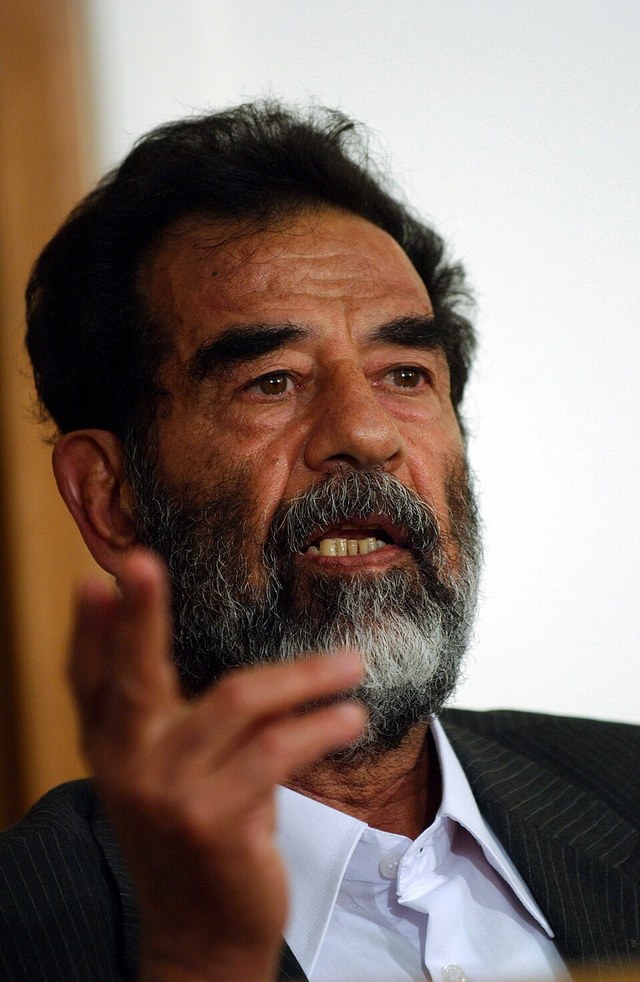
Photo: US Department of Defense (credited on Commons; DVIC still DDSD0503992), Public domain (US Department of Defense work)
Saddam Hussein
President of Iraq; Chairman of the Revolutionary Command Council; Secretary-General of the Ba'ath Party Regional Command · 1979 to 2003
Saddam Hussein: Read more
Deputy chairman of the RCC from 1969, he became president on 16 July 1979 when Bakr resigned and held the office until US-led forces took Baghdad on 9 April 2003; captured on 13 December 2003, convicted by the Iraqi High Tribunal over Dujail and hanged on 30 December 2006.
In their words
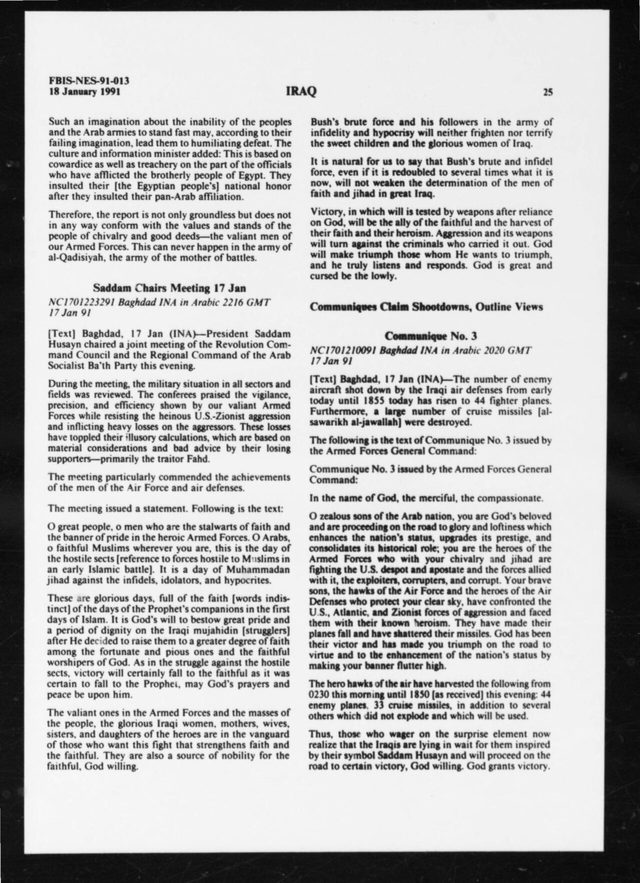
“The great duel, the mother of all battles has begun.... The dawn of victory nears as this great showdown begins!”
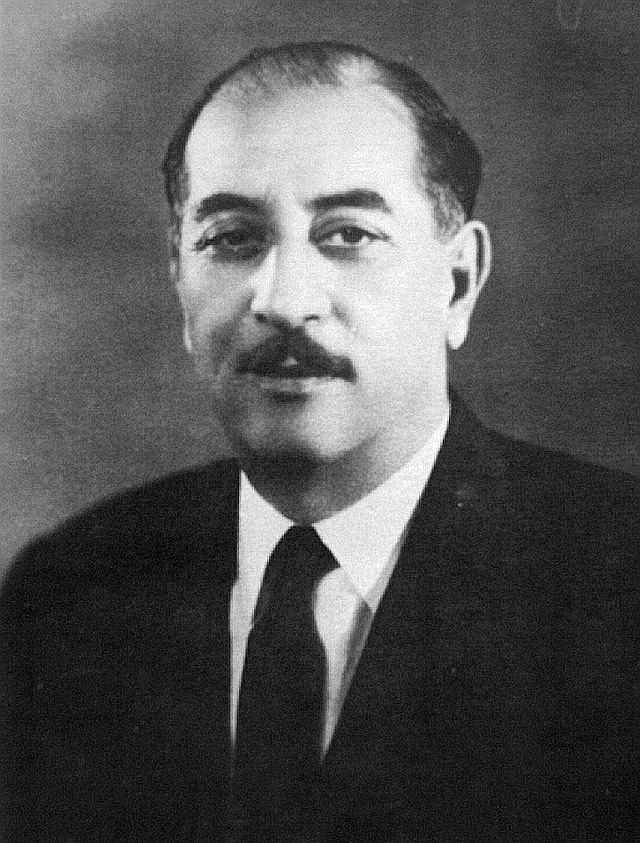
Photo: Unknown (Ministry of Information of the Republic of Iraq, as credited on Commons), Public domain per Commons (PD-Iraq basis); Iraq has no U.S. copyright relations other than the Marrakesh Treaty (Circular 38A)
Ahmed Hassan al-Bakr
President of Iraq and Chairman of the Revolutionary Command Council · 1968 to 1979
Ahmed Hassan al-Bakr: Read more
Army officer and Ba'ath leader who became president after the coup of 17 July 1968, held the presidency, the premiership and the RCC chairmanship, and resigned on 16 July 1979 in favour of Saddam Hussein; he died on 4 October 1982.
Party and state
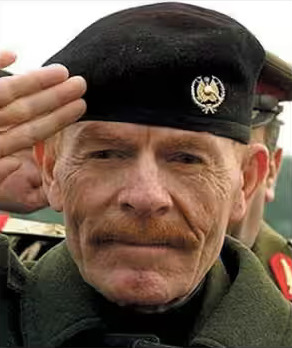
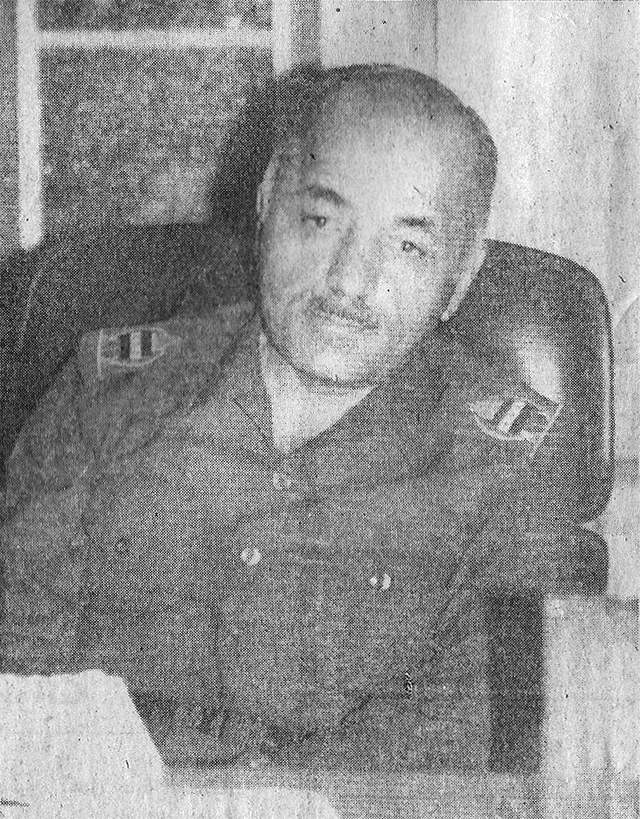
Photo: US Department of Defense, Public domain (work of a US military employee, per Commons)
Izzat Ibrahim al-Douri
Vice-Chairman of the Revolutionary Command Council · 1979 to 2003
Izzat Ibrahim al-Douri: Read more
Close associate of Saddam Hussein who was vice-chairman of the RCC and deputy to him in the party from 1979 to 2003, announced the result of the 2002 referendum, appeared as the King of Clubs on the US most-wanted cards of 2003, and died in 2020.
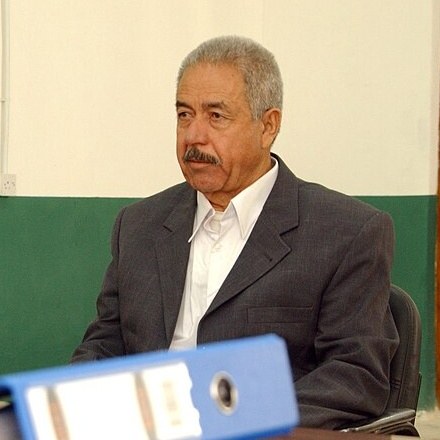
Photo: Iraqi News Agency (as credited on Commons), Public domain per Commons (PD-Iraq basis); Iraq has no U.S. copyright relations other than the Marrakesh Treaty (Circular 38A)
Taha Yassin Ramadan
Vice-President of Iraq · 1991 to 2003
Taha Yassin Ramadan: Read more
Ba'ath member who commanded the Popular Army and held the vice-presidency from 1991 to 2003; the Iraqi High Tribunal sentenced him to life over Dujail in 2006, the sentence was changed to death in 2007, and he was hanged on 20 March 2007.
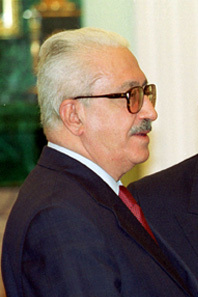
Photo: Presidential Press and Information Office (kremlin.ru), CC BY 4.0
Tariq Aziz
Foreign Minister; Deputy Prime Minister · 1983 to 1991
Tariq Aziz: Read more
Ba'ath member and former editor who was Iraq's foreign minister from 1983 to 1991 and a deputy prime minister until 2003, spoke for the government abroad in 1990 and 1991, surrendered in April 2003, was convicted by the Iraqi High Tribunal and died in custody in 2015.
Security and armed forces
BINo public-domain or openly licensed portrait found. Nearest: source (a US most-wanted card image, not verified for this page).
Barzan Ibrahim al-Tikriti
Director of the General Intelligence Directorate (Mukhabarat) · 1979 to 1983
Barzan Ibrahim al-Tikriti: Read more
Saddam Hussein's half-brother, who headed the intelligence service from 1979 to 1983 and later served as Iraq's representative to the UN in Geneva; the Iraqi High Tribunal sentenced him to death over Dujail on 5 November 2006 and he was hanged on 15 January 2007.
Photo: US Air Force photograph (credited on Commons; originally published on navy.mil), Public domain (US government work)
Ali Hassan al-Majid
Secretary-General of the Ba'ath Party Northern Bureau; Minister of Defence · 1987 to 1989
Ali Hassan al-Majid: Read more
Saddam Hussein's cousin, who ran the party's Northern Bureau from March 1987 to April 1989 during the Anfal campaign and was defence minister from 1991 to 1995; the Iraqi High Tribunal convicted him over Anfal in 2007 and over Halabja in 2010, and he was hanged on 25 January 2010.
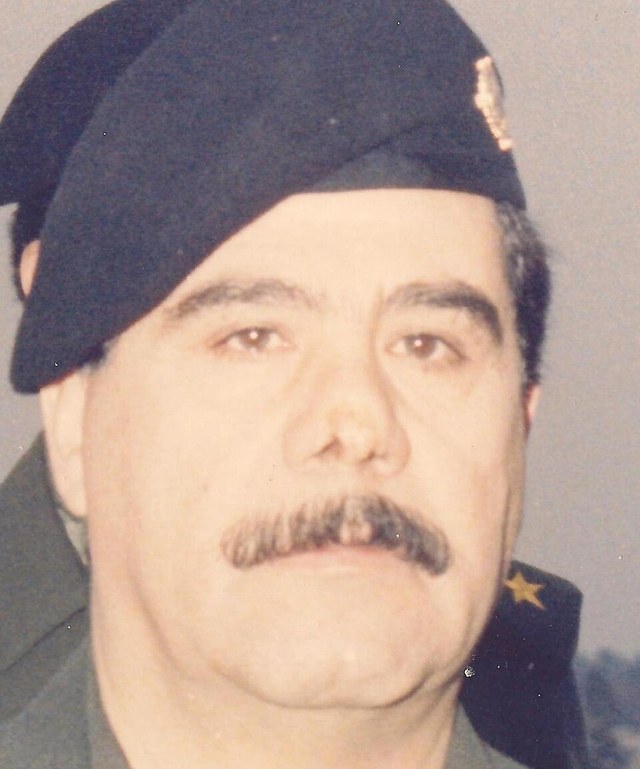
Photo: Iraqi Government / Iraqi Armed Forces photographer (as credited on Commons), Public domain per Commons (PD-Iraq basis); Iraq has no U.S. copyright relations other than the Marrakesh Treaty (Circular 38A)
Adnan Khairallah
Minister of Defence; Deputy Commander-in-Chief · 1977 to 1989
Adnan Khairallah: Read more
Army officer and cousin and brother-in-law of Saddam Hussein who was defence minister during the Iran-Iraq War and died on 5 May 1989 in a helicopter crash; the official account was an accident, which some sources dispute.
QHNo public-domain or openly licensed portrait of usable size found. Nearest: source, a 113 px frame from Iraqi state television, too small to host.
Qusay Hussein
Head of the Special Security Organisation · 1992 to 2003
Qusay Hussein: Read more
Saddam Hussein's younger son, who directed the Special Security Organisation from late 1991 or early 1992 to May 2001 and again from September 2002, and supervised the Republican Guard (Iraq Survey Group), was killed with his brother Uday in Mosul on 22 July 2003.
Propaganda and media
Photo: Iraqi State Television (as credited on Commons), Public domain per Commons (PD-Iraq basis); Iraq has no U.S. copyright relations other than the Marrakesh Treaty (Circular 38A)
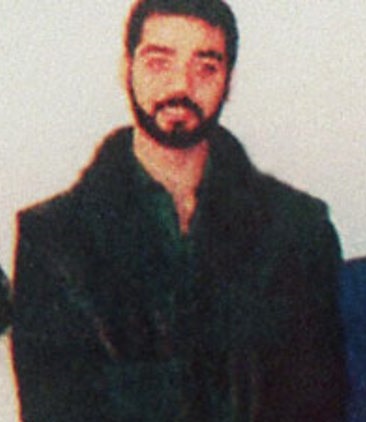
Uday Hussein
Chairman of the Iraqi Olympic Committee; owner of Babil; head of the Iraqi Journalists Union · 1984 to 2003
Uday Hussein: Read more
Saddam Hussein's elder son, who headed the Iraqi Olympic Committee from 1984 and the Journalists Union from 1988, owned the daily Babil and a youth television channel, and commanded the Fedayeen Saddam from 1995; he was killed in Mosul on 22 July 2003.
MSNo public-domain or openly licensed portrait found. Nearest: source, a television frame uploaded as own work under CC BY-SA 4.0 whose underlying broadcast rights are not cleared.
Mohammed Saeed al-Sahhaf
Minister of Information · 2001 to 2003
Mohammed Saeed al-Sahhaf: Read more
Foreign minister from 1992 to 2001 and information minister from 2001 to 2003, he gave the government's daily briefings to foreign reporters during the invasion of 2003.
Background and rise to power
Iraq had been a kingdom under British mandate and influence until the army coup of 14 July 1958 made it a republic. The Ba'ath Party (Hizb al-Ba'th al-'Arabi al-Ishtiraki, "Arab Socialist Ba'ath Party"), founded in Syria in the 1940s by Michel Aflaq and others, had an Iraqi branch that held office briefly in 1963 and was removed the same year. On 17 July 1968 Ba'athist officers and civilians, working with army officers, took the presidential palace; on 30 July the Ba'athists removed their non-party partners from the government. Ahmed Hassan al-Bakr, an army officer and party leader, became president, prime minister and chairman of the Revolutionary Command Council (RCC). His kinsman Saddam Hussein, who had joined the party as a young man and taken part in a failed attempt on President Abd al-Karim Qasim in 1959, became deputy chairman of the RCC in 1969 and ran the party's security organ (Sassoon).
The Interim Constitution of 16 July 1970 stated that "Iraq is a Sovereign People's Democratic Republic" whose "basic objective is the realization of one Arab State and the build-up of the socialist system" (Article 1) and that the RCC "is the supreme institution in the State" (Article 37). During the 1970s the state nationalised the Iraq Petroleum Company (1972), signed a treaty with the USSR (1972), and used rising oil revenue to expand schools, health care and the civil service; it also made peace with the Kurdish movement in 1970 and ended it in 1974 to 1975 (Marr and Al-Marashi).
On 16 July 1979 Bakr resigned, citing ill health, and Saddam Hussein became president, RCC chairman and secretary-general of the party's Regional Command. On 22 July he addressed a party meeting in the Hall of Congress in Baghdad at which a named group was called out and removed. Sources give 68 people arrested and 22 sentenced to death; they differ on how many were then executed, and the proceedings were filmed and circulated (Sassoon; Marr and Al-Marashi). Iraqi officials said the group had been part of a plot linked to Syria. Bakr died on 4 October 1982 (Britannica).
How power was organized
Formally the RCC was the supreme body: under the constitution it elected the president and vice-presidents, passed decrees with the force of law and could prosecute ministers (Articles 37 and 38). Ba'ath Party organisation ran from the Regional Command (Iraq) and the National Command (the pan-Arab body) down to cells in workplaces, schools and army units. Sassoon, working from captured party records, shows a party with hundreds of thousands of members, a bureaucracy of its own, and the use of membership for access to jobs and promotion. Makiya (Republic of Fear, 1989) describes the same structure as one held together by fear of the security apparatus. The two accounts are read as complementary by some scholars and as in tension by others, and the question of how far participation was voluntary is taken up again below.
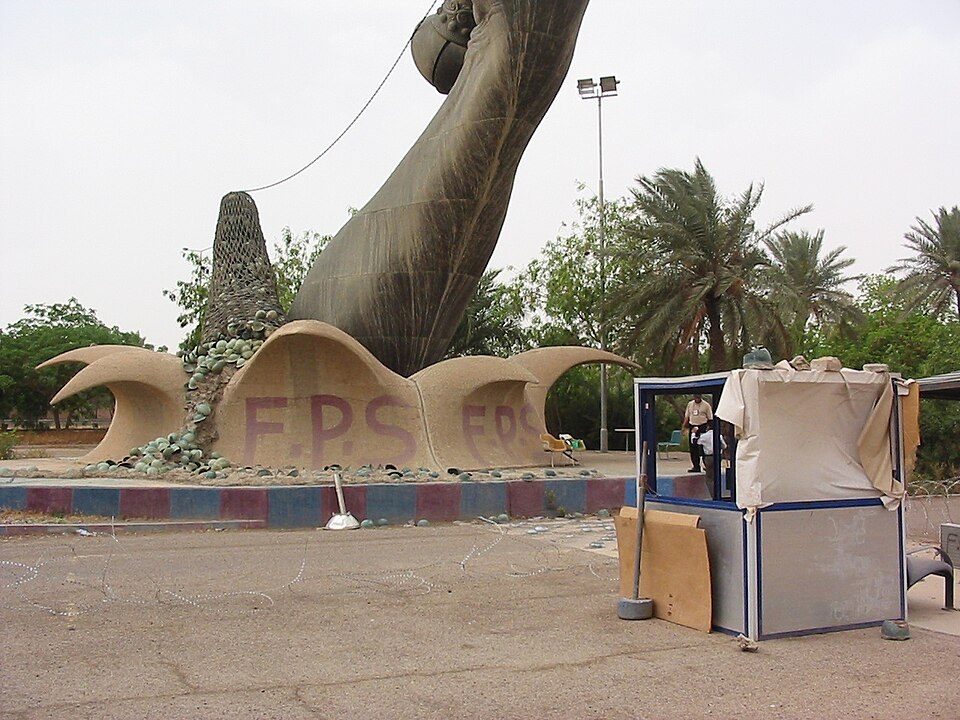
The base of the Victory Arch (the Swords of Qadisiyya), opened in 1989 to mark the end of the Iran-Iraq War, photographed in 2004 after the fall of the government. Source: NetSerfer, public domain, via Wikimedia Commons, Public domain (the photographer released it into the public domain worldwide, as stated on the Commons file page); the monument is an Iraqi work and Iraq has no U.S. copyright relations other than the Marrakesh Treaty (U.S. Copyright Office, Circular 38A).
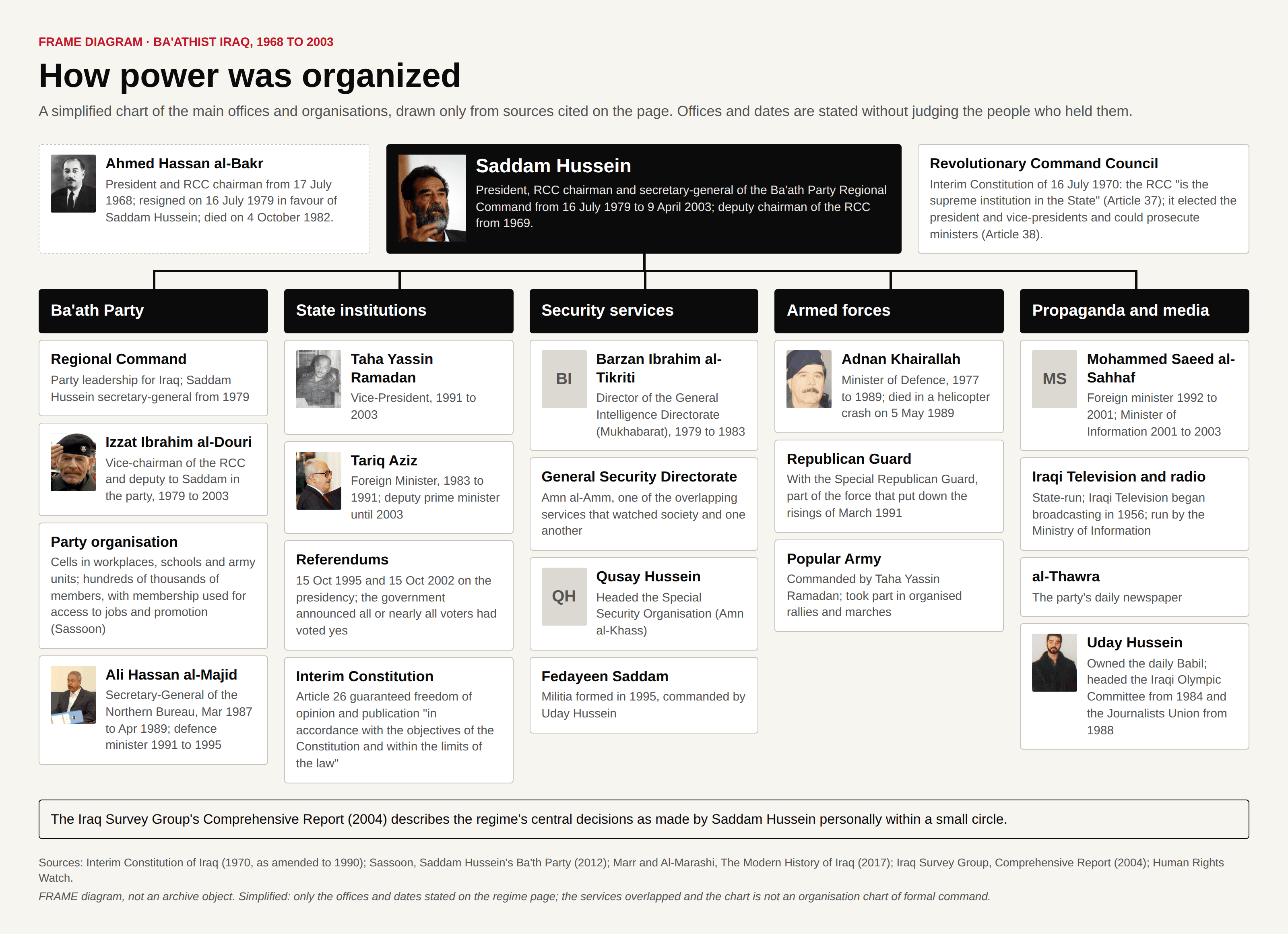
The main offices and organisations of the Iraqi state under the Ba'ath Party, 1968 to 2003, simplified from the sources cited on this page. Source: FRAME diagram. Portraits, cropped to thumbnails: Iraqi Government, via a collectors' forum and Wikimedia Commons; Ministry of Information of the Republic of Iraq, via Wikimedia Commons; US Air Force, via Wikimedia Commons; US Department of Defense, via Wikimedia Commons; US Department of Defense, via Wikimedia Commons; Iraqi News Agency, via Al-Qadissiya newspaper and Wikimedia Commons; kremlin.ru, CC BY 4.0, via Wikimedia Commons; Iraqi State Television, via Wikimedia Commons, CC BY 4.0 (FRAME archive content); portraits: CC BY 4.0; Public domain (US Department of Defense work); Public domain (US government work); Public domain (work of a US military employee, per Commons); Public domain per Commons (PD-Iraq basis); Iraq has no U.S. copyright relations other than the Marrakesh Treaty (Circular 38A).
Saddam Hussein held the presidency, the RCC chairmanship and, from 1979, the premiership, and appointed relatives and men from his home district of Tikrit to key posts: his half-brother Barzan Ibrahim al-Tikriti ran the intelligence service from 1979 to 1983; his cousin Adnan Khairallah was minister of defence from 1977 to 1989; his cousin Ali Hassan al-Majid headed the party's Northern Bureau from 1987 to 1989 and later the defence ministry; and his sons Uday and Qusay were given command of the media and Olympic bodies and of the Special Security Organisation. The Iraq Survey Group's Comprehensive Report (the Duelfer Report, 30 September 2004) describes the regime's central decisions as made by Saddam Hussein personally within a small circle.
Several overlapping services watched society and one another: the General Intelligence Directorate (Mukhabarat), the General Security Directorate (Amn al-Amm), military intelligence, the Special Security Organisation (Amn al-Khass) responsible for the president's protection and for concealment, the Republican Guard and Special Republican Guard, and, from 1995, the Fedayeen Saddam militia. The state conducted referendums on the presidency on 15 October 1995 and 15 October 2002; the government announced that all or nearly all voters had voted yes (in 2002 it announced 100 per cent of 11,445,638 voters). The 1990 text of the constitution guaranteed "freedom of opinion, publication, meeting, demonstrations and formation of political parties, syndicates, and societies in accordance with the objectives of the Constitution and within the limits of the law" (Article 26); in practice all licensed newspapers, radio and television were owned by the state, the party or the president's family, and no independent press operated inside the country (Marr and Al-Marashi; Duelfer Report).
The state also used force at home and abroad on a large scale. It invaded Iran on 22 September 1980 in a war that ran to 20 August 1988. In 1988 it carried out the Anfal campaign against Kurdish villages in the north. Human Rights Watch (Genocide in Iraq, 1993) estimated that 50,000 to 100,000 people were killed, with Kurdish authorities giving a higher figure, and recorded the chemical attack on Halabja on 16 March 1988, in which published estimates run from about 3,200 to 5,000 dead. On 24 June 2007 the Iraqi High Tribunal convicted Ali Hassan al-Majid and others over Anfal; on 17 January 2010 it sentenced him to death over Halabja (NPR; Al Jazeera). Iraqi officials attributed the Halabja attack to Iran in statements in the following weeks (The Trench, summarising contemporary reports), and Tariq Aziz repeated the claim in 2007 (Al Jazeera); Iraqi state documents recovered after 1991 refer to the attack as Iraqi. On 2 August 1990 Iraq invaded Kuwait; after the coalition's air campaign (17 January 1991) and ground war (24 to 28 February), risings began in the south and north in March 1991 and were put down by the Republican Guard; Human Rights Watch (Endless Torment, 1992) documented the killing of thousands of civilians, and estimates of the total dead run from tens of thousands upward. The sanctions imposed by UN Security Council Resolution 661 (6 August 1990) stayed in place until 2003.
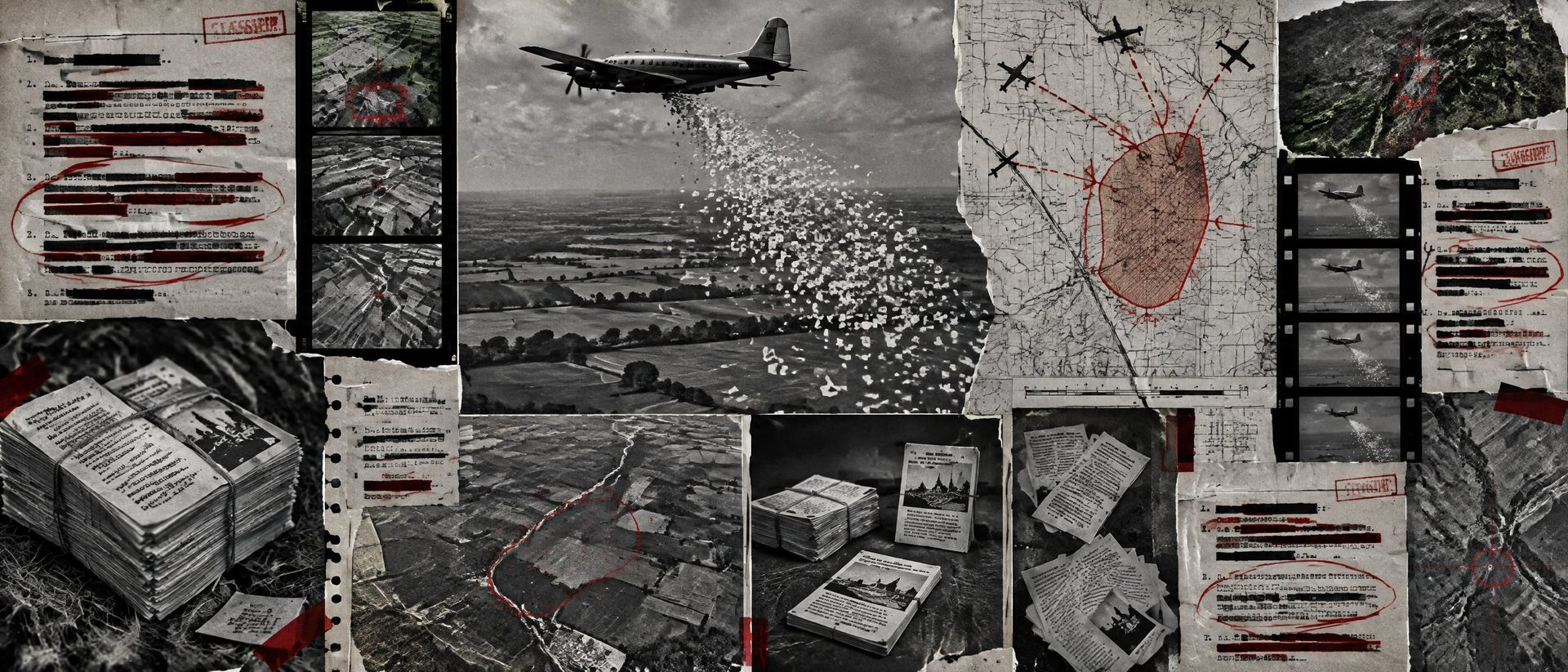
Illustration, not an archive object
The propaganda apparatus
Offices and channels. The Ministry of Information (at times "Culture and Information") ran Iraqi Television, which began broadcasting in 1956, state radio and the news agency, and licensed the press. The party's daily was al-Thawra ("The Revolution"). Babil, a daily owned by Uday Hussein, was the best known of the family's papers; Uday also headed the Iraqi Journalists Union (from 1988) and the Iraqi Olympic Committee (from 1984), and ran a youth television channel and a sports daily. Mohammed Saeed al-Sahhaf was foreign minister from 1992 to 2001 and information minister from 2001 to 2003, and gave the regime's daily briefings to foreign reporters in 2003. Local party branches, trade unions, schools and the Popular Army carried the message by organised rallies and marches.
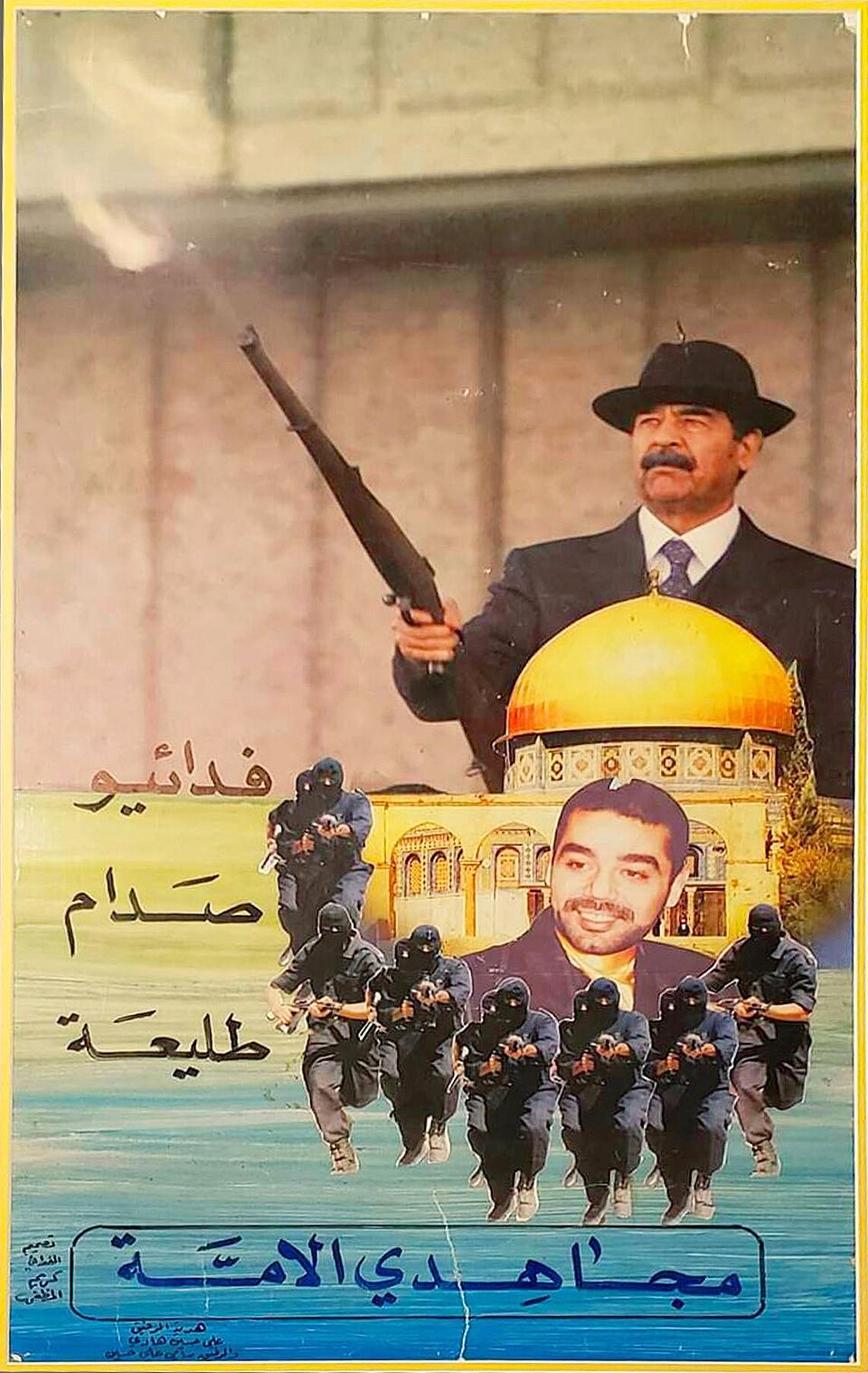
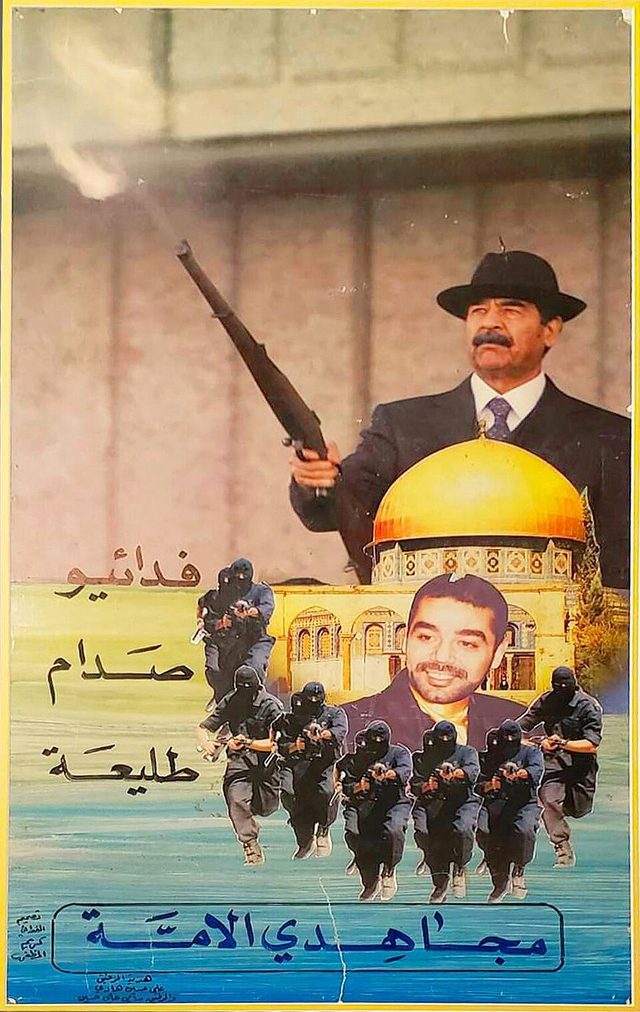
Content note: Glorifying poster of Saddam Hussein firing a rifle, with masked armed paramilitaries and the Dome of the Rock. This object is shown as it was published. Why
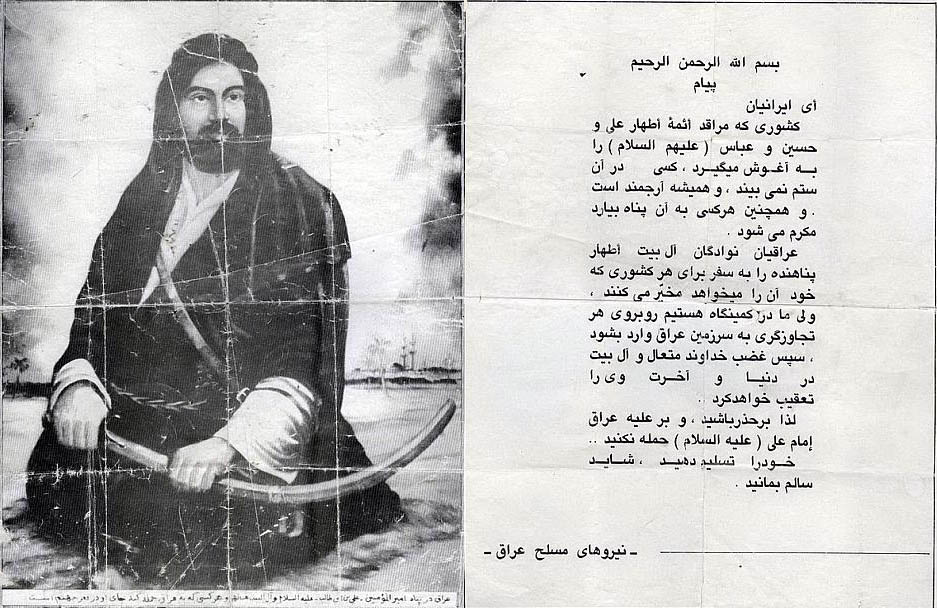
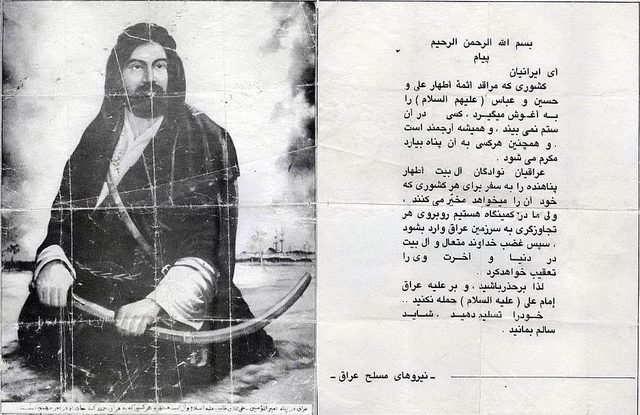
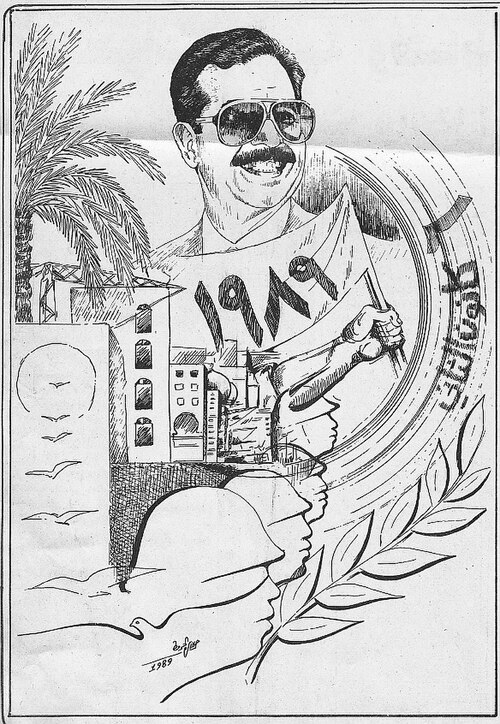
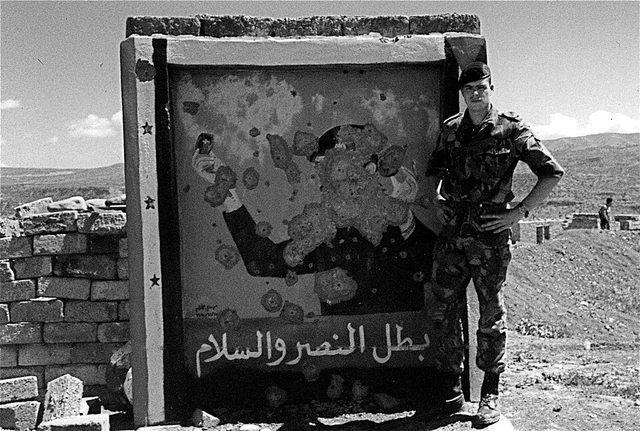
The leader cult. Portraits, murals and statues of Saddam Hussein stood in public buildings and squares across the country, in uniform, in Arab dress and in a business suit, and in some images beside Nebuchadnezzar or the twelfth-century commander Saladin. His birthday, 28 April, was marked as a national holiday. The state reconstructed Babylon from 1978 and held an International Babylon Festival from 1987; many of the bricks of the new palace were stamped with his name ("In the era of Saddam Hussein, son of Nebuchadnezzar, Babylon was revived"). In the Iran-Iraq War, state media and the army named the conflict Qadisiyyat Saddam ("Saddam's Qadisiyya") after the battle of al-Qadisiyya in about 636 in which Arab forces defeated the Sasanian Persian army, and the Victory Arch (the "Swords of Qadisiyya") in Baghdad, opened in 1989, shows two forearms, said to be modelled on the president's, holding crossed swords; Iranian helmets are reported to have been set into the base (Makiya, The Monument). Messages aimed at Iranian troops used the religious frame as well, as in a leaflet of about 1980 addressed to Iranian soldiers beside a portrait of Imam Ali.
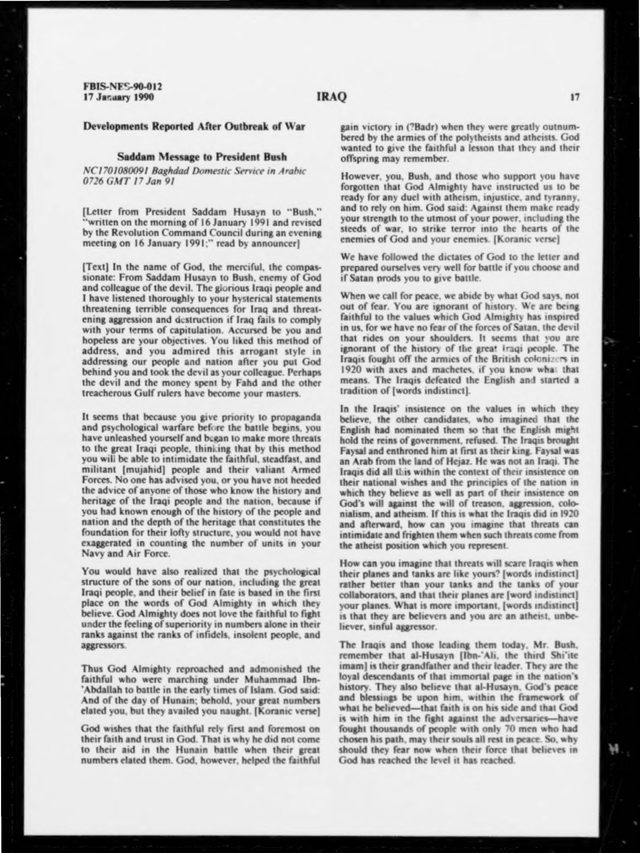
The faith campaign. In January 1991 the state added the words Allahu Akbar to the national flag, in the president's handwriting, and in 1993 the government began what it called the al-Hamla al-Imaniyya (the "Faith Campaign"), which expanded religious instruction, built mosques and, in 1994, introduced amputation for theft. Scholars disagree on what it was. Amatzia Baram (Saddam Husayn and Islam, 2014) reads it as a real shift by Saddam Hussein and the party towards Islam after 1991. Samuel Helfont (Compulsion in Religion, 2018), using captured state and party records, argues that it continued a policy begun in 1979 of controlling religious institutions and using religious language for state ends, rather than a new conversion.
Imposed or embraced. A second dispute concerns how far the cult and the party's slogans were imposed and how far they were embraced. Makiya's Republic of Fear and The Monument stress compulsion: portraits and praise were required, and failure to take part was dangerous. Sassoon, from the party records, adds that many took part for access to work, schooling and promotion. Neither author claims that the record can show what Iraqis privately believed, and the surviving documents were produced by the state itself.
The state's account of Halabja, Anfal and 1991. Iraqi officials attributed Halabja to Iran in statements in the weeks after the attack (The Trench; Al Jazeera, 2007). For Anfal, HRW (1993) records that the government used terms such as "collective measures", "return to the national ranks" and "resettlement in the south". The Iraqi High Tribunal and Human Rights Watch describe those events as killings of civilians (Anfal being judged genocide by the tribunal in 2007). For the 1991 risings, HRW's Endless Torment describes the government's reprisals; Sassoon and Helfont draw on the Ba'ath Party and state records captured in 1991 and 2003.
Coalition psychological operations aimed at Iraq, 1991 and 2003. The US-led coalition ran its own organised messaging towards Iraqi forces and civilians in both wars. The archive applies the same technique definitions to it as to Iraq's own output, and the differences are set out below.
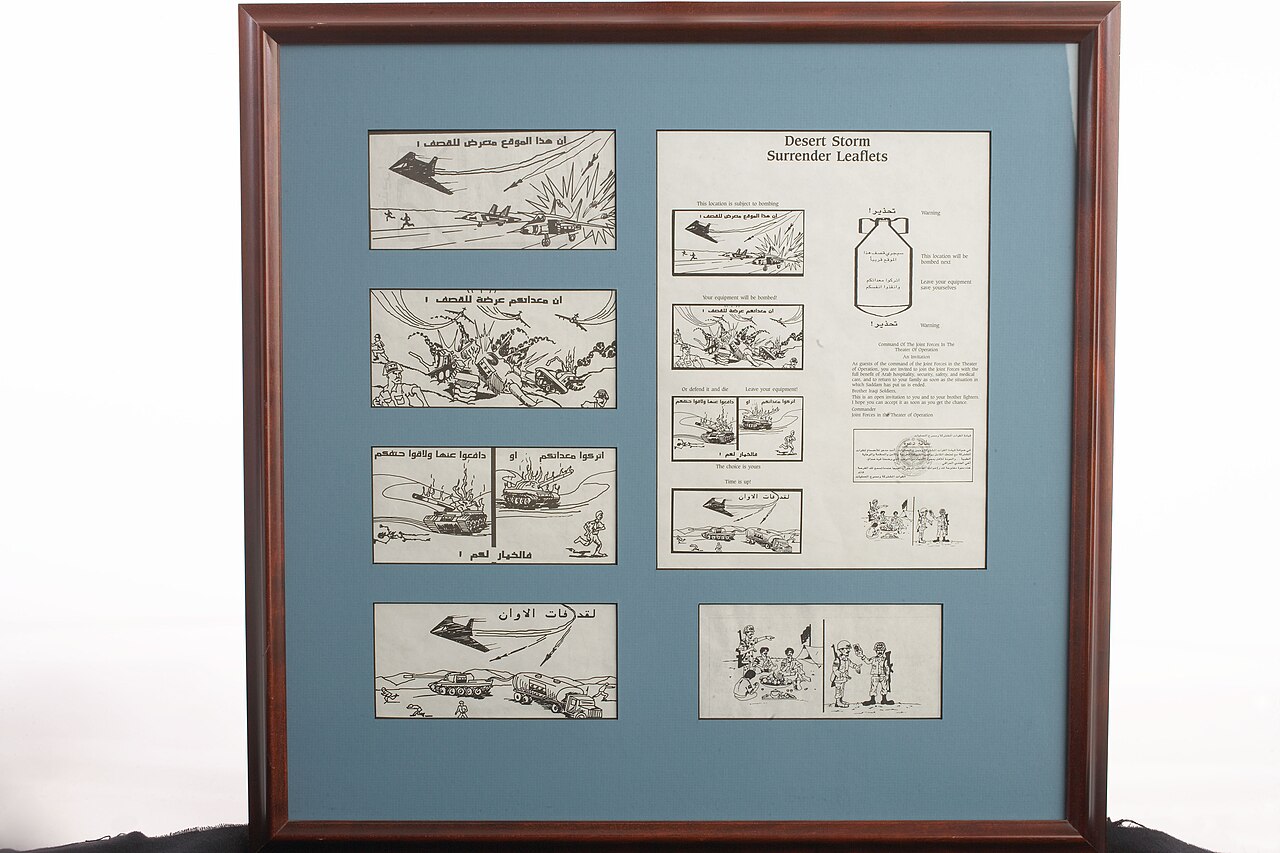
1991. A summary of the US Army 4th Psychological Operations Group's records gives over 29 million copies of 38 different leaflets between 30 December 1990 and 28 February 1991, on five themes ("Surrender", "US/Coalition Superiority", "Inevitability", "Saddam is the Cause" and "Abandon Equipment") (Friedman, psywarrior.com). The Army's own 1997 essay itemises 18.7 million leaflets from high-altitude MC-130 aircraft, 5.5 million from leaflet bombs on F-16 and B-52 aircraft (3.3 and 2.2 million) and 342,000 by waterborne insertion, manpack and other means, about 24.5 million in all, plus a further Kuwait City figure whose number is illegible in the copy read; the itemised total and the 29 million figure therefore differ, and the archive does not reconcile them, and records that Iraqi units forbade soldiers to carry coalition leaflets (AUSA Landpower Essay 97-3). Some leaflets told soldiers how to surrender and carried a pass for safe conduct, as in the leaflets shown by the CIA; others warned of coming bombing. "Voice of the Gulf" began broadcasting on 19 January 1991 (Friedman's summary of 4th PSYOP Group records) and, in the Army essay, ran 24 hours a day from three platforms; the EC-130 Volant Solo aircraft of the 193d Special Operations Group first monitored Iraqi radio and relayed Voice of America, then became the main aerial conduit (AUSA Landpower Essay 97-3; Friedman). The Iraqi state answered by jamming the station and by banning possession of coalition leaflets, and the Army records that Iraqi units warned soldiers the leaflets were chemically contaminated. The Army essay counts more than 87,000 prisoners and says 98 per cent of them reported having seen or kept a leaflet and acted as it urged, and that 58 per cent heard Voice of the Gulf; these are the Army's own survey figures, and analysts such as Cordesman and Wagner treat the weight of leaflets, bombing, ground combat and conditions in causing surrenders as unsettled.
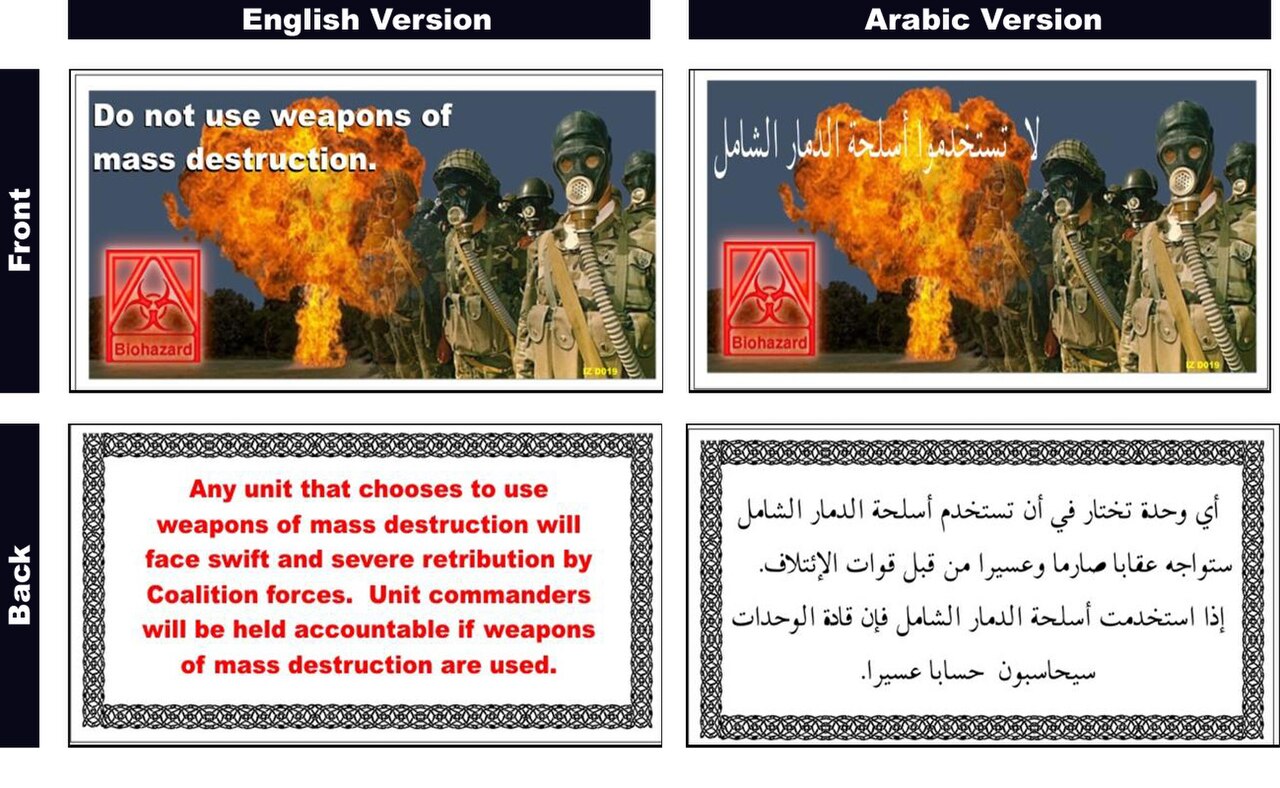
2003. Between 12 December 2002 and 18 March 2003 US forces dropped over twenty million leaflets, and over forty million by mid-April; leaflets told Iraqis which frequencies carried a coalition "Information Radio" programme, and Commando Solo EC-130Es and shipborne transmitters broadcast into Iraq (US Army Special Operations history). Defence officials confirmed in January 2003 that e-mails had been sent to Iraqi military commanders, promising protection to those who did not use weapons of mass destruction (Nextgov, 23 March 2003); press reports also referred to telephone messages, which the archive has not confirmed in an official history. A leaflet of February 2003 warned Iraqi forces not to use weapons of mass destruction. After the fall of the government, the Pentagon contracted for an Iraqi Media Network under the Coalition Provisional Authority from May 2003 (Arab Media and Society).
Same definitions, different scale and context. The archive scores these messages with the same list of techniques; the surrender leaflets and bombing warnings most clearly show fear appeal, and the "inevitability" theme corresponds to bandwagon. The Iraqi state's domestic output differs in setting: it was addressed for thirty-five years to its own population under a single party with no independent press, and was backed by the security services described above. The coalition's was a time-limited wartime operation addressed to enemy forces and civilians, from outside the country, by military units. The two are described side by side here because the definitions apply to both, not because their scale or consequences are equal.
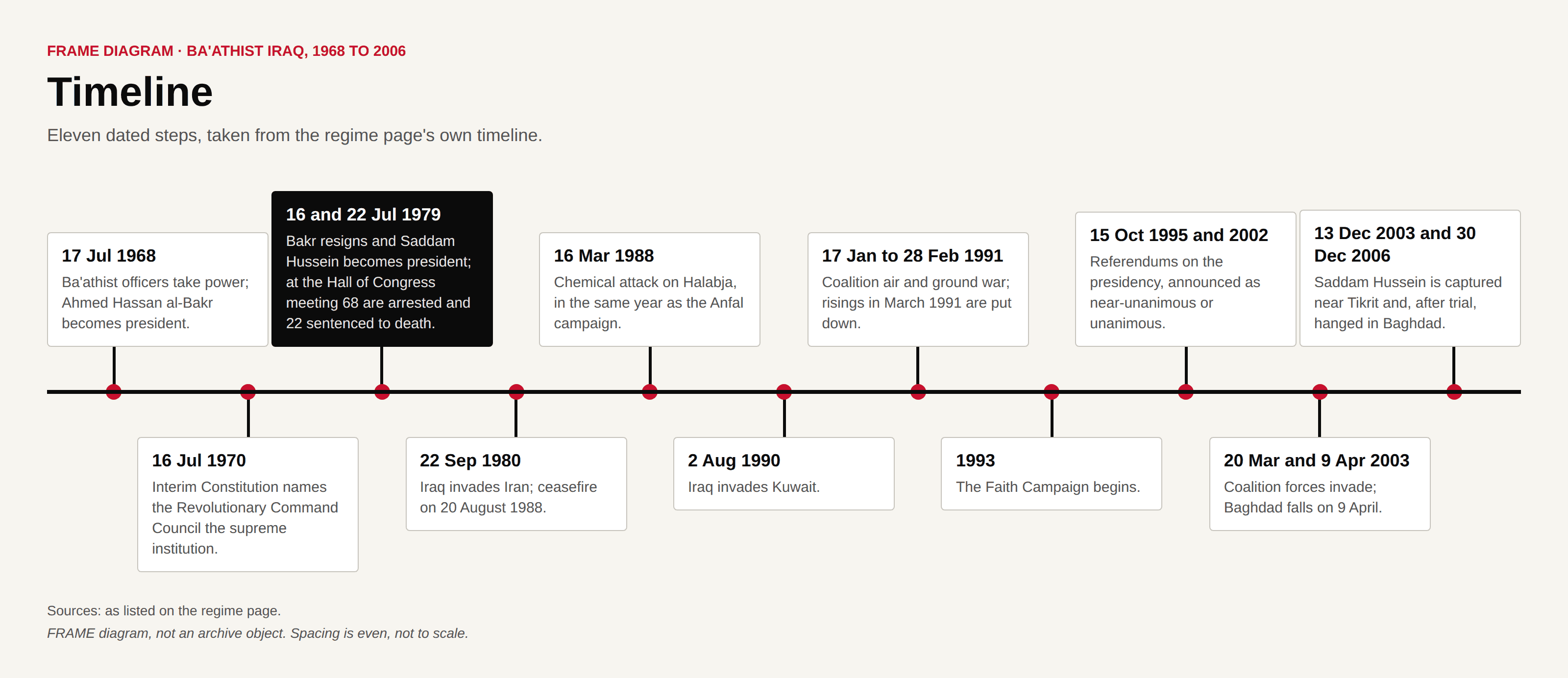
Timeline
17 July 1968: Ba'athist officers take power; Ahmed Hassan al-Bakr becomes president (the Ba'athists remove non-party partners on 30 July).
16 July 1970: the Interim Constitution names the Revolutionary Command Council the supreme institution.
16 July 1979: Bakr resigns; Saddam Hussein becomes president and RCC chairman.
22 July 1979: the Hall of Congress meeting; 68 arrested, 22 sentenced to death.
22 September 1980: Iraq invades Iran; the war ends with a ceasefire on 20 August 1988.
16 March 1988: chemical attack on Halabja, in the same year as the Anfal campaign (HRW treats Halabja as not technically part of Anfal).
2 August 1990: Iraq invades Kuwait.
17 January to 28 February 1991: the coalition's air and ground war; Iraqi forces leave Kuwait; risings in March 1991 are put down.
1993: the Faith Campaign begins.
15 October 1995 and 15 October 2002: referendums on the presidency, announced as near-unanimous or unanimous; on 16 October 2002 Izzat Ibrahim al-Douri announced 100 percent yes, 11,445,638 votes (UPI).
20 March 2003: coalition forces invade; 9 April 2003 Baghdad falls.
13 December 2003: Saddam Hussein is captured near Tikrit.
30 December 2006: Saddam Hussein is hanged in Baghdad.
Content note: Wartime leaflet showing gas-masked soldiers, an explosion and a biohazard sign, with a threat of retribution. This object is shown as it was published. Why
Ba'athist Iraq, 17 July 1968 to 30 December 2006, using the dates given on this page; spacing is even, not to scale, simplified from the sources cited on this page. Source: FRAME diagram, drawn from the sources listed on this page, CC BY 4.0 (FRAME archive content).
How it ended
Illustration, not an archive object
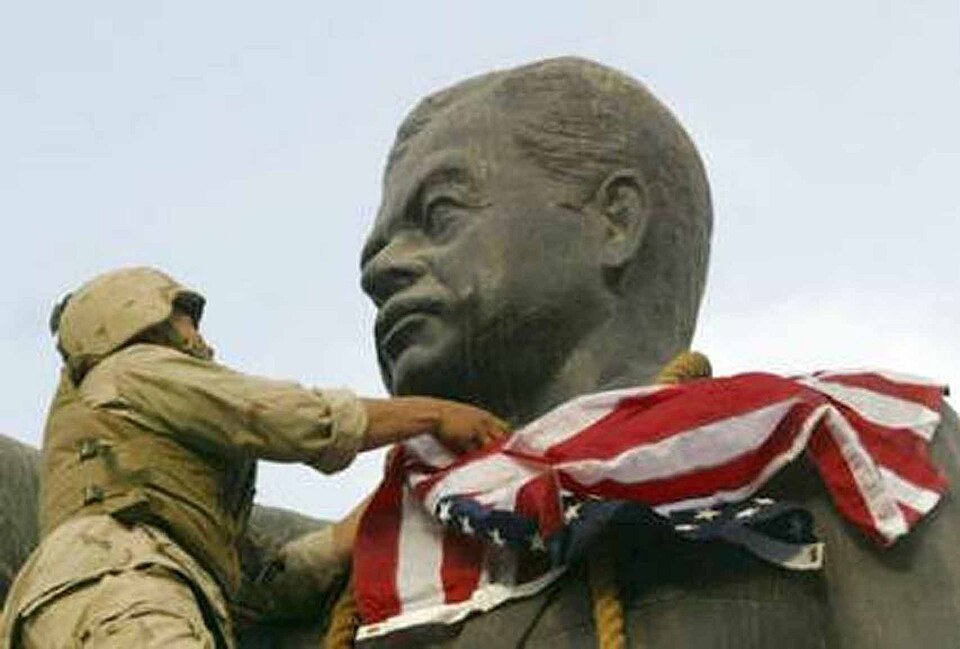
On 20 March 2003 US-led forces invaded, and on 9 April they entered central Baghdad. That afternoon US Marines helped bring down a statue of Saddam Hussein in Firdos Square before the cameras of foreign television crews, a scene broadcast worldwide. Accounts differ on how spontaneous it was: Peter Maass and an NPR report (2008) describe a Marine unit and an Army psychological operations team that selected the statue, cleared the square and used a recovery vehicle, with a small crowd; some participants and reporters describe Iraqis who joined of their own accord. Saddam Hussein was captured on 13 December 2003 near ad-Dawr, was tried by the Iraqi Special Tribunal (later the Iraqi High Tribunal) for the 1982 killings at Dujail, was sentenced to death on 5 November 2006 and was hanged in Baghdad on 30 December 2006 (Bremer transcript; HRW).
The statue in Firdos Square on 9 April 2003, before it was pulled down; accounts differ on how far the scene was organised by US forces. Source: US Marine Corps, public domain, via Wikimedia Commons, Public domain (US Marine Corps official image, as tagged on the Commons file page).
This page uses the same structure and definitions as every other regime page: a technique is listed only where the archive's working definition and a documented example fit, the same technique ids are applied to every regime, and offices and dates are stated without judging the people who held them. The scale and purpose of what this state did are set out as history and by the findings of named courts and organisations, not ranked: a one-party state under one man for twenty-four years that waged war on its neighbours, was found to have carried out mass killings of Kurds and of civilians in 1991, and ran a leader cult. The coalition's own psychological operations are described in the section above under the same definitions and are not equated with the Iraqi state's domestic output. Other regime pages record other systems, each with its own scale, intent and context.
Sources
Interim Constitution of Iraq, 16 July 1970 (text as amended to 1990), Articles 1, 26, 37 and 38: https://www.servat.unibe.ch/icl/iz01000_.html
Joseph Sassoon, Saddam Hussein's Ba'th Party: Inside an Authoritarian Regime (Cambridge University Press, 2012).
Kanan Makiya (as Samir al-Khalil), Republic of Fear: The Politics of Modern Iraq (University of California Press, 1989; updated 1998); Kanan Makiya, The Monument: Art, Vulgarity and Responsibility in Iraq (University of California Press, 1991).
Samuel Helfont, Compulsion in Religion: Saddam Hussein, Islam, and the Roots of Insurgencies in Iraq (Oxford University Press, 2018); Amatzia Baram, Saddam Husayn and Islam, 1968 to 2003: Ba'thi Iraq from Secularism to Faith (Johns Hopkins University Press, 2014).
Phebe Marr and Ibrahim Al-Marashi, The Modern History of Iraq, 4th edition (Westview, 2017).
Human Rights Watch, Genocide in Iraq: The Anfal Campaign Against the Kurds (1993): https://www.hrw.org/reports/1993/iraqanfal/ ; Middle East Watch, Endless Torment: The 1991 Uprising in Iraq and Its Aftermath (1992): https://www.hrw.org/reports/pdfs/i/iraq/iraq.926/iraq926full.pdf
Iraq Survey Group, Comprehensive Report of the Special Advisor to the DCI on Iraq's WMD (Duelfer Report), 30 September 2004.
Iraqi High Tribunal, Anfal verdict (24 June 2007) and Dujail verdict (5 November 2006); Human Rights Watch, "Judging Dujail" (November 2006): https://www.hrw.org/reports/2006/iraq1106/2.htm
US Army Special Operations history, "Reaching Out: Psychological Operations in Operation Iraqi Freedom": https://arsof-history.org/articles/v1n1_reaching_out_page_1.html
Association of the United States Army, Landpower Essay 97-3, "Psychological Operations in Desert Shield, Desert Storm and Urban Freedom" (1997): https://www.ausa.org/sites/default/files/LPE-97-3-Psychological-Operations-in-Desert-Shield-Desert-Storm-and-Urban-Freedom.pdf
Herbert A. Friedman, "Gulf War Leaflets" and "4th PSYOP Group", psywarrior.com (summaries of Army records): https://www.psywarrior.com/gulf1.html ; https://psywarrior.com/4thgulf.html
MERIP, "Bending History" (2011) and "Monumental Disrespect" (2003), on Qadisiyyat Saddam and Babylon: https://www.merip.org/2011/01/bending-history/ ; https://www.merip.org/2003/09/monumental-disrespect/
Anthony H. Cordesman and Abraham R. Wagner, The Lessons of Modern War, Volume IV: The Gulf War (Westview, 1996).
Peter Maass, "The Toppling", The New Yorker, 10 January 2011; NPR, "Reminder: Saddam Statue Was Toppled by Psy-Ops", 9 April 2008: https://www.npr.org/2008/04/09/89489923/reminder-saddam-statue-was-toppled-by-psy-ops
Transcript of Ambassador Bremer's remarks, 14 December 2003, Coalition Provisional Authority: https://govinfo.library.unt.edu/cpa-iraq/transcripts/20031214_Dec14_Saddam_Capture.htm
Arab Media and Society, "Iraq: A Diverse Media": https://arabmediasociety.com/iraq-a-diverse-media/
Britannica, "Ahmad Hasan al-Bakr": https://www.britannica.com/biography/Ahmad-Hasan-al-Bakr
NPR, "Iraq's 'Chemical Ali' Sentenced to Death", 24 June 2007: https://www.npr.org/2007/06/24/11342053/iraqs-chemical-ali-sentenced-to-death ; Al Jazeera, "'Chemical Ali' sentenced to death", 17 January 2010: https://www.aljazeera.com/news/2010/1/17/chemical-ali-sentenced-to-death-3 ; Al Jazeera, "Aziz blames Iran for Kurd gassing", 6 March 2007: https://www.aljazeera.com/news/2007/3/6/aziz-blames-iran-for-kurd-gassing
The Trench, "Allegations of Iranian Use of Chemical Weapons in the 1980-88 Gulf War: Halabja": https://www.the-trench.org/allegations-of-iranian-use-of-chemical-weapons-in-the-1980-88-gulf-war-halabja
UPI, "Saddam wins 100 percent of Iraqi vote", 16 October 2002: https://www.upi.com/Archives/2002/10/16/Saddam-wins-100-percent-of-Iraqi-vote/7381034740800/
Nextgov, "DOD aims psy-ops at Iraqi officers", 23 March 2003: https://www.nextgov.com/people/2003/03/dod-aims-psy-ops-at-iraqi-officers/224438/
Iraq Survey Group Final Report, vol. 1, annex C (Special Security Organisation and Republican Guard): https://www.globalsecurity.org/wmd/library/report/2004/isg-final-report/isg-final-report_vol1_rsi-anx-c.htm
Saddam Hussein quotation, 17 January 1991: Washington Post, 17 January 1991 (N. Boustany), as reproduced by Wikiquote: https://en.wikiquote.org/wiki/Saddam_Hussein


.jpg)

.jpg)


