Content note. This case gives figures for imprisonment, torture and killings under martial law, describes a bombing that killed nine people, and quotes labels used to brand people as communists and terrorists ("red-tagging"). The labels are quoted as evidence of the method. They are not this archive's description of anyone.
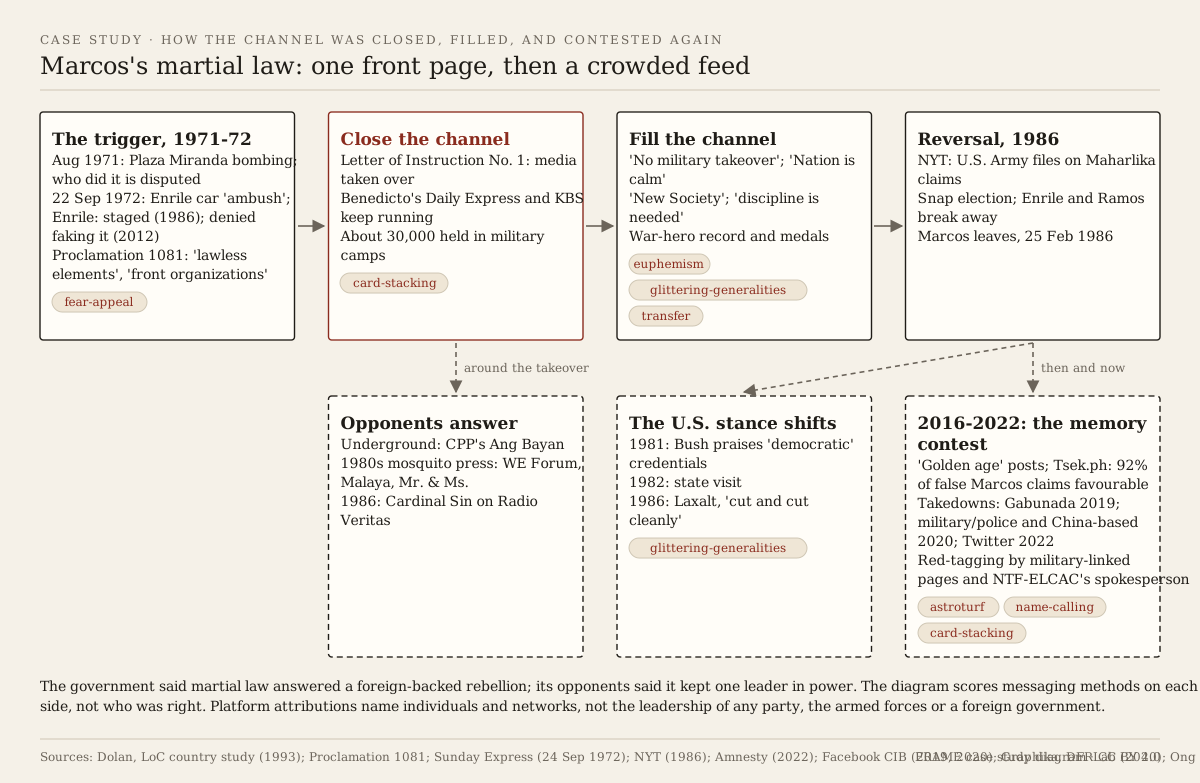
In one line: in 1972 President Ferdinand Marcos placed the Philippines under martial law, citing a communist conspiracy, closed all media except outlets owned by his associates and promoted a "New Society" under the slogan of discipline; opponents answered through an underground and "mosquito" press and, in 1986, church radio; from 2016 the era was contested again on social media, where platforms removed covert networks linked to a campaign operator, the military and police, and a China-based operation.
What happened
- 21 August 1971. Grenades at a Liberal Party rally in Manila's Plaza Miranda kill 9 people and wound about 100. Marcos blames leftists and suspends habeas corpus. Responsibility is disputed: the Library of Congress country study says evidence pointed to government involvement (Dolan 1993, p. 51); the journalist Gregg Jones and former Communist Party of the Philippines (CPP) officials interviewed by the Washington Post (1989) say the CPP leadership planned it. CPP founder Jose Maria Sison denied this.
- 21-23 September 1972. Proclamation 1081 is dated 21 September. It states that "lawless elements" with the "support of a foreign power" and guided by "Marxist-Leninist-Maoist teachings" work through "front organizations" among peasants, workers, students and "mass media personnel". On 22 September Defense Secretary Juan Ponce Enrile's car is reported ambushed, the immediate trigger. Marcos announces martial law on television on 23 September.
- The ambush, two accounts. In February 1986, breaking with Marcos, Enrile tells a press conference the ambush was staged; the country study records that he admitted his unoccupied car had been shot up by his own people (Dolan 1993, p. xxvii). His 2012 memoir denies that he faked his own ambush (Inquirer, 2012; Rappler).
- 22-28 September 1972. Letter of Instruction No. 1 orders the military to take over private newspapers, radio and television. The Manila Times, Manila Chronicle and others close; Marcos associate Roberto Benedicto's Daily Express and Kanlaon Broadcasting System keep operating (Rappler). Senator Benigno Aquino Jr., journalists and activists are arrested; about 30,000 are held in military camps (Dolan 1993, p. 52).
- 24 September 1972. The Sunday Express, the only paper circulating, runs "FM DECLARES MARTIAL LAW" beside "But civilian gov't still functions; no military takeover" and "Nation is calm; business, life go on normally". The same story reports that ABS-CBN's studios had been closed.
- 1972-1981. Marcos presents martial law as the start of a "New Society" (Bagong Lipunan) and a "revolution from the top" (Dolan 1993, pp. 52-53). Its slogan is "Sa ikauunlad ng bayan, disiplina ang kailangan" ("For the nation's progress, discipline is needed") (Martial Law Museum). Newspapers are controlled by Marcos's "relatives, friends, and cronies" until 1986 (p. 230). His stories of leading a guerrilla unit, the Maharlika, and his many claimed medals are "inflated by the media into a personality cult" (p. 49).
- Opponents' channels. The CPP publishes Ang Bayan underground, alongside Liberation and Taliba ng Bayan. In the 1980s an aboveground "mosquito press" grows: WE Forum, Malaya, Mr. & Ms. and the bishops' Signs of the Times (Bulatlat, 2020; Melencio).
- 17 January 1981. Proclamation 2045 formally ends martial law. Marcos wins the June 1981 election, which the main opposition boycotted (Dolan 1993, p. 56). On 30 June, U.S. Vice President George H. W. Bush toasts Marcos in Manila and praises his adherence to democratic principles and processes (UPI, 1981).
- 21 August 1983. Aquino is shot dead on his return to Manila; newspapers then grow more independent (p. 230).
- 23 January 1986. The New York Times reports that the U.S. Army concluded after the war that Marcos's claims to have led the Maharlika were "fraudulent" and "absurd"; it recognised 111 men on his roster only for service after January 1945.
- 22-25 February 1986. After the disputed 7 February snap election, Enrile and General Fidel Ramos demand Marcos's resignation. Cardinal Jaime Sin, on the church-run Radio Veritas, asks people to bring food to the rebels and block troops without violence. U.S. Senator Paul Laxalt advises Marcos to "cut and cut cleanly"; he leaves for exile on 25 February (p. 62).
- Toll. Amnesty International's figures, as reported by AFP (2022), are about 70,000 imprisoned, 34,000 tortured and over 3,200 killed from 1972 to 1981. The Human Rights Victims' Claims Board, set up under a 2013 reparations law, recognised 11,103 of 75,749 claimants (Rappler, 2018).
- November 2016. The Supreme Court votes 9-5 to allow Marcos's burial in the Libingan ng mga Bayani (Heroes' Cemetery); it takes place on 18 November.
- March 2019. Facebook removes 67 Pages, 68 accounts, 40 Groups and 25 Instagram accounts "linked to a network organized by Nic Gabunada", social media director of Rodrigo Duterte's 2016 campaign. About 3.6 million accounts followed the Pages; about $59,000 was spent on ads.
- 22 September 2020. Facebook removes two networks. One, linked to the Philippine military and police, posed as independent pages and posted against communism, youth activists and the opposition; DFRLab traced the "Hands Off Our Children" page to an Army captain. The other, run from Fujian, China, backed Duterte, Sara Duterte and Senator Imee Marcos; Graphika called its focus on Imee Marcos "particularly striking". Duterte criticised Facebook; the armed forces asked for their "advocacy" accounts back.
- January 2022. Twitter suspends more than 300 accounts in what Rappler identified as a pro-Marcos Jr. network, for platform manipulation and spam. The campaign's spokesperson, Vic Rodriguez, says there is "no certainty" they were supporters. Asked about Amnesty's figures, Marcos Jr. says: "I do not know how they generated those numbers, and I haven't seen them" (Philstar, 2022).
- 2022 campaign. The fact-checking coalition Tsek.ph reports that 92% of false claims it checked about Marcos Jr. favoured him (invented endorsements, inaccurate history about his father) and 96% of those about Leni Robredo were negative. AFP reports pages calling martial law a "golden age", including a false claim that the country was Asia's second-richest; by AFP's figures its GDP rank in Asia fell from fifth to sixth.
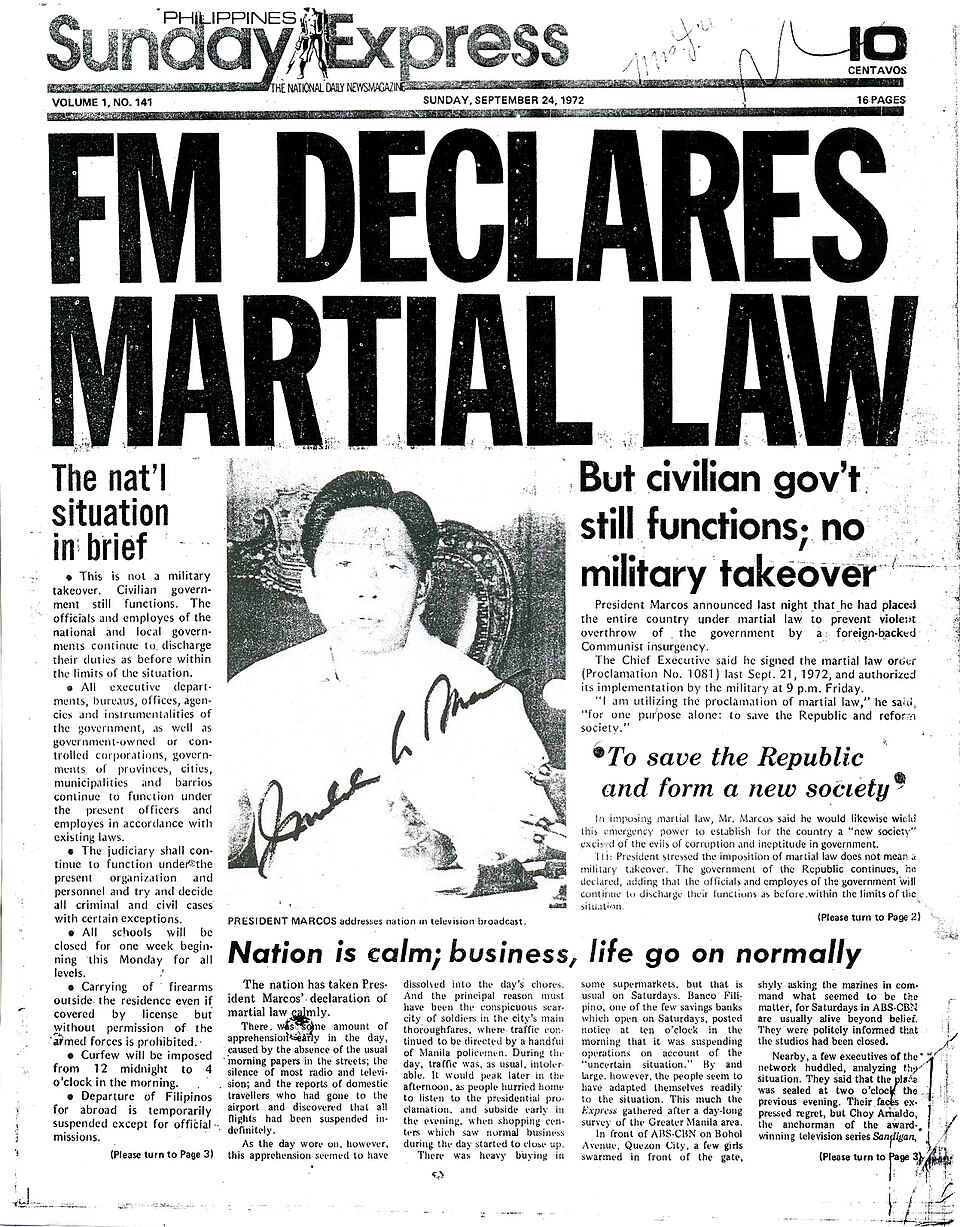
Front page of the Philippines Sunday Express, 24 September 1972, owned by Marcos associate Roberto Benedicto. Public domain (PD-Philippines-1972: published before the 14 November 1972 copyright decree without copyright registration; Commons notes no copyright notice). Shown as evidence of the government's framing.
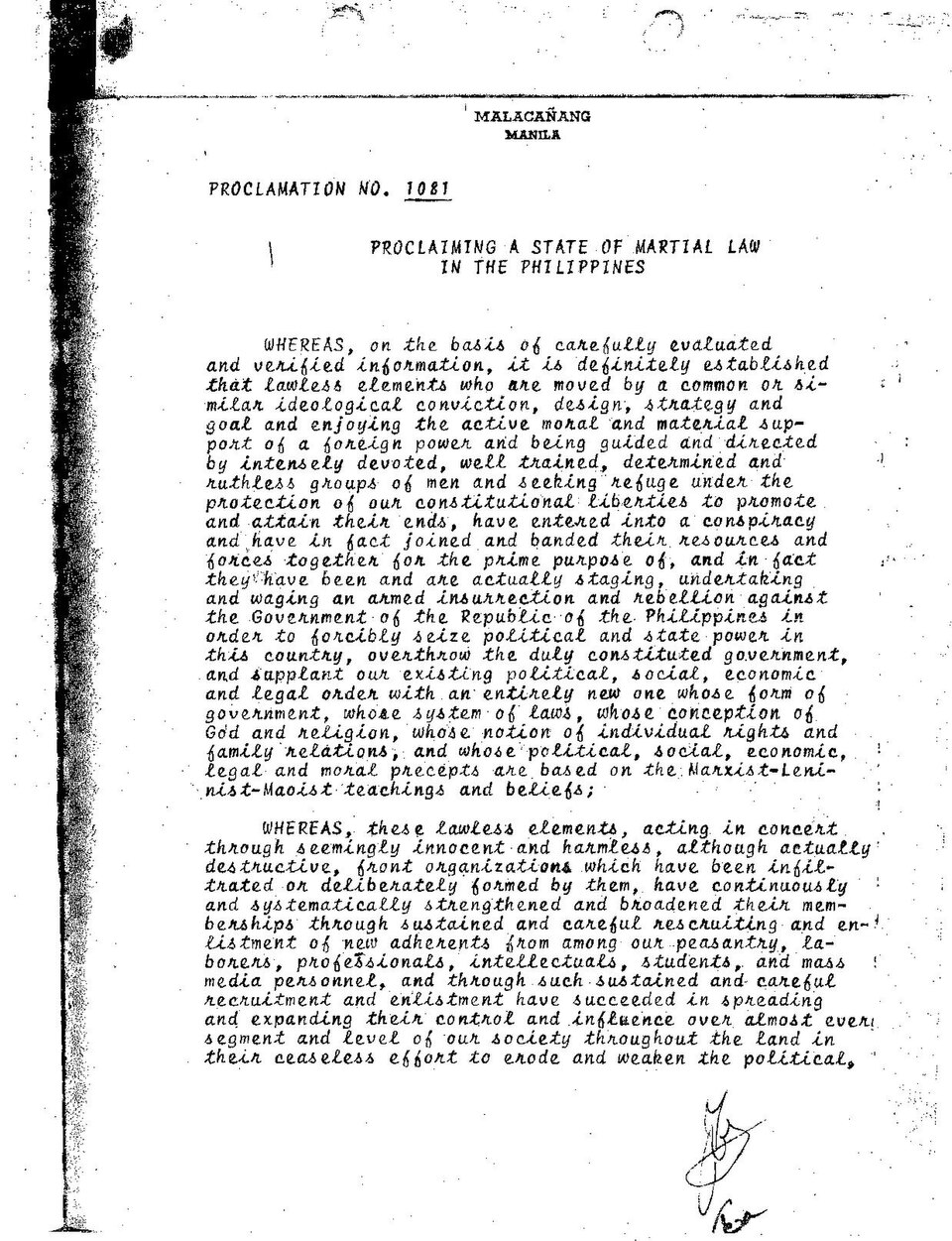
Page one of Proclamation No. 1081, dated 21 September 1972, from the Official Gazette. Government of the Philippines; public domain (PD-PhilippinesGov; an official edict).
How it works
- Fear appeal: the proclamation stages an armed, foreign-backed conspiracy reaching into peasants, students and "mass media personnel", and offers martial law as the protection. The incidents cited around it are disputed: the Enrile ambush by Enrile himself, and the Plaza Miranda bombing, which Marcos blamed on leftists, by conflicting accounts.
- Euphemism / doublespeak: "not a military takeover" and "civilian gov't still functions" ran while the military held the presses, the broadcasters and opposition leaders.
- Glittering generalities: "New Society", "save the Republic" and "discipline is needed" stand in for a testable programme. Bush's 1981 praise of Marcos's democratic principles, after an election the opposition boycotted, uses the same kind of virtue words.
- Card stacking: Letter of Instruction No. 1 left only outlets owned by Marcos associates publishing, so "Nation is calm" was the only account most readers could see. From 2016, "golden age" posts present selected or false economic claims and, AFP reports, cast doubt on the documented abuse record.
- Transfer: wartime heroism and a chest of U.S. and Philippine medals lent Marcos a soldier's prestige. U.S. Army records reported in 1986 found the Maharlika leadership claim unsupported.
- Astroturfing: Facebook and Twitter removed networks posing as independent users or pages: the Gabunada network (2019), the military- and police-linked pages (2020), the China-based network (2020) and the pro-Marcos Jr. Twitter accounts (2022). Ong and Cabañes (2018), interviewing 20 paid operators, found that they served clients across the political spectrum, not one camp.
- Name-calling: the military-linked pages "red-tagged" critics as communists and terrorists (DFRLab). NTF-ELCAC spokesperson Lorraine Badoy called a judge a "friend and defender" of communist rebels; the Supreme Court found her guilty of indirect contempt over those posts and fined her ₱30,000 (February 2024), and in May 2024 held that red-tagging, vilification and labelling threaten the right to life, liberty and security. Tsek.ph reports that Robredo was also called derogatory names.
Then and now
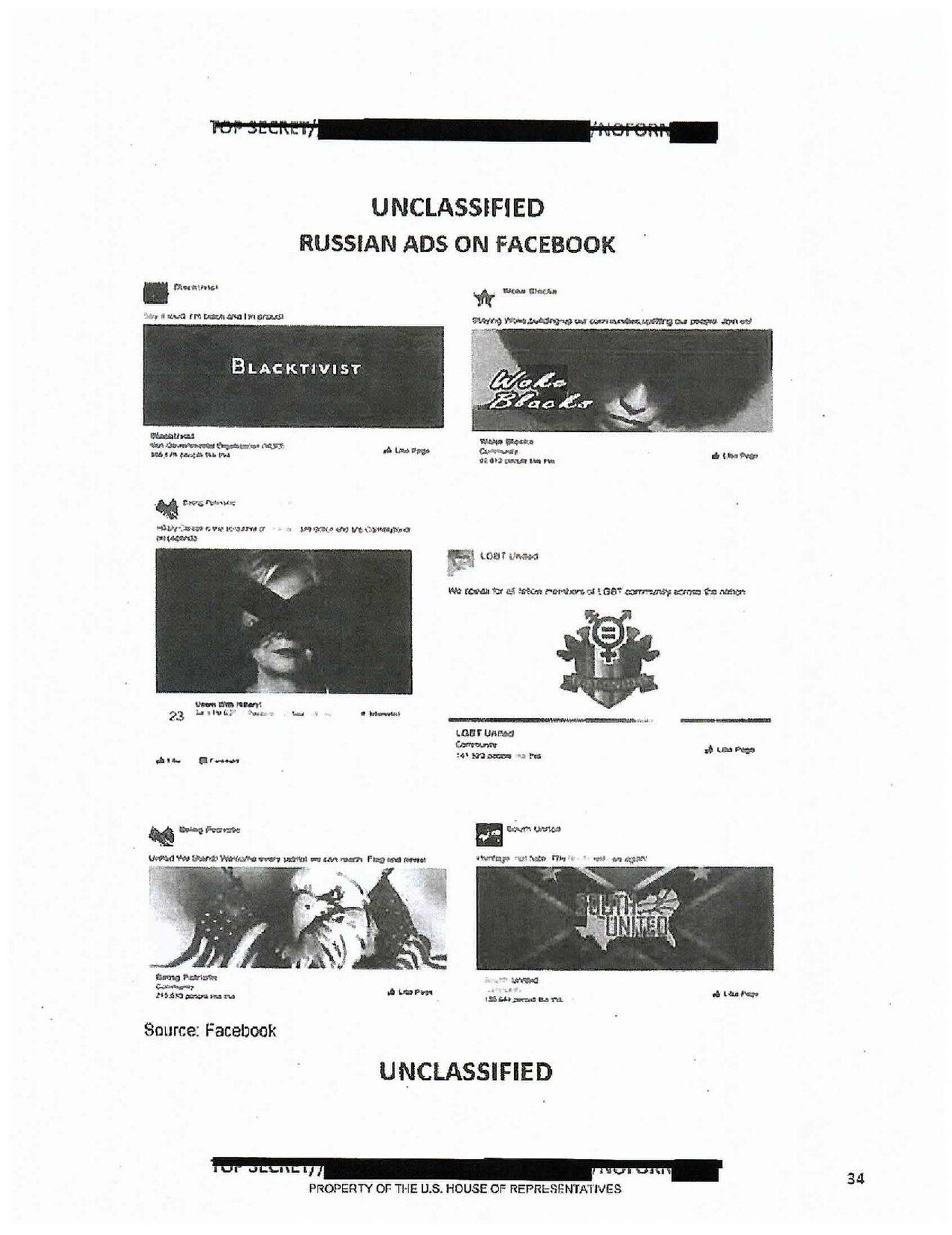
'Russian Ads on Facebook' (House Intelligence Committee exhibit), U.S. House Permanent Select Committee on Intelligence, 2018. Public domain.
The Internet Research Agency's pages posed as American community groups. The Philippine networks removed in 2019-2022 made the same move: pages that looked independent but were run by a campaign operator, military personnel or a foreign operation. The differences matter: the IRA was foreign, while two of the three Philippine networks were domestic, one linked to the state's own military and police.
The 1972 episode differs more. Then the state closed the press openly and put its framing on the only front page left; in 2016-2022 the contest over that era ran in a crowded online space where platforms, fact-checkers and rival campaigns all took part. Compare Gwangju, May 1980: 'rioters', 'spies' and the censored press and India's Emergency: 'India is Indira' and the censored press.
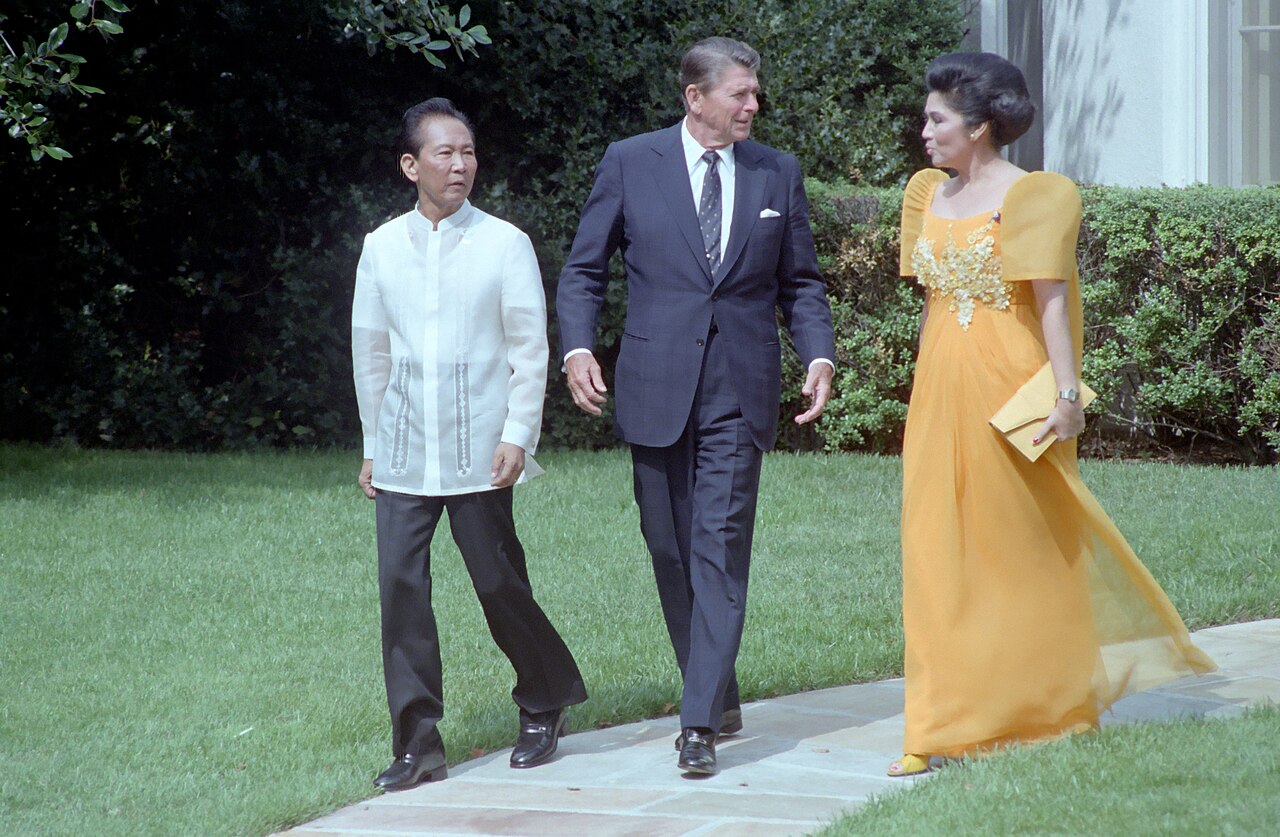
Ronald Reagan with Ferdinand and Imelda Marcos during their state visit, 16 September 1982. White House Photographic Office, Reagan Library. Public domain (U.S. government work).
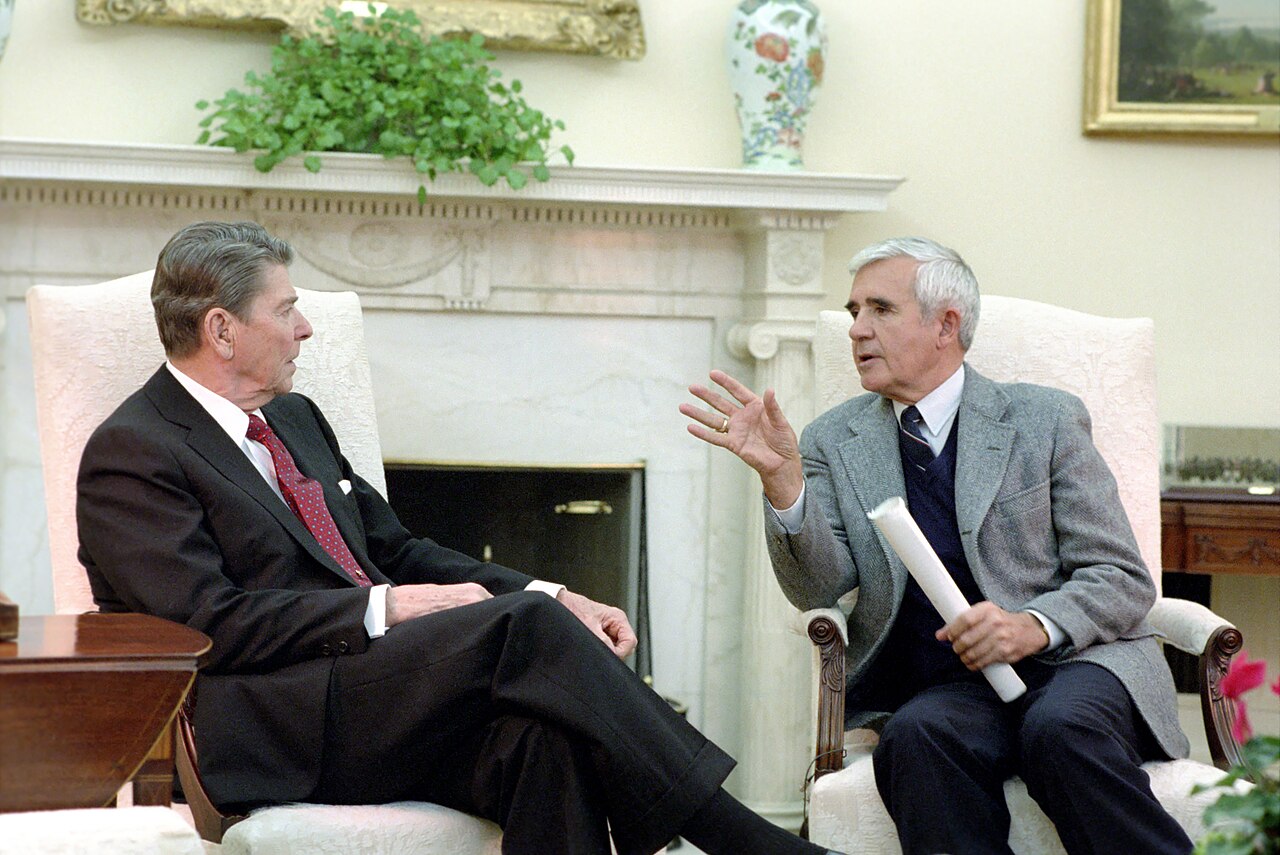
Reagan is briefed by Senator Paul Laxalt on the Philippines, 24 February 1986, the day before Marcos left. White House Photographic Office, Reagan Library. Public domain. Shown together to mark the shift in the U.S. stance between 1982 and 1986.
Positions on the record
- The Marcos government: martial law answered a foreign-backed communist rebellion and lawlessness, and made room for reform; the "New Society" would replace an elite-dominated old order. The country study records early economic gains under technocrats, followed by subsidised monopolies of those it calls "cronies" that depleted the treasury (Dolan 1993, p. xxvii).
- Its opponents: the CPP described the government as a dictatorship serving U.S. imperialism; the mosquito press and church media reported abuses and corruption; in 1986 the Catholic Church condemned the snap election as fraudulent (Dolan 1993, p. 61).
- Later governments and security forces: the armed forces described the removed 2020 pages as "advocacy" accounts. The Philippine Anti-Terrorism Council designated the CPP-NPA a terrorist organisation in December 2020, and the U.S. has listed it as a Foreign Terrorist Organization since 2002; critics of red-tagging say the label is applied to lawful activists.
- Marcos Jr. and his camp (2022): he questioned how Amnesty's figures were produced; his spokesperson disowned the suspended Twitter network.
- What is documented: the proclamation, the media takeover order and its exemptions; the Sunday Express front page; the 11,103 recognised victims; the Army files reported in 1986; the takedowns and their stated attributions; the 2024 red-tagging ruling.
- What is not shown / disputed: who bombed Plaza Miranda; whether the Enrile ambush was staged (Enrile's own accounts conflict); the exact toll (Amnesty's figures are estimates; the board counted only eligible claimants). Facebook did not say Duterte or the armed forces' leadership directed the 2019 or 2020 networks, and it tied the China-based network to individuals in Fujian, not named officials. Twitter's reported statements did not attribute its suspensions to the Marcos campaign. The sources reviewed here include no platform takedown or research report on the 2022 anti-Marcos campaigns' own messaging methods; the 2018 cross-party finding predates that campaign.
Same-method test
A government anywhere that cited a disputed attack to suspend liberties, left only friendly owners' papers running and printed "life go on normally" on the front page would be scored the same way. So would any state whose soldiers ran pages posing as independent citizens: Reuters reported in 2024 that the U.S. military ran fake accounts in 2020-2021 that, posing as Filipinos, cast doubt on China's Sinovac vaccine, and Meta attributed a separate covert network to individuals associated with the U.S. military in 2022.
How to spot it
- When an emergency is declared, look for evidence of the triggering incident and whether those involved later changed their account.
- Ask who is still allowed to publish. A calm front page means little when it is the only one.
- For history posts from any camp, such as the "golden age" pages, check the page's age, admins and ad history, and compare its figures with independent statistics.
Images
| Image | Source | Licence |
|---|---|---|
| Mechanism diagram (above) | Drawn for FRAME from this page's sourced facts (make_diagrams.py) |
CC BY 4.0, FRAME |
| Sunday Express front page, 24 Sept 1972 | Wikimedia Commons | Public domain (PD-Philippines-1972: published before PD 49 of 14 Nov 1972 without copyright registration, and no copyright notice, so not restored in the U.S.) |
| Proclamation No. 1081, page one | Wikimedia Commons, Official Gazette | Public domain (PD-PhilippinesGov; government edict) |
| Reagan with the Marcoses, 16 Sept 1982 | Wikimedia Commons, Reagan Library via DPLA | Public domain (U.S. government work) |
| Laxalt briefing, 24 Feb 1986 | Wikimedia Commons, Reagan Library via DPLA | Public domain (U.S. government work) |
| Russian Ads on Facebook (2018) | FRAME gallery | Public domain (U.S. government work) |


Image gaps
- New Society posters and "disiplina" billboards. Not included: no copy with a U.S.-valid public-domain rationale was found. Philippine artworks after 1972 are generally not safe in the U.S. Fillable only with a government-issued item carrying PD-PhilippinesGov.
- Mosquito-press and Ang Bayan pages, and Radio Veritas material. Not included: privately authored and still in copyright.
- Photos of People Power, February 1986. Most are press photos in copyright; U.S. government photos of the crowds were not found.
- The removed Facebook pages and the "golden age" videos. Not included: screenshots are copyrighted or carry personal data.
Sources
- Dolan, Ronald E., ed. Philippines: A Country Study, 4th ed. Federal Research Division, Library of Congress, 1993, pp. xxvii, 49-56, 60-62, 230.
- Government of the Philippines. Proclamation No. 1081, 21 September 1972 (Commons scan of the Official Gazette PDF); Letter of Instruction No. 1, 22 September 1972.
- Philippines Sunday Express, 24 September 1972, front page (Commons).
- Gerth, Jeff, and Joel Brinkley. "Marcos's Wartime Role Discredited in U.S. Files." New York Times, 23 January 1986 (CIA reading-room copy).
- Jones, Gregg R. Red Revolution: Inside the Philippine Guerrilla Movement. Westview Press, 1989; Washington Post, 4 August 1989: ex-Communists say party behind Manila bombing.
- Rappler: Enrile's "ambush", real or not?; Inquirer, 2012: Was 1972 Enrile ambush faked?
- Rappler: how Marcos silenced and controlled the media; Martial Law Museum: Promises of the New Society
- Bulatlat, 23 September 2020: the mosquito press; Melencio, Gloria E. "The fall and rise of the Marcoses: from mosquito press to troll farms" (University of the Philippines Los Baños).
- Communist Party of the Philippines. Brief Review of the History of the Communist Party of the Philippines (1988).
- UPI, 30 June 1981: Bush backs Marcos' rule
- Amnesty International, April 2022: Five things to know about martial law in the Philippines; Amnesty's 70,000/34,000/3,240 figures as reported in AFP, 20 September 2022 (below); Rappler, 2018: 11,103 victims to get compensation
- Inquirer, 8 November 2016: SC votes 9-5 for Marcos burial
- Facebook, March 2019: removing CIB from the Philippines; Facebook, September 2020: removing CIB from China and the Philippines
- DFRLab, 22 September 2020; Graphika, Operation Naval Gazing (2020); Inquirer, September 2020: Duterte to Facebook, why stay if you can't help government; Inquirer: AFP wants "advocacy" accounts back
- Ong, Jonathan Corpus, and Jason Vincent A. Cabañes. Architects of Networked Disinformation: Behind the Scenes of Troll Accounts and Fake News Production in the Philippines. Newton Tech4Dev Network, 2018 (Goldsmiths Research Online).
- Rappler, January 2022: Twitter suspends over 300 accounts in Marcos network; Philstar, 22 January 2022: Marcos camp disowns network; Philstar, 26 January 2022: Marcos questions Amnesty data
- GMA News, 2022: Tsek.ph, 92% of false info favourable to Marcos; Rappler: Tsek.ph study
- AFP via France 24, 8 May 2022: "Golden age": Marcos myths on Philippine social media; AFP via France 24, 20 September 2022
- Bing, Chris, and Joel Schectman. "Pentagon ran secret anti-vax campaign to undermine China during pandemic." Reuters, 14 June 2024; Meta, Quarterly Adversarial Threat Report, Q3 2022 (November 2022); Graphika and Stanford Internet Observatory, Unheard Voice: Evaluating Five Years of Pro-Western Covert Influence Operations (August 2022).
- Anti-Terrorism Council of the Philippines, designation of the CPP-NPA, 9 December 2020; U.S. Department of State, Foreign Terrorist Organizations list.
- Human Rights Watch, 8 May 2024: Supreme Court rejects red-tagging; Supreme Court of the Philippines, 2024: SC finds Lorraine Badoy guilty of indirect contempt