Content note. This case discusses the deportation and mass killing of Ottoman Armenians and quotes wartime texts that apply an ethnic label ("the Turk") to a whole state. The words are quoted as evidence of the method. No atrocity photographs are shown.
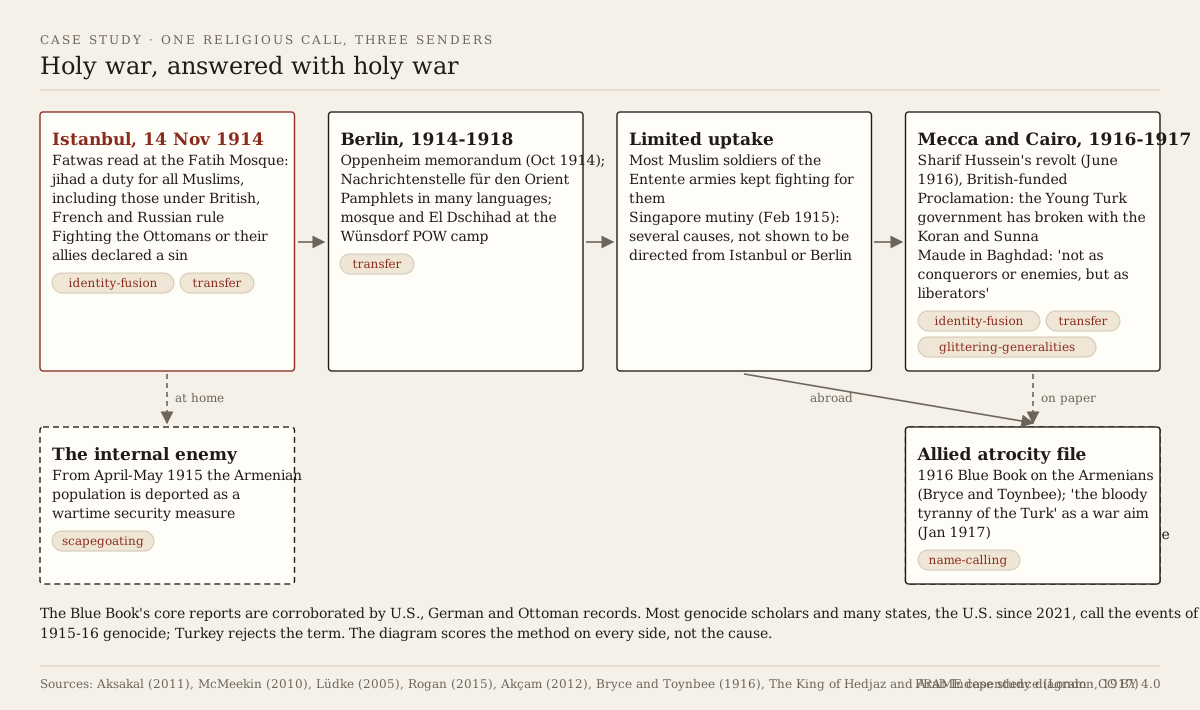
In one line: The Ottoman state declared the war a religious duty for all Muslims, Germany printed and carried that call to Muslims in enemy armies and colonies, and Britain answered with the Sharif of Mecca's own religious case against Istanbul, while each side also framed the fate of the Ottoman Armenians for its own audience.
What happened
- 2 August 1914. The Ottoman Empire and Germany sign a secret alliance. On 29 October Ottoman warships under a German admiral bombard Russian Black Sea ports, and Russia, Britain and France declare war in early November (Rogan 2015).
- October 1914. Max von Oppenheim, an orientalist attached to the German Foreign Office, submits a memorandum on revolutionising the Islamic territories of Germany's enemies. He sets up the Nachrichtenstelle für den Orient in Berlin, which produces pamphlets, newspapers and translations in Arabic, Turkish, Persian, Urdu and other languages (McMeekin 2010; Lüdke 2005).
- 14 November 1914. At the Fatih Mosque in Istanbul, a public ceremony proclaims the fatwas of the Şeyhülislam, the empire's senior religious official. In question-and-answer form they declare jihad a duty for every Muslim against Russia, Britain and France, including Muslims living under those powers' rule, and declare it a grave sin for such Muslims to fight the Ottoman state or its allies Germany and Austria-Hungary (Rogan 2015; Aksakal 2011). The New York Times ran a photograph of the crowd on 3 January 1915.
- 1915. Germany gathers Muslim prisoners of war from the French, British and Russian armies in the Halbmondlager (Half Moon Camp) at Wünsdorf, south of Berlin, builds a mosque there, and prints a camp newspaper, El Dschihad, in several languages. Some prisoners volunteer to fight for the Ottomans (Lüdke 2005; McMeekin 2010).
- 15 February 1915. Indian troops of the 5th Light Infantry mutiny in Singapore. The mutiny is sometimes linked to the jihad call. Accounts list several causes, including rumours that the regiment would be sent to fight the Ottomans and grievances within the regiment; it is not shown to have been directed from Istanbul or Berlin (Rogan 2015).
- April-May 1915. Ottoman authorities arrest Armenian community leaders in Istanbul on 24 April. On 24 May Britain, France and Russia jointly warn that they will hold members of the Ottoman government personally responsible for "crimes against humanity and civilization". On 27 May a temporary law authorises army commanders to deport populations on grounds of military necessity, espionage or treason. Deportations of the Armenian population follow across Anatolia, with massacres and death marches (Akçam 2012; Rogan 2015).
- July 1915 to March 1916. Sharif Hussein of Mecca and Sir Henry McMahon, British High Commissioner in Egypt, exchange letters. McMahon's letter of 24 October 1915 says Britain is prepared to recognise and support Arab independence within the limits Hussein proposed, excluding "portions of Syria lying to the west of the districts of Damascus, Homs, Hama and Aleppo" and areas where Britain could not act without harming France (Cmd. 5957, 1939; Rogan 2015).
- Early 1916. Britain sets up the Arab Bureau in Cairo to coordinate intelligence and propaganda on the Arab world (Rogan 2015).
- May 1916. British and French negotiators Mark Sykes and François Georges-Picot conclude an agreement, with Russian assent, dividing the Ottoman Arab provinces into zones of French and British control or influence, with an international administration for part of Palestine (Rogan 2015).
- June 1916. Hussein's forces rise against the Ottoman garrison in Mecca. His proclamation, dated 27 June 1916 in the English edition, accuses the Committee of Union and Progress of breaking with the Koran and the Sunna, names "Enver Pasha, Jemal Pasha and Talaat Bey" as the real rulers, and says the Ottomans shelled the Kaaba. It calls the Hejaz "independent in the fullest sense of the word, freed from the rule of strangers and purged of every foreign influence". The revolt is funded and armed by Britain (Rogan 2015). The Sharif's government publishes its own newspaper, al-Qibla, in Mecca.
- Late 1916. The British government publishes The Treatment of Armenians in the Ottoman Empire, 1915-16, a parliamentary "Blue Book" of eyewitness documents compiled by the historian Arnold Toynbee and presented by Viscount Bryce. Toynbee worked for Britain's wartime propaganda bureau at Wellington House (Sarafian 2000).
- 19 March 1917. After taking Baghdad, Lieutenant-General Sir Stanley Maude tells its people that he is "charged with absolute and supreme control of all regions in which British troops operate; but our armies do not come into your cities and lands as conquerors or enemies, but as liberators."
- 1917. A London booklet, The King of Hedjaz and Arab Independence, reprints Hussein's proclamation in facsimile and translation with Maude's text. Its introduction quotes the Allied statement of war aims of January 1917: "the setting free of the populations subject to the bloody tyranny of the Turk."
- 2 November 1917. Foreign Secretary Arthur Balfour writes to Lord Rothschild that the government "view with favour the establishment in Palestine of a national home for the Jewish people", provided that "nothing shall be done which may prejudice the civil and religious rights of existing non-Jewish communities in Palestine". Later that month the Bolshevik government publishes the Sykes-Picot terms from the Russian archives (Rogan 2015).
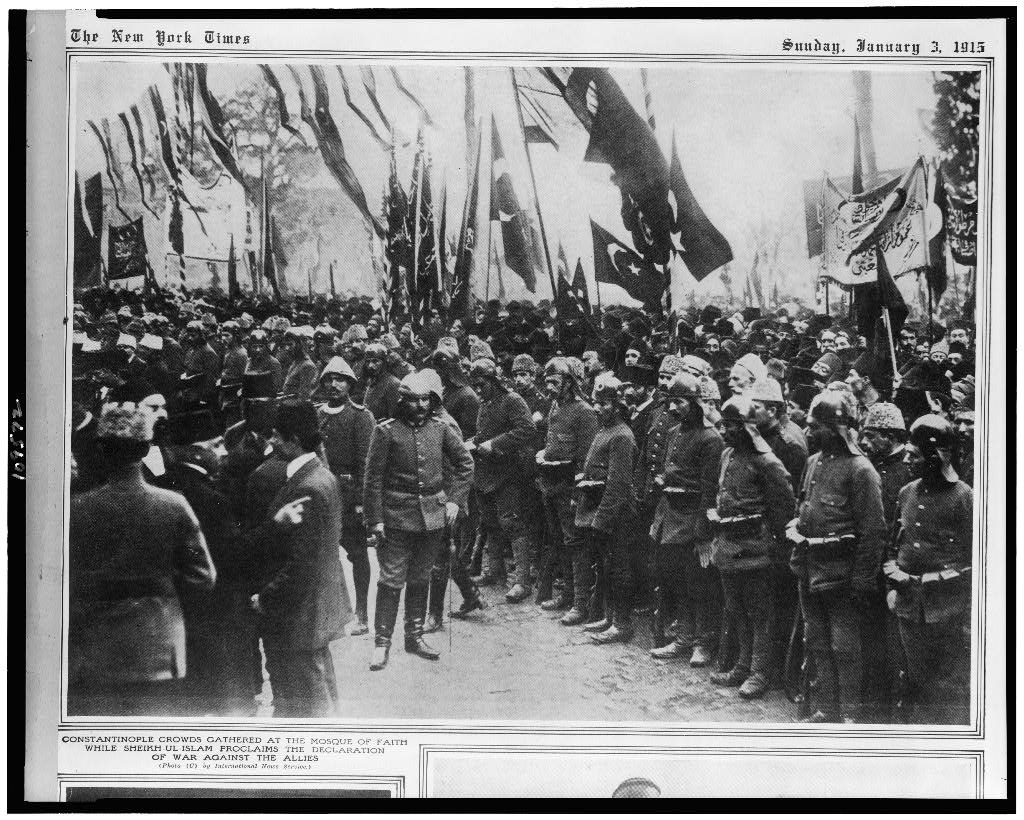
Crowds and soldiers at the Fatih ("Mosque of Faith" in the caption) in Istanbul during the proclamation of 14 November 1914, as printed in the New York Times picture section on 3 January 1915. Photo by International News Service. Library of Congress; public domain in the U.S. (published 1915).
How it works
- Identity fusion: the fatwas turn a choice of side into a question of faith. A Muslim soldier in the Indian or French colonial army who kept fighting was told he was sinning, so doubting the call became disloyalty to religion itself. Hussein's 1916 proclamation uses the same device in reverse: by listing the Istanbul government's alleged breaches of the Koran and Sunna, it makes loyalty to Istanbul the impious choice.
- Transfer: the Sultan's title of caliph, the Şeyhülislam's office and a ceremony at an imperial mosque lend religious authority to a war decided by a small group of ministers in alliance with Germany. Germany borrowed the same authority for its pamphlets, and built a mosque for its prisoners. Britain borrowed the standing of the Sharif of Mecca, described in the London booklet as "Hereditary Custodian of the Holy Cities of Mecca and Medina". The German poster below does the same with flags.
- Scapegoating: the Ottoman government presented the removal of the Armenian population as a security measure against an internal enemy, citing Armenian contacts with Russia and the fighting at Van in 1915. The measure fell on a whole population, including women, children and communities far from any front, rather than on named suspects (Akçam 2012).
- Name-calling: "the bloody tyranny of the Turk" puts one ethnic label on a government and its peoples. The Allied note and the London booklet use it as a war aim; the label arrives before any specific charge.
- Glittering generalities: Maude's "not as conquerors or enemies, but as liberators" sits in the same paragraph as "absolute and supreme control". Hussein's "purged of every foreign influence" describes a revolt paid for by Britain. The virtue word carries the sentence; the concrete terms are elsewhere.
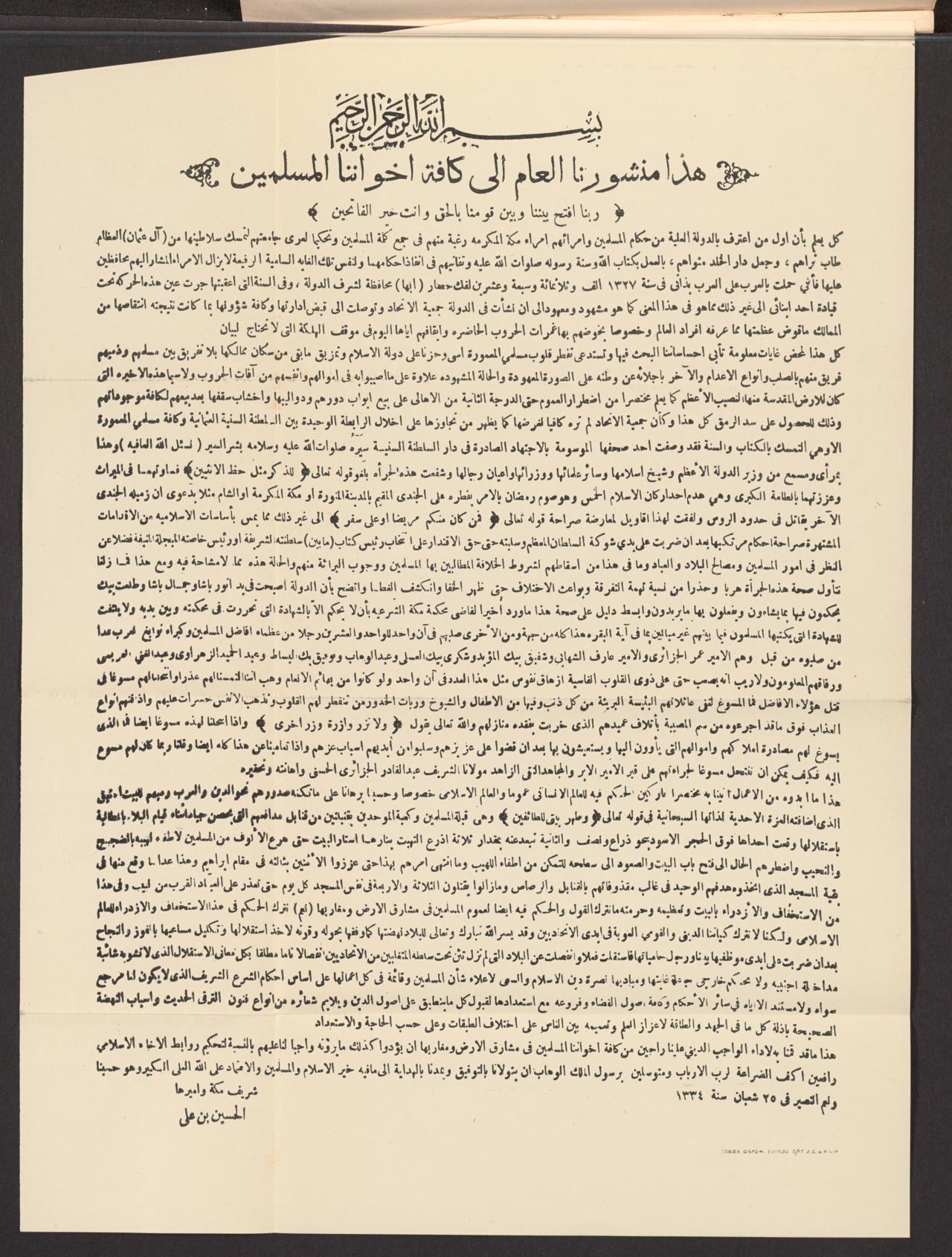
The Arabic facsimile of Sharif Hussein's proclamation, as reprinted in The King of Hedjaz and Arab Independence (London: Hayman, Christy & Lilly, 1917). Library of Congress; public domain in the U.S. (published 1917).
Three promises, three audiences
The documents can be read side by side. McMahon's 1915 letter promises Arab "independence" within limits described by district names, with no map. The 1916 Sykes-Picot agreement draws zones of French and British control over much of the same area. The 1917 Balfour Declaration promises a "national home" in Palestine, a term the letter does not define, with a safeguard for existing non-Jewish communities. Each was addressed to a different audience. Whether they conflict, and whether McMahon's exclusions covered Palestine, has been argued since; a British-Arab committee that examined the correspondence in 1939 did not reach an agreed reading (Cmd. 5974). This page reports what the texts say and does not settle that question.
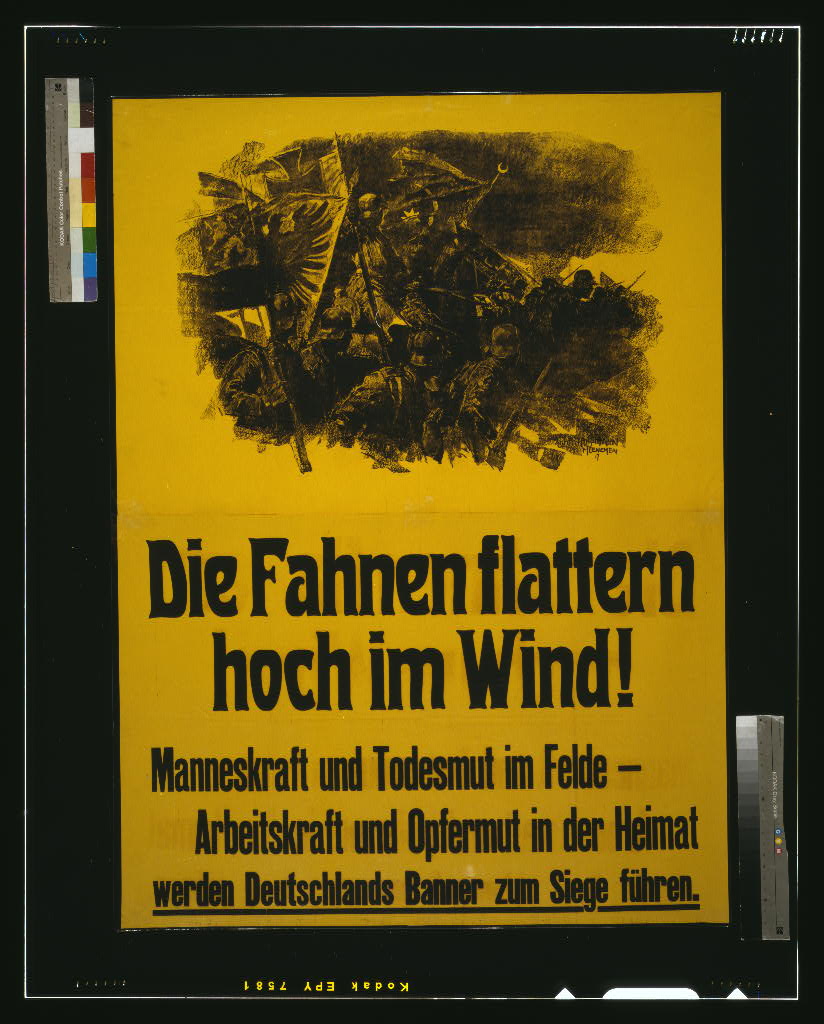
Die Fahnen flattern hoch im Wind! (The Flags Flutter High in the Wind!), Anton Hoffmann, Munich, 1917. Public domain. German soldiers charge under massed banners, one of them bearing a crescent; the text promises that virtue at the front and at home will carry Germany's flags to victory.
Then and now
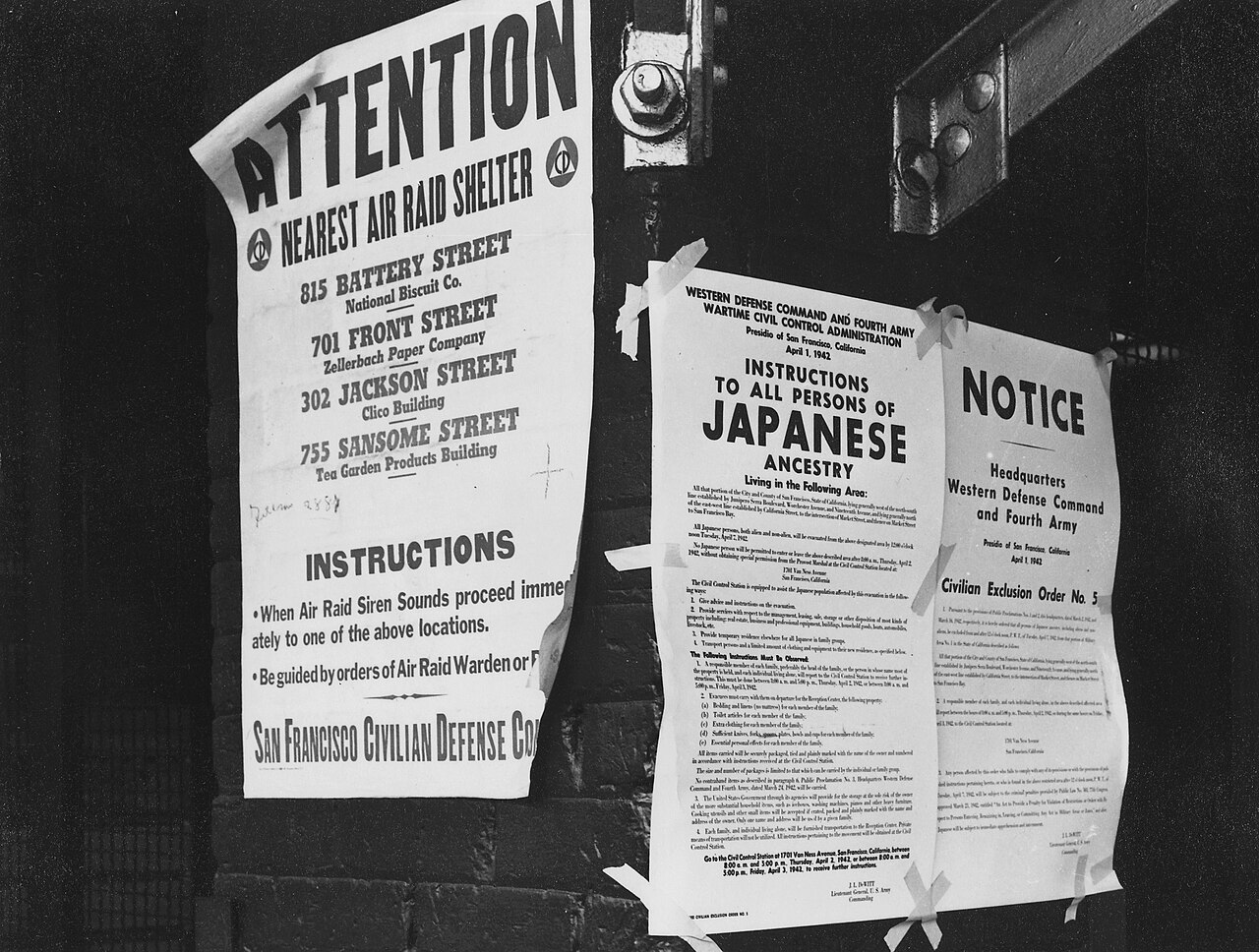
'Instructions to All Persons of Japanese Ancestry' (exclusion order posted in San Francisco), U.S. Army Western Defense Command, 1942. Public domain.
Both governments presented the removal of an entire ethnic group as a wartime security measure against an internal enemy, and both applied it to people by ancestry rather than by any charge against them. The differences are large and should be stated as plainly. The U.S. order removed about 120,000 people of Japanese ancestry from the West Coast to camps; most survived, and the United States apologised and paid redress in 1988. The Ottoman deportations were accompanied by massacres and death marches, and scholars' estimates of Armenian deaths run from several hundred thousand to more than a million (Akçam 2012; Rogan 2015). The comparison is to the security framing, not to the scale or the outcome.
Positions on the record
- The Ottoman government at the time: the jihad was a lawful defensive war proclaimed by the caliph against powers that ruled millions of Muslims. The Armenian deportations were a wartime relocation made necessary by rebellion and collaboration with Russia.
- The Turkish state now: it accepts that large numbers of Armenians died, attributes the deaths to war, disease, famine and intercommunal fighting in which Muslims also died, and rejects the term genocide. It rejected the U.S. president's statement of 24 April 2021 the same day.
- Most genocide scholars and a number of states: the deportations and killings of 1915-16 were genocide. Akçam (2012) argues this from Ottoman government documents. States that recognise the events as genocide include France (2001), Germany (2016) and the United States (2021).
- Who started the jihad call: McMeekin (2010) emphasises German initiative. Aksakal (2011) argues the decision had Ottoman origins and served Ottoman aims. Lüdke (2005) and Rogan (2015) find that the call did not produce the mass uprisings its sponsors hoped for.
- The Blue Book: it was produced within Britain's propaganda effort and aimed partly at American opinion. Its core reports, however, are corroborated by U.S., German and Ottoman records (Sarafian 2000; Akçam 2012). A belligerent's use of an atrocity report does not make the report false.
- What is not shown here: the full text of the fatwas in the original, or any finding on how many Muslims in Entente armies were swayed by the call.
Same-method test
Swap the flags and the finding should not change. This page applies Identity fusion to the Istanbul fatwas and to the Sharif's counter-proclamation alike, Transfer to the Ottoman, German and British uses of religious standing alike, and Glittering generalities to a German poster and a British general's proclamation alike. A Christian church ruling that fighting for the enemy is a sin, or any state deporting a whole minority as a security measure, would be scored the same way.
How to spot it
- When a religious or national authority rules that a political choice is a matter of faith, ask who took the political decision, and when.
- Check who paid and who printed. A pamphlet signed by a Muslim scholar may be printed in Berlin; a revolt that declares itself free of foreign influence may be funded from Cairo.
- Put promises made to different audiences side by side, with dates, and read what each one defines and what it leaves undefined.
- A security measure aimed at a whole population, rather than at named suspects, is the tell for scapegoating.
- An enemy's atrocity report can be true. Test it against the records of neutral states and of the accused side's own allies.
Images
| Image | Source | Licence |
|---|---|---|
| Mechanism diagram (above) | Drawn for FRAME from this page's sourced facts (make_diagrams.py) |
CC BY 4.0, FRAME |
| Crowds at the Fatih Mosque, 14 November 1914 (New York Times, 3 January 1915) | Library of Congress | Public domain in the U.S. (published 1915) |
| Facsimile of Sharif Hussein's proclamation (London, 1917) | Library of Congress | Public domain in the U.S. (published 1917) |
| Die Fahnen flattern hoch im Wind! (1917) | FRAME gallery, from the Library of Congress | Public domain in the U.S. (published before 1931) |
| Exclusion order, San Francisco (1942) | FRAME gallery | Public domain (U.S. government work) |
Image gaps
- Ottoman jihad posters and printed fatwas. Ottoman wartime posters are scarce in open collections, and none with a clear licence was found on loc.gov or Commons. May be fillable from Turkish collections tagged PD-Turkey.
- German Nachrichtenstelle pamphlets. None found in an openly licensed copy.
- Photographs of Armenian deportees and victims. Photographs exist, but their licence status varies by photographer and none was checked for this page; the page's argument rests on documents. May be fillable, with a content note, from a photograph whose public-domain status is confirmed.
Sources
- Mustafa Aksakal, "'Holy War Made in Germany'? Ottoman Origins of the 1914 Jihad", War in History 18, no. 2 (2011): 184-199.
- Sean McMeekin, The Berlin-Baghdad Express: The Ottoman Empire and Germany's Bid for World Power, 1898-1918 (Cambridge, MA: Belknap Press of Harvard University Press, 2010).
- Tilman Lüdke, Jihad Made in Germany: Ottoman and German Propaganda and Intelligence Operations in the First World War (Münster: LIT Verlag, 2005).
- Eugene Rogan, The Fall of the Ottomans: The Great War in the Middle East, 1914-1920 (New York: Basic Books; London: Allen Lane, 2015).
- Taner Akçam, The Young Turks' Crime Against Humanity: The Armenian Genocide and Ethnic Cleansing in the Ottoman Empire (Princeton: Princeton University Press, 2012).
- Viscount Bryce and Arnold J. Toynbee, The Treatment of Armenians in the Ottoman Empire, 1915-16: Documents Presented to Viscount Grey of Fallodon (London: HMSO, 1916; Miscellaneous No. 31, Cd. 8325).
- Ara Sarafian (ed.), The Treatment of Armenians in the Ottoman Empire, 1915-1916: Uncensored Edition (Princeton, NJ: Gomidas Institute, 2000).
- The King of Hedjaz and Arab Independence, with a facsimile of the proclamation of June 27, 1916 (London: Hayman, Christy & Lilly, 1917), Library of Congress. Source of the Hussein proclamation, Maude proclamation and "bloody tyranny of the Turk" quotations.
- New York Times picture section, 3 January 1915: "Constantinople crowds gathered at the Mosque of Faith while Sheikh Ul Islam proclaims the declaration of war against the allies", Library of Congress.
- Anton Hoffmann, Die Fahnen flattern hoch im Wind! (1917), Library of Congress.
- Balfour to Rothschild, 2 November 1917 (the Balfour Declaration), text as published in The Times, 9 November 1917.
- The White House, "Statement by President Joe Biden on Armenian Remembrance Day", 24 April 2021.
- Republic of Türkiye, Ministry of Foreign Affairs, press statement on the statement of U.S. President Biden, 24 April 2021.
- France, Loi n° 2001-70 du 29 janvier 2001 relative à la reconnaissance du génocide arménien de 1915.
- German Bundestag, resolution on the remembrance of the genocide of the Armenians and other Christian minorities in 1915 and 1916, 2 June 2016.
- Correspondence between Sir Henry McMahon and the Sherif Hussein of Mecca, July 1915-March 1916, Cmd. 5957 (London: HMSO, 1939).
- Report of a Committee Set Up to Consider Certain Correspondence between Sir Henry McMahon and the Sharif of Mecca in 1915 and 1916, Cmd. 5974 (London: HMSO, 1939).